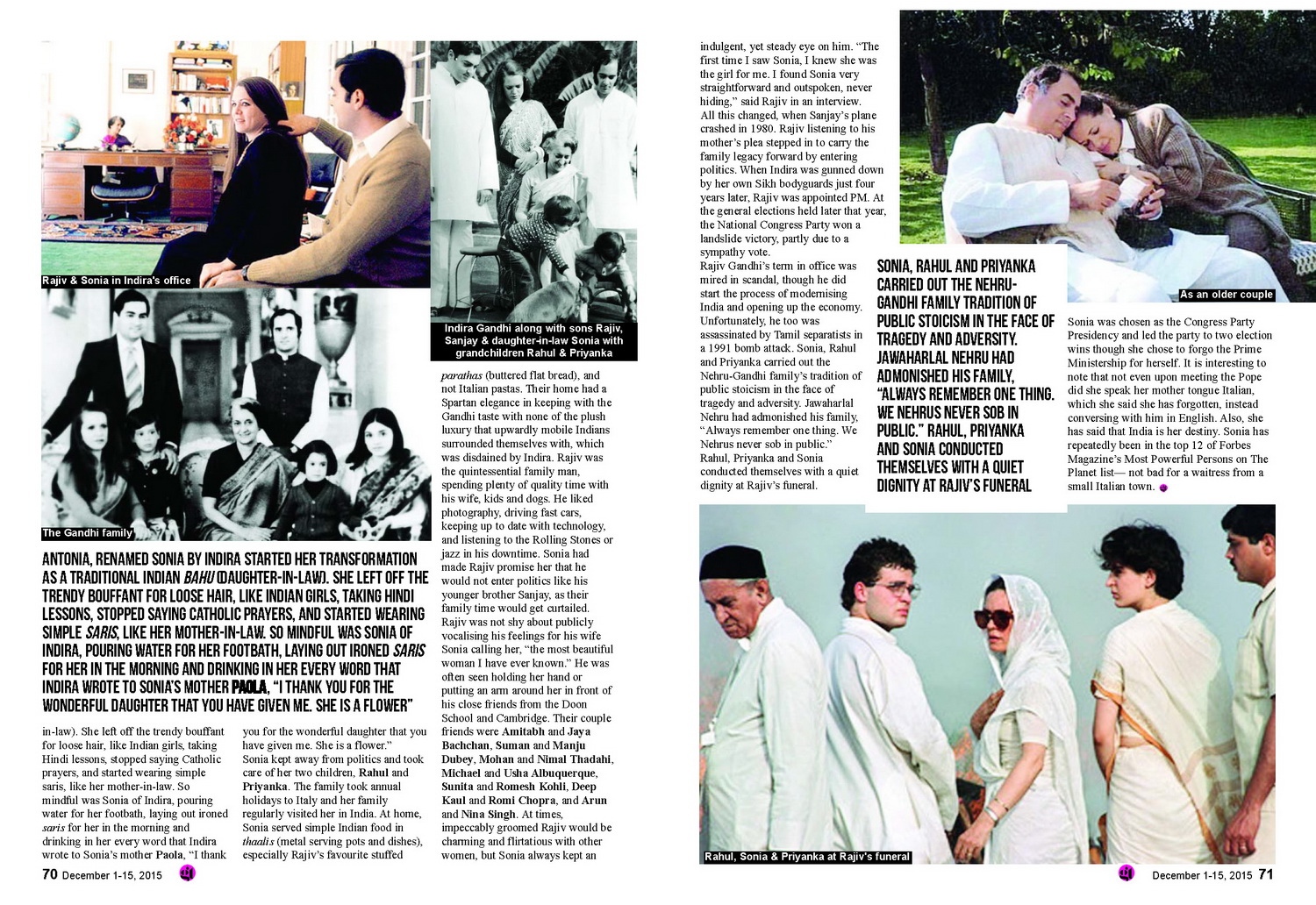
The tempestuous 15 year relationship of Z.A. Bhutto and Husna set against the backdrop of his meteoric rise and fall
When Zulfiqar Ali Bhutto met Husna Sheikh at Billo and Khalil Omer’s house in Dhaka in 1961, he was, at only 34 years of age, Ayub Khan’s young and fiercely ambitious foreign minister, a Sindhi feudal and an Oxford educated barrister, while she was married to a bourgeouis nationalistic Bengali lawyer Abdul Ahad and mother to two toddler girls. Not the girl next door, Husna was a rivettingly attractive, sari clad, husky voiced, tall, svelte, dusky beauty, with a mixed Pathan-Benagli ancestry.
Husna challenged Bhutto that evening, she recalls, on West Pakistan’s imperialism towards the East and how it would lead to the Bangladeshi movement, thus capturing his attention with her “aggressive confidence†and oozing sex appeal. But Bhutto was a nefarious philanderer. Not happy in her marriage, she reportedly played hard to get with Bhutto at the outset because, knowing his reputation, she didn’t just want to be his latest conquest. Bhutto already had one cousin-wife at his estate in Larkana and a second, the glamorous and elegant Kurdish-Iranian, Nusrat ensconced in his Karachi home at this point.
Bhutto and Husna were not only physically compatible, but had formidable intellects to match and the affair progressed to a stage that in 1965, Husna, leaving her husband behind in Dhaka, confidently moved to Karachi with her daughters, virtually penniless.
“The chemistry was undeniable,†said Husna to Jugnu Mohsin in her 1990 interview for The FridayTimes. “Both Zulfi and I were charged with something beyond each other. It was a vital, exuberant feeling.â€
In her autobiographical novel, My Feudal Lord, Tehmina Durrani writes that Mustafa Khar facilitated the still hush-hush affair, picking and dropping Bhutto in Karachi to Husna’s residence. On one occasion he even he witnessed a defiant Husna slamming the door shut in Bhutto’s face. It became a stormy, tumultuous affair between two head strong and independent minded people. Though he was a powerful and charismatic leader revered by millions, it must have been a novel experience to have a woman dependent on his good will stand up to him, unlike his sycophantic followers.
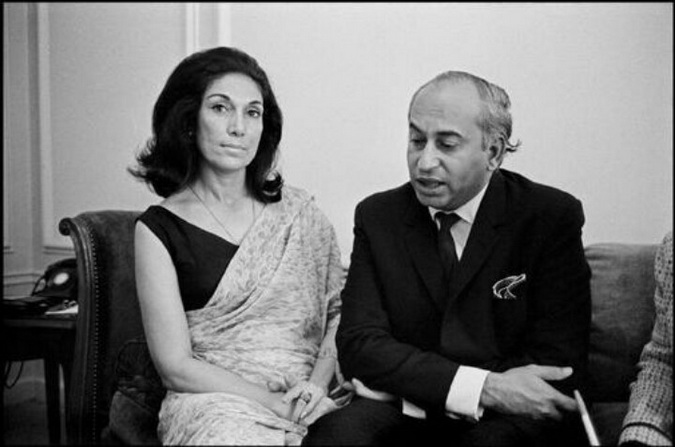
With second wife, Kurdish-Iranian Nusrat
Foreign Minister Z A Bhutto addresses the UN Security Council during the 1965 war
“The chemistry was undeniable,†said Husna to Jugnu Mohsin in her 1990 interview for The Friday Times. “Both Zulfi and I were charged with something beyond each other. It was a vital, exuberant feelingâ€
Managing an introduction to Sheikha Fatima of Abu Dhabi, Husna got a contract to decorate her Abu Dhabi palace in 1967. It was with these proceeds, Husna said, that she became the owner of two Karachi properties, a Moorish style villa called Manzil, in close proximity to Bhutto’s Clifton abode Al Zulfiqar, as well as a cottage at Hawk’s Bay, and later a flat in London, amongst other investments. It is anybody’s guess whether Bhutto himself or those seeking his favour were her actual benefactors.
Finally in 1969, Ahad divorced his errant wife. Bhutto was on the verge of marrying her when he got arrested, writes Mohsin. Disenchanted, she stayed out of his way for many months. The first day she returned to her home in Karachi, he silently came and stood behind her. Thinking it was her sister, she asked her what she wanted, turning around to see him weeping uncontrollably.
“How can you do this to me?†he asked her. “You are my destiny.â€
“He cried like a child and made me promise I would never leave him,†said Husna, “I realized that day how much I loved him.â€
Bhutto had charisma, charm, ambition and a keen intelligence
A rare photo of Husna Sheikh from the 70s
Stanley Wolpert in his 1993 biography Zulfi Bhutto of Pakistan: His Life and Times writes that though Husna was a ravishing beauty, it was not simply her physical charms that hypnotised Bhutto. She told Wolpert that she was the first woman the philandering politician had ever loved who could think, talk and understand power politics as he did. Even as she sated Bhutto, she stimulated his mind, body and spirit, “rousing him to peaks of excitement he had never knownâ€.
Pandering to his massive ego, Husna and ZAB discussed politics and world affairs after “the flames of passion had died down….For Zulfi’s proud, vain, arrogant, insecure, clever, scheming, easily bored, spoiled psyche nothing was as comforting as a beautiful woman who devoted herself fully to his needs, desires, and dreams, rousing his hopes and calming his darkest fears,†Wolpert writes.
According to Husna, soon after Bhutto became Prime Minister in 1971, he married her in December of that year. The clandestine nikkah was performed by Maulana Kausar Niazi and was witnessed by MustaphaKhar. As a marriage gift she received a Koran inscribed simply in Bhutto’s own hand with the words, “To my wife Husna.†Neither the Koran, nor the nikkahnama were ever found though years later the martial law government conducted many raids to recover them.
The Prime Minister of Pakistan
Bhutto & Qaddafi greeting each other at the
historic Organisation of Islamic Cooperation (OIC) meeting 22nd-24th February 1974 in Lahore
ZA & Benazir Bhutto with Indian PM Indira Gandhi at the signing of the Simla Agreement in 1972
With Shah of Iran’s Empress Farah Deeba Pahlavi, 1972
Stanley Wolpert in his 1993 biography Zulfi Bhutto of Pakistan: His Life and Times writes that though Husna was a ravishing beauty, it was not simply her physical charms that hypnotised Bhutto. She told Wolpert that she was the first woman the philandering politician had ever loved who could think, talk and understand power politics as he did. Even as she sated Bhutto, she stimulated his mind, body and spirit, “rousing him to peaks of excitement he had never knownâ€Â
Rumour has it that upon hearing the news of the marriage, Begum Nusrat Bhutto tried to commit suicide with an overdose of pills in Islamabad and was hospitalised at the Civil Military Hospital Rawalpindi. Husna had wanted Bhutto to claim her publicly, but he ended up promising Nusrat that she would remain the official First Lady, and he would refrain from giving Husna his name.
However, Husna was compensated handsomely by becoming the power behind the throne. From the time Bhutto became Prime Minister in December 1971 until the coup in 1977 when Husna sought refuge in London, she ran a shadow kitchen cabinet at her Karachi residence Manzil. Bhutto would meet her at least 4 to 5 times a month and never stayed away from her for more than ten days at a time. She even accompanied him on official trips abroad, though in an unofficial capacity. What better way was there to seek out the Prime Minister than when he was in a relaxed and jovial mood while being entertained by his favourite? Ministers and senior party officials desirous of currying the PM’s favour eagerly sought an invitation to Manzil and Husna’s ear. Many political appointments were decided in this way.
Socialist Bhutto, founder of the PPP
From the time Bhutto became Prime Minister in December 1971 until the coup in 1977 when Husna sought refuge in London, she ran a shadow kitchen cabinet at her Karachi residence Manzil….What better way was there to seek out the Prime Minister than when he was in a relaxed and jovial mood while being entertained by his favourite?
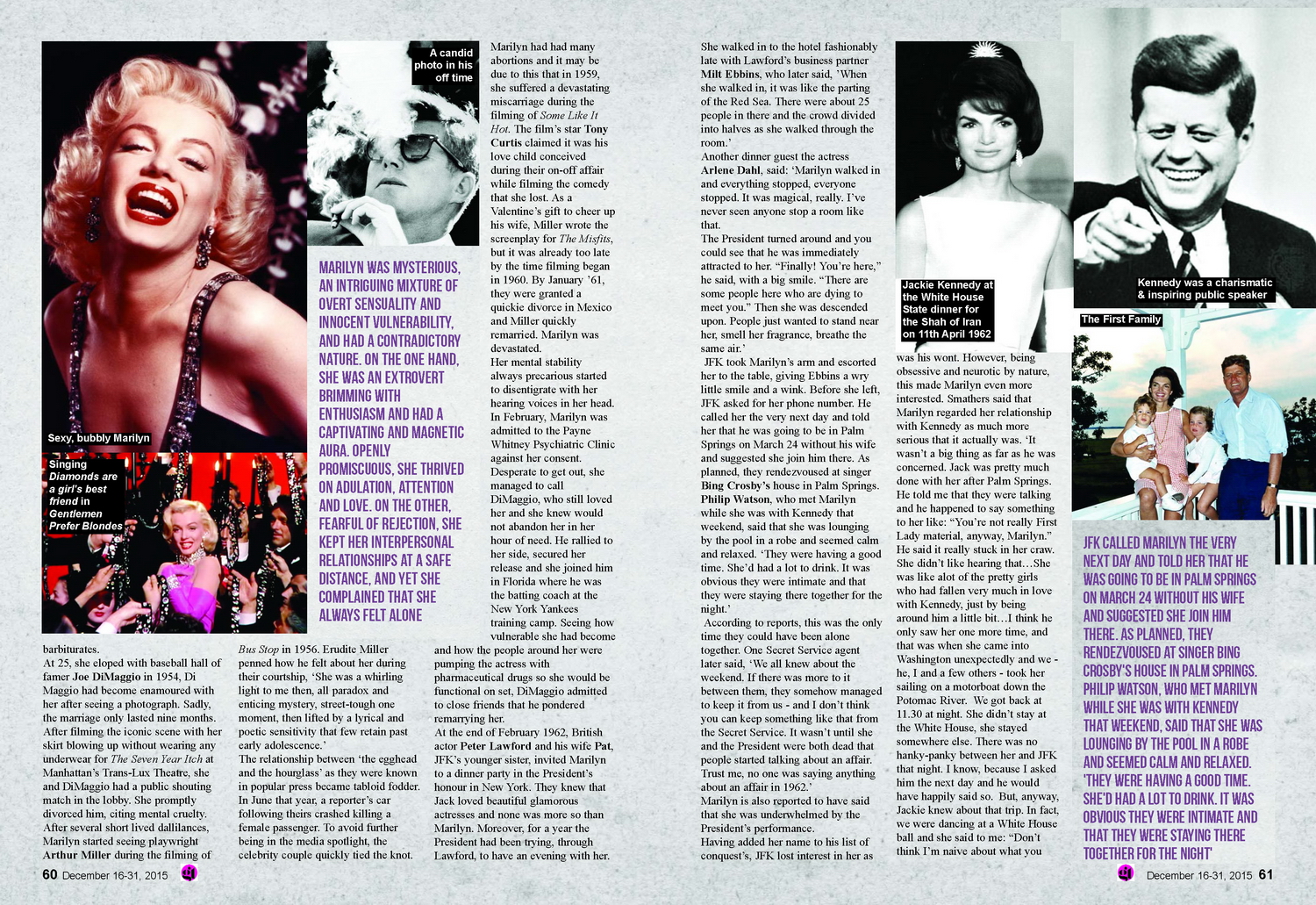
“Husna Sheikh was the Madame de Pompadour (official mistress of Louis XV, who helped him run France) of Pakistan,†said PPP politician Salman Taseer.
Husna recalls of Bhutto, the political leader and PM, “He believed in his own mission, but he believed his hands were tied. Kemal Ataturk was his great hero. I would ask him why he was in such a hurry. To which Zulfi would reply that he was in a hurry because he knew they were going to kill him.â€
She also said that the elections of 1977 were not rigged by him, but by his Chief Ministers. “Will someone tell my CMs not to ruin 20 years of my hard work?†he asked her. The situation soon snowballed out of his control.
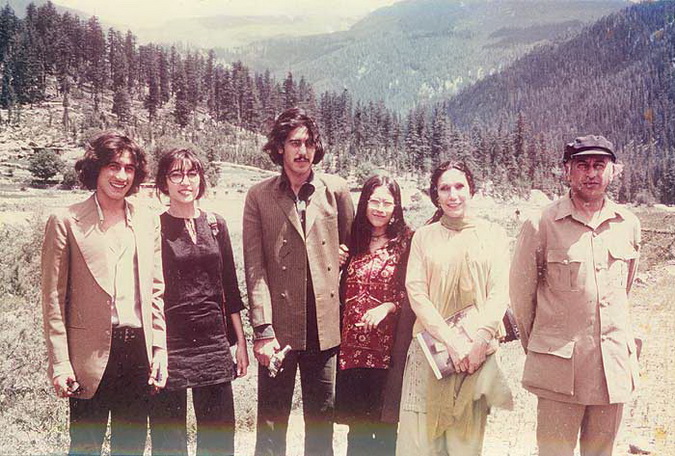
The Bhutto family taking the air in Murree
When the General Zia led military coup occurred, Husna said she was already in London where her eldest daughter was delivering a baby. She did not return. Though she was deeply resented by Benazir, who had obviously sided with her mother, Husna said Murtaza kept her in touch with Bhutto’s ordeal over the next two years, while ZAB was confined in a cramped prison cell, rapidly losing his health.
First, Husna hired British lawyer John Mathews to defend Bhutto in his murder trial held before the Lahore High Court, but the Pakistan government disallowed it on grounds that a foreign lawyer could not appear in a court until he had practised in Pakistan for a year. Then, she claimed to have pleaded with Sheikha Fatima to have the Emir Sheikh Zayed bin Sultan Al Nahyan ask Zia for clemency in the sentencing, but Zia turned a deaf ear. When Nusrat and Benazir visited Bhutto in jail in April 1979, Murtaza told Husna, it would be the family’s last meeting with him. He was hanged the next day.
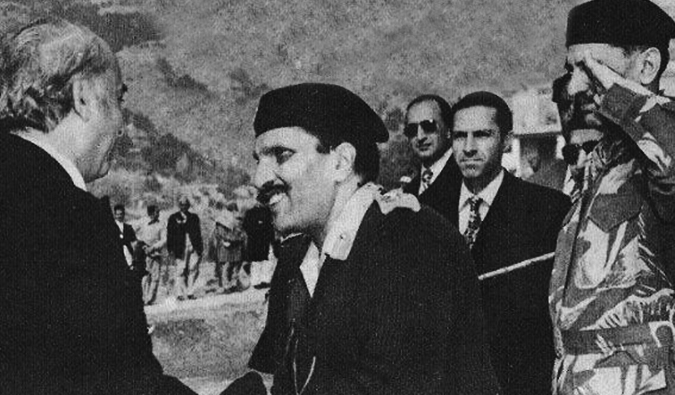
At the Dir helipand on 11th Nov 1976—Can you tell from the Chief of Army Staff General Zia ul Haq’s duplicitous smile with which he is greeting PM Bhutto that he will overthrow him in a coup and have him hanged the very next year?
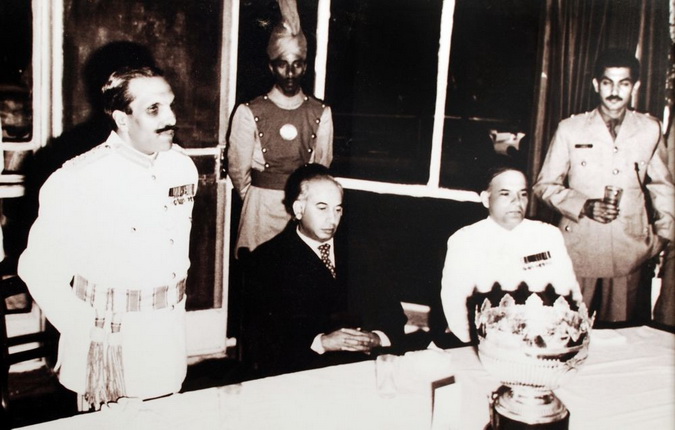
Generals Zia ul Haq & Akhtar Abdur Rehman with PM ZA Bhutto in Murree
Under arrest, Bhutto being made to the rounds of the court houses
An ailing and weakened Bhutto at the prison hospital
When the General Zia led military coup occurred, Husna said she was already in London where her eldest daughter was delivering a baby. She did not return
After Bhutto’s hanging, a deep depression took a hold of Husna and she contemplated suicide she said. However, she managed to pull herself out and has gone on to live out the rest of her life in relative peace and prosperity. Her union with Bhutto produced her youngest daughter Shahmeen and it was the thoughts of her family that gave her the strength to continue.
Husna is now a beautifully preserved octogenarian. She never remarried. And on April 4th 2016 falls ZAB’s 37th death anniversary.
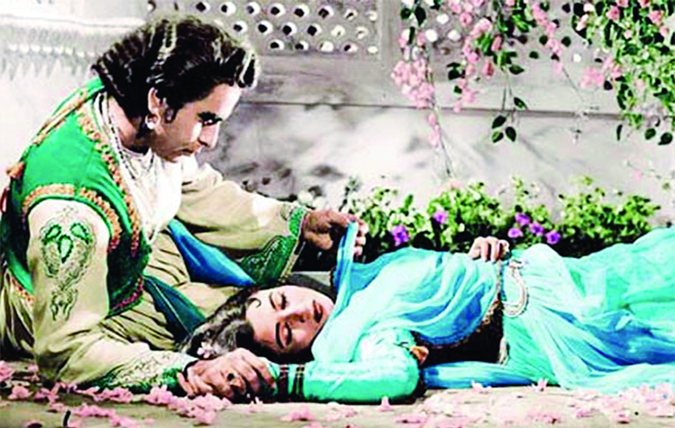
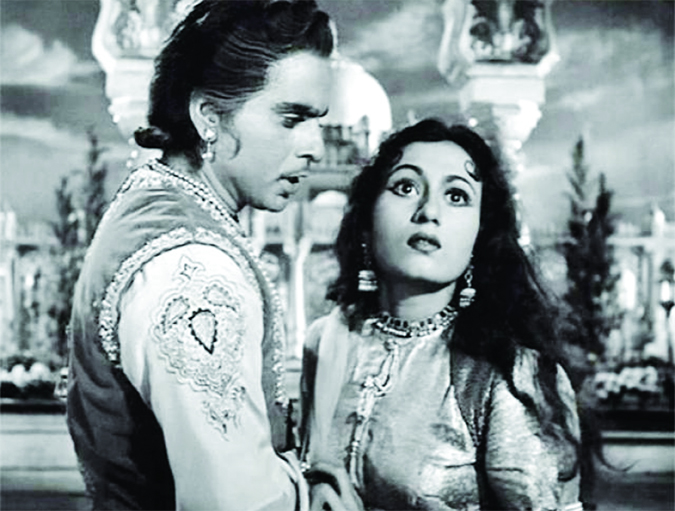
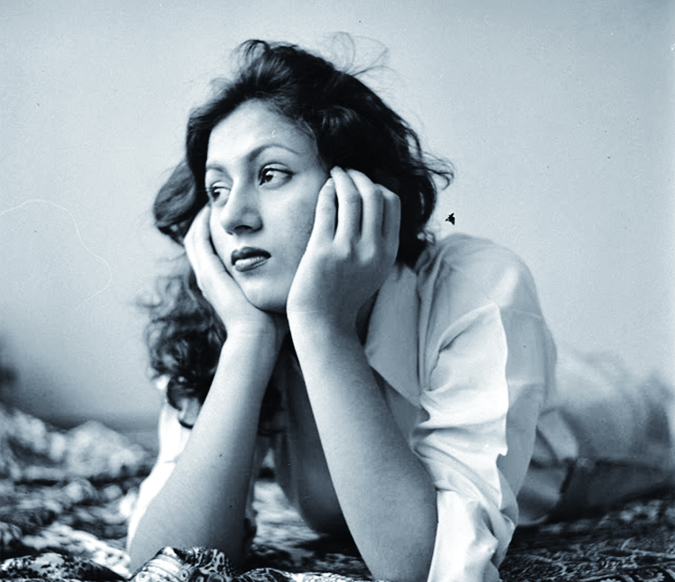
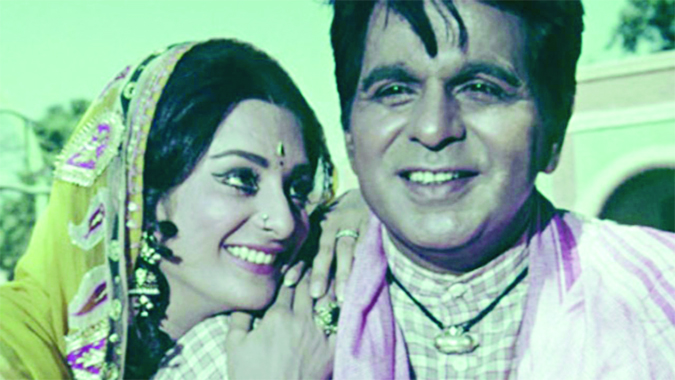
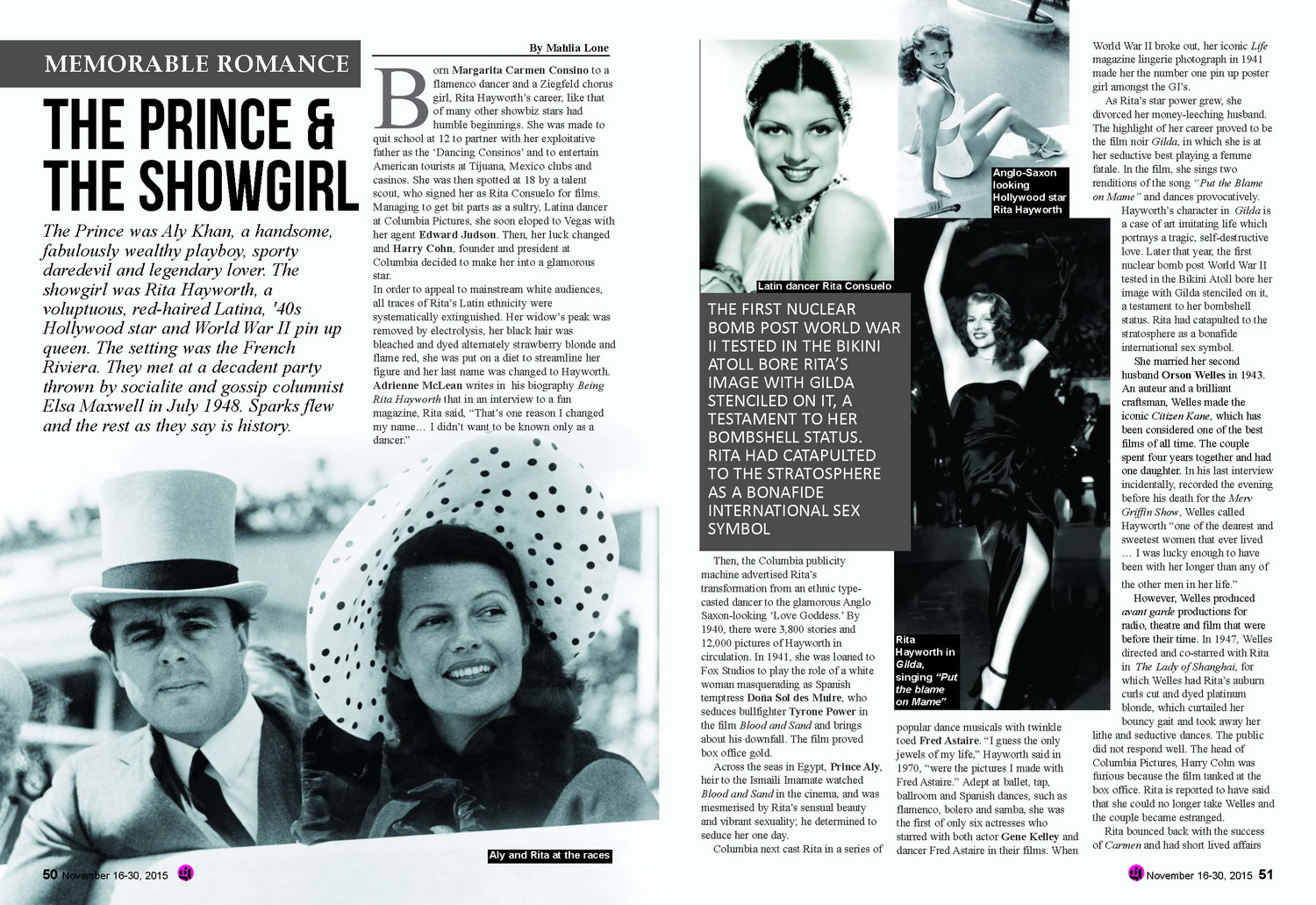
In a case of art imitating life, Madhubala and Dilip Kumar played star crossed lovers in the Indian film classic Mughal-e-Azam while nursing broken hearts over each other themselves, in her case quite literally
In 1942 Bombay, a tall, good looking Yusufzai Pathan who had recently gotten fired from his job at the Imperial Tabacco Company in New Delhi and relocated there with his wife and eleven children, took his angelic looking nine year old daughter Mumtaz Jehan Dehlavi and made the rounds of the studios in the hopes for finding a job for her. Soon Baby Mumtaz was given a small film role and subsequently became the sole breadwinner of her family. Though the father thought of himself as a self respecting Pathan, the truth was that he was extremely domineering and controlling of his star daughter because he was greedy for her income. This is what determined the course of her short and tragic life.
Born on Valentine’s Day 1933 a ‘blue’ baby (due to oxygen deprivation) with a ventricular septal defect (VSD) colloquially known as a hole in the heart that was undetected till she was in her 20s, Baby Mumtaz did not have a happy childhood. Five of her eleven siblings died in childhood due to their poverty stricken circumstances and even their small house in Bombay burned down due to a dock explosion in 1944. With no house, no job and six daughters to support, Ataullah Khan decided to use his prettiest daughter’s good looks to their advantage and she embarked upon a film career that lasted mostly from 1942 to 1960, though she made a few films in the 60s also. Her younger sister Madhur Bhaushan said in a Filmfare interview, ‘‘What do I say of her beauty? We suffered from a complex when we stood beside her. Being Pathans we were all tall, fair and had long hair. But none of us sisters looked like her. We weren’t a patch on Apa.â€
 It has been reported that a najoomi (fortuneteller) known as Kashmirwalle baba, predicted that Baby Mumtaz would grow up to be larger than life, “Badi hokar ye ladki bahot naam kamayegi, Bahot paisa aur shohorat paayegi, lekin (this girl will earn prestige, money and fame but) she will lead a very unhappy life with broken love affairs, a loveless marriage and will die at an early age.†His predictions proved to be ominously correct.
Spotting her talent and good looks, actress Devika Rani, founder of the movie studio Bombay Talkies, advised a teenage Mumtaz to assume the screen name Madhubala, meaning honey belle, because whenever she smiled she looked like a blossoming flower. Her first lead role, at the age of 14, was opposite Raj Kapoor in Neel Kamal (1947). Madhubala tasted mega stardom at only 16 in 1949 in Kamal Amrohi directed supernatural suspense thriller Mahal in which she plays a ghost. Overnight she became one the most sought after Indian actresses and sex symbols of the Fifties, known as the Marilyn Monroe of Bollywood and the Venus of India. In this blockbuster, the popular song Aayega aanewaala was sung by a teenage Lata Mangeshkar, singing playback for the first time.
“She was extremely popular and I think the only star for whom people thronged outside the gates. Very often when shooting was over, there’d be a vast crowd standing at the gates just to have a look at Madhu. It wasn’t so for anyone else. That was her personal effect on fans. Her personality was so vivacious,†said the love of her life Dilip Kumar
Other significant films of Madhubala’s career belonged to such different genres as Mehboob Khan directed psychological drama Amar (1954), Guru Dutt’s satire Mr. & Mrs. ‘55 (1955), Satyen Bose’s comedy Chalti Ka Naam Gaadi (1958), Samanta’s mystery Howrah Bridge (1958), Kamal Asif’s period tragedy Mughal-e-Azam (1960) and Santoshi’s romantic Barsaat Ki Raat (1960). Her film Hanste Aansoo (1950) was the first ever Hindi film to get a scandalous (for its time) adults only (A) rating from the Central Board of Film Certification. She worked with the most popular heroes of her time, including Ashok Kumar, Bharat Bhushan, Raj Kapoor, Pradeep Kumar, Shammi Kapoor, Dilip Kumar, Sunil Dutt and Dev Anand. Her memorable performance in Mughal-e-Azam established her as a timeless film icon.
Appearing in the American magazine Theatre Arts’ August 1952 issue, Madhubala was featured in an article titled: The Biggest Star in the World – and she’s not in Beverly Hills. The prestigious Life magazine also featured her in a glossy article. Academy Award winner American director FrankCapra, while visiting Bombay for the International Film Festival of India, even offered her chance to work in a Hollywood movie in a significant role, which she could have done because she had a private English tutor, but her father was not interested in loosening his iron grip.
In their 1962 book Self-Portrait, Harish Booch and Karing Doyle comment that “unlike other stars, Madhubala prefers a veiled secrecy around her and is seldom seen in social gatherings or public functions. Contrary to general belief; Madhubala is rather simple and unassuming.â€
Dilip Kumar is considered one of India’s greatest actors, holding the Guinness World Record for winning the maximum number of awards by an Indian actor with a record 8 wins of the Filmfare Best Actor Award and 19 nominations. Acclaimed filmmaker Satyajit Ray called him “the ultimate method actorâ€Â
“She was aware of her beauty,†reminisces B. K. Karanjia, former Filmfare editor and a close friend of both Madhubala and her father, “and because there were so many in love with her, she used to play one against the other. But it was out of innocence rather than shrewd calculation.â€
Co-star Dev Anand recalls, “She liked to flirt and was great fun.â€
 “She was extremely popular and I think the only star for whom people thronged outside the gates. Very often when shooting was over, there’d be a vast crowd standing at the gates just to have a look at Madhu. It wasn’t so for anyone else. That was her personal effect on fans. Her personality was so vivacious,†said the love of her life Dilip Kumar.
Madhur describes her sister, “She loved wearing plain white saris. At home she’d wear maxis. She loved mogras (jasmine) in her hair. She was fond of gold and kundan jewellery. She was also fond of sher shayri (poetry) as she knew a bit of Urdu. An English tutor also came home to teach her. She loved eating chaat and kulfi. She’d never diet. Those days actresses were healthy women, not size zero! She’d drive all of us to Chowpatty in her imported cars, Hillman, Buick and a station wagon but she’d wear a burqa (abaya) to hide her identity. When she’d be pulled up by the traffic police for that, she’d plead, ‘Please let me wear it or else I’ll get mobbed’. She even went to watch movies in a burqa. Apa became a craze because she was never seen in public. She wasn’t allowed to attend any function, any premiere. She had no friends. But she never resisted, she was obedient. Being protective, my father earned the reputation of being domineering. He was asked why he’d made her join films in the first place. He’d say, ‘I had 12 children. We would’ve starved to death. I’ve lost my sons who could’ve been my support.’
The early Fifties were Madhubala’s best years. She was rapturously and ecstatically in love and exuded happiness. Recalling those days, her friend Gulshan Ewing says, “She thrust on me the mantle of ‘confidante’. Many were the whispered conversations she had with me, all rustling with the same rhythm — Yusuf, Yusuf, Yusuf. She was so in love, the light leapt out and dazzled everyone. She would squeal when his name was mentioned, she would blush and perspire when his presence was imminentâ€
Apa was emotional by nature. She’d be in tears in seconds. We’d keep wondering what had happened. And she’d laugh easily too. The moment she began laughing, she couldn’t stop. She wasn’t religious but was God-fearing. She didn’t fast but prayed once a day.â€
Madhubala’s father kept a constant check on her movements. Madhubala kept a diary on daily basis like many of the young girls of her time. In this diary, she kept a full account of her romantic involvements, but her father buried the book with her in her grave.
Born Muhammad Yusuf Khan on 11th December 1922 in Peshawar, Dilip Kumar is considered one of India’s greatest actors, holding the Guinness World Record for winning the maximum number of awards by an Indian actor with a record 8 wins of the Filmfare Best Actor Award and 19 nominations. Acclaimed filmmaker Satyajit Ray called him “the ultimate method actor.â€
Again similar to Madhubala, Dilip Kumar became extremely successful and popular in the 1950s. He starred in the melodrama Babul (1950) opposite Nargis, as the alcoholic ‘Tragedy King’ in Chakraborty directed Daag (1952) opposite Nimmi, as a swashbuckler in Mahboob Khan’sAan (1953), as a dark hero opposite Madhubala in Amar (1954),  in Bimal Roy’s Devdas (1955), in Sriramulu Naidu’s comedy Azad (1955) opposite Meena Kumari, as a Roman prince in Bimal Roy’s Yahudi (1958) also opposite Meena Kumari, and in yet another Bimal Roy this time a suspense thriller Madhumati (1958) opposite Vyjanthimala. He was advised by a British psychiatrist to not play too many dark and depressing roles, which is why he went against type and started doing light comedic roles.
Playing star crossed lovers Prince Salim (later Emperor Jehangir) and courtesan Anarkali in Mughal-e-Azam
In yet another uncanny similarity with Madhubala, Dilip too was offered a plum role in a foreign English language film, in his case the role of Sherif Ali in British director David Lean’s classic Lawrence of Arabia (1962), but he declined it. The role eventually went to the Egyptian actor Omar Sharif. In his autobiography Dilip Kumar: The Substance And The Shadow, he expresses no regrets but simply writes, “Omar Sharif had played the role far better than I myself could have.â€
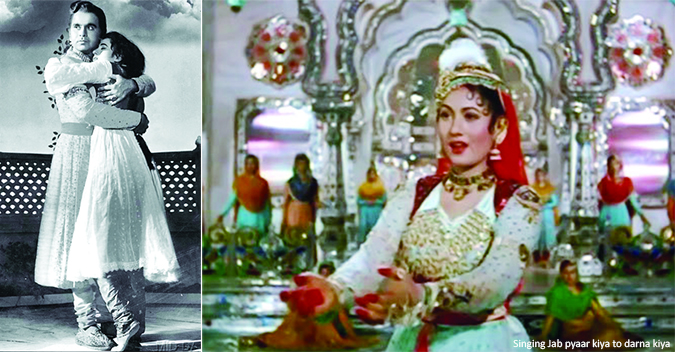
In 1960, Kamal Asif’s big-budget epic period film Mughal-e-Azam was released to critical and box office success. It is still the second highest grossing film in Hindi film history (in today’s currency value terms). Dilip Kumar plays the role of Prince Salim (later Emperor Jehangir) who revolts against his father Emperor Akbar (played by Prithviraj Kapoor) and falls in love with a courtesan (played by Madhubala). The film considered a classic was fully colourized and re-released in 2004, 44 years after its initial release. In the time that ensued between Dilip and Madhubala being cast together in their first film together Tarana (1951) and their controversial film Nayya Daur (1957) marked the beginning and end of their memorable but doomed romance.
Madhubala already had a few short lived broken romances when she hooked up with Dilip Kumar. “Madhubala was an extremely passionate and impulsive person,†says Khatija Akbar in her biography I Want To Live: The Story of Madhubala. Because she was lonely, she would approach men with a red rose and a handwritten note stating, “Accept it if you love me.â€
Her sister Madhu recalls, ‘‘Apa fell in love with (actor) Premnath. Their relationship lasted six months. It broke on grounds of religion. He asked her to convert and she refused.â€
Then, Madhubala, whose enigmatic smile and screen presence enthralled a nation, fell irrevocably in love with “the most charming man of the industry Dilip Kumar. He was not only a hugely successful movie star but a an impeccably well mannered man, one who treated women with love and respect,†writes Akbar.
Prior to this, Dilip had a romance with actress Kamini Kaushal who had been married by her family to her deceased sister’s husband to take care of their child. Though Dilip was willing to marry her, Kamini’s brother didn’t approve of the match and the relationship ended.
First meeting on the sets of the film Jwar Bhata (1944), Dilip and Madhubala fell in love during the shooting of Tarana in 1951 when she was 18 to his 29. They were both single. She presented him with her customary red rose and a whirlwind romance followed. They also became a popular onscreen pair appearing in a total of four films together.
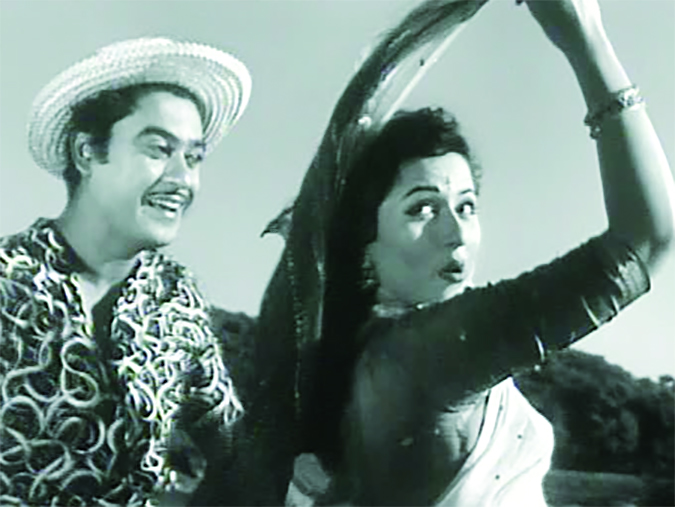
Films stills with Kishore Kumar
‘Dilip saab urged her repeatedly — again and again. He asked if this meant she was not willing to marry him. He told her if he went away now, he would never return. Madhubala was silent. At last, he got up and left — alone and out of her life’
Actor Shammi Kapoor recalls in an interview, “Dilip Kumar would drive down from Bombay to meet Madhubala … she was committed to Dilip … he even flew to Bombay to spend Eid with her, taking time off from his shooting stint …Her inability to leave her family was her greatest drawback for it had to be done at some time.â€
 The couple quickly became intimate and inseparable. They were expected to get married. The early Fifties were Madhubala’s best years. She was rapturously and ecstatically in love and exuded happiness. Recalling those days, her friend Gulshan Ewing says, “She thrust on me the mantle of ‘confidante’. Many were the whispered conversations she had with me, all rustling with the same rhythm — Yusuf, Yusuf, Yusuf. She was so in love, the light leapt out and dazzled everyone. She would squeal when his name was mentioned, she would blush and perspire when his presence was imminent.â€
 But Madhubala’s father, Ataullah Khan, did not approve of Dilip Kumar. “The reason was simple: money. Madhubala had been providing for her family for more than a decade. Marriage would end that, Khan feared,†writes Akbar. During the shoot of Naya Daur (1957) Khan’s interfering ways led to a standoff with the film’s director and eventually a court case. During the cross-examinations details about Madhubala and Dilip’s love affair came out and were revealed by the press. In the final days of the trial, Dilip declared in the court that he loved Madhubala and will continue to love her until his death. Finally, there was an out of court settlement. It was the final nail in the coffin for the relationship because Dilip had sided with the director against Madhubala’s father.
Madhur describes their relationship: “She met Bhaijan (brother Dilip Kumar) on the sets of Tarana. They later worked in Sangdil, Amar and Mughal-e-Azam. It was a nine year long affair. They even got engaged. Unki apa aayee thi, chunni lekar. (His sister had come with a ring as is the custom.) Bhaijan was also a Pathan. Contrary to reports, my father never stopped her from getting married. We already had enough money by then and were financially secure. Apa and Bhaijan looked made for each other. He’d often come home. He has even seen me in my school uniform. He was respectful towards us children and addressed us with ‘aap’. The two would go for a drive or sit in the room and talk.
The breakup with Dilip Kumar happened due to the court case during the filming of Naya Daur in the mid ’50s. The unit was to shoot somewhere in Gwalior. During the shooting of another film Jabeen Jaleel, at the same location, a mob had attacked the women and even torn their clothes off. My father was wary and just asked that the locale be changed. It’s not that he didn’t let her go outdoors. Apa had shot in Mahableshwar, Hyderabad and other places before. Bhaijan called my father ‘a dictator’ in court and sided with the Chopras.Apa used to cry a lot those days. They had conversations on the phone trying to patch up. He kept saying, ‘Leave your father and I’ll marry you’. She’d say, ‘I’ll marry you but just come home, say sorry and hug him.’He refused, so Madhubala left him. That one ‘sorry’ could have changed her life. It was zid (stubborness and ego) which destroyed their love. My father never asked her to break the engagement or ever demanded an apology from him.
Madhubala was confined to bed for nine years and reduced to just bones and skin. She’d keep crying, ‘Mujhe zinda rehna hai, mujhe marna nahin hai, doctor kab ilaaj nikalenge?’ (I want to live, I don’t want to die, wonder when the doctors will find a cure?)
Dilip Kumar said of his ladylove Madhubala, “She was a very, very obedient daughter and who, in spite of the success, fame and wealth, submitted to the domination of her father and more often than not paid for his mistakes. Actresses those days faced a lot of difficulties and constraints in their career. Unable to assert themselves too much, they fell back on their families who became their caretakers and defined everything for them.â€
In his candid autobiography, Dilip reveals his side of the story. He writes, “Was I in love with Madhubala as the newspapers and magazines reported at that time? As an answer to this oft-repeated question straight from the horse’s mouth, I must admit that I was attracted to her both as a fine co-star and as a person who had some of the attributes I hoped to find in a woman at that age and time. We had viewers admiring our pairing in Tarana and our working relationship was warm and cordial. She, as I said earlier, was very sprightly and vivacious and, as such, she could draw me out of my shyness and reticence effortlessly. She filled a void that was crying out to be filled, not by an intellectually sharp woman but a spirited woman whose liveliness and charm were the ideal panacea.
The announcement of our pairing in Mughal-e-Azam made sensational news in the early 1950s because of the rumours about our emotional involvement. In fact, K Asif (the film’s director) was ecstatic with the wide publicity and trade enquiries he got from the announcement. It was not anticipated or planned that it would be in production for such a long period as it was. Asif was aware of Madhu’s feelings for me because she had confided in him during one of their intimate talks. And, he was equally aware of my nature as a man who made no haste in taking critical personal or professional decisions. As was his wont, he took it upon himself to act as the catalyst and went to the extent of encouraging her in vain to pin me down somehow. He went on to advise her that the best way to draw a commitment from an honourable and principled Pathan, brought up on Old World values, was to draw him into physical intimacy.
In retrospect, I feel he did what any selfish director would have done for his own gain of creating riveting screen chemistry between actors who are known to be emotionally involved. Also, I sensed Asif was seriously trying to mend the situation for her when matters began to sour between us, thanks to her father’s attempt to make the proposed marriage a business venture. The outcome was that half way through the production of Mughal-e–Azam, we were not even talking to each other. The classic scene with the feather coming between our lips, which set a million imaginations on fire, was shot when we had completely stopped even greeting each other. It should, in all fairness, go down in the annals of film history as a tribute to the artistry of two professionally committed actors who kept aside personal differences and fulfilled the director’s vision of a sensitive, arresting and sensuous screen moment to perfection.
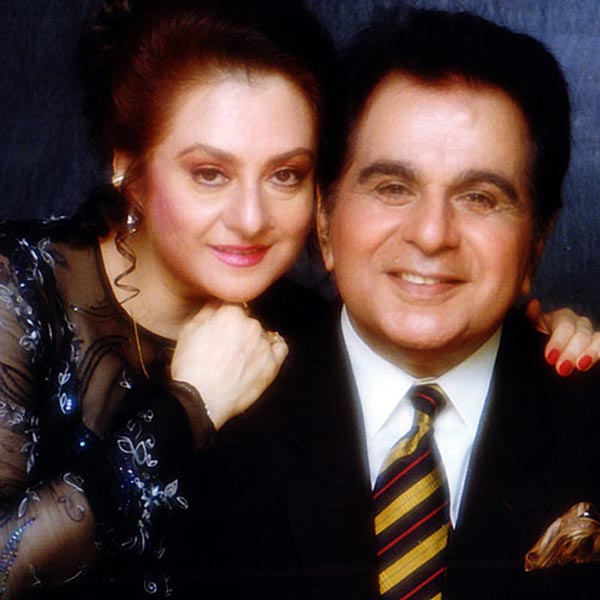
With wife Saira Banu
Contrary to popular notions, her father, Ataullah Khan was not opposed to her marrying me. He had his own production company and would have been only too glad to have two stars under the same roof. Had I not seen the whole business from my own point of view, it would have been just what he wanted, that is Dilip Kumar and Madhubala holding hands and singing duets in his productions till the end of our careers. When I learned about his plans from Madhu, I explained to both of them that I had my own way of functioning and selecting projects and I would not show any laxity even if it were my own production house. It must have tilted the apple cart for him and he successfully convinced Madhu that I was being rude and presumptuous. I told her in all sincerity and honesty that I did not mean any offence and it was in her interest and mine as artistes to keep our professional options away from any personal considerations. She was naturally inclined to agree with her father and she persisted in trying to convince me that it would all be sorted out once we married. My instincts, however, predicted a situation in which I would be trapped and all the hard work and dedication I had invested in my career would be blown away by a hapless surrender to someone else’s dictates and strategies. In the circumstances, therefore, it seemed best that we did not decide to marry or even give each other a chance to rethink because my resolve by then had become strongly against a union that would not be good for either of us.â€
The truth probably lies between these two versions. Madhubala, knowing the seriousness of her condition, knew that she need the fallback support of her family when her health would eventually deteriorate.
It has also been reported that during the making of Dhake ki Malmal (1956) the actor Om Prakash was on the sets of the film when he was startled by a message from Dilip Kumar who asked to see him. Dilip was with Madhubala in her makeup room and the atmosphere was tense. Om Prakash was requested to simply sit down and be a witness to the happenings. He watched as Dilip Kumar implored Madhubala, asking her to go with him and be married that very day. He had a qazi (priest) ready and waiting at his home and he wanted her to leave with him immediately. “I will marry her today,†he emphasized. It was the condition that he put forth that became the stumbling block: She would have to leave her father and never meet him again. Madhubala’s refrain was that this was impossible, and apart from this, she said nothing. ‘Dilip saab urged her repeatedly — again and again. He asked if this meant she was not willing to marry him. He told her if he went away now, he would never return. Madhubala was silent. At last, he got up and left — alone and out of her life.’â€
For the next few years, she drowned her sorrows with work, but the fabulous smile no longer reached her eyes. “She must have been miserable, but she wouldn’t show it,†comments Sushila Rani Patel.
“An ethereal beauty,†said Gulshan Ewing, “whose eyes were always sad, but whose lips were always smiling.†In the presence of her trusted friends and colleagues or in the privacy of her makeup room, there were times when sobs racked Madhubala. It seemed the pair continued to pine for each other from afar after their break up. Dilip drowned his sorrows in alcohol just as he had done in numerous films playing the jilted lover.
Madhubala was literally nursing a broken heart. ‘‘The hole in her heart (ventricular septal defect) was detected when she was shooting for SS Vasan’sChalak (1954) in Madras. She had vomited blood. She was advised bed rest for three months but continued working as her films would suffer,†said Madhur.
Celebrating his 90th birthday in style
One researcher writes, “Madhubala vomiting blood on the set was an ominous sign that electrified the Indian media. The history of her heart defect that came to public light as the mid-1950s brought her a string of failures, earning her the label ‘box office poison.’ With skyrocketing notoriety, no longer was Madhubala’s illness a family secret.â€
In 1953, Madhubala had been chosen to play the definitive role of her career as Anarkali. Bunny Reuben in his Book Dilip Kumar: Star Legend of Indian Cinema claimed that Dilip’s role was instrumental behind this selection given her history of illness. From beginning to end the film took nine years to complete so during the filming of their magnum opus, the relationship between the two stars was already over.
“For Mughal-e- Azam a film whose production was delayed for years, Madhubala and Dilip Kumar played the star-crossed lovers, Salim and Anarkali. It was their first meeting after their break-up. Madhubala was a pallid shadow of her former self,†writes Akbar.
The film’s production schedule ironically mirrored the stars real life love story. During much of the filming, Dilip felt bitter and was not even talking to Madhubala except when shooting required a dialogue delivery with her, but they both remained thorough professionals and didn’t let their inner turmoil mar their acting. Just as in the story Madhubala’s character Anarkali is compelled into convincing Dilip’s character Salim that she really does not love him, so did Madhubala keep her composure throughout the filming. The tragic final scene when a trapped Anarkali watches with terrified eyes the brick wall that is built around her, so was the real young woman terrified and trapped by her own deteriorating body.
The triumvirate: each considered the best actor of his genration
By the late 1950s, her health was deteriorating fast, worsened with the rigors of the shoot. Director K. Asif remained blissfully unaware the strain that the long shooting schedules were making on her health. She bravely posed as a veiled statue in suffocating makeup for hours under the studio lights and being shackled and dragging heavy chains. Madhur said. “While shooting for Mughal-e-Azam she was tied with chains and had to walk around with them. That was stressful. By the end of the day her hands would turn blue. She’d even refuse food saying that she had to look anguished and weary for the jail scenes.â€
“The lives of Madhubala and her screen character are consistently seen as overlapping, it is because of the overwhelming sense of loss and tragedy and the unrelenting diktat of destiny that clung to both and which neither could escape,†writes Akbar.
Madhubala found solace in the company of singer/actor Kishore Kumar who converted to Islam and took up the name Karim Abdul, until her death in 1969.“Madhubala was an uncomplicated person. She was famous and rich but lonely. She needed company and perhaps she thought Kishoreji would be the balm to her feelings,†Akbar writes.
Madhubala needed stability in her life and Kishore is reported to have needed financial help. At the time of this marriage, he owed huge amount of tax arrears to the Income Tax department, which had already assessed his Juhu House for auctioning off to pay this. Kishore thought that his rich wife could help him out financially. But Madhubala had severe health problems and was herself looking for a saviour. It was not till 1969 when the song Mere sapnon ki rani from the film Aradhana became a huge hit that Kishore’s fortunes changed drastically and he remained a hugely successful singer until his death in 1987, upon which he left behind Rs. 4 crore worth of assets.
“On the rebound Apa got involved with Kishore Kumar who was going through a divorce with Ruma DeviGuha Thakurta (actor/singer). What attracted her to Kishore? Maybe it was his singing or maybe his ability to make her laugh. Their love affair went on for three years through Chalti Ka Naam Gadi and Half Ticket. They got married in 1960, when she was 27. After marriage they flew to London where the doctor told her she had only two years to live. (A corrective surgery was not possible at the time.) If a 27-year-old is told that she has two years to live, what her state will be?†poses Madhur. “Due to her ailment, her body would produce extra blood, which would spill out from her nose and mouth. The doctor would come home and extract bottles of blood. She also suffered from pulmonary pressure of the lungs. She coughed all the time. Every four to five hours she had to be given oxygen or else would get breathless. After that Kishore left her at our house saying, ‘I can’t look after her. I’m on outdoors often’. But she wanted to be with him. He’d visit her once in two months though. Maybe he wanted to detach himself from her so that the final separation wouldn’t hurt. But he never abused her as was reported. He bore her medical expenses. They remained married for nine years, while she was confined to bed and reduced to just bones and skin. She’d keep crying, ‘Mujhe zinda rehna hai, mujhemarna nahin hai, doctor kab ilaaj nikalenge?’ (I want to live; I don’t want to die.When will the doctors will find a cure?)â€
Ashok Kumar defended his brother Kishore in a Filmfare interview: “Madhubala suffered a lot and her illness made her very bad-tempered. She often fought with Kishore, and would take off to her father’s house where she spent most of her time.â€
A few years back her tomb was demolished as it was in a Wahabi (a Muslim sect that doesn’t allow building of tombs) cemetery. They wiped away the last memories of a legend.’’
On March 18, 2008, a commemorative postage stamp featuring Madhubala was issued by India Post in a limited edition presentation pack. It was launched by her yesteryear actors Nimmi and Manoj Kumar in a ceremony attended by colleagues, friends and surviving members of Madhubala’s family.
Dilip Kumar went on to achieve a legendary film career. The government of India awarded him with the Padma Bhushan (third highest civilian award) in 1991,the Dadasaheb Phalke (highest award in cinema) in 1994 and the Padma Vibhushan (second highest civilian award) in 2015 for his achievements in Indian cinema. In 1998, the government of Pakistan awarded him the Nishan-e-Pakistan, (the country’s highest civilian award) making him only the second Indian to receive this honour. Now at a frail 93, Dilip lives a retired with his wife Saira.
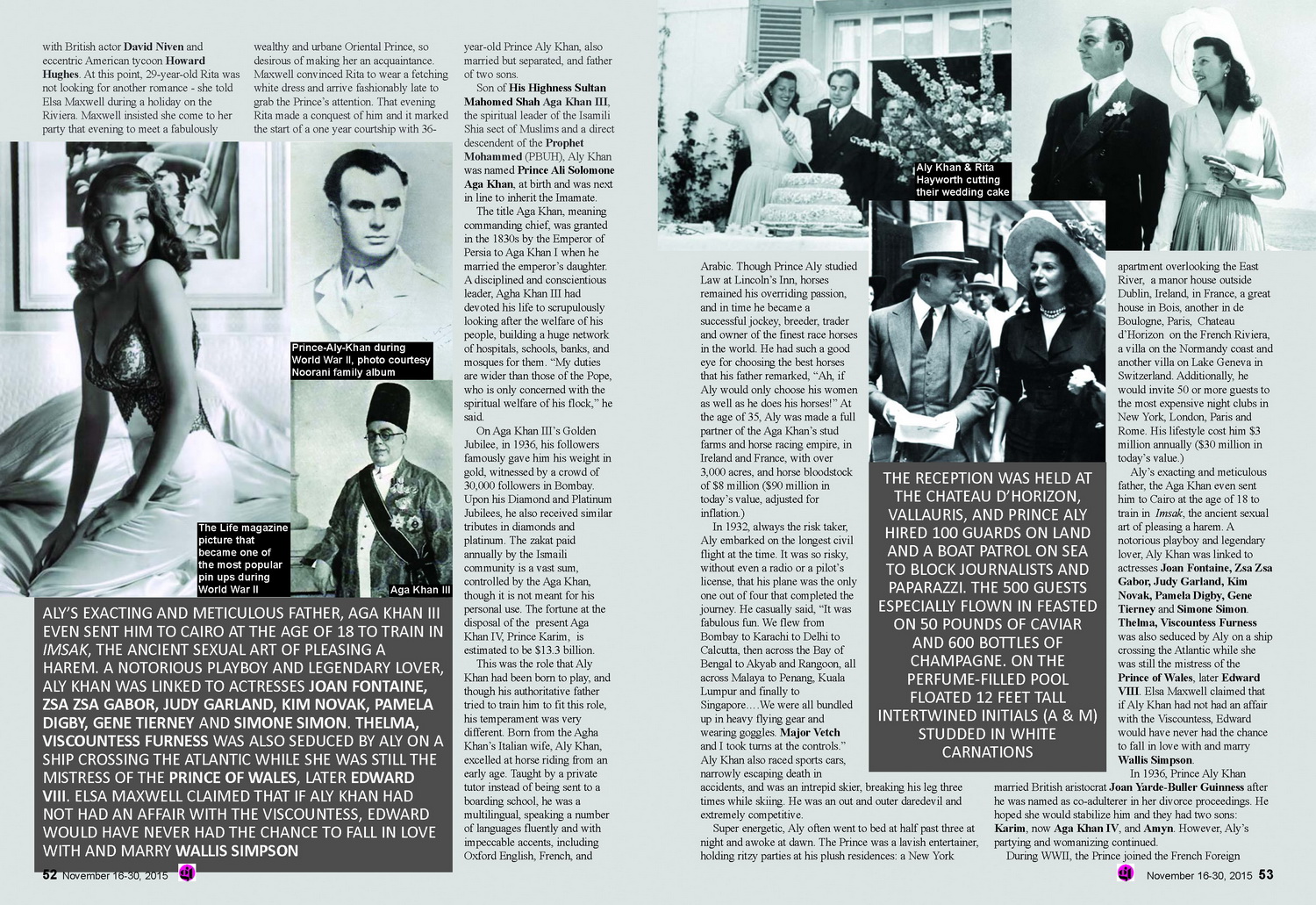
The Hashemite royal dynasty of Jordan can trace back its ancestry to Hashim ibn ‘Abd Manaf in the sixth century, Prophet Muhammad’s (PBUH) great-grandfather. From the 10th century to 1924 when the House of Saud gained power over Saudi Arabia, the Hashemites ruled Mecca with one from the tribe being selected as the Sharif (religious leader) and Emir of Mecca. When the Ottoman Empire was at its zenith, the Sultan started making the selection of the Emir from amongst the Hashemite tribe. thus, Sharif Hussein ibn Ali was appointed as Sharif and Emir of Mecca by Sultan Abdul Hamid II in 1908 just before World War I. With the waning of the Ottoman Empire’s power and influence, the Emir saw a chance to secure his family’s position as hereditary Emirs; hence, he led the Arab Revolt against the Ottoman Empire, urged on by the British. As a reward, his two sons were made Kings in 1921 by the British. Abdullah was made King of Jordan, while Faisal, who was earlier briefly King of Syria, was compensated with the throne of Iraq. His grandson King Faisal II was subsequently overthrown and murdered in a coup in 1958 when the Baathists took over Iraq, but the Jordanian royal family proved to be more progressive and resilient and have held on to their throne
It is to this family that Prince Hassan bin Talal was born on 20 March 1947 in Amman, the younger son of King Talal and Queen Zein al-Sharaf. His elder brother Hussein was destined for the throne, but Prince Hassan was for 33 years his chosen Crown Prince after the constitution was especially amended for this in 1965. During King Hussein’s absences from the country, Hassan would fill his shoes as Regent. But in a surprising turn of events, the King replaced him with his eldest son just days before he died in January 1999. There was much speculation in the media about this. One theory was that his Pakistani wife Princess Sarvath, considering the royal palace hers a bit prematurely while King Hussein was in the U.S. fighting for his life in a battle against cancer, ordered redecoration of the palace apartments to her liking. The King heard of her maneuverings and scrambling to establish control and finding her haste distasteful, chose to pass on the crown to his son instead. The Princess famously also didn’t get along with American born Queen Noor, King Hussein’s fourth wife who of course wanted her young son Prince Hamzah to inherit the throne. Not capitulating to pressure from external elements, the King wisely chose his eldest son (from his second wife) to replace him. Moderate King Abdullah II and his beautiful, charming and intelligent Palestinian origin wife Queen Rania have proven to be exceptionally popular monarchs. Approximately half of Jordanian citizens have Palestinian roots.
Let’s meet the Prince and Princess, who in this way, were sidestepped by history.
After early schooling in Amman, Prince Hassan attended English public schools, Summer Fields and Harrow. He graduated from Christ Church College at Oxford University with a BA and an MA. He speaks Arabic, English, French, German, Turkish, Spanish and even Hebrew. Known as the thoughtful ‘Philosopher Prince’, he has been awarded an impressive 25 honorary degrees from universities all over the world, including USA, UK, Brazil, Sweden, Hungary, Russia, Indonesia, Germany, Turkey and Pakistan. Additionally, he has worked for world and Middle East peace, which he refers to as “Muddle East†in an interview. Prince Hassan has served as the President Emeritus of the World Conference of Religions for Peace and has defended pluralism, human rights and promotes tolerance and understanding through dialogue between Muslims, Christians and Jews.
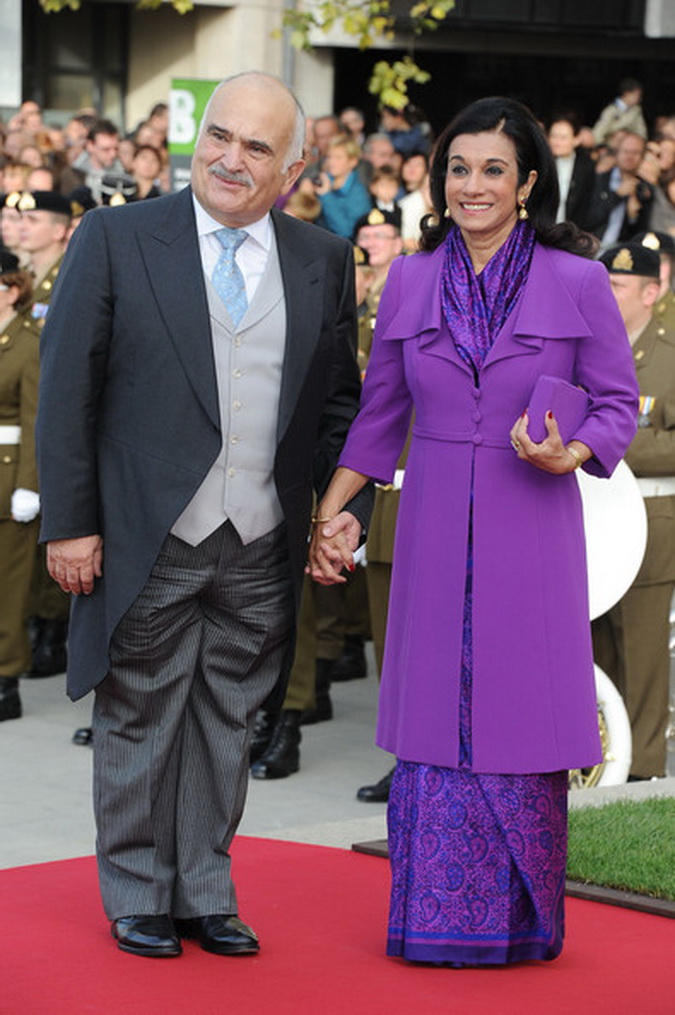
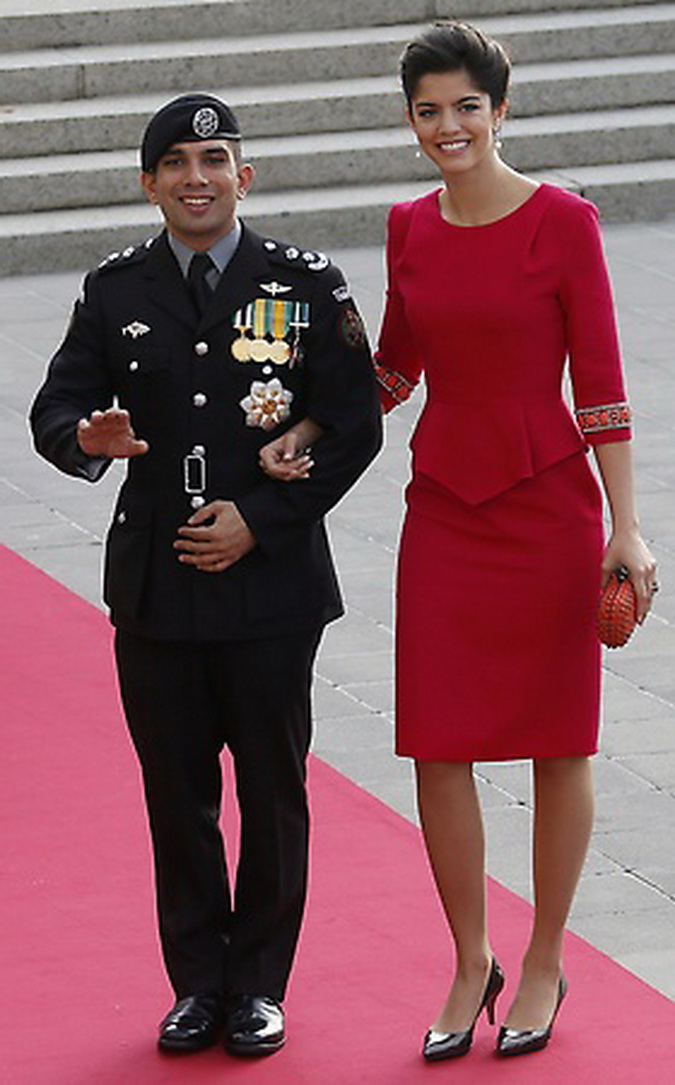
At the wedding of Prince Guillaume of Luxembourg & Stephanie de Lannoy
King Hussein replaced Crown Prince Hassan with his eldest son Abdullah just days before he died in January 1999. There was much speculation in the media about this. One theory was that his Pakistani wife Princess Sarvath, considering the royal palace hers a bit prematurely while King Hussein was in the U.S. fighting for his life in a battle against cancer, ordered redecoration of the palace apartments to her liking. King Hussein heard of her maneuverings and scrambling to establish control and finding her haste distasteful, chose to pass on the crown to his eldest son instead
One interviewer writes, “The Prince’s efforts to promote understanding between the Islamic and Western Worlds are crucial at a time when we seem to be drifting apart, with perceived differences appearing to overwhelm the many things we have in common, both culturally and religiously.â€
In recognition of his efforts, he was awarded the 2008 Abraham Geiger Award and the Four Freedoms Award for Freedom of Worship in 2014. He has received 33 awards and prizes in total, including Knight Grand Crosses, Medals, Medallions, and Grand Decoration of Honour with Sash (Austria). He has also served on 15 committees, mostly educational boards or related to academics and is the author of seven books and numerous articles in different languages. On 10 June 2013, he was also appointed as the Chairman of the Advisory Board on Water and sanitation (UNSGAB) by the United Nations Secretary-General Ban Ki-Moon.
A youthful Prince HassanYoung Sarvath at her engagement —Courtesy Getty ImagesAt their wedding celebration in AmmanKarachi wedding —courtesy Historical Images
Princess Sarvath (nee Ikramullah) was born in pre-Partition Calcutta just three months after Hassan. Her Bhopali father Mohammed Ikramullah, was a senior Civil Servant and a member of Muslim League’s Partition Committee. After Pakistan gained independence, he became the country’s first Secretary of State for Foreign Affairs and later Ambassador to Canada, France, Portugal and the UK. His last post was as Chairman of the Commonwealth Economic Committee. Sarvath’s mother, Begum Shaista Suhrawardy Ikramullah, was a Bengali writer, one of Pakistan’s first two female MNAs, Ambassador to Morocco and a delegate to the UN. Her uncles also held high offices in the Subcontinental governments; her paternal uncle Mohammad Hidayatullah was Vice-President of India and her maternal uncle Huseyn ShaheedSuhrawardy was the Prime Minister of Bengal during the British Raj and later the fifth Prime Minister of Pakistan. Her mother’s paternal family traces their lineage back to the 14th-century Persian Sufi philosopher Shaikh Shabuddin Suhrawardy. Sarvath doesn’t belong to a royal, but a respected and educated family. Princess Sarvath has three siblings, including the late Bangladeshi barrister Salma Sobhan and the British-Canadian filmmaker Naz Ikramullah.
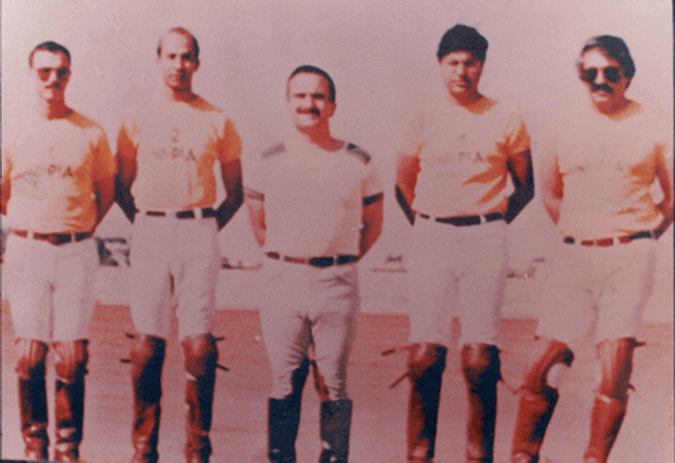
At the Lahore Polo Ground for an exhibition match
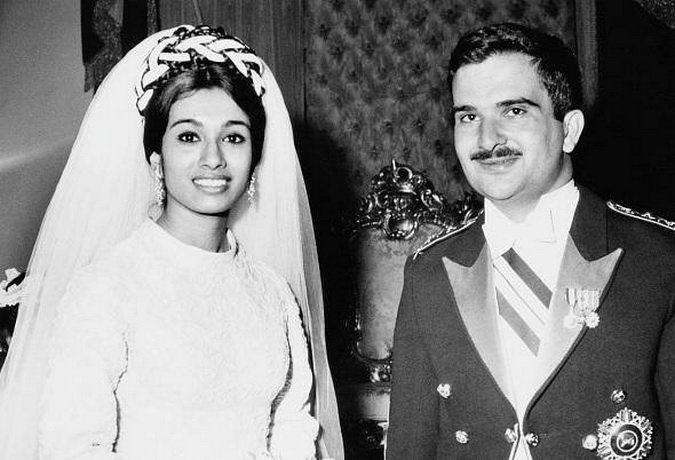
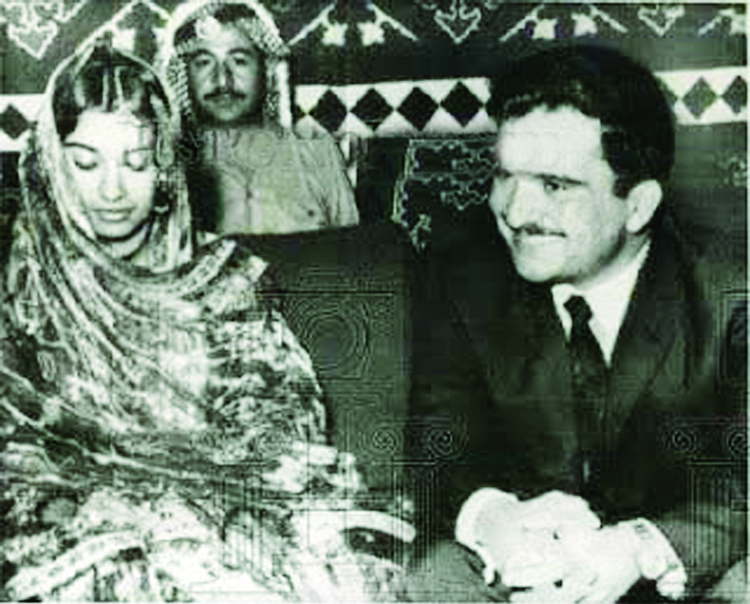
Though they are said to have met as eleven year olds in London in 1958, Hassan and Sarvath fell in love while studying at Oxford University and got married in Karachi on 28th August 1968. She was not a traditional choice for him. She was neither Jordanian, royal, nor beautiful, but they must have forged a strong connection. The Princess appears to be tenacious and has held on to her position as wife. King Hussein married four times, but Prince Hassan has had only one wife. They live in a lovely historic house in Amman and have four children together. Princess Rahma was born in 1969, Princess Sumaya in 1971, Princess Badiya followed in 1974 and the youngest a son Prince Rashid was born in 1979.
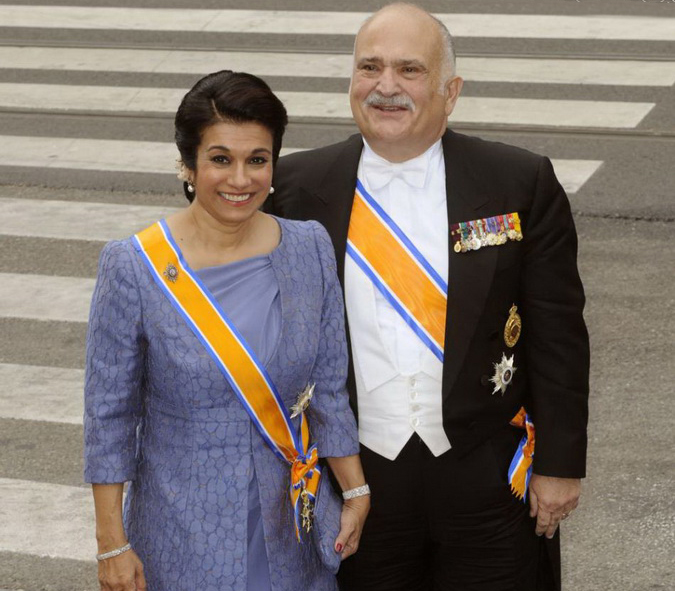
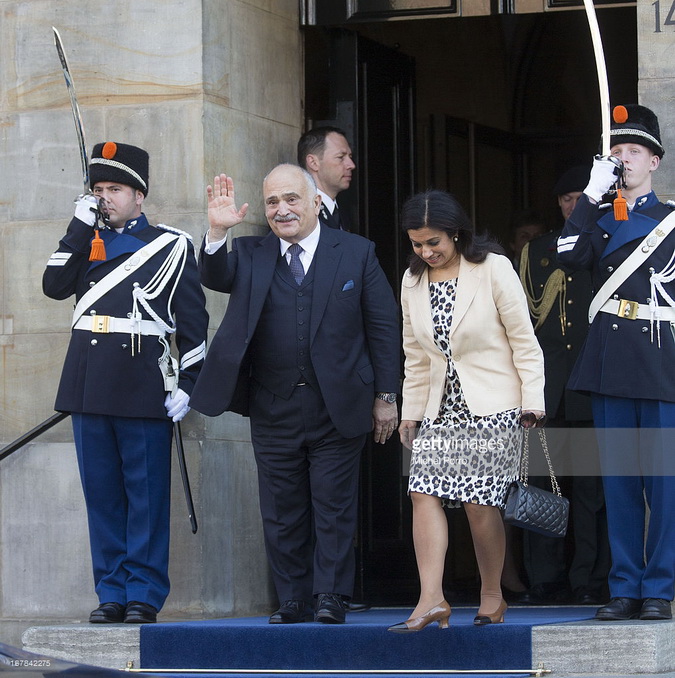
Princess Sarvath has served on many charitable organizations in Jordan, but she has also led a glamorous life accompanying Prince Hassan to royal events around the world, such as the wedding of Crown Princess Victoria of Sweden in 2010 and the inauguration of King Willem-Alexander of the Netherlands in 2013. In a 2013 appearance at Royal Ascot, she rode in pride of place with Queen Elizabeth II in her royal carriage. In fact at Prince Rashid’s wedding, it was observed that there was a greater number of European Royalty present than any other group. At most of these international events, Princess Sarvath chooses to wear silk saris in keeping with her Bengali heritage.
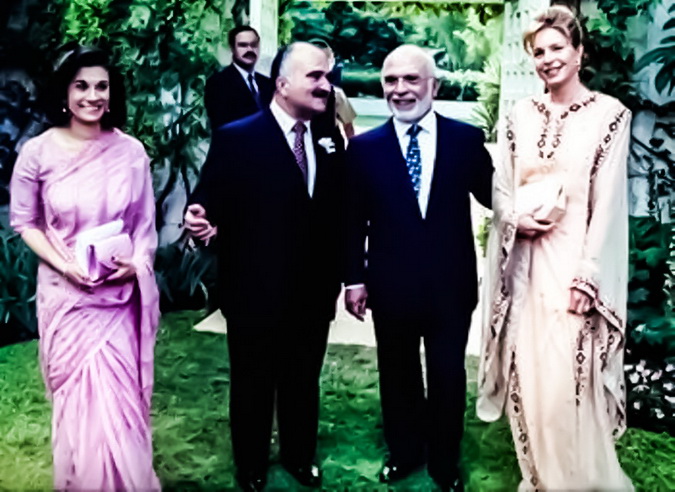
At the 2013 inauguration of King Willem-Alexander of NetherlandsAt a gala dinner on the eve of the abdication of Queen Beatrix of Netherlands and the inauguration of her successor King Willem-Alexander in Amsterdam in 2013Photo courtesy —Getty ImagesWith King Hussein & Queen Noor, with whom Princess Sarvath famously didn’t get along
Hassan and Sarvath fell in love while studying at Oxford University and got married in Karachi on 28th August 1968. She was not a traditional choice for him. She was neither Jordanian, royal, nor beautiful, but they must have forged a strong connection. The Princess appears to be tenacious and has held on to her position as wife. King Hussein married four times, but Prince Hassan has had only one wife
Princess Sarvath is sporty and enjoys skiing holidays, is the honorary President of the Jordanian Badminton Federation and was Jordan’s first female black belt in Taekwondo. She has kept up her connection to Pakistan with periodic visits, ordering outfits from fashion designers here, inviting Rizwan Beyg and others to hold fashion shows in Amman and commissioning interior designer Mian Ahad to do up her palace in Amman. She was also involved with charity fundraising for the Kashmir earthquake along with her son Prince Rashid who, as the President of the Hashemite Charity Organization, made visits here personally to oversee reconstruction of dwellings and rehabilitation of affectees. Princess Sarwat also contacted her friends, the royal families of Belgium, Denmark, England, Luxembourg, Spain, Sweden and Norway and Baden Aid (HRH The Margave of Baden in Germany) to raise funds after the devastating quake.
Hassan and Sarvath’s daughters grew up to be strong and accomplished modern day princesses. Their eldest daughter Princess Rahma received BA and MA degrees from Cambridge University after attending Sherborne School for Girls in Dorset, like her sisters who followed her there. In 2007, she married Alaa Batayneh, former Senator Arif El Batayneh’s son. Alaa is the country’s current Minister of Energy and Mineral Resources. The couple has two children together, Aysha who was born in 2002 and Arif, born in 2006.
Second daughter Sumaya graduated from the Courtauld Institute of Art at the University of London and married Nasser Judeh, former Cabinet Minister Sami Judeh’s son. Nasser also served as Jordan’s Minister of Foreign Affairs. The couple has four children: Tariq, Zein, Ali and Sukayna, but they divorced subsequently in 2007. Princess Sumaya University for Technology, founded in 1991, is named after her. In 2006 she was appointed President of the Royal Scientific Society, Jordan’s leading applied research institute, by Prince Hassan. She also sits as Deputy-Chair of the Higher Council for Science and Technology, advising the State on public policy issues relating to science and technology. In addition, Sumaya founded the El Hassan Science City, inaugurated by King Abdullah II in 2007.
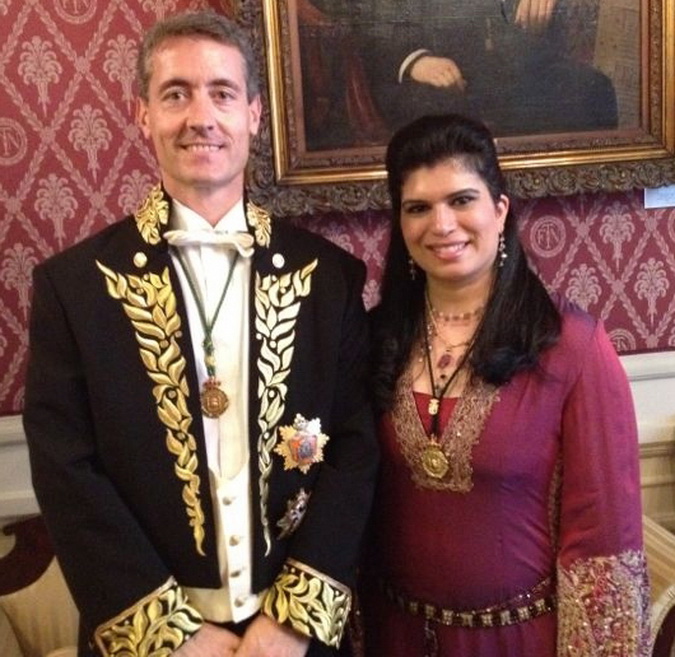
Princess SumayaPrincess Sumaya’s admittance to the Royal Academy of Economic Sciences, SpainPrincess Badiya’s Pakistani style MehndiPrincess Badiya’s 2005 wedding to Khaled Edward Blair in Amman
Princess Badiya attended Christ Church at Oxford, and then got a law diploma from The College of Law in London (where she met her future husband). She qualified as a barrister in 1998, being called to the bar at Lincoln’s Inn, the first member of the Jordanian Royal Family to become a lawyer. Next, she got her LLM in International Law from the London School of Economics. In 2005, she married Britisher Khaled Edward Blair in Amman and they have one son together named Ali. Khaled works as an investment banker in London. Speaking of her husband’s conversion to Islam, she said in an interview, “He became a Muslim before we married, but I was adamant that Ed’s conversion should be out of genuine religious conviction and not because of me. Would Ed have become a Muslim if he had never met me? Maybe not, it may not have occurred to him to look into it. As it was, he studied Islam and found that it was what he believed in already.â€
Part of their wedding festivities in Amman was a Pakistani style mehndi (henna) ceremony at which she dressed up as a traditional Pakistani bride, complete with jhoomar (head ornament) and lehnga (long embroidered bridal skirt). Princess Badiya has been photographed in Pakistani embroidered shalwar kameez on many occasions. In the UK, she works at promoting interfaith and cross-cultural understanding, human rights and the rights of asylum seekers and refugees through the Muslim-led charity Mosaic, a mentoring programme for youth founded by Prince Charles, of which she is the Chairperson.
Princess Badiya & Khaled Blair in LondonPrince Rashid & Zeina Shaban’s grand 2011 wedding at the Basman Palace in AmmanCake-cutting with his ceremonial swordThe groom looking jubilant at the reception
Prince Rashid attended Port Regis and Harrow schools, the Royal Military Academy Sandhurst and got his BA from Cambridge University. He joined the Jordanian Armed Forces as Captain and is currently serving as a Lieutenant Colonel in the Gendarmerie. In 2011, Prince Rashid had a grand royal wedding to Zeina Shaban at Amman’s Basman Palace. Zeina, a statuesque beauty and national table tennis champion, represented Jordan at the 2004 and 2008 Summer Olympics. The national flag bearer in Beijing, she had the whole country’s eyes on her. The Prince, himself a sporting enthusiast, looked jubilant at his wedding to the sporting star. The couple has a son Hassan, 2013. Prince Rashid has been head of the Jordan Amateur Boxing Association, and is the Captain of the Jordanian Polo Team and President of the Jordan Taekwondo Federation.
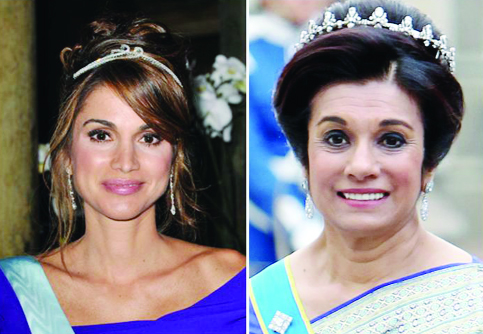
Rashid & Zeina wedding group with attending royaltyQueen Rania & Princess Sarvath in their royal tiarasPrince Rashid & Princess Zeina
An enlightened thinker that wants to see the Muslim world progress, Prince Rashid wisely said in an interview, “If wealthy Arab nations would develop a communication strategy for public diplomacy whereby such wealth – $1 trillion in bank deposits – actually is seen to be doing something to improve the Muslim world’s lot via empowerment and concern for the poor, then you’d see an evolution. Our concern then would become super-national, whereby the issue wouldn’t be to try to beautify our image in the eyes of others, i.e. the West, rather to promote ourselves not by words but by deeds. But unfortunately at the present time, nobody is taking the initiative toward this super-national thinking. For example, I don’t see why there isn’t an international fund for zakat (alms), even until now.â€
Let’s hope other Arab leaders follow his progressive thinking.
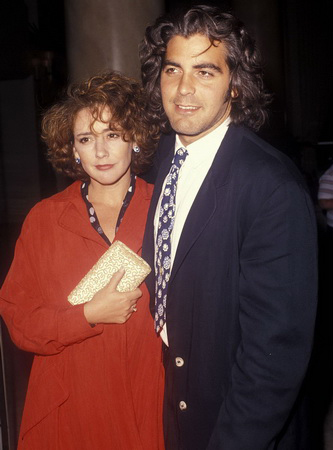
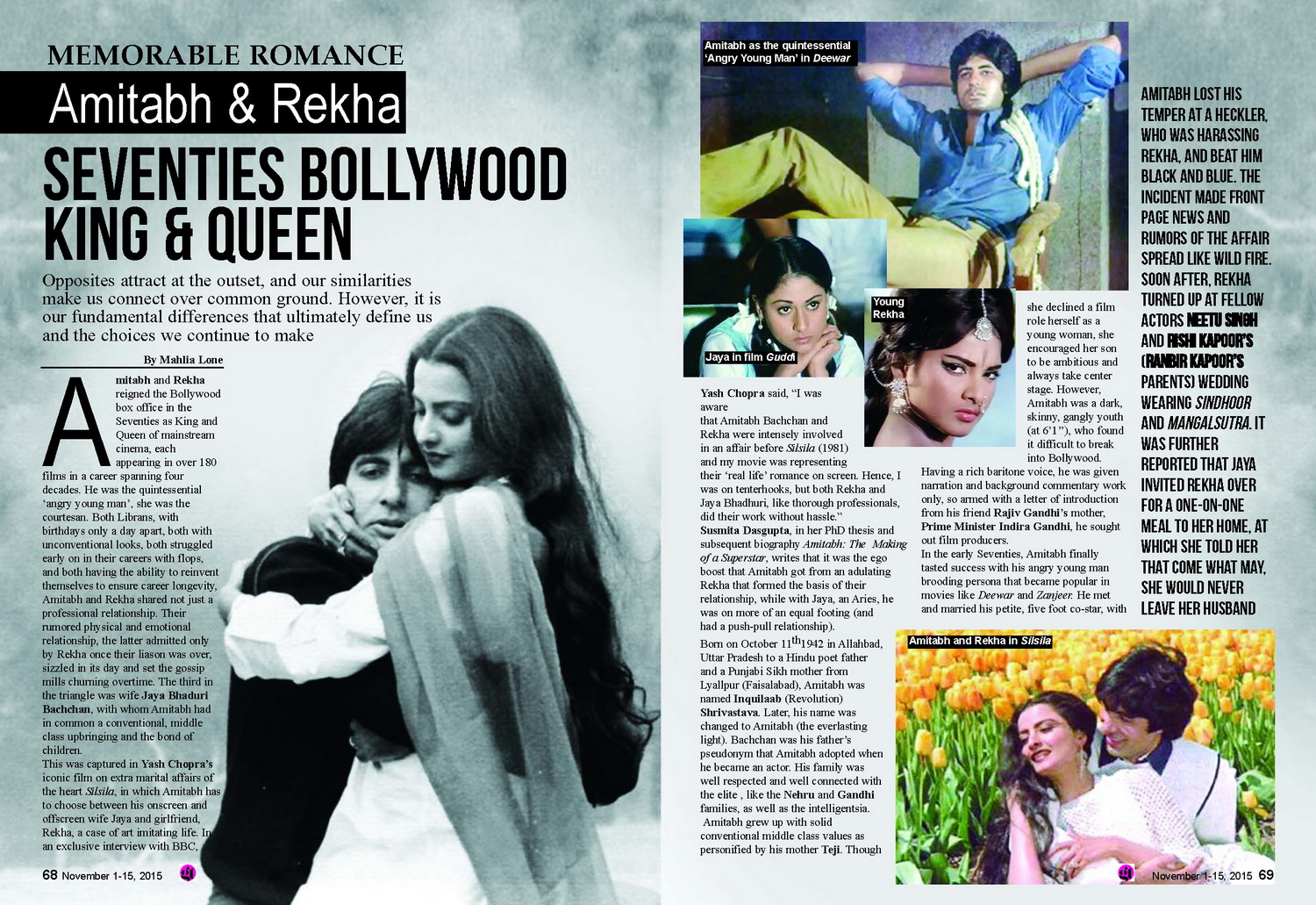
Long thought of as a confirmed bachelor, news of George Clooney’s impending nuptials with London-based barrister Amal Alamuddin sent shock waves through his legion of female fans. Overnight he went from being public domain to the committed partner of one. It was a move that he himself could not have foreseen; claiming he was just not marriage material and made “a lousy husband†after a short lived marriage to actress Talia Balsam in 1989 floundered in its early days. He also went against type when choosing a wife, going against the model/cocktail waitress type that he generally dated. On top of that, his chosen woman was of Middle Eastern descent and, gasp, a Druze Muslim!
Born George Timothy Clooney on May 6th 1961 in Kentucky, he is a suave, debonair and handsome Hollywood leading man of the Cary Grant variety. Additionally, Clooney is thoughtful, intelligent and a committed humanitarian with a broadcast journalist father and a mother with both beauty and brains, having served as a beauty pageant queen and city councilwoman. He has also descended on his mother’s side from the same stock as President Abraham Lincoln. We can rightly imagine then that politics and current affairs rather than show business dominated the dinner table conversation at the Clooney household of his childhood. A young George must have absorbed all that talk like a sponge and filed it away for future use. Growing up in a fervent Catholic household, George attended Catholic schools and was even an altar boy for a time. Rebelling against his childhood and with big dreams in his head, George dropped out of college. First, he tried out to play professional baseball for the Cincinnati Reds, but he did not make the team. Then, he moved to LA to pursue an acting career, like his aunt Rosemary Clooney, who was also a famous cabaret singer.
His first jobs were women’s shoe and door-to-door insurance salesman, construction worker and tobacco cutter. These minimum wage jobs supplemented his meager income from playing bit parts on TV while he was a student at the Beverly Hills Playhouse acting school for five years. Then came hit TV show ER in the early 90s, on which he played Dr. Doug Ross with Juliana Margulies (currently starring in The Good Wife on TV) as his nurse love interest, catapulting him to instant stardom. Handsome George became a household name and the object of lust for millions of women around the globe. During his five year run on ER, Clooney was lured to the silver screen. His first film was Robert Rodriguez directed From Dusk till Dawn in which sultry Mexican siren Salma Hayek famously does a sexy snake dance. Then, he did a romantic comedy, One Fine Day with established star Michelle Pfeiffer and the action thriller The Peacemaker with the then Mrs. Tom Cruise,Nicole Kidman. Rising star George Clooney was next cast as a superhero in Joel Schumacher’sBatman & Robin (1997) with Chris O’Donnell playing Robin and Steven Soderbergh directed cops and robbers flick Out Of Sight opposite a newly famous Latina, JenniferLopez in 1998. Next step was mega stardom with the Ocean’s Eleven trilogy. With a stellar ensemble cast, this heist movie was box office gold, a remake of a 1960 film starring Frank Sinatra. As Danny Ocean, Clooney led a modern day Rat Pack, including Brad Pitt, Matt Damon and DonCheadle, to name just a few of the actors bringing their combined star power to this fun blockbuster series.
In 2003, in opposition of the Iraq War, he said prophetically, “You can’t beat your enemy anymore through wars; instead you create an entire generation of people seeking revenge… Our opponents are going to resort to car bombs and suicide attacks because they have no other way to win… I believe (Secretary of Defense under George W. Bush) Donald Rumsfeld thinks this is a war that can be won, but there is no such thing anymore. We can’t beat anyone anymoreâ€
Not content to rest on his acting laurels, in 2001, Clooney co-founded Section Eight Productions with Academy Award winning director Steven Soderbergh and the following year Clooney proceeded to venture into directing with the biographical spy thriller Confessions of a Dangerous Mind, earning favourable reviews for his direction. In 2005, Clooney won his first Academy Award for Best Supporting Actor in the Middle East based political thriller Syriana that was inspired by the memoirs of former Central Intelligence Agency (CIA) agent Robert Baer of his posting in the Middle East. In 2013, Clooney received the Academy Award for Best Picture for producing yet another political thriller Argo. As an actor, screenwriter, producer and director, Clooney is the only person so far who has been nominated for an Oscar in six different categories.
In 2006, Clooney started another production company named Smokehouse Pictures. That same year, Clooney received the American Cinematheque Award, honoring his “significant contribution to the art of motion pictures.†In the recent past, Clooney has co-starred with Sandra Bullock in the 2013 sci-fi thriller Gravity, as well as produced August: Osage County, starring the Academy Award winning actresses Meryl Streep and Julia Roberts that same year.
In September 2013, when Clooney met human rights lawyer Amal Alamuddin at a charity fund raising dinner in Venice, he was discussing Middle East politics with the ease of a man who effortlessly commands an audience. She, however, was not impressed and quickly put him in his place. He was naturally intrigued, so used to women throwing themselves at him willy nilly
Clooney has admitted publicly that he greatly admires and looks up to his father Nick, so it was just a matter of time that he espoused worthy causes as a political activist and humanitarian. He supported the Democratic Party and President Obama in both his campaigns for the 2008 and 2012 presidential elections. George is a staunch supporter of gay rights. In 2003, in opposition of the Iraq War, he said prophetically, “You can’t beat your enemy anymore through wars; instead you create an entire generation of people seeking revenge… Our opponents are going to resort to car bombs and suicide attacks because they have no other way to win… I believe (Secretary of Defense under George W. Bush) Donald Rumsfeld thinks this is a war that can be won, but there is no such thing anymore. We can’t beat anyone anymore.â€
As a humanitarian, Clooney is involved with Not On Our Watch Project that focuses global attention and resources to stop and prevent mass atrocities, like the Armenian genocide, along with Brad Pitt, Matt Damon, Don Cheadle, etc. He has raised funds for the 2004 Tsunami, 9/11 New York attack and for the 2010 Haiti earthquake victims by organizing the Hope for Haiti Now telethon to collect donations.
His most significant contribution has been to the Darfur conflict in Chad and Sudan to date. With his father he travelled to Africa in 2006 and made the TV special A Journey to Darfur, showing the dire situation of Darfur’s refugees. Then, he was the executive producer and narrator for the documentary film Sand and Sorrow, on the Darfur crisis. Additionally, he addressed a Save Darfur rally in Washington, D.C. in the same year, and at the UN Security Council alongside Nobel Prize-winner Elie Wiesel appealed the UN to find a solution to the conflict and help the people of Darfur. Clooney appeared in Don Cheadle produced 2007 documentary Darfur Now, to appeal to people all over the world to help stop the Darfur crisis. Clooney and Don Cheadle received the Summit Peace Award from the Nobel Peace Prize Laureates in Rome. In his acceptance speech, Clooney said, “Don and I … stand here before you as failures. The simple truth is that when it comes to the atrocities in Darfur … those people are not better off now than they were years ago.†The United Nations announced Clooney’s appointment as a UN Messenger of Peace in 2008.
In September 2013, when Clooney met human rights lawyer Amal Alamuddin at a charity fund raising dinner in Venice, he was discussing Middle East politics with the ease of a man who effortlessly commands an audience. She, however, was not impressed and quickly put him in his place. He was naturally intrigued, so used to women throwing themselves at him willy nilly. He asked for her number, which she refused to proffer, thinking him a serial womaniser. Finally, after much cajoling, he managed to get her email address. After doing some homework on her, he sent her this flirtatious email: “I think the reported hottest man in the world should meet with the hottest human rights lawyer in the world.†In her mid thirties and single, Amal had been voted the hottest barrister in London in 2013 by the blog Your Barrister Boyfriend. George Clooney has not only has been voted People magazine’s Sexiest Man Alive on more than one occasion and No. 1 on TV Guide’s 50 Sexiest Stars of All Time list in 2005, but has also been included in 2009’s list of Time (magazine) 100 “Most Influential People in the World.†Amal that had prior to this in London been crying over several glasses of wine that she may never find a husband to her best friend, who later included this in her toast at the grand Clooneywedding, was being courted by the world’s Most Eligible Bachelor, as he was dubbed by the press.
The chase was on. Shrewdly playing hard to get, Amal was cool at first, not responding to his emails. Then, finally, she replied. She couldn’t resist the heady allure of Clooney’s charms for long. They met for a dinner date at London hotspot Berner’s Tavern where they talked about a surveillance satellite program over Syria. On Valentine’s Day, they came out as a couple at a special White House screening of Clooney’s World War II movie The Monuments Men, where the two were photographed coyly holding hands. Not content just to wine and dine her, Clooney whisked off Amal to a string of luxe holidays at exotic locales from Seychelles to Tanzania (on a safari) and Mexico. His only stipulation to her was that she quit smoking, which she promptly gave up cold turkey.
The world was agog with curiosity about how a regular non-celeb had achieved the impossible and got George Clooney to propose. His former girlfriends had sweetly smiled, appeared accommodating and non-demanding to no avail. The readers clamoured for information, which the press happily provided. Paparazzi followed the barrister around town as she quickly upped her style game.
Amal was born in February 1978, in Beirut to a businessman father, who belonged to a prominent Druze famil,y and a Sunni mother, who is a foreign editor of an Arab newspaper and a PR professional. Druze is a closed sect, the members of which may or may not be considered Muslim. This offshoot of the Ismaili sect has elements of Judaism, Christianity, but primarily of Islam. The Druze community is tightly knit due to constant persecution historically and no one can convert to the religion, you have to be born to it. The family moved to London in 1980 to get away from the Lebanese civil war.
Amal graduated in 2000 from St. Hugh’s College, Oxford University with a BA degree in Jurisprudence. An extremely bright and hard working girl, she received the Exhibition and Shrigley awards there. The following year, she enrolled in the Masters program at the New York University School of Law, where she was a clerk at the International Court of Justice. There, she received the Jack J. Katz Memorial Award for Excellence in Entertainment Law. She returned to London and was called to the bar (Bar of England & Wales, Inner Temple) and started working as a barrister at Doughty Street Chambers, specialising in international law and human rights. Her client roster reads like a Who’s Who of international political players, such as WikiLeak founder Julian Assange, former Prime Minister of Ukraine Yulia Tymoshenko, imprisoned Canadian-Egyptian journalist Mohamed Fahmy, the former Libyan intelligence chief Abdallah Al Senussi, the King of Bahrain, the State of Cambodia, Greece, and currently the former President ofMaldives Mohamed Nasheed. In 2013, Amal was appointed by the UN as an adviser to SpecialEnvoy Kofi Annan on Syria and as counsel to the 2013 Drone Inquiry by into the use of drones in counter-terrorism operations. It was just after this that she met Hollywood crusader George Clooney and corrected his facts about the Syrian geopolitical situation.
Villa Oleandra on Lake ComoThe happy couple have adopted a basset hound named Millie
In an interview, George said of why he fell in love with Amal, “She’s an amazing human being. And she’s caring. And she also happens to be one of the smartest people I’ve ever met. And she’s got a great sense of humor.â€
But it was only after she became Amal Clooney that she was chosen by Barbara Walters, American TV’s foremost interviewer, as the Most Fascinating Person of 2014.
When she made her red carpet debut at the Celebrity Fight Night charity event in Florence as Clooney’s fiance, the tall, slim and elegant brunette wowed in a black strapless silk gown with dangly gold earrings. A tuxedoed Clooney got onto the stage and declared, “I met my lovely bride-to-be here in Italy, whom I will be marrying, in a couple of weeks, in Venice, of all places… I would just like to say to my bride-to-be, Amal, that I love you very much and I can’t wait to be your husband.â€
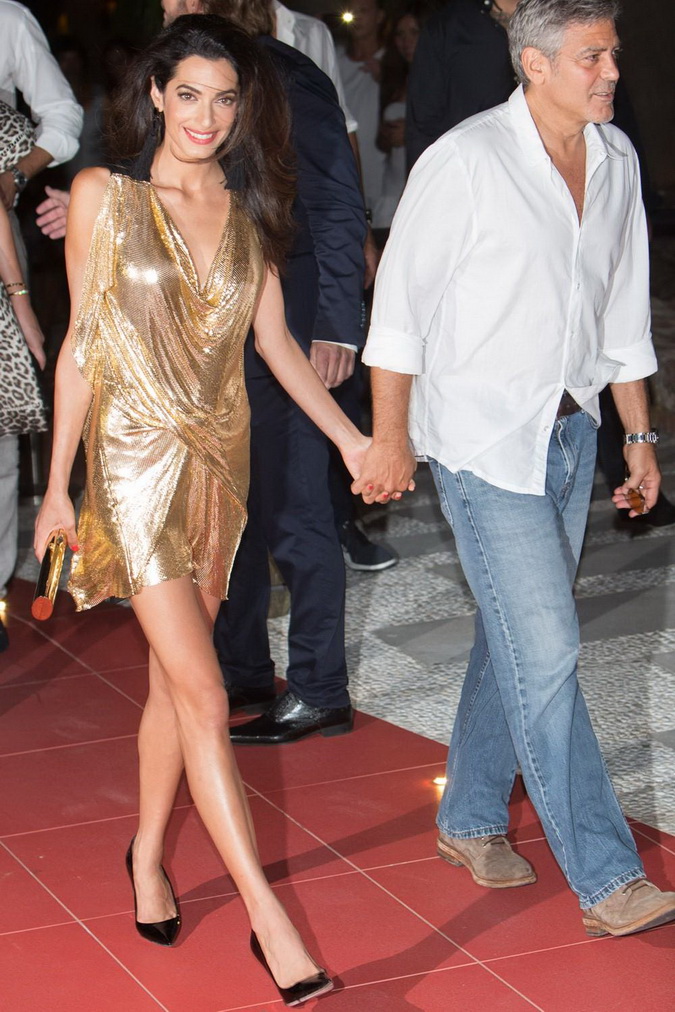
They filed for their marriage license in London and the notice was put up, as stipulated by English law, on the Chelsea Town Hall public board. In September, the wedding of the year took place. The happy couple arrived by a speed boat named Amore in Venice waving to the waiting crowds and a throng of eager photographers. Amal was clad in cream Stella McCartney wide legged trousers, short sleeve top wide brimmed hat with black ribbons in her hat and at her waist, and carrying a beige envelope clutch, while George was dapper in a grey Armani suit and black tie as they proceeded to the Venice City Hall for a civil ceremony. On the 26th, they celebrated the last night of singlehood at their respective bachelor and bachelorette parties. His was a seven course meal at Ristorante de Ivo restaurant where copious amounts of Casamigos tequila, owned jointly by Clooney and Rande Gerber (Cindy Crawford’s husband) and vintage wine, were consumed by the groom and five of his closest friends. The £3000 bill was waived by the restaurant owner for his famous frequent customer.
At the rehearsal dinner held at the Belmont Cipriani Hotel (where the entire wedding party was staying at the cost of £40,000 per night), Amal wore a fiery red waterfall cut (high-low) silk Alexander McQueen dress designed by Sarah Burton (who also designed Kate, Duchess of Cambridge’s lace wedding gown) that put her toned legs on display. She had a matching scarlet pout, left her luxuriant hair loose with a bouncy blow dry and wore black pumps and big diamond earrings. He wore an open neck white shirt and navy suit.
The next day on 27th September, the wedding ceremony took place at the 7 star Aman Canal Grande Hotel, which Clooney had volunteered to pay for but her father refused his help. However, Clooney footed the bill for the rest of the weekend long affair, including travel expenses of all the guests. Amal wore a white French lace and tulle Oscar de la Renta off-the-shoulder wedding gown embroidered with diamante and pearls with a circular train, a wide neckline and a cathedral length veil, costing £10,000. It was one of the last dresses that the late de la Renta was personally involved in designing. She wore simple natural white pearl earrings with square cut diamond accents. For the reception, she wore another de la Renta, a beaded and tiered short gold flapper dress more fit for dancing. George wore a Giorgio Armani tux. A Tuscan feast was laid out for the A-lister guests, such as American Vogue editor-in-chief, Anna Wintour and actor Bill Murray. Ravioli with Lemon and Ricotta, and a Lemon and Blue Lobster Risotto comprised the first course. The second course was a Chianina Tuscan Beef, and dessert was a Chaud-Froid (hot-cold) with Zabaglione (custard). The Chocolate Wedding Cake was equally decadent with intricate gold leaf decorations.
Having kept up her busy law practice fighting high profile cases, in a recent televised interview, Amal spoke of using her newfound celebrity for a good cause, “If there’s more attention paid – for whatever reason – to that, then I think that’s good….I think there is a certain responsibility that comes with that. And you know, I think I’m exercising it in an appropriate manner by continuing to do this kind of work.â€Â In addition, she is a visiting Professor at Columbia Law School. She has also partnered with the global initiative 100 Lives and founded the Amal Clooney Scholarship, whereby one female student from Lebanon is sent to the United World College Dilijan each year for a two-year International Baccalaureate program.
Meanwhile, George has been busy with upcoming movies releasing in 2016, such as the Coen Brother’sHail Caeser, in which he plays a 1950s Hollywood fixer, and Jodie Foster directed thriller Money Monster opposite Julia Roberts.
The couple juggles their hectic careers and have made a deal with each other not to spend more than a week apart. “I’m a much happier person and we have a very happy life. We enjoy many of the same things and I very much enjoy the projects that she takes on because they have real consequence,†said Clooney describing their married life in glowing terms and how he is more fulfilled now than ever before: a recipe for marital success.
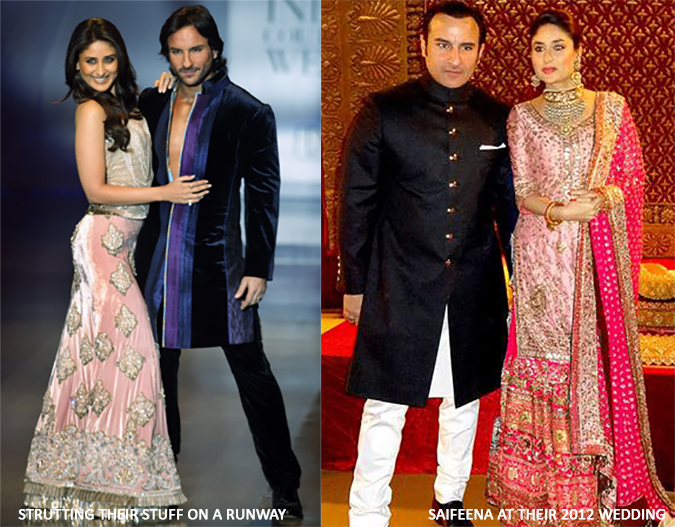
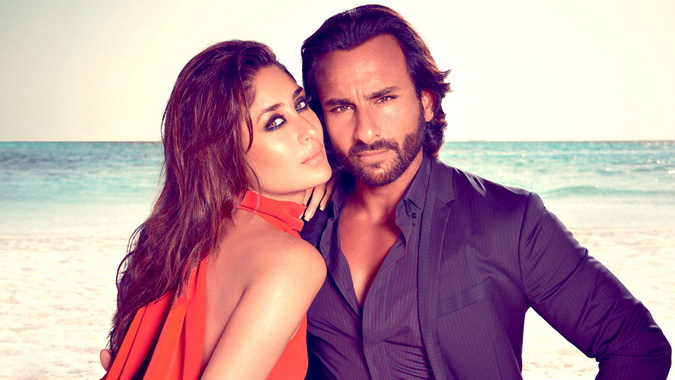
What makes a Bollywood power couple? It takes talent, good looks, connections, lineage, box office success, awards, and an ability for self promotion and marketing to become a star. When both partners possess these ingredients then the sum is greater than the parts, as in the case of Saif+Kareena=Saifeena. Let’s take a look at these savvy stars and what they want to achieve together
“If you are in love and you are happy, then that’s all that matters. I believe in the institution of marriage. It’s like a tag to cement the relationship for your friends, family and public. And it is a celebration of the fact that Saif and I are in love and we want to spend our life together,†said Kareena Kapoor Khan speaking about her marriage to fellow actor Saif Ali Khan.
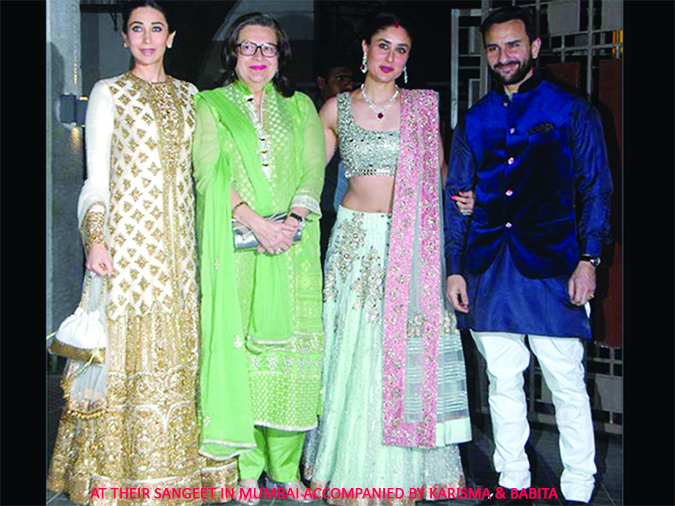
Eleven years his junior, one of the most popular and highest paid Bollywood actresses at the time of their 2012 wedding, what made Kareena Kapoor go for Saif Ali Khan, a short squeaky-voiced supporting actor and divorced father of two children, albeit a nawab? Unlike other Indian actresses who are photogenic and less attractive in real life, apparently Kareena (named by her mother Babita after Leo Toltstoy’s epic novel Anna Karenina) is tall and extremely pretty in person, just as she appears on screen. She is also Bollywood royalty, theater and film actor Prithvi Raj Kapoor’s great granddaughter and film maker/studio owner/actor Raj Kapoor’s granddaughter. Nearly all the Kapoors are or have been working actors, including in her immediate family her father Randhir Kapoor, her mother Babita, who is of Anglo-Indian descent, and even her elder sister Karisma. In fact, her parents split up because Babita wanted her daughters to become actresses, but the more conservative Randhir did not think it suitable for the women of the family. Though many of the male members of the family married actresses, they were all made to retire from their careers and become housewives, which they willingly did.
Randhir, Karisma, Babita & KareenaThe Pataudi Ibrahim Palace
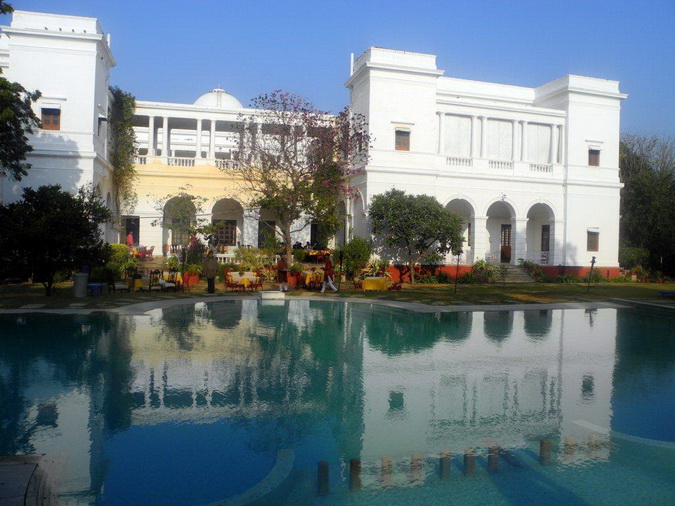
Saif Ali Khan, named Sajid at birth, comes from an entirely different stock from his father’s side. He is the tenth Nawab of Pataudi, (honorary) titular head of 52 villages, who studied at prestigious Winchester College in England and grew up in Ibrahim Palace, 26 km from Gurgaon, a New Delhi suburb. Ibrahim Palace is a vast fairytale palace that looks straight out of Disney’s Aladdin and has recently been renovated and converted to a hotel. His father Mansoor Ali Khan Pataudi, the ninth Nawab, also known as Tiger Pataudi, captained the Indian national cricket team, as did his paternal grandfather the eighth Nawab Iftikhar Ali Hussain who played first class cricket for both the British and Indian cricket teams. Saif’s paternal grandmother Begum Sajida Sultan was the daughter of the last ruling Nawab of Bhopal, while his mother is former B’wood actress Sharmila Tagore (renamed Begum Ayesha Sultana after converting to Islam uon her marriage), herself the granddaughter of Rabrindranath Tagore, the Nobel Prize winning Bengali poet. She currently serves as the head of the Indian censorship board. Saif’s youngest sister Soha Ali Khan and her husband Kunal Khemu are also actors, as was his first wife Amrita Singh, who hails from a Sikh landed family.
Amrita is not only 12 years older than her ex-husband, but physically taller and broader as well with a husky voice. Though the marriage lasted for some 13 years and produced two children Sara and Ibrahim, Saif cheated on her for a considerably portion of the time, finally leaving her for a Swiss model Rosa Catalano. Rosa herself contemplated moving to India and also becoming an actress at which point the by now divorced Saif broke up with her and started reinventing himself in an effort to revamp his image and career.
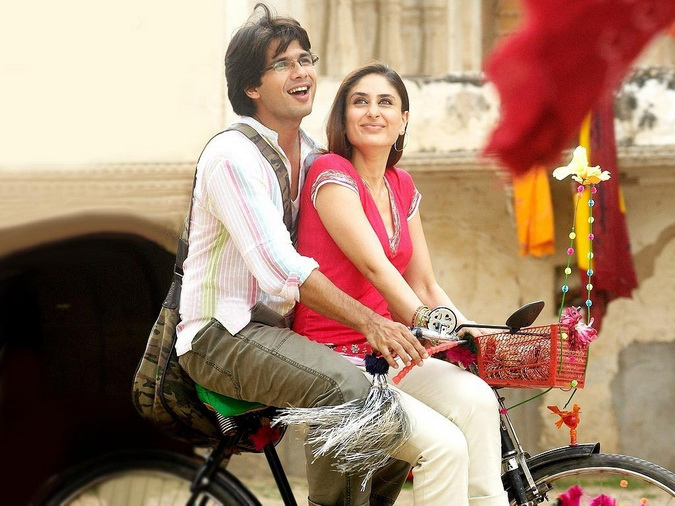
They hooked up during an oudoor shoot for TashanWith ex-boyfriend Shahid Kapoor in Jab We Met
Saif Ali Khan is the tenth Nawab of Pataudi, (honorary) titular head of 52 villages, who studied at prestigious Winchester College in England and grew up in Ibrahim Palace, outside New Delhi, which has recently been renovated and converted to a hotel. His father Mansoor Ali Khan Pataudi, also known as Tiger Pataudi, captained the Indian national cricket team, as did his paternal grandfather the eighth Nawab Iftikhar Ali Hussain, who played first class cricket for both the British and Indian national cricket teams. Saif’s paternal grandmother Begum Sajida Sultan was the daughter of the last ruling Nawab of Bhopal
Kareena, as younger sister of Karisma, a mildly successful lead heroine, had a highly anticipated film entry, though unluckily she opted out of a debut film with HritihikRoshan’sKaho Na Pyaar Hai (2000) that went on to be a big hit. Struggling to find her niche with initial box office duds, she finally had a massive hit with Karan Johar’s Kabhie Khushi Kabhie Ghum opposite Hritihik, with whom she reportedly also had an under the radar fling. Though the movie was a multi-starrer, Kareena gained a fan following after portraying an Indian version of Alicia Silverstone’s character in the hit Hollywood teen comedy Clueless. An intuitive and spontaneous actress, Kareena continued with fluff roles till she played the role of a prostitute in the film Chameli, for which she won a Filmfare Award. She started a relationship with newcomer Shahid Kapoor, a diminutive trained dancer, which lasted for three to four years and a mobile video of them French kissing went viral during this time. It was after their hit movie together Jab We Met that she broke up with him. Though she had starred with Saif Ali Khan in two movies up to this point, including the Othello inspired Omkara, they had not had many scenes together. To get over her breakup, Kareena decided to focus on exercise, weights and yoga (she can do 50 sun salutes at a time holding eacho position for 30 seconds), and diet regimen by becoming a vegetarian to get her body in tip top shape. Her size 0, 48 kg figure was then duly reported in the press and a noticeably trimmer Kareena appeared in tiny hot pants and bikini tops in the 2007 Yash Raj movie Tashaan, opposite a buffed up and goateed Saif Ali Khan. According to Kareena, it was during an outdoor shoot for this movie that she saw Saif lying bare-chested in just his jeans, sunning himself at the hotel pool that she checked him out and thought he was hot. However, according to what Shahid Kapoor alluded to in his interviews, there was some overlapping, during which time Kareena decided to dump the young actor for his older, vastly more eligible rival.
The phenomenon of Saifeena, as they were dubbed by the Indian press, was born. They announced their relationship at the Lakme Fashion Week that year. A source reported to the press, “Bebo (Kareena’s childhood nickname) and Saif behave like teenagers in love. They constantly send each other lovey-dovey messages and even have photos of one another on their phones.â€
The chic couple at a polo match
The couple garnered much publicity that has translated into many lucrative endorsements and modeling contracts together as a couple. Kareena, who has not been averse to plastic surgery to fine tune her looks though she has never publicly accepted this, introduced her boyfriend to botox and collagen fillers to rejuvenate his middle aged looks. Saif, henceforth, started appearing in films creaseless and with a taut forehead and an expressionless face. The publicity also helped his career and he ventured into film production making moderately successful films. Not only did Kareena help him out by starring in some of these, like his 2012 movie Agent Vinod, but she has also said she helps him market his films. “Saif just doesn’t take himself seriously enough. After his performance in Love Aaj Kal (2009 movie produced by Saif’s production company Illuminati Films that he stars in opposite Deepika Padukone and that has been directed by Imtiaz Ali), I’m convinced Saif’s best time begins now. But he doesn’t know how to market himself….This is Saif’s best performance after Omkara. I’m so proud of him. Love Aaj Kal is as much my baby as Saif’s. I’m going to be completely involved in the publicity, marketing, everything. This is our first production and we’re going to make it rock.â€Not content with just taking vacations together, Saif told Babita that he was committed to her daughter and wanted her to move in with him. “Kareena is my woman and we know that we want to spend the rest of our lives together.†Babita gave them her blessing and they started living together like a modern Indian couple.
  Actresses that Saif formerly had flings with, such as Priyanka Chopra, Bipasha Basu (during the fliming of Race) and Yana Gupta, Kareena is openly hostile and bitchy to, calling Bipasha, a “kaali billi†(black cat) for her dusky complexion. She said she knows that Saif has sown his wild oats, but now he has become grounded and if he ever cheats on her she threatened, “I will slaughter him.â€
But Saif proved his faithfulness to her and five years of dating later, they decided that their hectic careers allowed them a short time in which to tie the knot. “Of course, I want to be with her as much as I can,†Saif said in an interview. “My regret is we can’t be together more often. We are uncannily similar people and I’ve only now begun to understand why I need to be with her constantly. She complements me, as I hope I complement her. So of course, I try to be where she is.â€
During this time, Kareena’s career went from strength to strength. She’s the only heroine who can boast of starring in four hits that have grossed over Rs.1 billion each and has starred in films with all the top Khan triumvirate: Salman, Aamir and Shah Rukh. The highest paid Indian actress in 2012 for Heroine, receiving Indian Rs. 80 million (PKR 127 m) and with 16 brand endorsements, Kareena stints herself no indulgence. In 2010, Kareena bought herself a seven-carat diamond solitaire. She said in an interview that the ring was bought based on the advice of an astrologer who said it would bring her stability and happiness in her life. She also owns a fleet of luxury cars including a Mercedes S class sedan, an SUV and a Lexus LX 470. Kareena never misses an opportunity to head to Europe to unwind with London and Swiss skiing destination Gstaad being her top favourite vacation spots. She believes that two actresses in the same league can never be best friends, so her pal is struggling actress Amrita Arora. On October 27, 2011, Kareena’s wax statue was unveiled at Madame Tussauds in Blackpool in the UK. Quite the entrepreneur, Kareena also has a clothing brand and has co-written a few diet books.
At the age of thirty, Kareena became Mrs. Khan in a lavish wedding with five main functions spanning two cities. Unlike prior Pataudi Begums, she refused to covert from Hinduism to Islam or give up her lucrative film career. With his father already deceased, Saif did not demur and indulged his bride in all her wishes. The starry Mumbai functions, a Sangeet, a Mehndi and a Reception were hosted by Kareena’s parents. It was reported, “The Sangeet evening was marked with music, dance and masti. The terrace party was held at Kareena’s Bandra residence. Buddies Malaika Arora Khan, Amrita Arora, and Tusshar Kapoor shimmied to well-choreographed moves by Karan Johar. There was an array of dance performances to popular Bollywood numbers dedicated to the lovely couple. The terrace venue was covered to prevent media getting a snoop….Kareena in a pretty sari set the tone and note for the mehndi ceremony, where Saif looked dapper in a tuxedo. The mehndi ceremony was coupled with a private dinner for family and friends, which took place in Mumbai’s Taj Mahal Palace Hotel. The bride chose to wear ensembles made for her by her favourite fashion designer, Manisha Malhotra and especially created diamond and gem encrusted jewellery. A simple Nikkah and signing of the marriage registry was held at Saif’s residence in Mumbai. This was a personal affair to which they donned shalwar kameezes and waved to the press from the balcony. Kareena had refreshingly minimal makeup on. It was reported, “The after-marriage bash was a vibrant affair. Around 150 selected guests attended the celebration. B-town celebs like Shah Rukh Khan with wife Gauri, Sonam Kapoor with dad Anil Kapoor, Amrita Arora with husband Shakeel Ladak, Priety Zinta, Karan Johar, Tusshar Kapoor, and many more upped the starry quotient of the evening. Family members including Randhir Kapoor, Babita, Karisma,Rishi Kapoor with wife Neetu Singh and son Ranbir, Soha Ali Khan, along with Saif’s daughter Sara and son Ibrahim were seen in a joyous mood.â€
“After marriage, love becomes bigger, better. There’s greater understanding and respect. Saif admires me for being a working woman. A partner should help you fly. Saif’s perfect!…I can’t breathe without love. It gives me energy, a feeling of belonging, the need to GO out and conquer the world,†said Kareena
The couple returned to their respective film sets after the wedding and it was a little before they could take off for their honeymoon.
Spotted at Maldives Airport, Kareena, Saif, Soha & Kunal on a family holiday
Kareena has maintained that she will continue to act and may not have children till the age of 39. Kareena likes to cook for her husband, while he plays the guitar for his ladylove. She has also carefully cultivated a close relationship with his daughter Sara. Kareena said in an interview. “They are the most well brought up children. I always remember Sara standing up and doing adab (greeting). Both Sara and Ibrahim are like that. I am like a friend for them…. In fact, we’re like best friends. Saif refuses to come out with us. Sara’s my bar hopping partner. I enjoy my equation with her…. At times Sara and I chat over a glass of champagne. That’s the way Saif wanted it and that’s the way I wanted it. Whenever she wants to call me she does at time when Saif isn’t around and she doesn’t want to talk to him. She talks to me.’’
In another interview, Kareena said, “’After marriage, love becomes bigger, better. There’s greater understanding and respect. Saif admires me for being a working woman. A partner should help you fly. Saif’s perfect!’ She pointed out that she’s given a lot of time to the marriage, in fact to every relationship. ‘I can’t breathe without love. It gives me energy, a feeling of belonging, the need to go out and conquer the world,’ she stressed.â€
“I understand people want to put our relationship under a microscope. They want to know about our relationship,†said Saif thoughtfully in an interview. “But there’s only so much that they can know or perceive. What Kareena and I feel for each other, only the two of us know.â€
“Love is not all: it is not meat nor drink” Rishi Kapoor & Neetu Singh
A pragmatist knows that a love story does not end at the altar with a happily ever after. The loved up couple encounters many roadblocks, trials, fights, disagreements, heartbreak and testing times, along with the joy, love, jubilation, success and contentment they encounter along their life’s journey together. As long as the good moments outnumber the bad, all is well and they continue to be together. Rishi Kapoor and Neetu Singh (parents of heartthrob Ranbir Kapoor) had amazing on-screen chemistry in Bollywood films of the Seventies before they tied the knot and settled down to married life together. But along the way, due to career frustrations and the Kapoor family penchant for the good life, Rishi lost his way and nearly his wife as a result
The middle son of film maker, director and actor Raj Kapoor, Rishi, nicknamed Chintu by his older brother Randhir (father of Karisma and Kareena), started his acting career as a chubby schoolboy in Mera Naam Joker. Though considered an avant-garde movie at the time, the film bombed at the box office. Reeling from the financial loss and to relaunch his fair and handsome young son, Raj cast him as the male lead in Bobby (1973) opposite a nubile, mini skirt clad Dimple Kapadia. A rom-com with catchy songs, the movie was a tremendous success. The movie is about a teenage boyfriend/girlfriend from opposite side of the tracks, who defy their parents in their passionate love for each other and overcome all obstacles to be together at the end; a Seventies version of Romeo & Juliet with a happy ending and many masala (spicy) song and dance routines. What caught the audience’s imagination was the lead pair. They were refreshingly innocent-looking. Dimple, seemingly unaware of her sexy outfits, has a wide eyed innocent look in it that cannot be attributed to her acting, while Rishi is the chocolate boy hero, all spunk and excitable youthfulness. During the filming, the two became so close that Rishi asked Raj Kapoor if he could marry Dimple. Raj vociferously refused. Perhaps he thought his son was too young and still impressionable to tie the knot, but according to contemporary rumors, Dimple, who was raised in a tenement, could have been Raj’s love child with his mistress and love of his life film star Nargis (thus Rishi’s paternal half-sister), a farfetched story. Soon after, Dimple married the top star of that time Rajesh Khanna and left films at his behest. (They are the parents of Twinkle Khanna married to Akshay Kumar.) Rishi went on to become every teenage Indian girl’s crush in the Seventies.
During the filming of Bobby, the two leads became so close that Rishi asked Raj Kapoor if he could marry Dimple. Raj vociferously refused…. according to contemporary rumors, Dimple, who was raised in a tenement, could have been Raj’s love child with his mistress and love of his life film star Nargis (thus Rishi’s paternal half-sister), a farfetched story
In an interview for Afsana Ahmed of the Hindustan Times, Rishi said, “It wasn’t easy to be pitted against Amitabh Bachchan and Vinod Khanna (both Seventies action stars). But I did it and enjoyed that phase, especially the first 25 years of my stay at the top,†says the actor who appeared as the hero in nearly 100 romantic movies. “In the first 25 years of my career I sang songs, wore jerseys and romanced heroines in the valleys. And as was predictable in Hindi films, I got slotted into the quintessential chocolate boy image.â€
Baby Sonia, as Neetu Singh was known as a child star, had been appearing in films since she was only 8 years old. With her mother financially dependent on her, Neetu was a pretty and voluptuous doe-eyed Sikh actress with waist length thick, long and lustrous hair. She played the part of the lively, ebullient, peppy girl in movies. Though she had met Rishi when she was only 14 and they became friendly, their first film together was Zehreela Insaan in 1974. Off-screen she was his confidante, the female friend that he confided in about his love woes with various girl friends and cry on her shoulder after his various breakups. She too must have had a crush on him since she gave him so much of her time and attention. Six years her senior, Rishi treated her in a fond yet off hand way; he would nonchalantly pull pranks on her, such as rubbing kajal (black eyeliner) on her face after she would finish getting dolled up by the makeup artist. Their on-screen chemistry was red hot with him jumping around excitedly and impishly and her looking at him with lovelorn eyes. The popular pair have appeared in a total of 12 films with each other. After the 1976 film Kabhi Kabhi, in which they played yet another young and in love couple, Rishi got so used to her company that when he left for an outdoor shooting stint in Europe for the film Barood, he missed her after only a couple of days. He said in an interview, “I remember I had an argument with my girlfriend at the time and I was very heartbroken. Trying to win her back, I had taken Neetu’s help in writing telegrams to her. As time passed, I began to realise that Neetu is the one for me and I began to miss her when I had gone to Europe for a shoot. Ironically, I sent her a telegram from Europe to Kashmir.†The telegram simply stated, “Yeh Sikhni badi yaad aati hai†(I’m missing this Sikh girl dreadfully). Overjoyed at his declaration of love, Neetu rushed to show it to Yash (famous filmmaker) and Pam Chopra.
Rishi said, “as time passed, I began to realise that Neetu is the one for me and I began to miss her when I had gone to Europe for a shoot….I sent her a telegram from Europe to Kashmir.†The telegram simply stated, “Yeh Sikhni badi yaad aati hai†(I’m missing this Sikh girl dreadfully). Overjoyed at his declaration of love, Neetu rushed to show it to Yash and Pam Chopra. Rishi and Neetu started dating, but he cautioned her candidly but honestly, “I will only date you, but never marry youâ€Â
They started dating, but Rishi cautioned her candidly but honestly, “I will only date you, but never marry you.†With the optimism of youth and too smitten to care, Neetu took him at his word.
Her mother Rajee, however, was not happy. She wanted her daughter to focus on her career as the sole breadwinner of the family and not get a bad reputation. In an interview, Neetu recalled, “My mom was so protective that I was not allowed to even go for coffee with my friends. Even if someone looked at me, she would bash him up. She was really dominating and people would get scared of her. She would get upset if my husband flirted with me. She told me, ‘You should not have affairs. If you go from one person to the other, he will also leave you and then you would again have to go to yet another. Your name will be spoilt and it will remain like that.’ That stayed in my mind. So whatever ups and downs I went through with my husband, I did not want to leave him and wanted to always hold on.†Rajee made sure Neetu was always chaperoned; she would send Neetu’s first cousin with them on all their dates, who would sympathetically get dropped off along the way to give the couple some alone time. Rishi also put an 8:00 p.m. curfew on Neetu by which time she would be packed up on set and at home by 8:30 p.m. waiting by the landline for his phone call. He, on the other hand, continued to carry on with starlets on the side, which he would deny to her, and she would take him at his word.
Neetu said, “I was oblivious of my star status and would even sit on the floor talking to junior artistes. I was not pretentious. He (Rishi) would write letters when I went outdoors and have them delivered to me by all his friends who were my co-stars. I would be teased and be considered his property. We had been dating for five years. At 21, I had signed a lot of big movies and was at the peak of my career and had lost weight and that is when he got insecure. He would initially say, ‘I am going around with you, but will not get married to you.’ But then one day he asked me, ‘Don’t you want to get married?’ I said, ‘To whom?’ He said ‘What do you think I am?’ I agreed. (The two were formally engaged in a hush-hush ceremony during a Kapoor family wedding in Delhi with his sister’s ring.) I had settled my mom financially and bought her a house. She did my wedding in a grand way and the whole of India was upset that Rishi Kapoor was getting married.â€
Neetu admitted in an interview to being aware of Rishi’s extramarital dalliances, but deciding to turn a blind eye, “Even when we were dating, he remained a total flirt and would pretend he did not have other affairs when he was caught and always denied it. I knew that. But I was too innocent and if he said ‘nahi hai’ (it’s isn’t so) I would believe him. He knew in his mind that I was a simple person and felt yeh mujhe sambhal legi (she will sort me out) and that he could mould and dominate over meâ€
The Kapoor khandan (family), as it’s known in Bollywood circles, is patriarchal in nature, so Neetu rushed to finish her films and give up her career in lieu of a domestic life. Her trousseau was extremely lavish and theirs was the Bollywood wedding of the year 1980. Neetu was resplendent in a bedazzled bridal outfit and diamonds. Champagne flowed freely and all the Who’s Who of Bombay were in attendance. The couple started out living with their in-laws in a joint family system. The marriage was blessed with a daughter later that year Ridhima and Ranbir, in 1982. Ridhima became a fashion designer after growing up and married an industrialist. Ranbir is a current Bollywood hearththrob and considered the versatile actor of his generation.
After his marriage, Rishi was rumored to have affairs with starlets half his age, such as the tragic Divya Bharti (who jumped off a building in consequence of a fight with another boyfriend) and even popular girl next door actress, Juhi Chawla. Neetu admitted in an interview to being aware of Rishi’s extramarital dalliances, but deciding to turn a blind eye, “Even when we were dating, he remained a total flirt and would pretend he did not have other affairs when he was caught and always denied it. I knew that. But I was too innocent and if he said ‘nahi hai’ (it’s isn’t so) I would believe him. He knew in his mind that I was a simple person and felt yeh mujhe sambhal legi (she will sort me out) and that he could mould and dominate me.â€
Moreover, in the late 1990’s, Rishi’s career was at an all time low. In his late forties, with his family’s tendency to gain weight, he had a paunch and becoming a romantic lead was just not realistic. Frustrated, he took to the bottle, another family trait. It was rumored in Bollywood that he had become an alcoholic.
Neetu called the Police claiming that her husband would often get drunk and beat her up and that the frequency and intensity had increased….The next day, Neetu retracted her complaint. The domestic violence complaint was carried by the newspapers. It was even reported that Neetu moved out of the house and started a salon for a time
On November 1st 1997, at 3:45 a.m. Bandra police station received a call from Neetu Singh calling from their bungalow at 27, Krishna Raj road on Pali Hill, claiming that her husband would often get drunk and beat her up and that the frequency and intensity had increased. When they arrived to the house, however, Rishi told them that his wife was soundly asleep. The next day, Neetu retracted her complaint. The domestic violence complaint was carried by the newspapers. It was even reported that Neetu moved out of the house and started a salon for a time.
Later talking about that phase of their marriage, Rishi said, “Every relationship goes through such turmoil, but eventually comes out of it, ours was no different. I was being very difficult then but Neetu absorbed all the shock I have given her really well and held on to me. In another interview with Karan Johar, he said, “It has always been Neetu who has made all the effort, I have always been a difficult man.†Talking to Afsana Ahmed he said, “Being short-tempered has been my weakness. But everyone has different sensibilities, thoughts, opinions and mood swings. So there ought to be fights when two people live under the same roof. Hota hai yaar! (It happens). Both Neetu and I are very strong headed individuals and we fight every month. We don’t talk to each other for months, it takes a long time to patch up.â€
Neetu too said on Koffee With Karan, “There always comes a phase in a couple’s life when there would be friction, disagreements. Rishi and I also went through that stage. It was just one of those problems, which only the husband and wife would understand. Fortunately, we were able to sort out our differences. Today, everything is forgotten.â€
Ranbir said, “Sometimes the fights would get really bad. I would be sitting on the steps, my head between my knees, till five or six in the morning, waiting for them to stop. My parents had a very troubled marriage for a long time, and I was caught in the middle because I was there. Mom tried to make sure it didn’t affect usâ€
Equally honest is Ranbir while discussing his troubled childhood. In an interview, he said, “My parents were often at each other’s throats and the ugly scenes between them were deeply affecting their two kids. Sometimes the fights would get really bad. I would be sitting on the steps, my head between my knees, till five or six in the morning, waiting for them to stop. My parents had a very troubled marriage for a long time, and I was caught in the middle because I was there. Mom tried to make sure it didn’t affect us. She did that by being open about it, which was good. But let’s just say I didn’t grow up with any rose-tinted illusions about love. I learned the hard way how complicated a relationship between a man and woman could be.†Disturbed, embittered, and too embarrassed to share his problem with others, Ranbir went into a shell. “I just bottled everything up. There was a reservoir of emotions building up inside, desperately looking for an outlet,†he said. ‘Perhaps it’s all coming out in my films now.’†(Ranbir has chosen to do a wide range of roles.)
In the 2000s, Rishi moved on to do supporting, character roles and has even played villains. He is at a happier place in his life. He is proud of Ranbir’s success, stating, “Let me confess today that my chest swells when someone comes up to me and praises Ranbir. Success hit my head and I went crazy. And till I hit bad times, I didn’t realise what was happening. But when I look at Ranbir, I am amazed at the way he has handled his success. His discipline, modesty and down-to-earth values that he gets from his mother are very impressive. I had once told him to not let success go to his head and not let failure go to his heart. He has kept that in mind.â€
In another interview to the Mumbai Mirror, Rishi talked about his strained relations with his son Ranbir, “I know I’ve screwed up my relationship with Ranbir even though my wife kept telling me about what I was doing. It’s now too late to change it; both of us will not be able to adjust to the change. We’re not friends; we don’t have a buddy-buddy relationship. It’s like there’s this glass wall, we can see each other, we can talk, but that’s it; we can’t reach out. That’s the only thing that makes me unhappy. That’s the way I was with my father also. Maybe I could have broken this…but then I feel we should maintain this father-son relationship. I can’t be on backslapping terms with my son. We have a drink together sometimes, sort out our issues. But he definitely has aankhon ki sharam, baap ki sharam (he is respectful). He never discusses his love life with me. He talks to his mother.
Neetu and I are proud parents. Ranbir has made us proud. But the best thing about him is he is understated. He is most unlike me. I was an absolute brat when I was his age. I simmered down later in my career. Ranbir has got his feet on the ground. That makes me happy.â€
Neetu agreed that Ranbir and Rishi have different temperaments. “If Ranbir is north, my husband is south. They are of totally different nature. I don’t think Ranbir has even one thing that resembles my husband, except the voice.
However, all is not lost between father and son, Ranbir attributes his groundedness to his parents, who taught him the value of money, and not grow up with a starry sense of entitlement. At college in New York, he lived on a strict student budget and lived on McDonald’s. When he quit college and moved back to Mumbai to work as an assistant director, Rishi took away his car and he was forced to take a rickshaw to work and live within his salary, though he still lived at the family home. This taught the young actor to be self reliant and humble.
Speaking about their present and future plans, Rishi said, “Ab toh main pee bhi nahi raha hoon (I’m off alcohol). So my wife is happy. Yes, I’m in a terrible mood. I’m grouchy and at my worst when I’m not drinking. This is the worst period of my life. When I don’t drink, I get depressed. But I have to lose weight for Sudhir Mishra’sMehrunissa with Amitabh Bachchan. I go for a walk, I do yoga and I’m on a diet…Ranbir doesn’t live with us anymore, which is also a very big setback to Neetu and me. (He has moved into an apartment overlooking the sea with girlfriend actress Katrina Kaif.) We’re building a new home where there will be a lot of place for him and his family. Till then, life goes on.â€