

Lending a much-needed hand to the growth of contemporary art in Pakistan, Seher Tareen recently showcased the work of artist Julius John at Rohtas Gallery in Lahore. Having broadcast the work of minority artists, in particular the Hazaras, for her Master’s thesis while at St. Martin’s in London, Tareen continues to hold a candle to the flame of Pakistani art. “It’s important to elucidate what artists have to say about the social and political situation in a country,†she says.
But what does Julius John, the artist whose work Tareen has curated, want to show? We find a deeply personal response to the physical and emotional encroachments of the State. John was born and raised in Kot Lakhpat. He has spoken about the “ganda naala†that divides the posh areas of the city from the relatively impoverished quarters of the Christian community. Three years ago, the government razed the settlements to make a road. The decision naturally altered the landscape, but it also left a deep imprint on John.

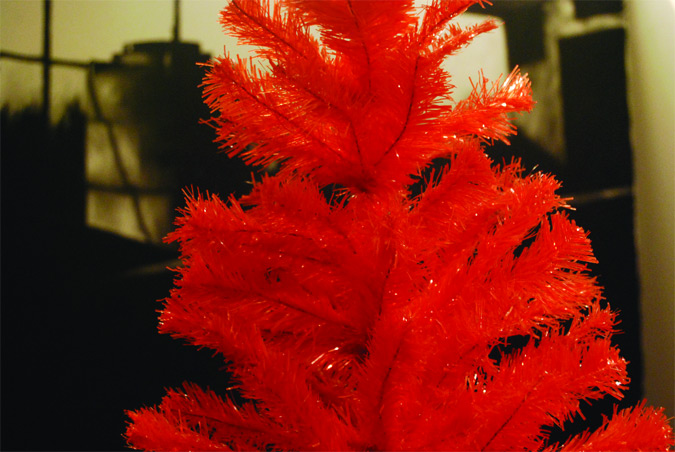
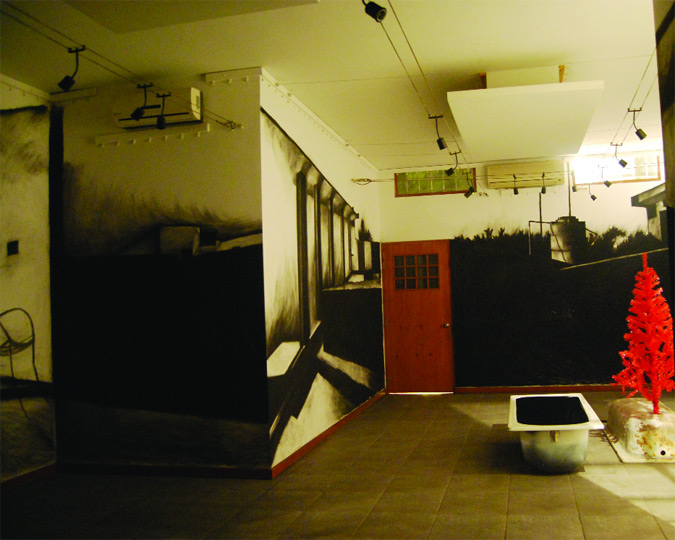
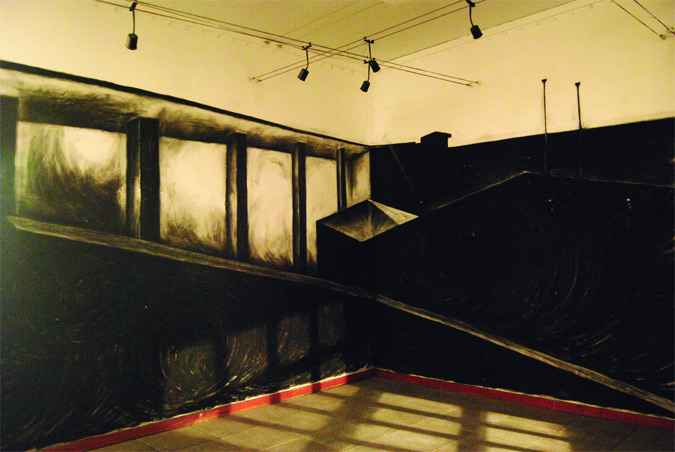
John decided to create something directly on the walls of the gallery. His work consists of three parts: two-dimensional wall paintings, an installation, and the play of light and shadow. Upon entering, the gallery is shrouded in darkness. Linear shadows merge and flicker on the walls. A dim glow outside the window illuminates the shadows cast by the trees; it is the only trace of light inside. Ambiguous spaces, seemingly ruinous and barren, are rendered on the walls in strong strokes of black pastel. There is a single Christmas tree bathed in red. Next to it, a bathtub oozes black tar.
John has developed his own system of cartography: successive photography, counting his steps as well as counting landmarks, like trees and bridges
Painting directly on the walls is one of the most powerful things about John’s work. Once the show comes down, the walls will be painted over. In the moment of viewing, however, the observer can’t help but be immersed in the piece. People who came to the gallery in a cheery mood left melancholic and perhaps even a little depressed: John holds a stark mirror to the society we live in. It made me think that there is no such thing as “apolitical art†in Pakistan. In a country ravaged by violence, the political seeps into every aspect of the personal. John’s Christmas tree is not brimming with shiny baubles; it is blood-soaked.
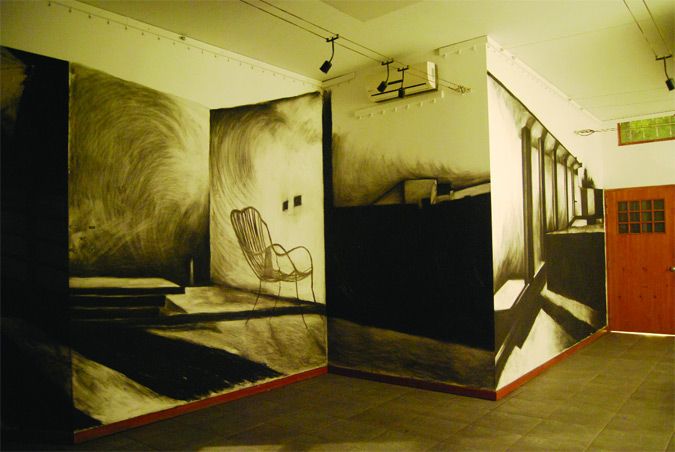

About the show, Tareen said, “I wanted to create an experience for viewers unlike most commercial art exhibitions where you have sculptures on pedestals and paintings on the walls. P.S. {ART} has been able to break free of the shackles of run-of-the-mill gallery shows where art work waits obediently to be purchased by trend-chasing enthusiasts.â€
John told me he was inspired by the Situationist movement of the ‘70’s, in which a group of artists and architects believed that the city should be a constant source of wonderment for its inhabitants. Their process involved moving through the city, documenting it and making alternate maps that they referred to as psycho-geographical maps. Similarly, John has developed his own system of cartography: successive photography, counting his steps as well as counting landmarks, like trees and bridges. John shared an example to illustrate his process: “There is a piece I have done titled 3000 steps of solitude: I walked along an open sewer and photographed the houses situated on the other side of the sewer. I would take a photograph every 30 steps and in total, ended up taking about 3000 steps. Conclusively, I drew all the steps using a solder rod on thermal paper and joined the photographs together.â€
The Christmas tree is not brimming with shiny baubles; it is blood-soaked
Before the show went up, Tareen was away in London while John was at the gallery for a span of two weeks; the space was his and he could do as he pleased. Tareen returned to find everything covered in black pastel. “For him, it was a very creative, immersive process. There is tremendous immensity in his strokes.â€
Creative it certainly is, but I left the gallery feeling both awe-struck and sad. John’s art is an unmistakable response to the violence of the State.


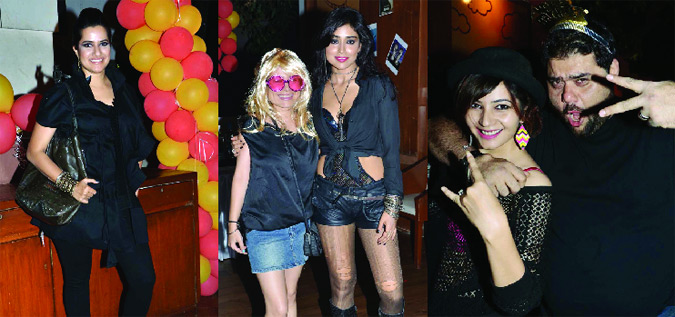
Living in Lahore taught me how much fun ‘fancy dress’ parties can be. Lahoris need any excuse to don something extravagant and step out for a special occasion. So, the Lahori in me simply couldn’t resist bringing some of that outlandishness to laid-back Bombay. I decided to organize a surprise birthday party for my husband, Riyaaz.
The theme ‘Rockstars and Groupies’ struck a chord with me, not least because I had plenty of appropriate clothing options in my wardrobe to choose from — bright neon wigs, black fishnet gloves, red feather boas and corsets, among other items. I even managed to put together a crazy outfit for Riyaaz, by digging out one of his old biker jackets, workout gloves and a getting him a fake red mohawk wig from the party shop!

I have to admit I was a little unsure of whether our guests would make the effort to dress up. Bombay is notoriously laid back in this regard, and I remembered how some people had turned up to my wedding reception in Hawaiian shirts and Bermuda shorts. So, I really didn’t know what to expect. But when everyone turned up looking like they just walked out of a drag club in New York over Pride weekend, I was very impressed. Bombay has a wonderful spirit and it’s liberating to live in a place where people don’t take themselves too seriously. They do, however, take their partying very seriously: We ended up bringing most of the party home with us and staying up till the wee hours.
The best part of the evening was how many real rockstars turned up. There was Sona Mohapatra, the singing sensation, with her husband the music producer Ram Sampath; Vishal Dadlani, the man who wrote ‘Sheila ki Jawaani’; Ankit ‘Ankytrixx’, one of India’s top dance music DJs; sultry actress Shriya Saran and TV superstar Narayani Shastri; Shiraz Bhattacharya, drummer for band Pentagram and one of the most amazing musicians I have ever known, and his ‘former Miss India’ actress wife, Shonali Nagrani; the list was endless.


Sometimes, as a female singer in Pakistan, I had felt like I was going against the grain of what society expected of me
Looking around that night, I remember thinking to myself that most people could have just turned up as themselves without violating the theme of the party — they really were rockstars. It also made me see how Bombay is full of creative people. It is such a blessing, as an artist, to be surrounded by other artists; by one’s own kind, in other words. Sometimes, as a female singer in Pakistan, I had felt like I was going against the grain of what society expected of me. While there were fans, there were also those who would discourage you. It can be exhausting to constantly swim against the stream. In India, and especially in Bombay, it’s a compliment to be considered slightly strange: an ambitious, creative person with big dreams. That’s probably why, when I first came to visit Bombay several years ago, I said to a friend, “I could live here in a heartbeat.” I had no idea that several years later it would actually happen.
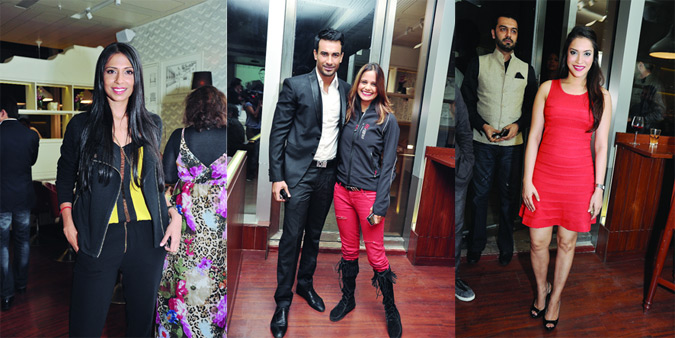

The morning after Riyaaz’s birthday party, with what seemed like a moment’s shut-eye, I dragged myself to the airport to catch a flight to Lahore. It was my friend Sameer Ahmed’s wedding. Naturally I had to be there. Sameer has broken many girls’ hearts in his time, being the mysterious, green-eyed bass player for several major bands, like Coven, Mauj, and the Mekaal Hassan Band. You can imagine my delight when I saw that he had finally met ‘the one’ in the lovely Kanwal Eshai. Seeing them together I realized that there really is someone out there for everyone; one ought to wait for the right person. The highlight of the wedding was a wild party thrown by all of Sameer’s musician buddies, with special performances by Club Caramel, Symt and EP among others.
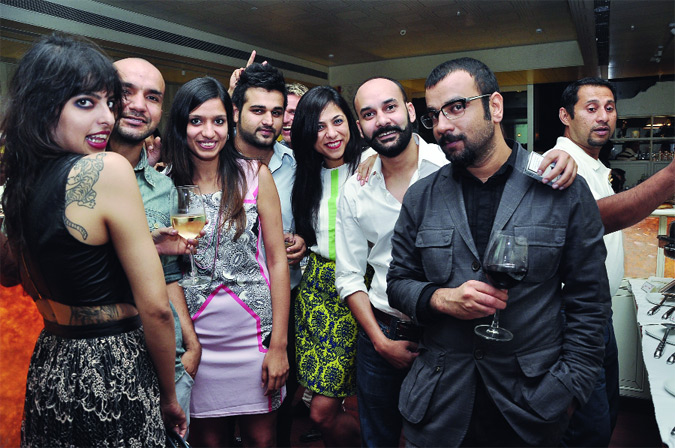
Returning to Bombay, I had just enough time to change and get into party mode again for the launch of my husband’s latest restaurant in Bombay. The Smoke House Deli, Bandra launch party was a good excuse to reconnect with everyone. But, dear reader, before we could really catch our breath, we had to pack our bags again – this time for a much-needed two-week vacation in Australia.
The journey became magical with the car-roofs down and the summer breeze blowing through our hair along the most beautiful coastline I have ever seen
Riyaaz and I had decided that this time for the New Year, we would not go to Goa (like everyone else in India), but try to explore a country we had not experienced before, hence the unusual destination of the ‘land down under.’ The fact that it was peak summer there was a big deciding factor. We managed to persuade a few of Riyaaz’s close friends to join us and before we knew it, we were a party of seven including Mikhil and Gauri Narang, Jay and Padma Galla and my husband’s bestie Rahul Aggarwal.
We flew into Brisbane and drove to Surfer’s Paradise on the Gold Coast to soak up some sparkling summer sun. The evenings were spent strolling on the sea-front promenade that stretched for miles along pristine beaches. The nights were mostly spent in very loud Irish pubs. On the weekend we managed to get a VIP table at the popular ‘Club Liv,’ which turned into an unexpectedly fun night (mostly due to Rahul’s ordering of two bottles of a certain sherbet).


Then, feeling very adventurous, we decided to hire some wheels to take a road trip down to Sydney. The boys got carried away with the hire cars and somehow we decided against the more practical SUVs we had originally planned for and ended up instead in Ferrari, Porsche and BMW convertibles! We obviously had no room in the boots of these cars for luggage, so the ingenious plan of sending our suitcases by air-freight was hatched. Boys really will be boys. Looking back, though, the journey became magical with the car-roofs down and the summer breeze blowing through our hair along the most beautiful coastline I have ever seen. We stopped at small towns along the way, like the very Bohemian Byron Bay and Coffs Harbour, and ended up in Sydney late into the night, exhausted and exhilarated from our drive.
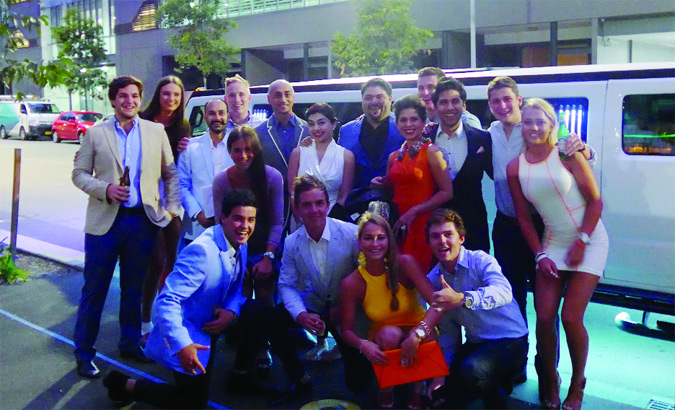
The Sydney Harbour with its landmark Opera House makes for a spectacular evening stroll with its waterfront bars. The restaurants are also top-notch; in particular, the Opera House and ‘Tetsuya,’ an award-winning Japanese restaurant which served us a beastly nine-course menu over a five-hour meal. The Sydney fireworks on New Years Eve are a spectacle, so we wanted to make sure we had a good vantage point to observe those. Rahul surprised us all by booking a stretch Hummer Limo for the night, which to me looked more like something Snoop Dogg would ride around in. It certainly got a lot of attention from the ladies (which in all honesty had probably been Rahul’s intention!)


From Sydney, we made our way to Melbourne, which by far was my favorite part of Australia. The city has tons of character with lots of edgy, interesting watering holes, like the Carlton Club and rooftop bar amusingly-titled ‘Naked for Satan’! I also got to catch up with two friends, Sherry and Afra, whom I hadn’t seen in ages. Melbourne felt like a slice of home, not to mention the fact that almost every cab driver was from Lahore!
But the best part of the whole vacation, and the biggest insight gained from it all was in returning home to Bombay. Before this journey, I would often feel deflated at the end of a vacation; coming home felt like a downer after a good holiday. This time I realized, perhaps for the first time in my life, how good it was to come home to a place you love, especially a place that you share with someone you love. Â


The peacock that eclipses all other fashion motifs, including the Angry Birds chick, can be traced to architect-cum-fashion designer, Arjumand Bano. Upon arrival at her swanky and meticulous studio in Defence, I see that the peacock is just one of many motifs that Arjumand has single-handedly developed in her signature 3D style. She is an artist who believes in creating something exquisite from her bare thoughts. This instinct coupled with serious drive makes her a formidable contender in the world of Pakistani fashion, where old powerhouses are found to be, more often than not, stoic and formulaic.
At Beaconhouse National University in Lahore, Arjumand developed a discipline in sketching that led to ideas one rarely sees in the carousel of commercial fashion designers. Of her process, she says: “The idea evolves from the first sketch to the last; the result itself is often a complete transformation from the initial scribble! Like most artists, I keep sketching and then I leave it for a while; I revisit my design and it can take up to three months to work it all out.” That she sketches with a needlepoint drafting pencil is telling of the effort that goes into her drawings. No computer-aided software for Arjumand, who believes in feeling out her work through hand drawings and extensively intricate sketches. As she says, “I love paying attention to detail.”


The two months of November and December, Arjumand can be found exclusively in her tracks and a huge chaaddar, surrounded by mugs of coffee and her sketches
With increased access to technology and the manically-updated bubble that is social media, designers in the East can keep up now more than ever before with the fashion world of the West. Arjumand argues that this is the changing face of the industry: In fits and starts, new designers are trying to outdo the old by putting in longer hours. “Everyone in the Pakistani fashion industry is trying to stay on top of their game because every year you hear there are fifty new designers coming out!” But the profusion of fashion designers has somewhat devalued the profession, says Arjumand. When people find out about her occupation, their reaction is, “Oh God, another fashion designer!”
If anything, the reaction has spurred Arjumand to stick to her guns. “Every party I’d go to, I’d put together something to wear, often stitching it myself. A good friend, Rana Nauman, asked me why I didn’t just do this for a living. For the longest time, it was a hobby: taking scraps of fabric and putting something fun together,” Arjumand recalls of her pre-Opera House fashion obsession.

Eventually, her family convinced her to go for it. Arjumand dotes on her mother and tells me how all this would not have been possible without her mom who has given her strong motivation to excel and to be happy. “I’ve always been the kind of person who never wants to be treated differently because I am a girl. My parents have always been so proud of me: I do architecture, I do clothing, and I take care of my family. Even if everything drives me crazy, I love it because I’m a workaholic and I want to have no regrets about having missed out on life, especially because I was a girl.”
‘I’m a workaholic and I want to have no regrets about having missed out on life, especially because I was a girl’
The study of Mughal architecture and jaali work, patterns, mehrabs and various other more figurative elements has brought Arjumand to the realm of old-world workmanship that merges with a contemporary vision. “I don’t just like doing a simple motif on a shirt, I like to go the extra distance and would want it in 3D.” True words from someone who is constantly seeking to do better in everything—from how the inside of her studio looks to how her labour is run. A workaholic to boot, Arjumand finds it difficult to delegate: in the process, a degree of charm and attention to detail is lost, she says. But as she expands, she is learning to slowly entrust her colleagues with authority. “Every time a client comes back to me, the little child inside me jumps with excitement!”Â

The two months of November and December, Arjumand can be found exclusively in her tracks and a huge chaaddar, surrounded by mugs of coffee and her sketches. She is churning out work for the onslaught of shaadis that begins in the winter. Often, when she ventures out herself, she finds people in her eveningwear. “It’s a great feeling to run into someone wearing my designs and hear them say how strikingly signature my pieces are.” Some of Arjumand’s signature flourishes include peacock motifs, jewellery woven into pieces, and bright embroidery reminiscent of Pakistani truck art.
“When it comes to creation, it’s constantly a learning process”, says Arjumand. With anyone coming into the fashion industry, especially those with a college education behind them, engaging with Pakistani craftspeople is a true test of patience. Putting aside the lack of proper documentation of age-old crafts, Arjumand has learnt everything by simply plunging headlong into her work, and getting her hands dirty. Now, nothing makes her happier than working alongside her kaarigars to create something old from new, and vice versa.Â