
A MEETING OF THE MINDS
By Mahlia Lone
“My childhood was spent in a commune,†Shabana Azmi, the renowned Indian actress, recounted in an interview. “My entry into this world — on September 18, 1950 in Hyderabad — was thanks to a blind dai (midwife). Soon, my family shifted to a semi-commune at Red Flag Hall in Bombay. My father Kaifi Azmi, a Communist Party of India (CPI) member, shared a flat with comrades such as Ali Sardar Jafri and Sawantji. We had a room each and a bal-cony converted into a kitchen. For eight years, I grew up amid CPI meetings. It was an unusual childhood: Each couple, includ-ing my parents, would take turns to look after all the children of the families who lived together. We celebrated all major festi-vals together — be it Holi, Diwali, Eid, Xmas. My education was varied. Due to our meagre income, I went to an Urdu-medium school, and then a municipal school. When I got zero in all subjects, Abba sent me to Queen Mary’s, where the fees were a princely Rs. 30. As English-speak-ing parents were a pre-requisite for admission, Sardar Jaffrey’s wife Sultana became my mother Shaukat; Munish Narayan Saxena pretended to be Kaifi Azmi!


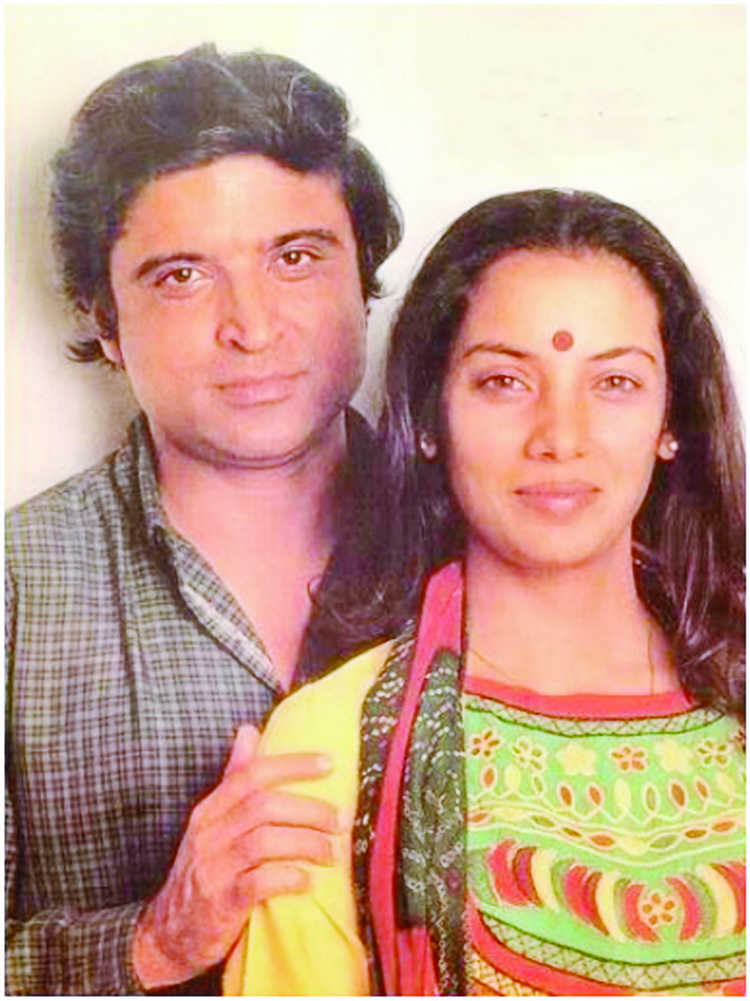


My parents worked hard to give us a better life: Abba gave all his earnings to his party and was left with Rs. 40 each month. This was when my mother started working —first as an announcer on AIR and then with the Indian People’s Theatre Association (IPTA). Later, she joined Prithvi Theatres. Life improved after my father wrote the film Buzdil, for which he was paid Rs. 500. My father was different other fathers who left for the office in the mornings. My kurta-pyjama-clad Abba, instead of going to office, would write all day.â€
Sayyid Akhtar Hussein Rizvi, known as Kaifi Azmi, was the son of a zamindar from Uttar Pradesh (United Provinces in British India) who gained renown at a young age for his Urdu poetry, especially as a ghazal (lyrical poem) writer. He joined first the Quit India Movement, then the Communist Party of India and lastly the Progressive Writers’ Movement. He married Shaukat in Hyderabad where Munni (later named Shabana by a family friend) was born. The young family moved to Bombay where their son Baba was born. There Kaifi met filmmakers and started to work in the film industry as a script and dialogue writer and lyricist. Kaifi revamped Hindi film dialogues and songs by bringing Urdu literature to films. He changed the tenor and vocabulary of the filmi song. Kaifi Azmi’s greatest feat as a writer is considered to be Chetan Anand’s Heer Raanjha (1970) for which he penned the entire dialogue of the film in verse.
Shaukat Azmi in her Urdu lan-guage book Kaifi Aur Main, which has been translated into English by Nasreen Rehman under the title Kaifi and I, writes about Shabana’s personality growing up: “It was her hypersensitivity that made her (Shabana) acutely aware of our financial constraints, and she never made the usual demands that most children make of their parents. White plimsoles were a part of her uniform and Shabana went through a pair in three or four months. One day, I grumbled, ‘Such large feet like Clodhoppers! How can I afford a new pair, every three months?’ A few days later I noticed that her shoe was ripped near the small toe, but instead of asking for a new pair Shabana had cut out a piece of cardboard and glued it on the hole. My heart went out to her and I scraped togeth-er some money and bought her a new pair.


I used to give Shabana thirty paisa a day for her bus fare from Juhu to Santa Cruz station. If she wanted a snack she saved five paisas by getting off the bus four stops earlier at Juhu Chowpatty and trudging home, but she never demanded extra money. Once again, it was from Parna that I learnt about this many years later.
Shabana was always looking for ways to earn some extra money for the house. After she had passed her Senior Cambridge in the first division, Shabana had three months before going to col-lege. She found herself a job selling Bru Coffee at petrol stations, earning thirty rupees a day. She did not tell me, and I am afraid that I was so busy rehearsing that I did not notice her absence. At the end of the month she handed me all the money she had earned. Surprised, I asked, ‘Betey, where did you get this money from?’ She made light of it and said, ‘I had three months to wait before going to college. I thought, why not put the time to some use.’
I was very proud of Shabana but I was also distraught that at this young age she felt she had to share her family’s financial responsibilities.â€
Despite the family’s finan-cial constraints, Shabana grew up in awe of her father who gave his children a unique Bohemian upbringing that contributed to their creative careers (Baba became a cine-matographer). Shabana com-pleted a graduate degree in Psychology from St. Xavier’s College, Mumbai, and went to watch a film in the cinema that changed her life.
“I had the privilege of watch-ing Jaya Bahaduri in a (diploma) film, Suman, and I was completely enchanted by her performance because it was unlike the other perform-ances I had seen. I really mar-velled at that and said, ‘My God, if by going to the Film Institute I can achieve that, that’s what I want to do.’†said Shabana looking back

Since she had always enjoyed acting in school and college, she decided to pick it up as a vocation and joined the Film and Television Institute of India (FTII), Pune. Incidentally this was where actor Farooq Shaikh, of Umrao Jaan fame (that also starred Shaukat Azmi as the head courtesan), was two years her senior. Naturally gifted, Shabana topped the list of successful candidates of successful candidates of 1972.
Her professor at FTII was the iconic film actor/director Guru Dutt’s award winning documentarist grandson Shyam Benegal. For his directorial feature film debut Ankur (The Seedling, released in 1974), he cast Shabana in the lead. The film is based on a true story of eco-nomic and sexual exploitation in his home state, Telangana. In it, Shabana plays Lakshmi, a married village servant who drifts into an affair with a col-lege student who visits the countryside. Benegal shot to fame with this film that started the realistic New India Cinema or parallel cinema. For her portrayal, Shabana won the National Film Award for Best Actress, quite a feat for a newcomer.


That year she also starred in Dev Anand’s mainstream movie Ishq Ishq Ishq. Dev’s nephew, Shekhar Kapur, who had recently given up a desk job as a chartered accountant in London to pur-sue his Bollywood dream, had a support-ing role in the film. The actor, and later director, was smitten. Shabana promptly dumped her boyfriend actor Benjamin Gillani and began a seven year relation-ship with Shekhar. They eventually got engaged and moved in together to make a go of it. Though it didn’t work out; they split up so amicably that later Shabana starred in Shekhar’s directorial debut Masoom (1982), based on Erich Segal’s novel Man, Woman and Child, which catapulted him to fame as a director.
Shekhar went on to direct such commer-cial and critical successes as Mr. India and Bandit Queen. Internationally, he was chosen to direct Cate Blanchett in the vastly successful Elizabeth and Elizabeth: The Golden Age but after the box office dud Four Feathers, Western filmmakers are no longer as interested in hiring him.
In the meantime, the very married writer Javed Akhtar who lost his own poet father in 1976 had started visiting the Kaifi household. Javed had just added poetry to his roster of literary accom-plishments, having written his first Urdu couplet as homage to his father and sought counsel on matters pertaining to Urdu literature from Kaifi Azmi.
Javed was born in 1945 in Gwalior to Jan Nisar and Safia Akhtar. Jan Nisar, an Urdu poet of ghazals and nazms (rhymed and prose style poems), a Bollywood lyricist and a part of the Progressive Writers’ Movement, belonged to a renowned family of Sunni theologians, scholars and poets. His father Muztar Khairabadi and paternal uncle Bismil Khairabadi were both poets, while his great-grandfather, Fazl-e-Haq Khairabadi was not just a scholar of Islamic studies and theology, but also edited the first diwan of Mirza Ghalib upon his request. He was also a leader of the Indian Revolution of 1857 in his hometown of Khairabad.
Javed grew up in Lucknow and attended Saifiya College in Bhopal. Then, film star Rajesh Khanna changed his life. Up till now, different writers were used to pen a film’s story, screenplay and dialogue and none of them were given any credits in the title. Rajesh Khanna gave Javed and his writing partner Salim Khan (Salman Khan’s father) their first break as screen-play writers by hiring them for Haathi Mere Saathi and sweetening the pot by mentioning them in the film’s credits. Javed said in an interview, “One day, Rajesh Khanna went to Salim sahib and said that Mr. Devar had given him a huge signing amount with which he could complete the payment for his bunga-low Aashirwad. But the film was a remake and the script of the original was far from being satis-factory. He told us that if we could set right the script, he would make sure we got both money and credit.â€
Of the 25 films Salim-javed wrote, Â 21 were huge hits. Eventually, they split in 1982 reportedly due to ego issues. They are known as “the most successful (Bollywood) scriptwriters of all-time”
The eminently suc-cessful duo Salim-Javed became con-tracted by G. P. Sippy as resident screen-writers for Sippy Films and were responsible for such blockbusters as Andaz, Seeta Aur Geeta, Zanjeer, Deewaar, Sholay, Don and Mr. India, directed by Shabana’s ex Shekhar Kapur.
Together the Akhtar-Azmis are a redoubtable film family
On the sets of Hema Malini starrer Seeta Aur Geeta, Javed met the former child star and then 17 years old Honey Irani who had a supporting role in the film. Honey belonged to an Irani, Zoroastrian family and her older two sisters were also in the industry. Honey’s eldest sis-ter Maneka is married to the stunt film-maker Kamran Khan and is the mother of film-makers Sajid Khan and Farah Khan, the latter is ofcourse one of the better known choreogr-pahers in the indus- try. Honey’s mid-dle sister Daisy, who was a suc-cessful actress, is married to screen-writer K.K. Shukla.

Honey developed a teenage crush on the 26 year old writer and the two bonded on a similar sense of humour. “I liked his sense of humour, he liked mine,†Honey told Farhana Farook, “Love is blind. I was totally in awe of Javed….He was los-ing in a game of cards on the sets. I said, ‘Let me pull a card for you’. He said, ‘If it’s a good one, I’ll marry you’. The card was good. He declared, ‘Chalo, chalo let’s get married….Salim sahib, a family friend, told my mom that this boy wants to marry her but he has no home, plays cards and drinks. My mom said, ‘Let her get married, she’ll learn a lesson and come back.’†Javed later immortalized their proposal in the Sholay scene when Amitabh Bachchan takes Dharmendra’s proposal to Hema Malini’s aunt Leela Mishra.
They got married in 1972. “We didn’t have a place. My elder sister Maneka, who was married to filmmaker Kamran Khan (filmmakers Farah and Sajid Khan’s father), had an extra room in Juhu. It was used to store shooting props.
She cleared it for us. We stayed there for a year,†Honey said. “Javed made me promise; I wouldn’t accompany him to parties, apply make-up or hire a maid. So, I’d get up at 4 am to fill water. Of course, when I got pregnant, we had a maid. I had two air-conditioners in my parents’ home. Javed felt bad for me as we didn’t have one. He got a second-hand air condition-er. We were thrilled and called our neigh-bours. And just when they had gathered, the AC conked off. I was so upset. We’d then sprinkle water on the floor, spread a chaddar and sleep.â€

Two children were born in quick suc-cession, Zoya and Farhan. Affluence fol-lowed Javed’s career success. Honey’s film connections and Javed’s talent made the couple popular socially and soon they were spending convivial evenings with top stars like Amitabh Bachchan. Honey reminisces, “I guess I was lucky for him. After Zanjeer, we never looked back. We bought a flat in Bandstand and then this bungalow. Mashallah! We had a party every night. Amitji and Jaya (Bachchan), Yashji and Pam (Chopra), Yashji and Hiroo (Johar) would often be here. Those days Amitji used to drink. We’d have a blast the whole night and then go and drop him for his shoot at 5 am. The initial years were wonderful. I don’t really blame Javed for what hap-pened later. He was young when he got such huge success. It’s not easy to handle that. He used to drink a lot too. That was one of the major problems.â€
Simultaneously, another relationship was brewing. Shabana recounts how “Javed had been coming to our home for a long time, like other poets he would come to read his poems to my father, seek his opinion. But I was very busy with my work, and never really engaged with him. I would try to avoid him since Javed was a married man with two children.†Finally, he took the first step at a Page 3 event, and struck up a conversation with Shabana about her film Sparsh and it was the first of many engaging literary, philo-sophical and political conversations between the two.
Javed said at this time Shabana was plagued by “thousands of questions about which she’d never thought earlier. It’s no surprise then that we were drawn closer to each other.â€
Shabana added, “I sat in on conversa-tions my father had with him on poetry, on politics, and I realised he was very different from his image. Look at the similarities in our backgrounds. In dis-covering Javed I rediscovered my father. Both are from UP, both poets, film lyri-cists, writers. Both love politics… In fact if you consider the fact that one seeks the perfect match of backgrounds for an arranged marriage, then this could well have been the perfect arranged marriage. He was already married by the time I realised how well suited we were. We stayed away from each other for as long as was possible. My mother was against it completely.â€

Shabana said she liked Javed’s wit, humour and his tehzeeb (manners). “He would never put up his feet before elders.â€
1976 onward rumours of his closeness with Shabana fuelled frequent feuds between the married couple. “We separat-ed in 1978 as things had turned bad,†said Honey without any bitterness. Javed and Shabana had become increasingly open about their relationship in the couple of years preceding the separation. “There were fights and ugly scenes. But we ensured the children (Farhan and Zoya) weren’t around. I realised there was no point in living with a man who was no longer in love with me. So I told him, ‘Please.’ Javed said he couldn’t speak to the children. So I spoke to them and said, ‘Your father is not leaving me because of you guys. It’s just that we don’t get along.’â€
“Nobody can understand the anguish, the heartbreak,†said Shabana. “There were children involved. For 2 to 3 years, we suffered the trauma. And then one day, we decided to break up. It was too trau-matic for the children if we went on. We told each other, ‘We will break up after one last meeting.’ We met for that last meeting and we talked and talked … not love talk alone, but about everything, pol-itics, poetry. We got so busy talking, we forgot to break up.
After the separation, though Javed was providing child support, it didn’t cover all the children’s expenses. “I started embroidering saris. Reena Roy, Mumtaz and others would buy them,†said enterprising Honey. “I had written some short stories but feared they’d be dismissed as Javed’s.†She showed one to Pam Chopra who showed it to her husband Yash Chopra, the uber successful filmmaker. Yash chose it for a film. “Later, Yashji asked me to develop a ‘five minute’ idea which he gave me. Soon, I wrote the script and read it out to him. But he just got up and left. An hour later, he returned after having completed his pooja. He hugged me saying, ‘I was so moved. It’s fantastic.†The film was Lamhe (1992), which became a big hit. Honey also wrote Darr (1993) for Yash Raj Films, followed by Kaho Naa Pyaar Hai, Kya Kehna and Koi Mil Gaya. She fell out with the Chopras when she complained that she wasn’t given due cred-it for writing Dilwale Dulhania Le Jaayenge.
When I told my father, I asked him, ‘Is he wrong for me?’
And he said, “He is not wrong, but the circumstances are wrong.’
When I asked him, ‘What if I change the circumstances?’
He said, ‘Then it should be okay.’
Shabana and Javed’s affair continued for the next six years and Shabana inspired him to write romantic couplets.
The song Dekha ek khwaab from Silsila picturised on Amitabh-Rekha was written in 1981 at the height of their affair. They eventually tied the knot in a traditional Muslim ceremony in 1984, while his divorce from Honey was finalized the fol-lowing year.
The public was outraged because peo-ple felt that Shabana who proudly posed as a feminist was being a hypocrite by first having an adulterous affair and then getting married to an already mar-ried man. Shabana defended her decision explaining that she was no home-wrecker and that the mar-riage was already over by the time she entered the scene. Though not entirely true, that was her justifica-tion.
Honey said she maintained cor-dial relations with her ex and still respected him. “He has been decent and generous. He gave me this house. Javed says, ‘One good thing about you is that you don’t cling to negative thoughts’. Once someone says ‘sorry’, my slate is clean.â€

 “Girls run after him. He is a poet, he must be so romantic, they think. But believe me, there is not a single romantic bone in his body. I once asked him about it and he joked: ‘Look, the trapeze artist does not hang from a trapeze at home.â€
“I didn’t make any sacrifices — that’s too dramatic. I did what I thought was right,†she said describing her life as a struggling single mother. “I did miss a man. I was in a long relationship, which didn’t work. But I never gave marriage a thought. I didn’t know how he’d be with the kids. Though they did tell me, ‘If you wish to get married, go ahead’. Today I have my grandchildren (Shakya 12, and Akira 5), my friends and my work. Of course, you do feel lonely. But I can’t go through the pain again. At this age what you need is a companion, someone to share, to travel with…There again I’m being a romantic.â€


She was generous enough to allow Shabana to enjoy a warm relationship with Farhan and Zoya. “I never spoke a word against Shabana or Javed. I didn’t want the children to develop feelings of hate or anger. They’d go over and meet them. Javed would come over. Touchwood! Their relationship never went wrong. But I have no rapport as such with her. I go to Javed’s house on his birthday. Shabana and I greet each other. It’s cordial. There’s a lot of respect. That’s it. But it’s not as if we are sahelis (friends). Not at all.â€
Shabana described her conjugal bliss in an interview, “After marriage it was like we were two peas in a pod. So much was similar about us. There was not much adjustment needed on my part. There was so much he had gone through in a broken marriage that he had come out of it wiser, more mature. I married a sensible man, growing wiser with years. We have each shaped and moulded the other since we married, but the most important fact is that we are also very good friends. And he jokes in his typical manner. He loves to say ‘Shabana is such a good friend; even marriage could not spoil our friendship.’
I have no interest in action films, or in sports. He loves all sports: tennis, cricket, soccer. He took me to watch the finals at Wimbledon. I watched the match and swore never to go again. He also likes to joke: If there’s a sad serious film on TV, or a boring programme, he will say, ‘Shabana ko bulao, it’s her type of pro-gramme.’â€
While doting on her husband Shabana continued, “the wonderful thing about Javed is that whether I am with him in a slum or with the Queen of England, he is so completely at home. He will win them all over. He is constantly stealing my friends away from me! But to give him his due, in academic circles he is known at Princeton, Harvard, Columbia, and he has delivered lectures there. He com-mands a lot of respect. He is competitive but never jealous; he is ambitious but never insecure.
For medical reasons, I could not have a child. It hurt a lot, and I was heartbroken for a while. Then I told myself, ‘One can’t have everything in life.’ Also Zoya and Farhan were very young then, and their mother was generous in letting us have access to them. So I had children around. And I got the man! I cannot imagine being married to anyone else.
We have deep trust and faith in one another. He will never open my bag, or read my mail. (I would do all that though.) The friendship keeps us close. He is deeply emotional and sen-sitive. Of course we have fights and bit-terness; we are so busy in our own worlds that it is great to be together when we do meet! That is what marriage should be about – the undying and unconditional friendship between two individu-als who invest trust and time in each other for a lifetime.â€
Javed said something similar
to Priya Gupta in an interview for The Times of India, “Shabana is basically my friend. We happen to be married. Our friendship is so strong that even marriage could not break it. We got mar-ried as people thought that you have to be married. What is impor-tant is there are so many things that we share, like our basic values and our aesthetics. And there are many matters on which we differ from each other. But if we are totally sim-ilar, then you should not live with a person who is exactly like you. And if you are totally different, then too, you can’t function together. So I think there is a right kind of balance between similarity and dissimilarity between us. She is a very strong woman with a strong sense of fairness and desire for justice all around. We have come from the same training school. Her parents were poets, leftists, involved in progress of writers’ movements. We both, in our own way, have learnt to hold progressive, liberal, religious and as a matter of fact almost anti- religious values. But she is dangerously frank. That makes me uncomfortable. I generally don’t do that. Much like all cultural civilisations, I am diplomatic.â€
“The camaraderie between Shabana Azmi and Javed Akhtar is hard to miss; they are so at ease with each other. ‘We have a really happy marriage because we rarely meet,’ quips Shabana.
Javed believes that two people can be happy together only when they are happy as individuals. “And no matter how close you are to each other, every-one has a private space that needs to be respected. When you expect more than the other person is willing to give, the relationship sours,†he says.
Shabana recounted an incident where a woman walked in on her ironing Javed’s kurta. ‘She asked me how I could call myself a feminist. I was doing it because I wanted him to wear a well-ironed kurta. It was that simple,’ she says. Javed adds, ‘Thankfully no one came into the room the day I was press-ing your feet because you were tired. They wouldn’t have believed it if I told them that it was not an everyday occurrence!’
And when it comes to age, Shabana is more accepting of it. ‘Embrace your age. Don’t fight to be younger,’ she says, even as Javed adds, ‘Given a chance, I’d live forever. Not because I love myself — although that is true too — but because the thought that I won’t be around to see new movies, listen to new songs and learn about new discoveries about the human body and the uni-verse is depressing. And there are so many poems, scripts and more waiting to be written.’†—Susanna Myrtle Lazarus, The Hindu “Girls run after him. He is a poet, he must be so romantic, they think. But believe me, there is not a single romantic bone in his body. I once asked him about it and he joked: ‘Look, the trapeze artist does not hang from a trapeze at home.â€
The Sunday Tribune article described their relationship thus: “Here’s a marriage where the couple discuss various ‘isms’ (socialism, Marxism or secularism) over a cup of adrak (ginger) tea which Javed cannot make and Shabana loves. It’s another matter altogether that their rare disagreements lead to heated debates. Shabana Azmi and Javed Akhtar’s is a marriage of intellect, and like true believ-ers in democracy, they agree to disagree.
While possessiveness for the man and jealousy in the woman are considered inevitable and even prescribed in a romantic relationship, here’s a couple who thinks differently. Says Javed in an interview, ‘We seek love from one source, wisdom from another and companionship from yet another. Seldom does it all come from one single source. She gives me all this plus mental and intellectual support.’
And when constant companionship like Siamese twins is considered a hall-mark of intimacy, Shabana has her own prescription for a successful relationship. ‘Bumping into each other, occasionally, at airports,’ she says, ‘is very good for mar-riage!’
The world knows her as the inspiration behind Javed’s most romantic song, Ek ladki ko dekha toh aaisa laga. She was the narmi ki baat (gentle whispers), sardi ki dhup (the winter sun), resham ki dor (a strand of silk) and sandhal ki aag (a sandalwood fire).
She, in turn, simply calls him Jadu—in her peculiar style with sparkling eyes disap-pearing into the crinkles. She is not the only muse in this relationship. ‘What I really value is when I have to write a paper and am stuck; I know I can depend on him to help me.’ For Shabana, Jadu is the touchstone for testing ideas and thoughts. It’s Javed who encouraged her to do the con-troversial role in Fire (in which she plays a lonely lesbian). He is the one who coerced her into Submitting Arth for National Film Awards (1982) and Fire for the Best Actress Award both times.â€
Though Javed was born a Muslim, he is a self proclaimed atheist and raised his children with the same beliefs. In fact, Javed gets upset when people refer to him as being Muslim. he replies that only his name is muslimÂ

After his second marriage, Javed had a solo writing career in which he wrote the scripts for a dozen movies and more than 100 songs. He has won a total of 11 National Film Awards for his song lyrics and 13 Filmfare Awards; he was also awarded the civilian honours Padma Shri in 1999 and the Padma Bhushan in 2007 by the Government of India, as well as the 2013 Sahitya Akademi Award in Urdu, India’s second highest literary honour, for his poetry anthol- ogy Lava. He also served for a term in the Parliament’s upper house Rajya Sabha starting 2009.
Javed’s son Farhan Akhtar is an actor/filmmaker and Zoya is a screenwriter/direc-tor. They have collaborated on films such as Dil Chahta Hai, Rock On and Zindagi Na Milegi Dobara that have the recurring theme of friendship. Farhan said this was because he leaned on his friends’ support during the painful times his parents split up. “I have always found this relationship of friends very beauti-ful. It made a lot of sense to me when Zoya told me that dur-ing our growing up years, friends played a very important part for us. Given the fact that my parents were going through a divorce, friends became a huge part of our support sys-tem and eased a whole lot of pain for us.â€

Recognised as one of the finest Indian actresses and having appeared in more than 120 Hindi and Bengali films, Shabana in her turn has won the National Film Award for Best Actress five times and also bagged four Filmfare Awards, as well as several international awards like the Silver Hugo Award for Best Actress at the 32nd Chicago Film Festival and Jury Award for Best Actress at Outfest, Los Angeles. Some of her notable films include Shyam Benegal’s Nishant (1975), Junoon (1978), Susman (1986), and Antarnaad (1992); Satyajit Ray’s Shatranj Ke Khiladi; Mrinal Sen’s Khandhar, Genesis, Ek Din Achanak; Saeed Mirza’s Albert Pinto Ko Gussa Kyon Aata Hai; Sai Paranjpye’s Sparsh and Disha; Gautam Ghose’s Paar; Aparna Sen’s Picnic and Sati; Mahesh Bhatt’s Arth; Vinay Shukla’s Godmother. She has starred in Western productions such as John Schlesinger’s Madame Sousatzka (1988) and Roland Joffe’s City of Joy (1992), Klotz’s Bengali Night, Immaculate Conception, the comedy Son of the Pink Panther, and Ismail Merchant’s In Custody. She is also a skilled theatre actress having performed in many plays, such as M. S. Sathyu’s Safed Kundali (1980), based on The Caucasian Chalk Circle; Feroz Abbas Khan’s Tumhari Amrita with actor Farooq Sheikh, which had a vastly suc-cessful five year run; the Singapore Repertory Theatre Company production Ingmar Bergman’s adaptation of Henrik Ibsen’s A Doll’s House; and in 2014 toured UK, Dubai and India with British production Happy Birthday Sunita. Having worked in films, theatre and televi-sion, she pointed out the differences in these media, remarking that the-atre is really the actor’s medium; the stage is the actor’s space; cine-ma is the director’s medium; and television is a writer’s medium.
Finally about her marriage she has this to say, “after 32 years of marriage, you get so intertwined with each other,†said Shabana speaking of Javed. “It’s the same with him. In fact, Javed has even written a poem, titled Shabana, which talks precisely about this. The time we spend together, watch-ing movies, listening to music—those are far more precious to me than any solitaires.â€

Â