
Tag

Mohsin Naveed Ranjha

Browsing

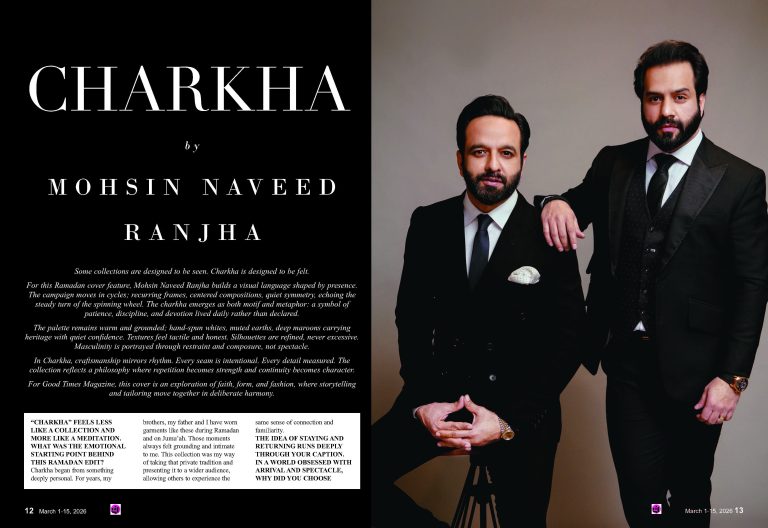
Some collections are designed to be seen. Charkha is designed to be felt.

For this Ramadan cover feature, Mohsin Naveed Ranjha builds a visual language shaped by presence. The campaign moves in cycles; recurring frames, centered compositions, quiet symmetry, echoing the steady turn of the spinning wheel. The charkha emerges as both motif and metaphor: a symbol of patience, discipline, and devotion lived daily rather than declared.

The palette remains warm and grounded; hand-spun whites, muted earths, deep maroons carrying heritage with quiet confidence. Textures feel tactile and honest. Silhouettes are refined, never excessive. Masculinity is portrayed through restraint and composure, not spectacle.

In Charkha, craftsmanship mirrors rhythm. Every seam is intentional. Every detail measured. The collection reflects a philosophy where repetition becomes strength and continuity becomes character.

For Good Times Magazine, this cover is an exploration of faith, form, and fashion, where storytelling and tailoring move together in deliberate harmony.

Rapid Fire with Mohsin Naveed Ranjha

One emotion that defines Charkha?
“ Yaad “

The quietest luxury?
Your comfort

A fabric that feels like faith?
Linen

What does masculinity mean in 2026?
Steadfastness

Staying is…?
No fun, if it’s staying in the same place

“Charkha” feels less like a collection and more like a meditation. What was the emotional starting point behind this Ramadan edit?

Charkha began from something deeply personal. For years, my brothers, my father and I have worn garments like these during Ramadan and on Jumu’ah. Those moments always felt grounding and intimate to me. This collection was my way of taking that private tradition and presenting it to a wider audience, allowing others to experience the same sense of connection and familiarity.

The idea of staying and returning runs deeply through your caption. In a world obsessed with arrival and spectacle, why did you choose stillness as your central theme?

In a world that constantly celebrates spectacle and arrival, I wanted to focus on stillness. Ramadan naturally slows you down. It encourages reflection, restraint and inner calm. Choosing stillness as the central theme felt honest to the spirit of the month and true to how we experience it ourselves.

The charkha symbolizes patience, repetition, and quiet labour. How does that metaphor translate into the craftsmanship and silhouettes of this collection?

The charkha represents patience, repetition and quiet dedication. That metaphor translates directly into our craftsmanship. The silhouettes are refined rather than excessive, and the detailing is intentional and considered. Each piece reflects time, care and discipline, much like the steady turning of a wheel. Nothing is rushed, and that quiet labour is what gives the garments their strength.

Your muse is introduced “not as spectacle, but as stillness.” How are you redefining masculinity through this portrayal?

With Nameer, the intention was to portray masculinity through restraint rather than display. He carries a quiet strength and maturity that felt aligned with the spirit of the campaign. Instead of presenting masculinity as loud or performative, we chose to show it as grounded, composed and self-assured.

Ramadan is often about introspection rather than display. How did you balance spiritual subtlety with the visual richness that MNR is known for?

For us, spiritual subtlety and visual richness are not opposites. Even beyond Ramadan, we believe in designing within our cultural framework rather than chasing extremes. The richness comes through fabric, texture and finish, while the overall aesthetic remains refined and respectful. That balance feels authentic to our brand identity.

The palette and textures in this edit feel rooted in heritage yet incredibly contemporary. How do you keep tradition alive without letting it feel nostalgic or frozen in time?

Tradition stays alive when it is worn and lived, not when it is treated as something frozen in time. The palette in this collection reflects colours I have personally gravitated toward for years, so it feels natural rather than nostalgic. The fabrics carry depth and luxury, but the tailoring keeps everything current and relevant for today’s Ramadan and Eid celebrations.

This campaign feels cinematic — almost poetic in tone. Do you see storytelling becoming as important as garment construction in modern fashion?

Storytelling has become just as important as garment construction. A strong narrative gives emotional context to the clothing and strengthens brand identity. It requires the same energy and intention as designing the collection itself. Over the years, shoots at locations like Sheeran Wala Bagh, Capri Cinema, Radio Pakistan and Rooti Booti have helped us build a cinematic language that complements our craftsmanship.

You speak about devotion that “does not seek to be seen, only to be true.” In your own journey as a designer, what has “staying” meant for you?

For me, staying has always meant consistency. Talent alone is never enough. What truly shapes a journey is the discipline to show up every day, even when there is no immediate reward. In an era that seeks overnight success, I believe steady commitment creates lasting impact. I myself am an example of that.

In Charkha, love is shown as consistency rather than intensity. Is this also how you approach creative evolution — slow, steady, intentional?

Yes, I approach creative evolution in the same way. Growth should be intentional and steady rather than reactive. Trends may change quickly, but identity is built over time. Consistency allows a brand to evolve without losing its essence. Even the brands friendship with Nameer evolved over the many years we have known him and that is due to consistency on both sides.

If Charkha were not a collection but a prayer, what would it be asking for?

Love and hapiness always?

If Charkha were a prayer, it would ask for sincerity, patience and lasting love. It would seek the strength to remain grounded and true, both in craft and in spirit.

Charkha

Ramadan Edit by mohsin naveed ranjha

Charkha is a counterfactual — an intentional reimagining of Mahi Ve Tere Vehar Nu. In the song, the girl waits beside the charkha, suspended in longing. This campaign begins where the waiting ends. Here, the boy is already there — not as spectacle or promise, but as steady presence.

The charkha shifts from a symbol of yearning to a witness of consistency. Love is not about anticipation; it is about return. About showing up beside the same person, in the same place, choosing them again and again without applause.

This is a meditation on devotion that is lived, not declared. On partnerships built through everyday rituals. Charkha honors the quiet, radical act of staying — where love is made thread by thread.

The design language reflects the philosophy of presence. Repetition and rhythm shape the visual system — recurring frames, centered compositions, and cyclical movement echo the act of returning. The charkha becomes both motif and metaphor.

The palette is warm and grounded: hand-spun whites, muted earths, deep maroons. Textures feel tactile and honest — raw cotton, matte surfaces, unpolished finishes. Nothing glossy or performative, only what feels lived-in and sincere.

Typography and spacing are restrained and human. Generous negative space allows stillness to breathe. The overall sensibility favors continuity over climax — embodying the campaign’s core belief: love is not in the arrival, but in the staying.
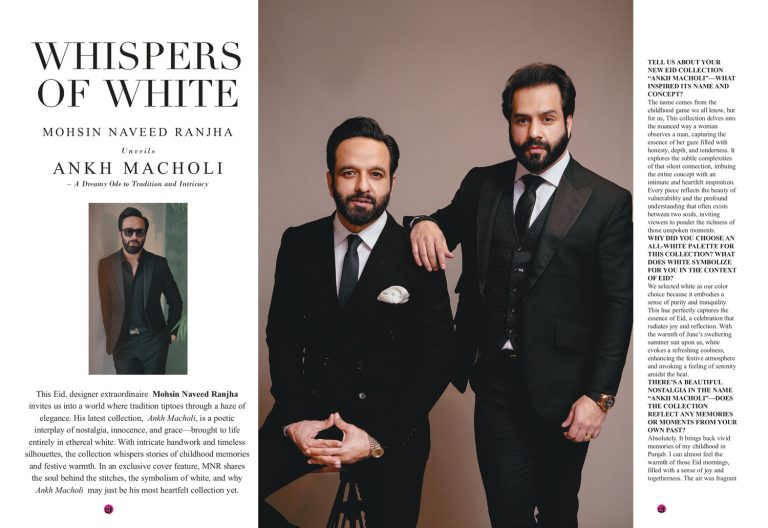
This Eid, designer extraordinaire Mohsin Naveed Ranjha invites us into a world where tradition tiptoes through a haze of elegance. His latest collection, Ankh Macholi, is a poetic interplay of nostalgia, innocence, and grace—brought to life entirely in ethereal white. With intricate handwork and timeless silhouettes, the collection whispers stories of childhood memories and festive warmth. In an exclusive cover feature, MNR shares the soul behind the stitches, the symbolism of white, and why Ankh Macholi may just be his most heartfelt collection yet.

Tell us about your new Eid collection “Ankh Macholi”—what inspired its name and concept?

The name comes from the childhood game we all know, but for us, This collection delves into the nuanced way a woman observes a man, capturing the essence of her gaze filled with honesty, depth, and tenderness. It explores the subtle complexities of that silent connection, imbuing the entire concept with an intimate and heartfelt inspiration. Every piece reflects the beauty of vulnerability and the profound understanding that often exists between two souls, inviting viewers to ponder the richness of those unspoken moments.

Why did you choose an all-white palette for this collection? What does white symbolize for you in the context of Eid?

We selected white as our color choice because it embodies a sense of purity and tranquility. This hue perfectly captures the essence of Eid, a celebration that radiates joy and reflection. With the warmth of June’s sweltering summer sun upon us, white evokes a refreshing coolness, enhancing the festive atmosphere and invoking a feeling of serenity amidst the heat.

There’s a beautiful nostalgia in the name “Ankh Macholi”—does the collection reflect any memories or moments from your own past?

Absolutely. It brings back vivid memories of my childhood in Punjab. I can almost feel the warmth of those Eid mornings, filled with a sense of joy and togetherness. The air was fragrant with spices and sweets, and everyone wore their simplest yet most beautiful clothes, adorned with vibrant colors. It’s a nostalgic reminder of that pure, innocent love we all seem to recall from somewhere deep within us, capturing the essence of simpler times and cherished moments.

How did you approach the embroidery work in this collection? Can you describe the kind of craftsmanship that went into it?

We focused on creating a design that is both delicate and intricately detailed. The piece features exquisite threadwork that weaves a tapestry of texture, complemented by charming eyelet details that add an airy elegance. Each element has been meticulously hand-finished, showcasing our commitment to craftsmanship. Every stitch and embellishment has been infused with love and care, resulting in a product that truly reflects our passion for quality and artistry.

White is often seen as a minimalist color, but your designs are known for their richness. How did you strike a balance between simplicity and opulence?

That was the challenge—making white feel distinctly MNR. We wanted to preserve the purity and elegance of the color while infusing it with the brand’s signature character. To achieve this, we worked meticulously with texture, layering, and fine embroidery, allowing the fabric to come alive with subtle complexity. Each detail was carefully considered to create dimension and depth without adding visual or physical weight. The result is a piece that feels light and effortless, yet unmistakably rich in craftsmanship and identity—true to the spirit of MNR.

Would you say “Ankh Macholi” is a departure from your usual work, or is it an evolution of your signature style?

This experience represents a pivotal moment in both my personal development and the progression of our brand. It adopts a more nuanced and reflective tone, while still being firmly anchored in the unique details and narratives that characterize MNR. We have gained a deeper level of maturity, which is also reflected in the evolution of our brand storytelling.

What kind of woman do you see wearing this collection? What mood or energy does she carry?

She’s confident, kind, and graceful. She doesn’t need to shout to be seen because there’s power in her calm.

Which piece from the collection is closest to your heart and why?

There’s a white kurta with floral vines. It’s simple but has such emotion in the embroidery. It feels like home to me.

You’ve always had a deep connection to tradition in your designs—how do you keep that alive while staying relevant and contemporary?

By being honest. I love our culture and our people, but I also see how people live today. So I blend the two. It is never forced, always natural.

How do you want people to feel when they wear “Ankh Macholi”?

Happy, and loved.

What was the creative process like behind the scenes—mood boards, materials, late-night design sessions? Give us a glimpse.

Lots of chai, lots of sketches at 2 a.m., discussions with my team and many beautiful messes in the studio.

What does Eid mean to you personally, and how does that reflect in this collection?

It’s family, prayer, food, and dressing up with love. This collection carries that spirit.

Can we expect any signature MNR silhouettes or are you introducing something fresh with this line?

Some signatures are there, yes but we’ve played a lot with  new silhouettes and fabric textures, especially in menswear. It will feel new.

You’ve dressed celebrities and royalty—any hints on who might be spotted wearing “Ankh Macholi” this Eid?

Let’s just say you’ll see some familiar faces but to be honest the real joy is seeing everyday people wear it their own way.

What’s next for Mohsin Naveed Ranjha after this collection?

Something very close to my roots, think stories from the soil and abroad but with a twist. I’m excited.

Lollywood of the golden era gave us a treasure trove of larger-than-life heroines and heroes whose influence lingers even today. From Noor Jehan’s haunting melodies to Sultan Rahi’s commanding presence, these films reflected societal dreams and ambitions. Cinemas and theaters became sanctuaries of art and culture, a place where glamour, storytelling, and community converged in the glow of the big screen. Mohsin Naveed Ranjha’s velvet collection titled “Roxy Cinema” is a love letter to this glittering legacy. Featuring the most glamorous embroideries, shimmering like starlight, and crafted in sumptuous hues worthy of the silver screen. Premiere this festive season at a celebration near you.

Muse: @thealiciakhan
Photographer: @asadbinjavedphoto
Styling: @zahrasarfraz @glamgencyy
Makeup: @fatimanasirofficial
Jewellery: @hamnaamirjewelry

How would you describe your signature design aesthetic, and how does this collection align with your overall vision?

We keep it raw, authentic, and true to what we personally love while staying aligned with our brand’s DNA.

What specific inspirations, whether historical, cultural, or artistic, influenced the design direction of this velvet collection?

A few years ago, we created a collection inspired by Lollywood’s golden era, which was a huge success. We loved it so much that we wanted to revisit it and celebrate Lollywood’s legacy and style.

Who is the ideal customer for this collection, and how did you consider their preferences and lifestyle in the design process?

Any woman who wants to look classic while embracing the roots of our heritage and culture.

Why did you choose velvet as the primary material for this collection, and what unique qualities of the fabric did you aim to highlight?

It’s a winter festive collection, and velvet is unparalleled for this season. It’s my personal favorite because of its richness, warmth, and elegance.

What specific embroidery and embellishment techniques were employed in creating these pieces, and how do they contribute to the overall luxury and elegance of the collection?

We used a mix of techniques, mainly tilla, marori, zari, nakshi, gota, and sitara work. These enhance the opulence and timeless appeal of the pieces.

How does your brand approach sustainability and ethical sourcing, and are there any specific initiatives or practices implemented in this collection?

Unfortunately, sustainability efforts in our country are minimal. Designers and brands are working independently without systemic support. This industry has great potential to generate revenue for Pakistan, but we need serious attention and action.

How do you perceive the future of the fashion industry, and what emerging trends or technologies do you anticipate will shape the landscape?

I’m concerned about the lack of infrastructure to promote our crafts locally and globally. Without support, smaller brands will struggle, and we risk losing this industry’s potential to boost Pakistan’s economy.

What are your long-term goals for your brand, and how do you envision its evolution in the coming years?

We’re going with the flow, striving to give our best. The goal is to put in 100% effort and enjoy the journey, wherever it takes us.

What advice would you offer to aspiring fashion designers who are passionate about pursuing a career in the industry?

“Mehnat ka koi alternate nahi” (There is no substitute for hard work).

What are the standout pieces in this collection, and what makes them unique and special?

The standout pieces reflect a perfect balance of heritage-inspired embroidery, luxurious textiles, and timeless silhouettes.

How do you envision this collection being styled, and what occasions or settings would be appropriate for these pieces?

These pieces are perfect for winter weddings, festive gatherings, and any event where you want to make a regal statement.

Can you provide any insights into the direction of your future collections, and whether we can expect to see more velvet pieces in the future?

We’ll continue to experiment with velvet and other luxurious materials, especially for winter collections.

What were the biggest challenges you encountered during the design and production process for this collection, and how did you overcome them?

In the past, challenges were more work-related. Now, external factors like smog, political instability, and electricity and gas shortages have made things more complicated.

Are there any upcoming collaborations or partnerships that you’re excited about, and how do they align with your brand’s vision?

Something big is coming in 2025—stay tuned!

What is the most rewarding aspect of being a fashion designer, and what drives your passion for creating beautiful garments?

I feel proud to play my role in preserving and promoting Pakistan’s craftsmanship globally. Supporting our hand embroidery artisans, dyers etc  and showcasing their unmatched skills drives my passion.

Step into a reverie of timeless elegance with the enchanting bridal collection b y Mohsin Naveed Ranjha. In the hear t of Karachi ‘s ancient colonial stone buildings, where time seems to stand still, discover a treasury of untold tales with our la test Gold Series bridal collection titled ‘Hussan Ara Mansion! Each delicate stitch in these ensembles serves as a tribute to the narratives of love , joy, and yearning whispered by these age-old walls. From the noble elites to the ordinary souls who once inhabited these halls, their stories are woven into the very essence of our heritage. Inspired by the exquisite tradition of Sola Singhar, acherished beauty grooming ritual of yore , each ensemble is a masterpiece of hand embroidery, reminiscent of the opulent craftsmanship that adorned Pakistani fashion during this golden era. Prepare to be transported to a bygone era of sophistication and splendour.

Muse: @sadafkanwal
Photographer: @rizwan.haq
Stylist: @khojiiii

HUSSAN ARA MANSION

DESIGNER’S NOTE
Born f rom my journe ys to Karachi , the Hussan Ara Collection is inspired by the weathered colonial buildings
that I encountered. Each time I came across these structures, I found myself immersed in a world of stories. These di lapidated edifices, with their faded grandeur, inspired me deeply. Through this collection, my aim is to honor not just the lavishness of past eras, but also the indomitable spirit of those who dwelled within these historic spaces. The collection is centred on the use of finest textiles and elaborate embellishments. Join us as
we journey back in time, honouring the elegance and resilience of those who came before us, and celebrating the enduring allure of tradition

MOHSIN NAVEED RANJHA (Creative Director)

ABUBAKAR NAVEED RANJHA (Managing Director)

Introducing Mohsin Naveed Ranjha’s Summer Festive collection. “A celebration of style that floats like a dream through the daylight hours. Din mein Khuwaab is a visual periphery of abundance. As the drapery of the night sky is inadequate to contain the vastness of our dreams, the stars linger, filtering through the sun’s embrace to shield the dreamers of the day.

These ethereal visions transcend the confines of darkness, spilling into the daylight and weaving an unbroken tapestry of imagination and hope. Inspired by the slow summer days, the garments are an ode to ease and lightness, eschewing heavy embellishments for airy adornments in hues of dusty pink, white, lilac, and blue, ensuring comfort during the sweltering summers of Pakistan.

Photography: @asadbinjavedphoto
Concept: @haideralishah_
Stylist: @abdullah_sidiki
MUA: @makeupbyshainal
Jewellery: @amnashariff.jewelry @ayeshaccessories
Videography: @abdulah_mehr

Step into the nostalgia of a bygone era with Mohsin Naveed Ranjha’s exquisite Eid collection, a visual ode to the golden age of train travel. Shot against the timeless backdrop of Lahore Railway Station, the collection captures the spirit of journeys taken to reunite with loved ones. Immerse yourself in meticulously embroidered menswear and womenswear, adorned with intricate block prints. Crafted from luxurious karandi, cotton, and lawn, these ensembles are a celebration of tradition and a stylish embrace of the upcoming warmer season. Mohsin Naveed Ranjha invites you to relive the charm of train voyages with this sartorial journey.

Our latest 2024 eid collection pays homage to the rich heritage of train travel and the timeless allure of Lahore Railway Station. As we delve into the nostalgia of bygone eras, we celebrate the cherished memories of journeys undertaken to reunite with loved ones during the festive season. Train travel holds a special place in my heart and I am sure of many others too. It transcends social boundaries and weaves unforgettable stories. From the bustling platforms to the rhythmic chug of locomotives, Pakistan Railways has been an intrinsic part of our collective experience, offering a unique glimpse into our lives, hopes and dreams.We invite you to embark on this journey with us, as we celebrate the spirit of tradition, nostalgia, and timeless elegance.
Photography: @paragonstudioofficial, @waqar_ahmed_butt
Boys Grooming: @paragonsalonlhr
Stylist: @abdullah_sidiki
MUA: @syedhussain_mua
Jewellery: @pierregemmebyhur, @rgb.hifsafarooq, @hafsajahanjewelry
Pin It