
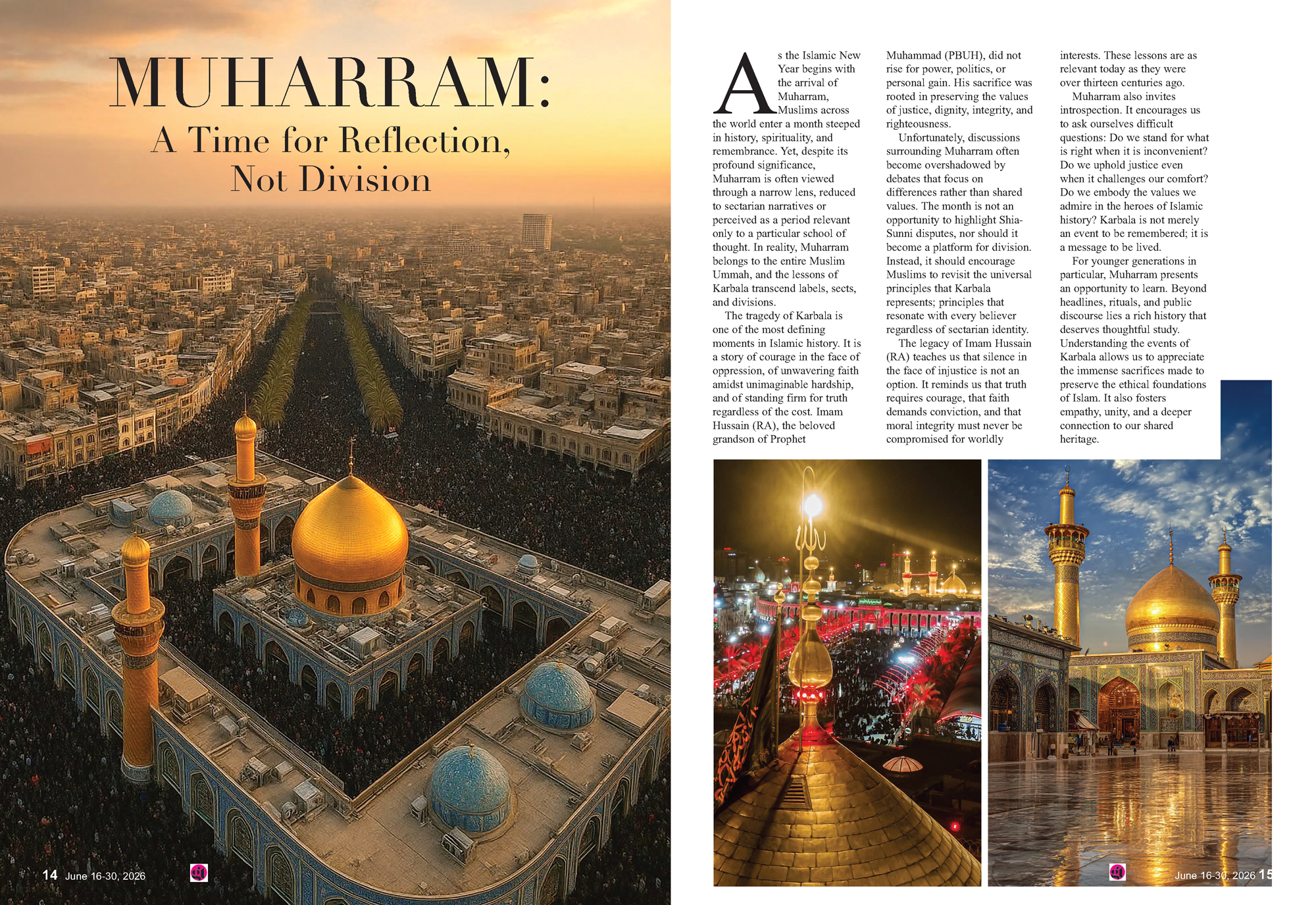
As the Islamic New Year begins with the arrival of Muharram, Muslims across the world enter a month steeped in history, spirituality, and remembrance. Yet, despite its profound significance, Muharram is often viewed through a narrow lens, reduced to sectarian narratives or perceived as a period relevant only to a particular school of thought. In reality, Muharram belongs to the entire Muslim Ummah, and the lessons of Karbala transcend labels, sects, and divisions.
The tragedy of Karbala is one of the most defining moments in Islamic history. It is a story of courage in the face of oppression, of unwavering faith amidst unimaginable hardship, and of standing firm for truth regardless of the cost. Imam Hussain (RA), the beloved grandson of Prophet Muhammad (PBUH), did not rise for power, politics, or personal gain. His sacrifice was rooted in preserving the values of justice, dignity, integrity, and righteousness.

Unfortunately, discussions surrounding Muharram often become overshadowed by debates that focus on differences rather than shared values. The month is not an opportunity to highlight Shia-Sunni disputes, nor should it become a platform for division. Instead, it should encourage Muslims to revisit the universal principles that Karbala represents; principles that resonate with every believer regardless of sectarian identity.
The legacy of Imam Hussain (RA) teaches us that silence in the face of injustice is not an option. It reminds us that truth requires courage, that faith demands conviction, and that moral integrity must never be compromised for worldly interests. These lessons are as relevant today as they were over thirteen centuries ago.

Muharram also invites introspection. It encourages us to ask ourselves difficult questions: Do we stand for what is right when it is inconvenient? Do we uphold justice even when it challenges our comfort? Do we embody the values we admire in the heroes of Islamic history? Karbala is not merely an event to be remembered; it is a message to be lived.
For younger generations in particular, Muharram presents an opportunity to learn. Beyond headlines, rituals, and public discourse lies a rich history that deserves thoughtful study. Understanding the events of Karbala allows us to appreciate the immense sacrifices made to preserve the ethical foundations of Islam. It also fosters empathy, unity, and a deeper connection to our shared heritage.


