


By Mahlia Lone
This is the story of Tahira and Mazhar Ali Khan, fellow idealists, humanists, activists and Communists who shunned a life of wealth to work for the betterment of the working class and for women’s rights
We are of course a product of our environment and our families. In order to understand the mindset of the rebellious heroine of our story Tahira, we must first delve into her antecedents.
Khan Bahadur Capt. (retd) Sardar Sir Sikandar Hyat Khan, KBE (Knight of the British Empire) was the younger son of Nawab Muhammad Hyat Khan of Wah (then a village), who had been awarded the title and lands for his unswerving service and loyalty to the British and the East India Company. Muhammad Hyat hid and tended to the mortally wounded British army office Brigadier-General John Nicholson, whose personal native orderly officer he served as, from further Sikh attacks during the War of Independence (1857). Nicholson on his deathbed recommended to Brigadier-General Sir Henry Montgomery Lawrence KCB (Knight Commander of the Bath) the Chief Commissioner of the Punjab at the time to reward and assist Muhammad Hyat in his career, which then took off.


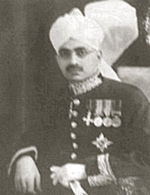
The Hyat family belonged to the Khattar tribe of Attock, North Punjab. A friend of Sir Syed Ahmed Khan, Muhammad Hyat helped him set up the Muhammadan Anglo-Oriental College at Aligarh that later became the Aligarh Muslim University. Accordingly, Sikander was educated at school in Aligarh, then at Aligarh Muslim University and briefly studied in England as well, till he was recalled home in 1915 due to World War I. During the war, he served as one of the first Indian officers to receive the King’s Commission with the Punjab Regiment. For his valour during that war as well as the Third Afghan War in 1919, he was awarded a knighthood.

In 1920, Sir Sikandar turned his financial and managerial talents to business and soon became a director of several successful companies, including the Wah Tea Estate, Amritsar-Kasur Railway Company, People’s Bank of Northern India, Sialkot-Narowal Railway, ACC Wah Portland Cement Company, Wah Stone and Lime Company, Punjab Sugar Corporation Ltd, Lahore Electricity Supply Co. etc. In this way, he added to his father’s agricultural estate with cash from lucrative businesses helped by his British contacts. In addition, Sir Sikander became an honorary magistrate, Chairman of the Attock District Board and briefly acting Deputy-Governor of the newly established Reserve Bank of India in 1935.
All this time, Sir Sikander, not one to sit on his laurels, was also simultaneously consolidating his position as a Punjabi Unionist (pro-British) politician. This was an all-Punjab political party representing the interests of the landlords of Punjab, whether Muslims, Sikhs or Hindus. Secular minded Sikandar Hyat Khan would say, “I am a Punjabi first then a Muslim.â€
Leading his party the Unionist Muslim League to victory in the 1937 elections, held under the Government of India Act 1935, Sir Sikander became the Premier of Punjab in coalition with the Sikh Akali Dal and the Indian National Congress and carried out many reforms that benefitted the Punjabi zamindar (feudal landlord).
In October 1937, Muhammad Ali Jinnah and Sir Sikander signed the Jinnah-Sikandar pact at Lucknow, merging the Muslims of his Unionist party with the All India Muslim League to pursue a united front safeguarding Muslim rights and interests. Sir Sikander was also one of the chief supporters and architects of the Lahore Resolution, March 1940, which at that time called for an autonomous or semi-independent Muslim majority region within the larger Indian confederation and only later led to the demand for an independent Pakistan. Being a part of the British establishment, not surprisingly Sir Sikander opposed the Quit India Movement of 1942. Believing that by politically co-operating with the British was the best way to gain independence of India and maintain the unity of Punjab, he supported the British during World War II. But maintaining the balance of power between the different religious communities in Punjab proved to be an onerous task and life draining for him.

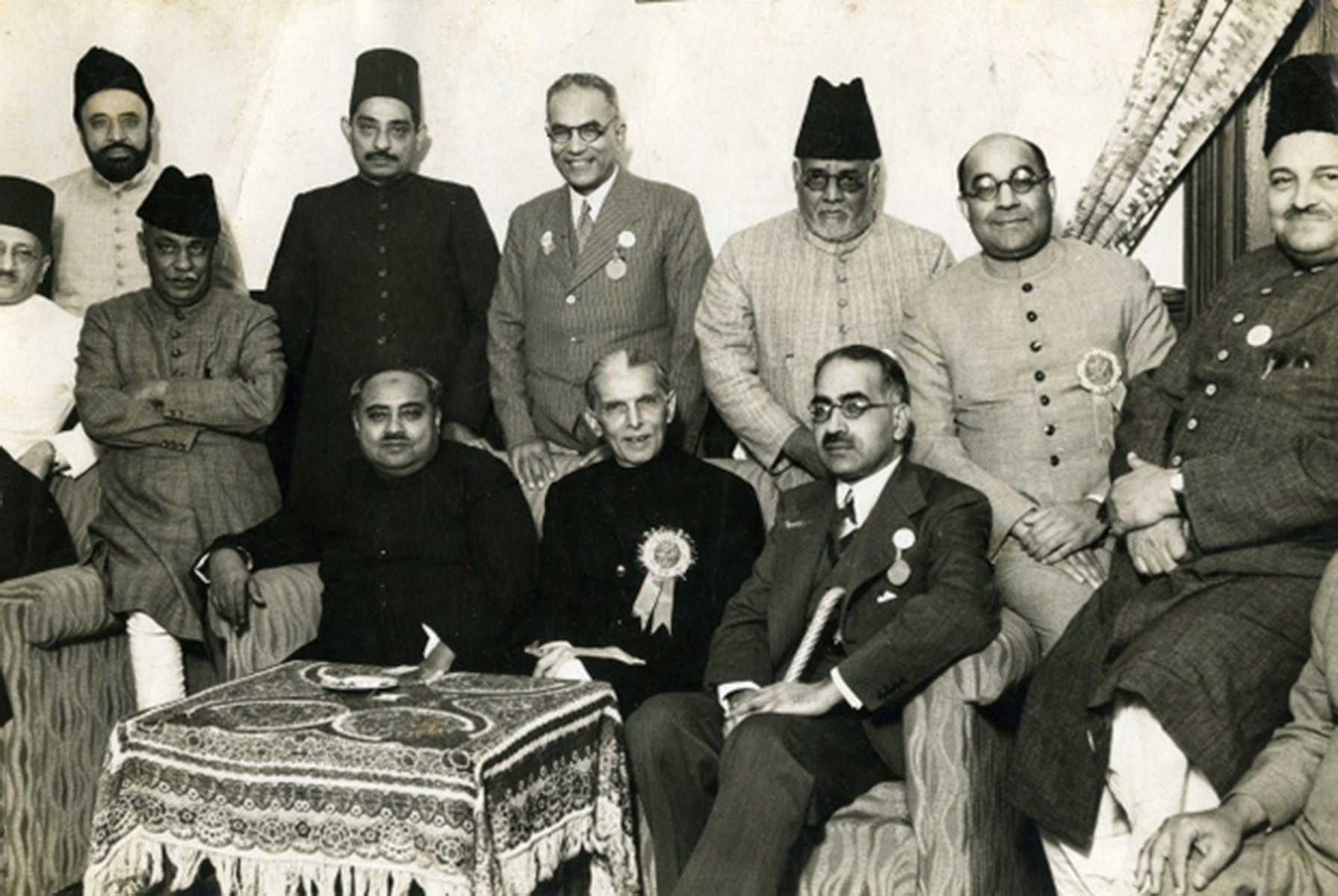
This is the affluent and politically powerful family that Tahira was born into in 1924. A younger sister to Sardar Shaukat Hyat Khan and Begum Mahmooda Salim Khan, she was educated at Queen Mary College in Lahore.
Shehar Bano Khan writes in an article on Tahira, “As a schoolgirl at Queen Mary’s in Lahore, Tahira Hyat Khan was the only one in her class to stand up to make an unusual request to the principal, Ms. Cox. She asked her if Pandit Jawaharlal Nehru, leader of the Indian National Congress, could be invited to the school. She was instantly rebuked for forgetting that Queen Mary’s was a purdah school, where men were not allowed. When the young girl stood up for the second time to say how unfair it was that an important leader could not come to the school, the principal had to discipline her by expelling her for an entire term.
‘I had met Nehru at my father’s house and had written to him several times asking why I needed to sit for exams. He always replied saying that exams were necessary for education,’ she said amusedly.


“A little older and displaying the same fervour for politics, the daughter of Sir Sikandar Hyat Khan, leader of the Unionist Party and Prime Minister of the Punjab in 1937, decided to pay a visit to M. A. Jinnah at Mamdot Villa. By that time, Tahira had developed a keen interest in the Communist Party of India. One of the reasons was her fascination for a young man who often visited her father’s house, and was a member of the Communist Party.
‘Mazhar was a good friend of my elder sister (and a second cousin). He would come and discuss politics, but I must confess he never noticed me. He was a great debater and more of a hero for me,’ her face softened as she remembered,†according to Khan’s article. “But it was quite difficult not to notice Tahira Hayat Khan for too long.â€
“Bicycling her way to Mamdot Villa, the 14-year-old Tahira told the chowkidar to inform Mr Jinnah that Tahira had come. ‘He knew my father and I’d already met him when he came to our house. He was very nice to me and told me that he knew the stance of the Communist Party. I showed him a pamphlet I was carrying in which the Communist Party had declared its support for an independent country.’â€

“In 1941 Muhammad Ali Jinnah went to see her father Sir Sikandar Hyat Khan, Prime Minister of the then undivided Punjab, at his office on the Upper Mall in Lahore,†Omar Waraich writes in an article for The Independent. “‘I know all about you,’ Jinnah said reproachfully when introduced to her. ‘You prefer Jawaharlal to me.’ Tahira secretly maintained a correspondence with Nehru. He would write back, discussing the freedom struggle against the British Raj and offering reading suggestions. Tahira’s letters are preserved in the Nehru Museum in Delhi but Nehru’s letters were destroyed after reading. Tahira was fearful that her father, a noted opponent of the Congress, might discover them.â€

This was the idealistic, willful girl who had a crush on her older cousin Mazhar Ali Khan, son of Nawab Muzaffar Khan belonging to the senior branch of the family. On paper, it was an ideal match, but in reality Mazhar lacked a profession and means to support a wife. On top of that, as a committed Communist, he publicly spoke out against Sir Sikander. At a public rally Mazhar accused Sikandar of “getting up on his hind legs to plead with the British.†Tahira’s brother, who was present, quickly reported it back to his family and they were livid at the public diatribe.
Jugnu Mohsin, who personally knew Tahira, quotes her in her obituary in The Friday Times, “‘Mazhar was born with the Revolution in 1917. His father, Nawab Muzaffar Khan, was my father’s cousin. Our family lived in Wah, the elders thought the tribe came to India from Ghazni with Sultan Mahmud. They also believed that (the Mughal emperor) Jehangir stopped by the springs on their land en route to Kashmir and exclaimed, ‘Wah!’ We were brought up in Lahore, we were a large brood, ten children off three mothers. Abaji (Sir Sikander) was very keen that we be constructively employed in after-school hours. He encouraged an interest in the arts and culture. I went to Queen Mary’s College with my sisters and had a passion for sport. We spent the weekends at our family home in Lahore where the other cousins also gathered.



‘Mazhar was 8 years older than me. I must have been 14 or 15 when I first noticed him. He was tall and quiet. He was already a well-known debater and student leader. I remember I tried several antics to attract his attention. He ignored me. I think he began to notice me a year or so later. We married when I was a little over 17 and he 25. Abaji would’ve been happier had I married Mumtaz Daultana. It was an unspoken understanding between his father Chacha Ahmedyar and Abaji. Don’t forget, Mazhar was unemployed. But I made my preference known to Abaji and he agreed. We went to live in Wah after we married.’â€
Sikandar finally gave his conditional consent that Mazhar could marry his daughter if he joined the Allied Forces in the Second World War. As luck would have it, the Soviet Union was invaded shortly after and the Communist Party of India asked all its members to join the war effort. This way neither father-in law nor son-in-law needed to back down from his stance. The couple was duly married before Lieutenant Mazhar Ali was sent to Italy to fight.
“‘The first thing I did after getting married was to go to my mother and tell her that I was going to the cinema. Marriage meant independence and not asking parents for permission,’ Tahira laughed†Shehar Bano writes, “After three days of marital bliss, she was hit by an immense tragedy. In 1942, en route to Delhi, she received news of her father’s death. ‘I can’t explain what a shock it was. I felt a part of me had died with my father,’ said the activist.â€
Sir Sikandar’s final days as Punjab’s Premier were mired in controversy. He was desperately trying to keep together an increasingly fractious province during an incendiary, volatile time. Literally exhausted, his heart gave out on him in December 1942. To commemorate the restoration of Lahore’s Badshahi Masjid, he is buried within footsteps of it. He had been the Premier of Punjab for five years till his death. While a supporter of Independence, he wanted it granted with the support of the British, as they had rewarded him for his loyalty. His daughter and new son-in-law, on the other hand, remained staunchly anti-establishment, shunning an easy life of affluence to achieve their idealistic utopia through Communism.


Tahira told Jugnu Mohsin, “Mazhar was a Communist sympathizer although he never joined the party. In Wah, he worked with the peasants and workers at Khaur. Of course the family was distinctly uncomfortable with this line of activity but they didn’t object openly. Those were happy days. We lived on virtually nothing. I remember the time Ghaffar Khan was externed from the Frontier. He came to live with us in Wah for two months. Shortly after that, Mazhar left for the Middle East on military service. I was very pregnant by then. We didn’t see each other for two years. I started working for the Women’s Defence League. Our son Tariq was born (in 1942) while Mazhar was away. By the time he returned, I had joined the Communist Party. I had given away my entire trousseau, including the family jewels, to the Party. We were penniless but content. We were living off just Rs. 300 a month for an entire year, and often ate spinach and daal. I must tell you here that I had no regrets, no complaints and no second thoughts about leaving the luxury of my home. My life with Mazhar was meaningful and complete. Our home may have been empty of material things, but my life was full in every way that mattered.
“One day Mian Iftikharuddin came to Wah to see Mazhar. He said he wanted to launch a daily newspaper, The Pakistan Times. He and Mazhar discussed it for days and eventually agreed to put an organization together. It was called Progressive Papers Ltd (PPL). This was the year before the Partition. Mazhar became editor of PT and then went to the news desk when Faiz (Ahmed Faiz) took over the editorship. We moved to Lahore; we had another child, a daughter, Tausif. I worked with women and trade unionists. I used to cycle all over Lahore. Our children were raised by Mazhar’s wetnurse, Jan Amma. I don’t think I could have managed without her. The children called their father Majo and me Maa.â€

After the Partition, Tahira worked for displaced and working women. “Unlike the activism of nowadays, ours was very strong and touched the base of the social structure,†she said.
In 1950, supported by the Communist Party and led by Tahira, Fahmida Butt and Naseem Shamim Ashraf Malik, the Democratic Women’s Association, the country’s first women’s rights organization, was formed. It was Tahira who for the first time in Pakistan observed International Women’s Day publicly, openly demanding that women be given equal status and their rights be established. “Our members were women workers. There was Hajra Masood, Khadija Omar, Amatul Rehman, Alys Faiz and so many countless others whose names I can’t remember now. It was not an elitist organization. We were not getting funds from international donor agencies like the NGOs of today,†Tahira said. “Our work was in the mohallas; there was a perpetual fight against the establishment for people’s rights.†Remembering when railway workers were ejected from their mud huts to give residential space to officers in 1950, she said. “For one whole week, we formed a circle by holding each other’s hands in front of the huts to stop the police from entering them. Eventually, we got the land back for the workers.â€
Tahira and Mazhar’s home became a salon for writers, poets, activists and foreign visiting socialist leaders and was also the birthplace of the Progressive Writers’ Association. Tahira said, “Our apartment on Nicholson Road overflowed with life. The Progressives were constantly in and out of our home — Sajjad Zaheer, Sibte Hassan, Mirza Ibrahim, Faiz Ahmed Faiz and Ahmed Nadeem Qasimi. Zulfikar Ali Bhutto was friends with Mazhar and visited him in Lahore to warn him that the military dictatorship of General Ayub Khan was poised to snatch control of the newspaper he edited, The Pakistan Times.
“In 1959, General Ayub Khan nationalized PPL and Mazhar resigned immediately. We were lucky to have had our own house but the going got tougher and tougher, so we rented out our house and moved to an apartment on Nicholson Road. Ayub sent messages through General Sheikh who was his interior minister and Mazhar’s brother-in-law for him to return to PT. But Mazhar declined, saying he couldn’t collaborate with a martial law regime. By then I was expecting our third child, Mahir.
“Mazhar remained unemployed for years together. He kept his sanity by observing a strict regime of exercise. We swam regularly in the summer and played tennis in the winter. He also read voraciously. It wasn’t possible to write anywhere in those days. It was much later that Mazhar began to write for The Bengali Weekly Forum. His great pride and joy was Tariq, our elder son, who at 12 had led a demonstration of schoolboys to protest the murder of Patrice Lumumba (Congolese independence leader and first PM). He was also a keen debater, another thing he had in common with his father,†she said.
“During Ayub’s regime, we (DWA) invited women from Vietnam to visit Pakistan. Led by Mirza Ibrahim, the trade union leader, a huge number of women came to greet them. When we made a call, people would come out on the streets,†Tahira said. But soon after in the ‘60s, Ayub Khan banned the DWA because it opposed his rule.
Family friend and rights activist, Neelam Hussain writes in a tribute, “My earliest memories are of Tausif and Tariq’s birthday parties at the Nicholson Road flat, where poetry recitation was part of the evening’s entertainment, and we — Nina, Kauchi, Chhammi, Shelly, Cheemi, Mizu and others quite literally had to ‘sing for our supper’ even as the seeds of future friendships were sown. Great ‘walkers’ – long before walking became trendy and branded attire a mandatory given – Tahira Chachi in khadar suit and ‘fleet’ shoes and Mazhar Chacha in baggy blue shorts and tee shirt were familiar figures of the canal and Jail Road landscape. They would often stop by at our house during these walks and we had come home once to find them quite comfortable on a charpai near the gate. Judging them on sartorial merit, the cook, a new man, had not let them into the house.â€
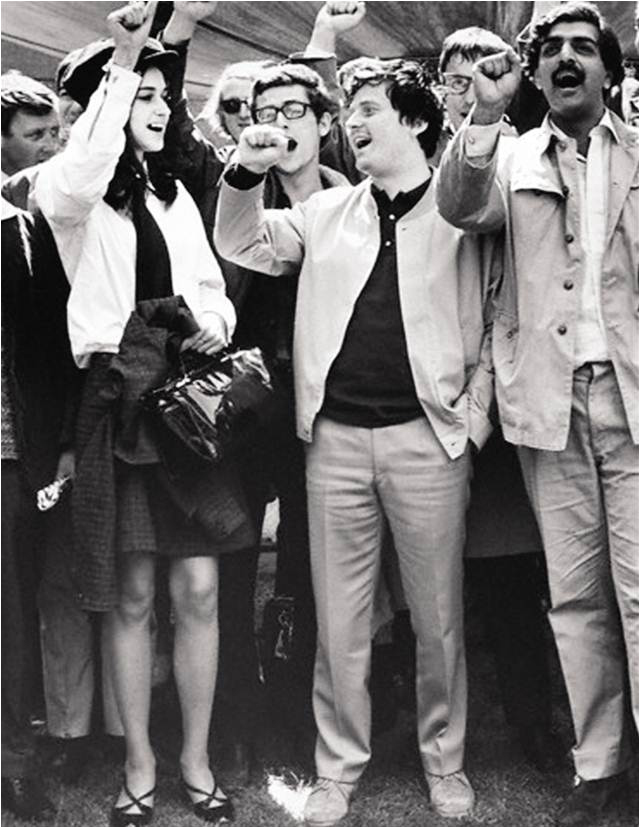
While studying at the Punjab University, Tariq Ali organized demonstrations against General Ayub’s military dictatorship. A relative who worked in the ISI (Interservices Intelligence) warned Mazhar and Tahira that Tariq was in danger, so they decided to get him out of Pakistan. Tariq went to Oxford, where he studied Philosophy, Politics, and Economics. A clever, fiery young man sharing his parents’ convictions and oratory skills, he was elected President of the Oxford Union in 1965. Tariq’s stint at the Union included a famous meeting with Malcolm X in December 1964 during which the latter revealed that he was under threat of assassination. Quickly becoming famous and popular as a student leader, in 1967, Tariq Ali was one of 64 high profile personalities, including The Beatles, who signed a petition calling for the legalisation of marijuana. Tariq debated against the Vietnam War with such figures as President Richard Nixon’s National Security Adviser and Secretary of State Henry Kissinger and American author Michael Stewart. He became friends with influential political figures such as Stokely Carmichael, Trinidadian-American revolutionary who was a part of the Civil Rights Movement, and later, the global Pan-African movement and pop culture icons John Lennon, wife Yoko Ono and English actress Vanessa Redgrave.
“The 60s closed on an optimistic note. Zulfiqar Ali Bhutto won a landslide victory. Sometime in the early 70s, newspaper Dawn’s management asked Mazhar to fill in for their editor Altaf Gauhar, who had been imprisoned by Bhutto. When he came back to Lahore, he launched a weekly called Viewpoint. We sold our house, retaining the patch with the annexe, to get Viewpoint going. It was a labour of love for Mazhar. The children were growing up; Tariq had been to Oxford and won his own recognition. I was busy with the Democratic Women’s Association. Viewpoint was a bottomless pit though; we ended up selling almost everything we had to keep it going. I did protest that we couldn’t carry on like that but I just couldn’t say no to Mazhar in the end. It was his life,†Tahira recalled in her interview with Jugnu Mohsin.
Neelam Hussain writes, “Tahira consistently upheld the workers’ cause to take a stand against her own class including personal friends and she was among the handful of people who had come out on Lahore’s Mall in 1971 to protest army action in East Pakistan and been spat upon for traitors by passersby. And there was WAF – women from her daughter’s generation – whom she had disagreed with, criticised, and stood with in common cause against military rule, Islamisation and unjust laws.â€
Though Z.A. Bhutto had been a friend, he apparently was threatened by Tariq. When he became Prime Minister in 1972 he blocked him from landing in Lahore from the UK. Tahira wrote Bhutto an angry and bitter letter, accusing him of betraying the people’s cause, and he quickly lifted the travel ban.
Usman Khan, a family friend, said, “My grandmother and Tahira were friends since Queen Mary College. The relationship between Tahira and Mazhar was strained many times. Tariq was approached by Bhutto to join the PPP’s Youth Wing, which he refused to do. Bhutto never forgave and never forgot. Enormous pressure was put on the family, and due to that, Tariq decided to live in the UK for good. Something died inside Tahira on that day and she never recovered from Tariq’s departure.â€
Then, during Z. A. Bhutto’s term as PM, he reinstated the DWA and it picked up where it had left off. Tahira was the DWA General Secretary and traveled to international conferences. On one occasion, she met the Turkish dissident poet, Nazim Hikmet, who kissed her hand and charmingly said she was the most beautiful woman he had ever seen..
The General Zia era, starting with a coup in 1977, imposed restrictions on all political life, and the DWA was no exception. In reaction to Zia’s retrogressive laws against females, the Women’s Action Forum (WAF) was formed in 1981 as a new resistance movement. “Till the Zia era we managed to put our force to work, bringing change,†said Tahira. For her opposition to his oppressive military dictatorship, Tahira was jailed. “The pressures were enormous. Mazhar was arrested and imprisoned in 1978 and then again in 1981, following the hijacking of the PIA plane. He developed a heart problem and had to have bypass surgery the following year.â€
Sharing the same birthday, 5th January, Tahira sent Bhutto a symbolic and conciliatory gift, a box of Cuban cigars, when he was in jail in Lahore awaiting his trial, following the General Zia’s 1977 military coup. It was a reminder of their common socialist convictions, the times they had shared and a gesture that meant she had forgiven him. Bhutto must surely have appreciated the kindness of an old friend.
Tahira said, “We kept Viewpoint going for as long as we could. Eventually, it became such a strain that we had to close it down in 1992. Mazhar went back to writing a weekly column for Dawn. On the afternoon of January 28, 1993, he complained of a feeling of ‘heaviness’. I took him to hospital. He asked me to call his editor at Dawn and tell him that he wouldn’t be able to send in his column on time. He died the same night. I wouldn’t say he was broken by the closure of Viewpoint. No, he’d come to terms with it. He had watched the Cold War thawing with great interest. Although he’d been a member of the Pakistan-Soviet Friendship Society for years, along with Faiz, he was not uncritical of what passed for Communism in the USSR. He was enormously heartened by Gorbachev’s appearance. When the Soviet Union broke up, he said it was the dialectic at work. Communism had had an enormously salutary effect on capitalism. The welfare state and ‘caring capitalism’ were the West’s response to the threat of Communism. No, we did not mourn the demise of the Soviet Union.â€
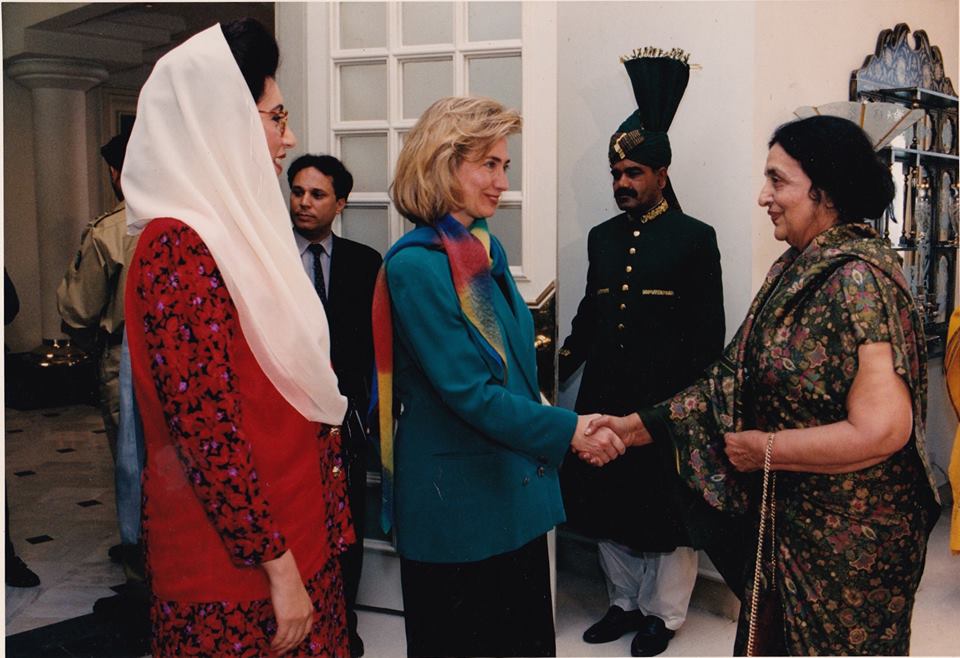
Tahira remained a champion of workers’ rights and was an activist for 60 years, working for the Railway unions, Kissan Party and Labour Party. She also mentored Benazir Bhutto and even made it clear to her that she did not approve of Asif Zardari, warning her that he would be her ruin. Tahira was extremely proud of her son Tariq, a novelist, filmmaker, journalist and political activist who continues to live in London. While her younger children, daughter Tausif and son Mahir, sort of lived in Tariq’s shadow, their own quieter qualities of loyalty, consistency and stoical perseverance in their chosen professions made them no less successful and exceptional. To her dying day in March 2015, at the ripe old age of 91, Tahira was cared for by her daughter Tausif.
The couple’s partnership was exemplary, the tapestry of their lives rich and fulfilling. In Tahira’s own words, “Activism was not a profession for us. It was our life.â€


Zahrah Ehsan’s artistry is a decorous and bold treat for the eyes. There’s an overwhelming rutilance to her surfaces that lends her work the quality of dream-scape. The carnaval-esque palette and immersion into fantastical themes absorb the viewer completely at first impression. The fantastic luminosity of her canvases often carry messages that are feminist and self-interrogatory in nature. The beautiful tumult of colour serves as a prelude to the truth, often dark, enclosed within. Zahrah spoke to Afshan Shafi about her journey as an artist and of the creative visionaries that inspire her.
Please tell us about your background as an artist and your education in this regard.
I think I always knew that I would end up becoming an artist/painter, but was not really sure until I had a life changing ten minute conversation with my former O Level teacher, Farwa Tahir a day before my Art exam. During my time in Lahore Grammar School, I was fortunate to have teachers like her and Murad Khan Mumtaz as my O and A Level teachers respectively, who dedicated their time and saw the potential in me. Later I joined the National College of Arts, where I came across a diversity not only in terms of competent teachers, but also in terms of peers. I graduated with a Bachelors in Fine Arts majoring in Painting, and securing an honour for my thesis project. Both during and after my intensive incubatory training at the institution, I was able to undertake several exhibitions, projects and other similar enterprises. I think going to NCA was the best decision of my life.


Which artists, local or international, have influenced or informed your point of view the most?
I do not think I can ever limit myself to just a couple of favourites. As I was trained to self-reflect during the process of my work, I developed a habit of looking at artists coming from different disciplines and not just looking, but also reading about them and their inspirations. There is an exhausting long list of both local and international artists that I believe have influenced my way of thinking. To name a few Krzysztof Wodiczko, Edward Hopper, Jeff Wall, Pipilotti Rist, Iqra Tanveer, Alex Katz, Rachel Whiteread, Dan Flavin, Huma Mulji, Rene Magritte…the list is never ending.
What’s integral to the work of an artist?
For an artist, there should be an innate understanding in making sure that your work is reflecting a marriage between research and skill. The artist’s work will speak in volumes only when the artist himself/herself is well informed about his/her work and is not shying away from the transformations that are taking place in the process.


What has been a seminal, life changing experience in terms of your art?
I guess that was when my work began to criticise the commodified types of women’s roles in modern society. I realised this when I made my pink and blue dream-like paintings with plastic baby tub stuck on them in 3rd year of college, along with a video that was hugely inspired by a parody video and performance piece, Semiotics of the Kitchen by Martha Rosler, and also similar to Salima Hashmi’s 70’s segment called Handa Hubaalna from the show Taal Matol.
What themes do you pursue?
My work hearkens back to that sense of longing for what is perhaps, unattainable. Teacups, the colour pink and dollhouses act as a metaphor for the ideals that the protagonist in my images holds, all of which are somewhat unreal. These are figments of an overheated imagination. I am obsessed with the notion of childhood dreams shattering as we grow older. To attain the ‘happiness’ that girls are told to wait for; the ‘happiness’ that they are promised while they pour tea into their doll’s tea cup.

What’s your ultimate, favourite art work?
My ultimate favourite art work has to be Rene Magritte’s The Tempest. The strange, yet subtle arrangement of ordinary objects shown in the painting will never seize to amaze me.
How has your practice change over time?
I think my practice has only improved over time, and the more committed I am to this course of life the better it gets. It is almost addictive, if I count the years of practice that started when I was a student and decided to display works outside college. It has been a little over a year since I have gotten a studio after graduating three years ago, and there is no going back. According to a dear friend, this studio has given me a good show. I am waiting what else it brings out in me. Looking forward to the challenges ahead.

What superpower would you have and why?
I would love to enter all these paintings of artists like Hieronymous Bosch, Magritte, Edouard Vuillard and experience what’s happening inside the canvas that only shows us one perspective in its two dimentionality. Haha, something very similar to how Bugs Bunny and Daffy Duck enter Munch’s Scream in the movie Space Jam and turn into that screaming man, or start melting when they enter Dali’s painting, The Persistence of Memory.
Name something you love and why?
The beach! I love the sound and the view of the waves crashing on the beach and how it naturally reflects the sky. The beach is the best place to have real conversations.
Name something you don’t love and why?
Clutter is something that I can bear with, but I loathe things lying around. The kind of routine that I have, I am not able to keep my room and studio clean at all times. But when I do, my studio mates are also unfortunately caught in the storm.


What is your dream project?
I would want to create an experiential party like setting in a given gallery space and would want to be there as a host, rather than as an artist displaying works. And no, I am not talking about the kind you saw in Alice in Wonderland. This is something that I am still working on.
Name three artists you’d like to be compared to.
Edward Hopper, Rene Magritte and Gerhard Richter.
What work of art do you wish you owned?
Infinity Mirrored Room – The Souls of Millions of Lightyears Away by Yayoi Kusama.
Which artist living or dead would you have loved to collaborate with?
I think I would be happy to collaborate with this Canadian artist, Jeff Wall. I have always been drawn to his staged photographs like The Destroyed Room and Mimic. I like how his photograph’s compositions are cinematographic and relatable at the same time.
What is an artistic outlook on life?
For me an artistic outlook on life simply means to acknowledge and embrace the highs and lows of your artistic journey, and to accept that an artist’s work makes them who they are and tells them where they stand.
What under-appreciated artist, gallery, or work do you think people should know about?
Leonora Carrington, a member of the surrealist movement, is well known as Max Ernst’s wife. I think she is one of the many under-appreciated women artists in the art world. I find her dreamlike, highly detailed fantastical paintings along with her life story extraordinary.
What’s your favourite thing you’ve ever created?
That is a tough one as all of my works are an outcome of a more personal struggle. But recently, one of my four new works that were shown at Canvas Gallery, Karachi, with the title Monologue is currently very close to my heart.
Which creative medium would you love to pursue but haven’t yet?
As for now, I have attempted almost all kinds of mediums that I was familiarised with in college, but I believe I have not been fully able to explore installations.
What memorable responses have you had to your work?
I remember my former A levels teacher, Murad Khan Mumtaz coming in as an external juror to NCA for a painting critique and mentioning how my painting was ‘well painted’, which was very unlike him. Similarly, I have had many other accomplished teachers, like Quddus Mirza, R. M. Naeem and Mariam Hussain, appreciating my work and their responses have really directed me to be more consistent with my practise.
Favourite or most inspirational place?
I do not think I have an inspirational place in particular. Any place can inspire me as long as I it can host art, music and conversation.
What are you working on as a future project?
I am working for a solo show at the moment. Details of the show will be disclosed soon.

By Fatima Sheikh
Boxer Amir and wife Faryal Khan throw an extravagant birtday party for toddler daughter in a football stadium
Daughters are a gift from God. Every parent would agree with me when I say daughters are angels sent from heaven to put a smile on our faces. All parents do their utomost to keep their little girls happy. Amir and Faryal Khan, who live in Bolton, U.K. went all out for their their little princess for an over the top birthday party costing £100,000 to celebrate her second birthday, which fell on May 23rd.
During the planning stage whenever Amir was out of town for training, promotional event or a fight, Faryal kept him updated about the event planning and took the initiative to arrange everything herself for the extravagant day. She took 3 months to plan the whole extravaganza. With a lot of effort and a huge budget, Lamaisah’s second birthday was a memorable and precious day for the family, which they shared with their 250 nearest and dearest.

The grand party took place at the Bolton Wanderers Football Stadium, which was set up with a carousel for the occasion and included Pegga Pig, Disney princesses and a real life ballerina.. The couple complemented each other in shades of blue—Amir wearing an Aegean blue checked suit with a sky blue shirt and Faryal wearing an arctic blue sari. Their daughter was dolled up in a rose pink fluffy frock. The couple was clearly beaming with pride and joy as you can see in Amir’s Instagram video. How they danced with their daughter in the middle of the stage! Must have been quite a spectacle. Faryal’s effort even astounded the boxer as he gasped about how beautiful it looked and that she had done such an amazing job.

“I was busy training when she was planning this, but every day I was getting crazy bills and thinking, ‘What’s this for?’ Every penny spent on my daughter is worth it, though. After all, all this hard work I do is for her, for my kid,†the boxer said in an interview to Hello magazine U.K.
Faryal justified the exorbitant expense by saying in the same interview that that the next grand party for their daughter would be be held when her daughter turns 16, so she wanted one extra special day for her princess. She added that initially adjusting in the UK was difficult for her when she got married in 2013, but now she has held her ground, especially after their daughter was born.

Both the parents confessed how their lives have changed since the beginning of their marriage with the birth of Lamaisah and how they now revolve around their child. Their priorities have switched from traipsing around to loving each other and their little one. Faryal gave details about how Amir has over time helped her adjust from a different place with his kind heart and nature. She describes in the same interview how he does everything for his wife and child now putting himself second. She now has to force him to go out and loosen up a little more often, but he likes getting cosy with two of his favourite females. I must say he has settled down to become quite the family man.





By Mahlia Lone
A royal love affair, a beautiful Maharani, glittering palaces, lost wills, and legal wrangling over a quarter of a billion pound estate
Jaipur, the magical pink city with the vast fairytale palaces had a Maharaja, who only had eyes for his Maharani. So strong was their love that he allowed his glamorous, intelligent and independent Anglicized wife break with tradition and venture out of the zenana and behave like a thoroughly modern woman, so she would be happy and fulfilled. The Maharaja was Sawai Man Singh II and his Maharani was Gayatri Devi, one of the world’s Ten Most Beautiful Women as listed by none other than Vogue magazine, after Cecil Beaton photographed her in Jaipur in 1943.

Gayatri came from a line of strong women. In her book, Maharanis: The Extraordinary tale of Four Indian Queens and their journey from Purdah to Parliament, Lucy Moore follows the stories of the three generations of game-changing Maharanis (Gayatri, her mother and grandmother). She writes, “These Maharanis and their husbands were cosmopolitan in their tastes and Anglophile in culture. They had an aura of glamour and even celebrity clung to all three women, and their extravagance and adventurism became legendary. There were tales of Rolls Royces won and lost at the gambling tables of Monte Carlo, of millions of pounds spent to maintain dozens of residences and hundreds of servants, of promiscuity and reckless, gilded bohemianism. This was a time when modernity, independence and internationalism were swiftly replacing tradition, colonialism and provincialism. And thus these three Maharanis lived confused, sometimes deeply unhappy lives.â€


The story starts with Gayatri’s maternal grandmother Chimnabai of Tinjore, the Maharani of Baroda, whose husband Maratha King Maharaja Sayajirao Gaekwad III transformed Baroda into the most advanced princely state in India and had a fabulous jewel collection. As wilful and capable as the Maharaja himself, Chimnabai refused to live a quiet and confined life, entering the world of men alongside her husband and sharing in is progressive rule during their 53 year marriage. Gayatri’s mother the Maratha King’s only daughter, the rebellious Maharaj Kumari Indira Raje of Baroda created quite a ruckus in the Maratha ruling families when the time of her marriage drew near.
In 1909, forty year old and extremely wealthy Maharaja Madho Rao Scindia of Gwalior was already married, but his Maharani was unable to bear a child. To produce an heir to the gaddi (throne), he needed to take another wife when he met the beautiful and well educated eighteen year old Maharaj Kumari Indira during the London season. Upon returning to India, he began negotiations with her family and after the astrologers were consulted and horoscopes were compared, the date of the wedding was finalized. Indira was informed of her engagement but she was unhappy. It wasn’t just the age difference; the Maharaja was known to be very conservative and would keep her restricted in the palace of Gwalior in strict purdah. She would rarely be allowed to see even her brothers.

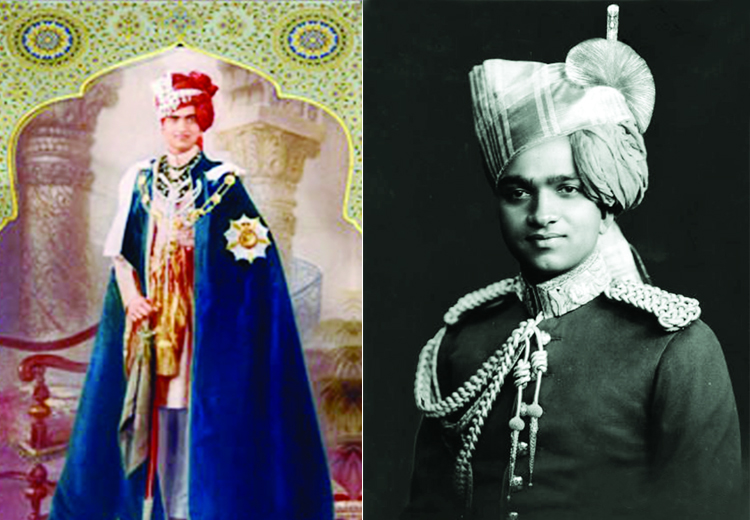
In 1911, Indira Devi accompanied her parents to the Delhi Durbar held to commemorate the accession of King Emperor George V and Queen Empress Mary to the British throne. All the Princes of India gathered to pay allegiance to the British Crown and this was the first time a sitting monarch visited the Subcontinent. The regal festivities lasted for several weeks with polo matches, garden parties, balls and even a ladies durbar. Indira Devi caught up with the princesses of Cooch Behar (the sisters of Maharaja Shri Sir Raj Rajendra Bhup Bahadur Narayan), her friends from the finishing school in Eastbourne that they had attended together. Soon she met and fell in love with the Maharaj Kumar Jitendra Narayan Bhup Bahadur, the Crown Prince’s younger brother.
Upon returning home where preparations for her wedding were in full swing, without telling her parents she wrote to her fiancé that she couldn’t marry him. The wedding preparations in Baroda were in full swing at the time, so it must have been quite a courageous act. The Maharaja of Gwalior immediately telegrammed her father: “WHAT DOES THE PRINCESS MEAN BY HER LETTER?†Her parents were livid, but her brothers stood by her side. Her fiancé acquiesced and agreed to break off the engagement. It wasn’t because Cooch Behar was a small state and Jitenra was merely a younger brother that Indira’s father disapproved of the match, but because the Cooch Behar royal family was considered unorthodox and too westernized, sociable with the Europeans and living an Edwardian lifestyle. Maharaja Nripendra Nayaran Bhup Bahadur and Maharani Suniti Devi were favourites in the court of Queen Empress Victoria, and both of the Maharaj Kumar’s sisters had married European men.

Maharani Gayatri Devi, in her memoirs A Princess Remembers, recalls: “a mental picture of him (her father) standing in front of the fire in the drawing-room at Hans Place. He was wearing his dressing-gown and held a glass of whisky in his hand. He was very tall – nearly all the men in the Cooch Behar family are over six foot – and extremely handsome.â€Â Maharaja Jitendra was a football and polo player, a keen musician, attending concerts and then playing the music back by ear, and very fond of children. Unfortunately, the Maharaja died after only ten years of marriage and his widow returned home to become the state’s Regent.
Cooch Behar, located in West Bengal, was much smaller than Baroda. The houses there were quaintly built of bamboo and perched on stilts to prevent flood damage, as there was no local stone to be used for building. The roofs were covered with scarlet plumes and hibiscus, and the roads were similarly hued and lined with red gravel. Palm trees swung in the breeze. Small white temples dotted the main town with little oblong ponds in the front in which worshippers bathed before entering the temple. Only official buildings like the state treasury and council house were built with brick. The royal palace with its huge central durbar dome and two long wings was located in the outskirts of the town. Built in 1870 by an English architect, who also built the palaces of Kolhapur, Panna, Mysore, and Baroda, the palace was designed for the hot climate with long cool verandahs on all sides furnished with sofas, chairs, and carpets, beyond which stood a large garden with pavilions and small ponds.
 The palace was staffed with four to five hundred people including, Gayatri writes, “For the parks and grounds there were twenty gardeners, twenty in the stables, twelve in the garages, almost a hundred in the pilkhanna (elephant stables), a professional tennis coach and his assistant, twelve ball-boys, two people to look after the guns, ten sweepers to keep the drives and pathways immaculate, and finally, the guards.
Indoors there were three cooks, one for English, one for Bengali, and one for Maratha food. Each had his separate kitchen, with his own scullery and his own assistants. There were besides, six women to prepare the vegetables, and two or three bicycle sawars (riders) whose job it was to fetch provisions from the market every day.
The Maharaj Kumaris each had a maid in addition to their governess Miss Oliphant and tutors, while Indrajit (the younger son) had one personal servant and the new Maharaja had four. The Rajmata Indira Devi’s entourage included a secretary (who, in turn, controlled another secretary and typist), ladies-in-waiting, and a number of personal maids.
Along with this large staff there were five to six ADCs (Aide de Comp) who were from good families and could not be considered servants. These ADCs had the responsibilities of running different parts of the household. They escorted the Rajmata Indira Devi whereever she went and also helped entertain guests at the palace. These ADCs also acted as filters between the Rajmata and whoever came to see her. They sifted out the genuine visitors from the curiosity-seekers and those with manufactured complaints or petitions. Finally, about forty people compiled the state band that played before dinner every day and during ceremonials occasions.
Though the Rajmata levied many of the responsibilities to comptrollers, clerks and ADCs the final decisions were always hers and hers alone.â€Â Â
For two years, Indira and Jitendra kept up their love affair in secret and finally got married in a London hotel in 1913 according to Brahmo Samaj rites but without her parents’ participation. Maharani Chimnabai did not speak to her daughter for two years until Indira Devi gave birth to her first child. Three weeks later after the marriage, Jitendra’s older brother died. He had been in love with the English actress Edna May, but he was not allowed to marry her and drank himself to death. Next in line, Jitendra succeeded to the throne.
The new Maharaja and Maharani of Cooch Behar had five kids in quick succession. Because Maharaja Jitandera’s health was deteriorating, they were living in London where their fourth child baby Gayatri was born. Though the name Gayatri was chosen after consultation with Hindu astrologers, Indira had been reading a Rider Haggard novel while pregnant and wanted to name the baby Ayesha after the heroine, even though it’s a Muslim name, so she was nicknamed Ayesha.


Gayatri grew up a tomboy. Nina Wolia, who interviewed her for The Times of India, writes, “In her crisp English accent, she talked in a matter-of-fact way about her happy childhood days, ‘When I close my eyes, I recall my happiest days were as a child in Cooch Behar. Those were days of innocence. When I read comics like Tiger Tim and Puck. When I’d go shooting, I would plead with the mahout to let me sit on the neck of the elephant. There I used to lie down, my head between the elephant’s ears. At dusk, I would come home riding on my elephant. When I remember this moment, it takes me back to a time when my life was untouched by change and the loss of people dearest to me. I often dream about my childhood days, we had so much fun with my brothers and sisters.’â€
Gayatri had a privileged, well rounded education for the time, attending in turn London’s Glendower Preparatory School, London School of Secretaries, Brillantmont, the most fashionable and exclusive finishing school for debutantes, the Monkey Club, Knightsbridge, Patha Bhavana of Visva-Bharati University, Shantiniketan, and in Lausanne, Switzerland, where her family vacationed.
When she was only twelve, she met the man who was to be the love of her life and whom she would affectionately call Jai.


Mor Mukut Singh was the second son of Thakur Sahib Sawai Singh of Isarda (a dusty, walled town), a nobleman belonging to the Kachwaha clan of Rajputs. His family was connected to the ruling house of Jaipur. The Maharaja of Jaipur, Sawai Madho Singh II, had been born the son of a former Thakur of Isarda and had been adopted into the ruling family of Jaipur. Madho Singh’s biological father in turn adopted Sawai Singh, son of a relative. Although the Maharaja of Jaipur, Madho Singh II had 65 illegitimate children, he refrained from having any by his five wives because had been warned by a sadhu (Hindu holy man) against having legitimate heirs. Thus, the highly superstitious Maharaja Madho Singh II adopted Mor Mukut to be his son and heir and was renamed Man Singh. When he was only 11, Man Singh succeeded to the throne in 1922 and became H.H. Saramad-i-Raja-i-Hindustan Raj Rajendra Sri Maharajadhiraja Sir Sawai Man Singh II of Jaipur.
Man Singh’s first two marriages were arranged to suitable Rajput brides chosen from the royal family of Jodhpur. His first wife was Maharani Marudhar Kunwar, sister of Sumer Singh, Maharaja of Jodhpur, while his second wife was Maharani Kishore Kanwar, niece of his first wife and daughter of the same Sumer Singh.


Man Singh was an avid 10 goal polo player, winning among other trophies the World Cup in 1933. At 21, he came to Woodlands, Calcutta to play during the polo season of ‘31 and that is where he met the 12 year old Gayatri for the first time. Having read a complimentary article on him written by Rosita Forbes, Gayatri was struck by the grown up, exceedingly rich and dashing Maharaja. Gayatri shared with him a love for equestrian sports, polo and riding. A year after meeting the Maharajah, she also shot her first panther.
Maharaja Man Singh conducted a six year secret courtshipfor games of tennis and cycle racing, meeting Gayatri, while she was attending the Monkey Club finishing school in London. In her memoirs, she talks about how gossip about her and the married Jai got around. People warned her mother that life as a third Maharani would be tough. Gayatri said reminiscing, “Looking back, I see that those times were much more ahead than an ordinary approved courtship would have been. There was the challenge of outwitting our elders, of arranging secret meetings….And every now and again, there was a marvellous, unheard of liberty of going for a drive in the country with Jai, of a stolen dinner at Bray, or of an outing on the river in a boat. It was a lovely and intoxicating time.â€

“Style comes naturally to me. I guess you’re just born with it. My mother has been my role model and icon. When I was young, I watched her dress. Ma was very fussy about her clothes. Did you know she was the first person to start wearing saris made of chiffon? But her greatest passion was for shoes. She had hundreds of pairs and still went on ordering them from Ferragamo in Florence. She always knew the best place to buy anything and she shopped all over the world. I guess, I learnt about style from her. She taught me all about style. Life was more glamorous in the olden days, a lot has changed now,†Gayatri said in an interview.
One day, Jai invited Gayatri to a park. He asked her if she would marry him and also that he had already spoken to his mother about doing so. He had told her that he played polo, rode horses and flew planes, so could die any moment and asked if she still wanted to marry him despite this. She agreed instantly. and
On his second visit to Calcutta on her return from London, Man Singh invited Gayatri for dinner to Firpo’s, the city’s most fashionable restaurant. She recalled that the glow of the attention she received that evening was to remain one of the enduring memories of her life. They subsequently announced their engagement in 1939. But her mother Indira Devi was not pleased for her daughter to become a third wife.


“’The Maharaja likes girls,’ her brother warned her just before the wedding, ‘and just because he is marrying you, one must not expect him to give up all his girls.’â€
“’The Maharani-to-be had an answer: Because the maharajah was marrying her and not the other way around, ‘there would be no need for him to have other girls.’â€
Their marriage took place on the 9th of May in 1940 after intense diplomatic maneuvering. Because his first two wives belonged to the royal family of Jodhpur, few royal households attended. Confident Gayatri Devi, however, was not perturbed, “I am in the Guinness Book of Records twice, first for having had the most expensive wedding in history and second after the royal privileges were removed and democracy took over, I won by the largest majority ever recorded in a democratic election.â€

Arriving as a newlywed bride by train to Jaipur, Gayatri said, “The nearer we drew to Jaipur, the more terrified and unsure I became. I tried desperately not to show it, but Jai I think understood how I felt. As we entered the station, the servants pulled down the blinds around our carriage and very gently Jai told me to cover my face.â€
“The third Maharani of Jaipur accepted her role as the Maharaja’s favorite but junior wife with good grace,†the London Daily Telegraph noted. “She adjusted to the formality and restrictions of royal life, but at the same time used her authority to bring the palace women forward into the 20th century.â€


Together the Maharaja and Maharani set about on a program of modernization, creating infrastructure and founding numerous public institutions that would later result in Jaipur being selected as the capital of Rajasthan. At the time of India’s Independence in 1947, the Maharaja acceded Jaipur to the Dominion of India. In 1949, Jaipur was merged with 18 other princely city states to form the new state of Rajasthan with it as the capital city. The Maharaja had surrendered his sovereignty and accepting the appointment of Rajpramukh of that state until even that office was abolished when the Indian states were further re-organised in 1956. Although Maharaja Man Singh was appointed State Governor, it soon became apparent that all power lay with the ruling Congress Party. Although the 560 Indian Princes had relinquished their ruling powers, they remained entitled to their titles, limited privy purses and some privileges until the adoption of the 26th amendment to the Constitution of India on 28th December 1971. Accordingly, Man Singh II remained Maharaja of Jaipur until his death; he was the last one.
Gayatri contributed by promoting education in Jaipur, and established the prestigious Maharani Gayatri Devi Girls’ Public School in 1943 with 40 students and one English teacher, amongst other schools. She also revived the dying art of blue pottery. In the early 1960s, when the heritage walls of Jaipur city were being torn down, she wrote to Jawaharlal Nehru. He immediately responded in a letter to her, “I have told them to stop the sacrilege.â€


Princess Diya Kumari of Jaipur, only child of Bhawani Singh and who herself married the Palace accountant, said in tribute, “Maharani Gayatri Devi will be an eternal legend. She was a great influence to the women of Jaipur. She was the first woman of substance and style of her generation. The world bowed to her beauty. Indeed, she was a people’s Princess.â€
Gayatri also went on shikars (hunts) with her husband. Years later, she told Time magazine that she killed 26 tigers before she retired her gun, because “I feel sorry for the animals.â€
Gayatri also shared with Jai a love for cars and flying. The first Mercedes-Benz W126, a 500 SEL was imported to India for her expressly. The couple also owned several Rolls Royces and an aircraft. During the 1950s, Man Singh owned the 100 acre Saint Hill Manor in East Grinstead, West Sussex, which was sold to L. Ron Hubbard, founder of Scientology in 1959, and where Tom Cruise now lives.
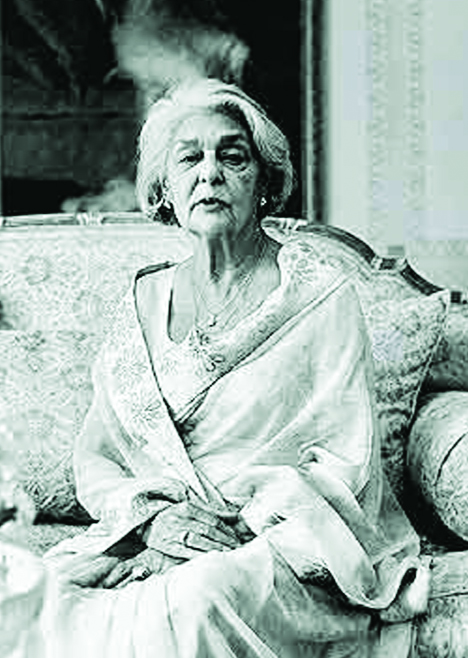
Her beloved Jaipur was close to her heart till the end. Even at the age of 89, the Rajmata sat in a 2008 dharna to protest against encroachments. The desecration of Jaipur hurt her terribly. She lamented that in London, like in many historic European cities, no one can build a house that does not conform to the overall architectural layout and strict guidelines. “Who cares for Jaipur anymore?†she asked. “I try but it is a fruitless battle.â€
In 1949, she gave birth to her only child, Jagat Singh of Jaipur, later Raja of Isarda when his father granted him his uncle’s fief as a subsidiary title. His eldest half-brother from Maharaja Sawai Man Singh’s first wife, Bhawani Singh was of course the Crown Prince.


Land reform, such as the Jaipur Tenancy Act, was also first introduced in his state under Man Singh’s wise rule. In 1956, the Jagidari (feudal) form of political administration was abolished during the government of the Congress party in India. Several of the royal households became destitute overnight but the former Jaipur royal family, among India’s richest, remained wealthy. In 1958, Man Singh hit upon an excellent scheme, turning Rambagh Palace into a luxury hotel, as was being done by other far-thinking Rajas. In 1965, the Indian government appointed Sawai Man Singh as the Indian Ambassador to Spain and, utilising his European social contacts, he set about attaining new military technology and arms-deal for the Indian Army.
Before and after independence, Man Singh and Gayatri Devi summered in London, partied in Europe and entertained famous visitors, including Queen Elizabeth and Prince Philip at a tiger hunt and the American First Lady Jacqueline Kennedy (with whom Ms. Devi was often compared). Life magazine called Gayatri one of the most beautiful women in the world. Her mellifluous throaty English accent The Washington Post once noted, “makes her sound like an Indian Tallulah Bankhead (film star).â€

With Man Singh’s role in state affairs and the royal family’s prestige on the decline, in 1960, Gayatri Devi joined the conservative Swatantra party founded by C. Rajagopalachari a few years earlier in opposition to the socialism of Jawaharlal Nehru’s ruling Congress Party. In the ’62 elections, Gayatri Devi ran for Parliament, even thought her campaigning meant she could no longer spend time with Jai, driving out at 7 in the morning in her monogrammed white Jaguar and exercise their 18 polo ponies with him. However, she won the constituency in the Lok Sabha in the world’s largest landslide, winning 192,909 votes out of 246,516 cast, as confirmed by the Guinness Book of Records. President John F Kennedy of the U.S. called her, “the woman with the most staggering majority that anyone has ever got in an election.â€
In 1965, during a meeting with Prime Minister Lal Bahadur Shastri, Gayatri Devi was again asked to join Congress. This was the time when, despite the fact that her husband was being made ambassador to Spain, she struck to her principles and decided not to join the party. She got re-elected in 1967 and 1971, on the Swatantra ticket, running against the dominant Indian National Congress party.

Then tragedy struck; Man Singh died aged 58, in 1970, while umpiring a polo match in Cirencester, England, due to a riding accident. Then, next year the privy purses were abolished in 1971, terminating all royal privileges and titles. Indira Gandhi imposed a 21 month long state of emergency imposed in response to escalating riots around the country, during which time the PM suspended all laws and ordered mass arrests. Popular leader Gayatri Devi was also arrested alongside 12 MPs and her step son Bhawani Singh on a trumped up charge of violating tax laws, but she was never tried. It was often said the socialist PM was jealous of the royal politician, and once referred to her in Parliament as a “bitch and a glass dollâ€.
During the five months the Maharani spent in prison, she continued to wear chiffon saris, jewellery and perfume and is said to have borne herself with grace. “It wasn’t too bad,†she once cheerfully told an interviewer. “In Tihar, I had my own bedroom with a veranda and my own bathroom. We were well looked after, except we were not free.â€Â She spent five months in Tihar Jail where she developed gastric problems that were to remain with her for the rest of her days. After that, she retired from politics and published her autobiography written with Santha Rama Rau in 1976, which became a French film Memoirs of a Hindu Princess, directed by Francois Levie.
Rajmata Gayatri Devi’s two decades of widowhood were not spent in seclusion, as widows of Rajput rulers were expected to do, but to the indignation of the traditionalists, she continued to live life to the fullest. She travelled extensively, summered in a flat in Cadogan Square, Knightsbridge and spent the winter in her Jaipur dower house Lilypool that her husband had built after their first home, Rambagh Palace, had been transformed into a hotel. A list of VIPs, including Mick Jagger and Sir Michael Caine, were sent over from the hotel daily to Lilypool where she would entertain them over for a glass of champagne in the evening, or held garden parties for them. Funnily enough, those who displeased her were billed for the champagne. When her autobiography came out in a paperback edition in England in the ‘80s, she asked her publishers if she might have a chauffeur-driven car for a morning’s shopping. The chauffeur later reported back that the shopping morning had constituted of a drive out to Surrey for the purchase of a large house.
In her memoirs, the Rajmata talks about her son’s Jagat’s marriage in 1978 to Priya, the daughter of Prince Piya and Princess Vibhavati of Thailand: “We had a reception in London and the Queen of England, the Lord Mountbatton and many friends attended it. A year later, Jagat and Priya had a daughter named Lalitya and two years later they had a son called Devraj. My time was spent not only in India and England but also in Thailand where I went often to visit Priya’s family. Bangkok is a fascinating city. And I love my grandchildren.â€
Priya divorced the playboy Jagat in 1987 on grounds of adultery, and their two kids grew up in Bangkok. Jagat died in 1998 and the two royal families became embroiled in a feud over his estate worth approximately Indian Rs. 25 billion or £250 million, which includes fabulous palaces, jewels, paintings and the Knightsbridge flat, and which was finally settled in September 2015.
The case goes something like this. After Jagat’s death the Rajmata produced a letter from him, allegedly a forgery, stating that his children should not inherit any part of his estate after his death. She also argued that her grandchildren could not own property in India because they held Thai and British passports. Their dispute was apparently settled and the Rajmata and her grandchildren struck a deal to split the estate equally between the three of them. Her share was expected to pass to them upon her death and in the meanwhile her step son Prithviraj (step brother of Jagat Singh) would manage the income from the Jai Mahal Palace Hotel until they were no longer minors and were old enough to take over. Originally built for the kingdom’s Prime Minister, this mid-18th century palace that appears to float on a lake was bequeathed by Man Singh to Jagat Singh and is now one of the world’s most luxurious spa hotels, leased out to the Taj group of hotels since 1972. To give you an idea of its value, one night in the hotel’s one bedroom Presidential costs an exorbitant $12,282.
In 2009, the 90 year old Rajmata was being treated for her chronic gastric disorder at the King Edward’s Hospital in London, when suddenly she asked to be returned home to Jaipur, ostensibly to die at home. Immediately, she was was flown there in an air ambulance. She died due to lung failure in a local Jaipur hospital.
In an exclusive interview just before her death, the Rajmata said, “I’ve had a very happy life. I have no regrets. I’m not a nostalgic person. I live in the present. I just try to do what I can, when I see unhappiness around me. Why grumble about things that don’t go your way. Make the most of life. Don’t make me sound arrogant or extraordinary.†(But, asked the interviewer, she’s been a woman of immense strength, role model to millions of Indian woman? )â€I’m flattered that you say so. I don’t agree though. But I’d like to tell women of India that they must lead a full life. They must give their everything to life and be faithful to their families.â€
But her family was feuding over her estate, which the Rajmata had left to her stepson Prithviraj, a move challenged in court by her grandchildren. They sued him accusing him of watering down their shareholding in the hotel from 99 per cent to just 7 per cent. The late Jagat Singh held 99 per cent of the company’s shares and the property was gifted to him by his father late Man Singh. Later, Jagat Singh’s estate had been diluted to seven per cent while Maharaj Prithviraj and his family now owned 93 per cent stake in the company.
Devraj said in an interview that the ill-feeling of his step-uncle Prithviraj, who had once acted as his grandmother’s executor, even extended to two vintage vehicles once owned by his father and grandmother that were currently sitting gathering dust in a shed under covers, a baby-blue Bentley from the ’20s, and a 1949 Jaguar sports car. He said ruefully, “My uncle has the keys to these.”
After a nine year legal battle, the courts granted Maharaj Devraj Singh his share of his father and grandmother’s estate upon the discovery of the Rajmata’s will naming her grandchildren as her legal heirs. On Sept 23rd 2015, the Supreme Court of India upheld the Delhi High Court’s verdict in favour Devraj and his sister, allowing them to claim their shares in the Jai Mahal Palace Hotel, Rambagh Palace Hotel, Sawai Madhopur Lodge and SMS Investment Corporation, the first three businesses being luxurious heritage hotels, while SMS Investment organises weddings and seminars.
Devraj and Lalitya celebrated their hard won victory in style with Cristal champagne and caviar.