



































Meher Hasan is on our radar for a number of reasons. Having started modelling only a short time ago, she has already scored high profile campaigns with the likes of Muse Luxe, Afsaneh, Rema Shehrbano, and Zaha to name a few. Not only is she beautiful, but is also a highly imaginative and dedicated writer of short stories and poetry. We love her buoyant personality and kitschy sense of style. Read more in her chit chat with Afshan Shafi
Name three things you love:
Roses, Clouds, Rain
Name three things you hate:
Morning alarms, Waiting, Bullies

What do you do in your free time?
I hardly get any free time anymore but when I do, I like to spend it with my loved ones or catch up on lost sleep.
describe your style:Â Boho-chic. Sometimes I like masculine cuts and take lots of inspiration from vintage glamour, especially for colour palettes and makeup looks.
Dream career:
Working at Vogue
Favourite holiday destination:
Paris
Best thing about modelling:
Being part of a creative vision
Worst thing about modelling:
Never having time!

Last dream:
I was standing in the garden of my old house when a strange reptilian creature tried to attack me. Fortunately, I managed to defend myself with a sharp sword. Basically, I’m a ninja in my dreams. And in real life
Favourite writers/books:
I’m the worst at answering questions like this. I can never decide a favourite book, but I can name writers I like to read again and again: Vladimir Nabokov, Mohammed Hanif, Arundhati Roy, Sandra Cisneros, Nadeem Aslam, Italo Calvino, Francis Scott Key Fitzgerald, Salman Rushdie, Jhumpa Lahiri, Toni Morrison and Miriam Toews, to name a few. There’s tons more but these are all I can think of for now.

People that inspire me:
Lady Gaga
Favourite designers:
Fiorucci, Raf Simons, Ali Xeeshan, Faraz Manan, Jean-Paul Gaultier, Alessandro Michele, Naeem Khan, Kamiar Rokni, Azzedine Alaïa, Faryal Aftab, Marc Jacobs, Miuccia Prada, Nomi Ansari, Phoebe Philo, Virgil Abloh, Sabyasachi Mukherjee, Alexander McQueen, Iris van Herpen, Misha Lakhani, Maheen Khan, the Mulleavy sisters and Elsa Schiaparelli

Future projects:
You’ll have to wait and see!
Photography: Tajwar Munir
 Coordination: Afshan Shafi
Wardrobe: Hira Ali, Dolce & Gabbana




Waqas Abbas form the third generation of artists in their family. With their good looks and immense talent, we’re
excited to see their upcoming drama serials and music.

Who says siblings only colour coordinate their outfits as kids? Zara and Ahmad Abbas wear burgundy in their own unique ways

 There’s nothing quite like a sibling bond. Waqas, Ahmad and Zara have always inspired and protected each other, but also never missed out on an


devoted fan following through her powerful performances and forthright demeanor.
Born to a family of artists, her love for artistic expression is deep-rooted, but what
makes her truly special is her admirable aplomb and integrity. Mehek Raza Rizvi
meets her on a chilly afternoon in Lahore for an exclusive tête-à -tête
Rani, Bubbly, Nigaar… the recent roles you’ve portrayed have been of multi-layered strong women. Is this a conscious decision?
Yes. The status quo for a lead heroine is to play the docile girl in need of a man to save her and I have to admit I’ve accepted such roles many times. However, I now feel like I’ve paid my dues and can choose the characters I want to portray. With AAAI (Alif, Allah aur Insaan) I also think I set a precedent for myself. My audience wants to see me portray real women. Women are complex creatures with many layers. To box them in as one- dimensional characters is unfair to our gender. I’m glad the screen is changing and I’m humbled to be chosen to play such characters.
With the conversation on gender equality and feminism on the rise, how important is it for female actors to choose their roles carefully and avoid playing the damsel in distress?
We can’t completely avoid playing the damsel in distress because she is the quintessential fantasy heroine. It’s a treat for audiences to see their favourite faces play the fairytale princess they’ve grown up admiring. I think it is okay to indulge in that fantasy every now and then but the over-all ideology must change. We must never glorify abuse, which is what we did in my drama serial Bashar Momin. As much as I love that project of mine, I do feel guilty sometimes because that’s not the message I want to give young women. In Lashkara, my character is that of a beautiful daydreamer who is very much in love with her prince but when tragedy hits, it’s her own strength that perseveres, not that of a man. Drama serials, such as Lashkara, have been my way of rectifying the messages my submissive roles have sent.
As actors we have a lot of power over the message we send out and in today’s age, women have a responsibility to further the feminist movement. Female actors are certainly not exempt from that. It’s not my job to tell other actors which roles to select but, as I grow older, this responsibility becomes clearer to me.

“EVERY NOW AND THEN, ANOTHER ACTRESS IS
FAVOURED FOR A ROLE MEANT FOR YOU BECAUSE
SHE IS WILLING TO GIVE IN TO A MISOGYNIST
PRODUCER/DIRECTOR’S WHIMS”
How hard is it to detach yourself from the intense and complex characters you play? Does some part of them stay with you?
When on set, the traits of my on-screen characters definitely seep into my own personality. I became versions of myself I didn’t recognize during Rukhsaar and Piya Mann Bhaye. I found myself behaving very timidly during Bheegi Palkein, Shehre-Yaraan and Bashar Momin. Alif Allah took me through many emotional stages off and on camera, which certainly helped the evolution of Rani to Reena Begum but made me behave almost bi-polar. Lashkara was dark and I often found myself depressed and with Nigaar in Balaa, I would be very difficult sometimes (quickly realized my fault and apologized though).
Hence, you could say I’m definitely somewhat an unintentional method actor during shoot. Once camera packs, a quick getaway vacation is mandatory to get the character out of my system and become Ushna again.
Out of all the characters you’ve portrayed, which one do you relate to most and why?
My characters are an extension of myself and my experiences, so in a way they’re always a part of me. However, there isn’t any one character that’s completely like me. I’d feel too exposed to play something like that. There’s security and protection in playing something that’s not you. You can then bring yourself in that character without feeling vulnerable. That’s the beauty of expression through acting.
“IT IS NOT MY JOB TO TELL OTHER ACTORS WHICH ROLES TO
SELECT BUTÂ AS I GROWÂ OLDER, THISÂ RESPONSIBILITY
BECOMES CLEARER TO MEâ€
The fame and influence celebrities enjoy, puts immense responsibility on them to use it wisely. Do you ever feel burdened by the constant spotlight?
I always feel a responsibility to speak up for what I believe in and that almost always gets me in trouble. The platform celebrities have for their voice is a huge responsibility and it would be ungrateful not to use it. The spotlight is rather overwhelming, which is why I’ve backed away from a lot of the PR related social media posts and focused on acting and performance centric roles.
Apart from your strong screen presence, you’re also known for being very outspoken on social media. When a public figure sparks debate, backlash is inevitable. How do you deal with the difference of opinion and hostile voices in particular?
I’ve developed a fairly thick skin so I do what my contemporaries do, which is to ignore. Hostile voices are usually anonymous ones belonging to keyboard warriors who are extremely unsatisfied with their lives and feel the need to attack famous people for their own gratification; those voices aren’t worth responding to. Every now and then, however, I’ll respond, but that’s usually due to boredom or maybe a bad mood.

“WOMEN ARE COMPLEX CREATURES WITH MANY LAYERS. TO BOX THEM IN AS ONE-DIMENSIONAL CHARACTERS IS UNFAIR TO OUR GENDERâ€
As a woman, have you experienced any inherent prejudices in your line of work?
Absolutely! Ageism for one. The blatant sexism and objectification we are subjected to are a close second. Every now and then, another actress is favoured for a role meant for you because she is willing to give in to a misogynist producer/director’s whims.
When a male actor/ producer/director is firm, it is because he is professional and he is the boss, but when a woman behaves in a similar way, she is called an entitled diva. Women are expected to always have a smile on their faces and not show any signs of authority.
I’m glad to see this trend finally change but I’ve gone through a lot because of it in the past. It bothers me greatly.
As the ambassador of Todd’s Welfare Society (TWS), animal well-being and safety is a cause close to your heart. How do you wish to contribute to this objective?

“HOSTILE VOICES ARE USUALLY ANONYMOUS ONES BELONGING TO KEYBOARD WARRIORS WHO ARE EXTREMELY UNSATISFIED WITH THEIR LIVES AND FEEL THE NEED TO ATTACK FAMOUS PEOPLE FOR THEIR OWN GRATIFICATIONâ€
I do my best to raise my voice wherever I can. I believe there needs to be a movement in Pakistan in favour of animals, both domestic and wild.
Firstly, strict laws need to be passed and implemented against animal abuse. The hunting of wild animals, especially endangered bucks and snow leopards in the north, should be strictly banned. For domestic animals, there ought to be licenses and health checks to ensure they’re not overworked and are well fed. ACF (Ayesha Chundrigar Foundation) has come out with “humane harnesses†for donkeys, which I think should be mandatory for anyone using these animals for transport.
Culling of any kind should be strictly banned and instead a spaying and neutering campaign should be made to control the stray population in Pakistan. Animals meant for slaughter (such as chickens) should be kept in healthy environments.
Most importantly, the public should be educated on the importance of treating animals with compassion. To this end, public service ads should be issued and school curriculums should include courses on the importance of empathy towards animals.
We have a long way to go.

What is Ushna Shah like at home? Tell us about your childhood and family?
I grew up as the youngest of six children. My elder siblings and I have a huge age gap so it was more like having five extra parents instead of brothers and sisters. I guess in that way I was a bit spoiled but also very disciplined. My family is full of artists and performers and I am essentially an extension of them.
Theater, film or TV?
Theater
What irks you most about social media?
People getting insecure by the fake lives created by others.
Biggest pet peeve?
Slow drivers/walkers/ATM users, etc.
 Your biggest strength?
My uncompromisable integrity
 And biggest weakness?
Fries
 Favourite ‘90s jam?
Everybody by Backstreet Boys What was the last photo you took?
A selfie with my niece
 Your personal style in three
words?
Comfort Costume Swag
 Last impulsive buy?
A plane ticket
 Most prized possession?
Possessions shouldn’t be prized, people should be.
 What was the last lie you told?
“I’ll definitely try to make it!â€
 One habit you have that annoys your family?
Taking ages in the shower (I just asked my sister).
 Do you have a nickname?
Several: Ush, Ushi, Ushners, Uch, Uchi, Tush, Ushi-Baby and many other variations of Ushna. The rest are very personal and only for family so won’t share those.
 What’s one choice you really regret?
Any choice I’ve made that may have hurt someone else.
 What’s your favourite movie quote?
“Don’t tell me you’re innocent. Because it insults my intelligence and makes me very angry.â€
—The Godfather
Â
Interview: Mehek Raza Rizvi
Photography: Mohsin Khawar
Hair & Makeup: Zara Gul
Location: Marina Home

Please tell us about your background as an artist and your education in this regard
In 2006, I did my Bachelor’s in Fine Arts, specializing in Indo-Persian Miniature Painting, and in 2012, I did my Master’s in Visual Arts (M.A honours) both from The National College of Arts, Lahore, Pakistan. Before this, I went to the Lahore Grammar School, Defence Branch, and The Convent of Jesus and Mary, Lahore.
Which artists, local or international, have influenced or informed your point of view the most?
Famous miniatures, poetry, and stories from such great masterpieces as Shahnama of Firdausi, especially under the patronage of Shah Tahmasp and Mohammad Juki, Hamzanama, Mirajnama, The Conference of the Birds by Farid ud din Attar, Maqamat or Sessions of Al-Hariri, Diwan of Hafez, The Khamsa of Nizami, and The Haft Awrang by Jami are some of my major literary and artistic inspirations. As far as the great painters of these manuscripts are concerned, undoubtedly painters such as Kamal ud-Din Behzad Heraw1, Mir Sayyid Ali, Reza I Abbasi, Sadiqi Beg, Khawaja Abdus Samad,and Agha Mirak who for the first time brought individualization, free manner of interpretation, of portraiture and nature in the World of Islamic Art as we see it now.

Sana Kazi’s work takes you on a sweeping journey of deftness and grace through the narratives of Sufi poets and thinkers. Both intellectual and mystic, there are no boundaries to what Kazi can accomplish with exhibitions both internationally as well as locally. Sana catches up with Afshan Shafi for an insightful interview
What has been a seminal, life changing experience in terms of your art?Â
A meeting with a group of professionals and intellectuals i.e. doctors, engineers, musicians, painters, lawyers, and writers from the Chishtia order in 2016 changed my views on art and literature, and nurtured my existing practice with a profound meaning and purpose. Frequent visits and sittings with these bright and talented individuals developed my understanding towards Beauty, and the Beautiful, or as is the Prophetic (SAW) saying, “Allah is Beautiful and loves Beauty.â€
The aspect of sublime beauty and its incorporation through image and its concept has been the most life changing experience for me.
Which of your creations are you most attached to and why? Â
Attachment to any given thing has never been a part of my art practice, in regard to painting or even its concept. I paint, the transitory, what is in transit and the passing of every single aspect of life, searching and yearning to be with the One and Only Constant, which is God.

What themes do you find yourself drawn towards most often in your art?Â
The only theme of love, as Waris Shah explains in his poetry, is that all worship is based and is through the circle of love, not by fear or any law and ordinance. Work is worship and worship is nothing without love.
This “is the freest and the most accepting of times that the world has ever seenâ€
If you could travel back in time to an era in art history which period would you choose and why?Â
This time, this age, this era, I would rather be here than any other time ever. We may not broadly categorize any specific art movement at the moment, but it is the freest and the most accepting of times that the world has ever seen.
What is your dream project? Â
I am currently in process of two projects, which were my dream projects, and have come to reality, hoping for their completion in 2019. Those projects involve materials and concepts that no one in my knowledge has ever attempted before. So let’s see.
Which work of art do you wish you owned?
The complete Shahnama under the patronage of Shah Tahmasp.

8ft by 8ft
Dry pigments on ash covered wasli, 2017


“A meeting with a group of professionals and intellectuals i.e. doctors, engineers, musicians, painters, lawyers, and writers from the Chishtia order in 2016 changed my views on art and literature, and nurtured my existing practice with a profound meaning and purposeâ€
Whose portrait would you love to make?
A portrait is in process a surprise that shall unravel itself in March 2019 in Karachi. It is a portrait of someone I had only dreamed I would make one day. So I am, and let’s see how it turns out. Its titled, Shaikha, meaning calling out to Shaikh, (teacher, murshid.)


8ft by 8ft
Dry pigments with gold, & copper on ash covered wasli, 2017

8ft by 8ft
Dry pigments and gold on ash covered wasli, 2017
Which artists living or dead would you have loved to collaborate with?
Reza I Abassi
What are you working on as a future project?Â
Currently I am working on solo shows in Italy, France, Karachi and Lahore for 2019.
Photography by Raza Ali


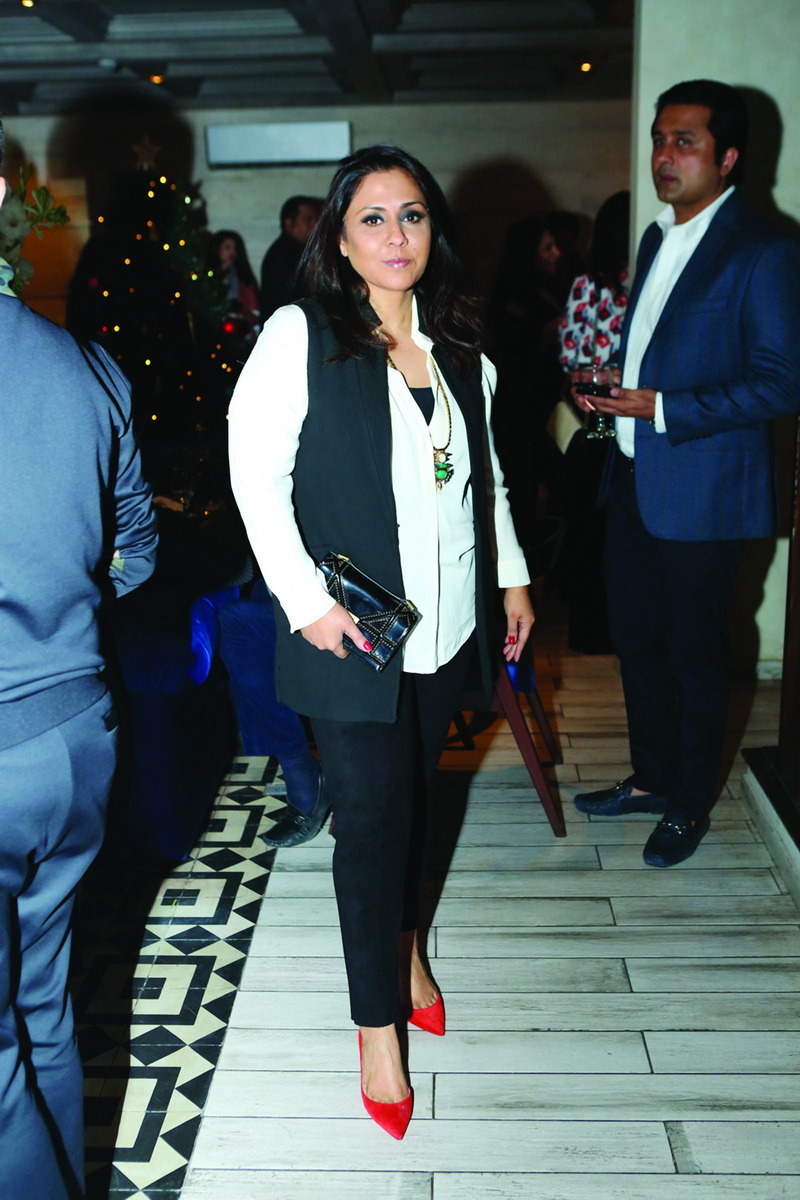
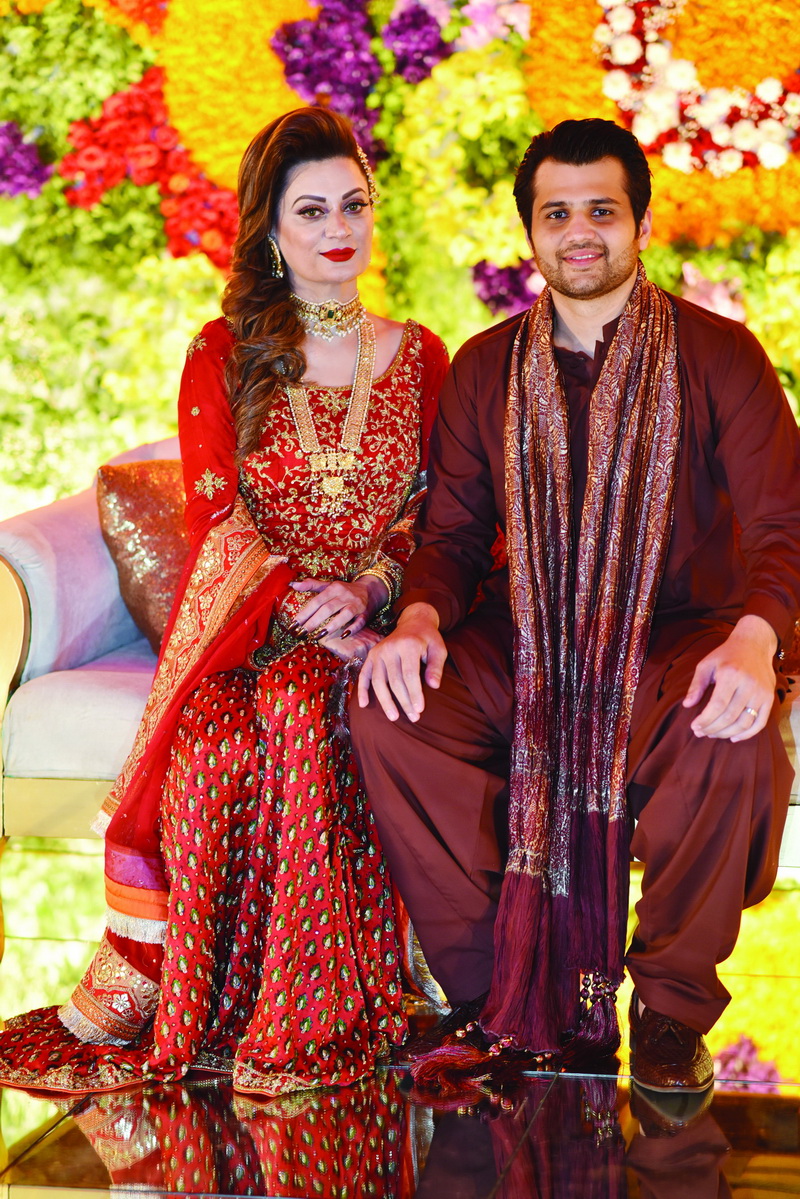
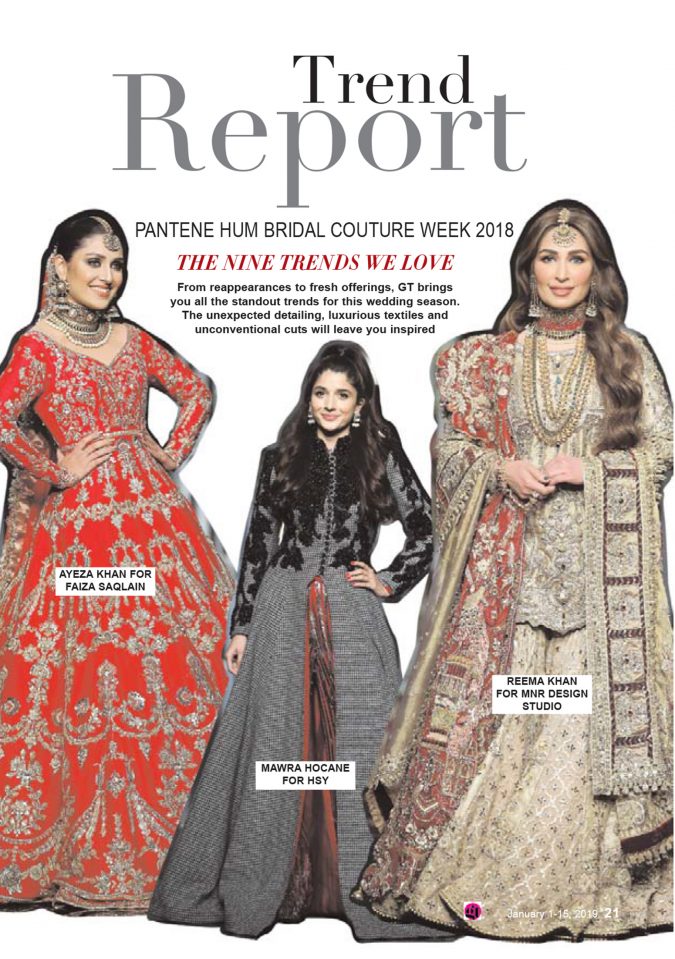
Since the party/ wedding season is in full swing, let’s first talk fashion. On the desi front, many of the 80s and 90s stalwarts, like the peshwas, tasseled dupatta, longer kameeze and shalwars, from the wide pancha (cuff) ones to cowl and full on dhoti, have been brought back by designers after the recent successful revival of ghararas, angarkhas and tulip style shalwars, albeit in a more tailored form. On the western front, corduroy is also back from the 70s and 80s, though its wales are more plush and luminous and the fabric is softer. Cleverly, fashion designers reimagine and change up the style enough so you can’t really pull out your old clothes from their mothballs, but have to go out and buy the new version. With the glut on the high street of fast fashion and over-priced bespoke wedding outfits, designers are scrambling for fresh ideas and one easy way is looking to the past for inspiration, change it up a bit and serve.
In this our last issue of the year, we catch up with Farhan Saeed and Urwa Hocane as they celebrate their second wedding anniversary. Ramsha Khan tells us how she managed to turn around her acting career after her debut movie didn’t even make it to the big screen. Peppy Anmol Baloch and Sonya Hussain share how they traverse the tumultuous path of social media as celebs. And lastly, but certainly not least, artist Sana Kazi teaches us about Islamic art.
On a personal note, this is my last issue as the editor of Good Times. I had a great experience keeping in touch with all the GT readers. The New Year will start with a new editor working to bring you interesting stories from the world over. Take care. I’ll see you around.