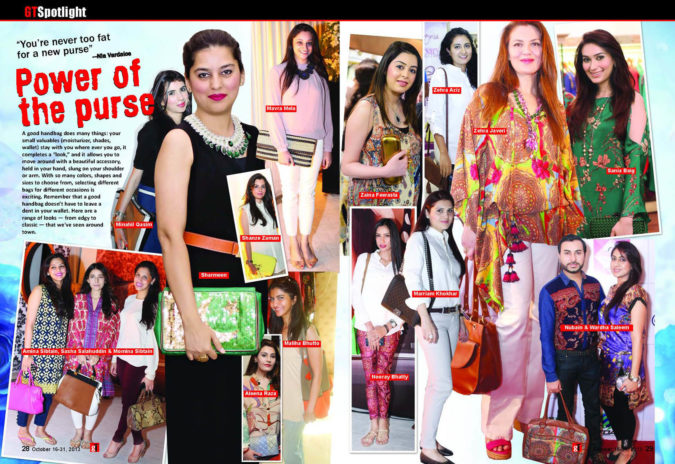

A good handbag does many things: your small valuables (moisturizer, shades, wallet) stay with you where ever you go, it completes a “look,†and it allows you to move around with a beautiful accessory, held in your hand, slung on your shoulder or arm. With so many colors, shapes and sizes to choose from, selecting different bags for different occasions is exciting. Remember that a good handbag doesn’t have to leave a dent in your wallet. Here are a range of looks — from edgy to classic — that we’ve seen around town.
—Nia VardalosÂ


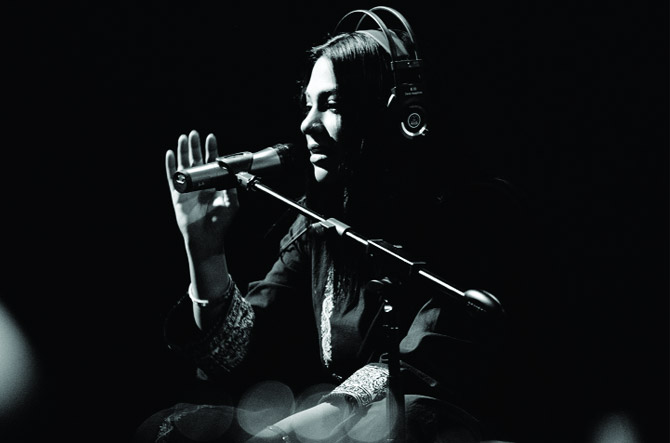
[fdropcap]A[/fdropcap]fter much insistence to please not bother with tea, I was served cold and refreshing aab-e-zamzam and dates from the umrah from which Sanam Marvi has recently returned. I began by asking Sanam ji about her childhood and the path that led to her becoming a Sufi musician. Sanam’s father was a Sufi singer and is a devout fakeer of Hazrat Shah Abdul Bhitai. Growing up in Hyderabad, Sanam Ji accompanied her father to the darbars of Sufi saints and attended the performances of very talented and spiritually powerful Sufi musicians. She got classical training from Ustad Fateh Ali Khan of the Gwalior gharaana and began singing at the age of seven. She serenely told me, “I pray for Pakistan, and I pray for our people. I urge more are more people to read Sufi kaalam and to read books by Sufi mystics and there will be more peace and calm in their lives.”
When Sehwan Sharif calls, Sanam goes. She works hard to give a performance that resonates with love and respect
At a UNESCO summit that took place recently in Tashkent, out of 80 singers from 80 different countries, Sanam ji won the first prize. It was a great moment of pride for her as the flag of Pakistan was hoisted high. Sanam is fluent in Siraiki, Sindhi and Punjabi. When you meet her, she appears to be a genuinely humble woman, true to the values of the long-standing Sufi tradition of peer and fakeer. She told me, for example, that she is not worthy of the knowledge she has gained, and has much more to learn. Spoken like a true Sufi gulukaara.
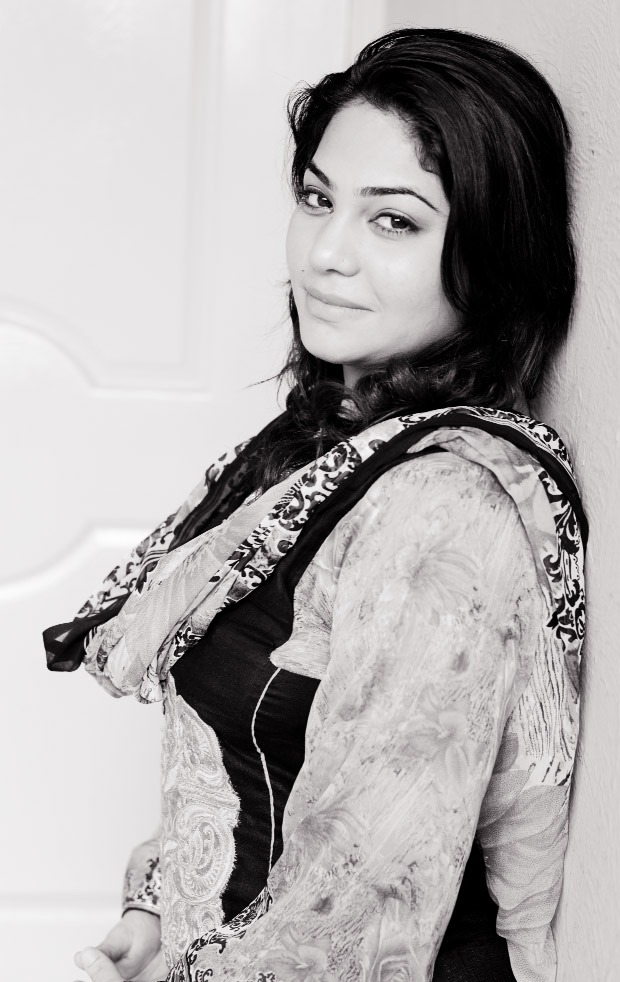
Sanam attributes her appearances in the PTV’s Virsa Heritage program as the moment when her career started. Virsa Heritage has been instrumental in the promotion of Pakistan’s Sufi poetry and has been able to portray the verse in such a way that young and old listeners alike enjoy it. It is because of shows like this, and Coke Studio, that we are beginning to see aspiring musicians come to the fore.
‘I do not know understand why ustaads nowadays do not pass on their education? When they have the honour of being the caretakers of this treasure, why would they take it with them to the grave?’
“Mian Yusuf Salahuddin is like a father, like a murshid,” Sanam ji told me. It was with the support and encouragement of Mian Salli, coupled with the exposure Sanam received from the Heritage program that she branched out to bigger ventures. Her performances at Coke Studio are beloved of Pakistan’s youth. Her Sufi-qawwal music has earned her vocal appearances in Bollywood films such as London Paris New York and The Dirty Picture. She is routinely invited to Sufi festivals and has toured France and Morocco as well.
Sanam joined Coke Studio in 2009 when they were producing their third season, and her powerful, rich voice was an immediate hit. She will appear in the much-anticipated sixth season that features musicians trained in both contemporary and traditional instrumentation. When asked about Coke Studio and the dynamic between everyone, she says that it is much like a family; everyone is caring, there is education and input and a back-and-forth that is quite magical. The improvisational nature of the performances has led the musicians to evolve and work together. Sanam ji told me she admires and respects the founder of Coke Studio, Rohail Hyatt. “He is always keen to listen and suggest ways of improving,” she says. “He treats me like a younger sister.”
Riaz, or practice, is something that Sanam is diligent about. Being a mother of two, as well as staying true to her musical talent, is not easy. She says she has immense support from her husband and her children. “If they weren’t with me, I would not have reached where I am today.”

She cooks, maintains her household (very nicely I might add), and is a loving wife and a national musical sensation. “To keep a good home and to give my children a good life is my duty.”
And then she must perform at the darbars. Sachal Sarmast’s shrine holds ‘Sufi Mela,’ where Sanam has an obligatory performance every year at the urs. For her it is part of her religion and of her worship. Shah Abdul Bhitai’s shrine holds a similar mela every year where Sanam sings the sacred verses of the Sufi saints. She also goes to the urs of Bedil and Bekas, a father and son from the pious family of Rohri who have upheld the Sufi traditions of the generations before them. And when Sehwan Sharif calls, she goes. Her attendance at the Lal Shahbaz Qalander urs is mandatory, she says. She works hard and meditates in order to give a performance that resonates with love and respect.
‘In 2009, when I had only just gotten started, Yusuf Sahib gave me the most shocking of surprises: I found out I was to be singing alongside Rahat Fateh Ali Khan’
When asked about artists she has most enjoyed working with, Sajjad Ali’s name crops up. “It was such a dream to have worked with him. He is a kind-hearted person who gave me respect and knowledge as one would to a shaagird.” The same way, she mentions working with Rahat Fateh Ali Khan as a wonderful experience. “In 2009, when I had only just gotten started Yusuf Sahib gave me the most shocking of surprises: I found out I was to be singing alongside Rahat bhai.” Of course, she has sung alongside Shafqat Amanat Ali, Arif Lohar and many others.
When asked if she would venture into pop music or perhaps the likes of Noor Jehan covers, she responded no. “I have the voice for Sufi poetry and it is my wish to continue to sing our Sufi kalaam.” Currently, Sanam is working on an album in India featuring Reshma ji’s songs. “Roots2Roots is a company in India that I have signed with and it is through them that I am recording the album featuring all of Reshma Ji’s classic songs with some improvisation of my own.”
With regards to the state of education of classical music in our region, she says musicians from the most knowledgeable gharaanas say that this art must die with them. “Knowledge only grows by passing it on” she says. “I do not know understand why ustaads nowadays do not pass on their education? If you are teaching Raag Aimen, you have to teach everything about it — what are the waadhi and samwaadhi surs, when is it sung? When they have the honour of being the caretakers of this treasure that has been passed down, why would they take it with them to the grave?” More power to Sanam ji for asking these questions.



[fdropcap]D[/fdropcap]o you remember the early-90s? Before the era of supremely-arched eyebrows, “rosy†complexions and the overly made-up bridal look? Shazad Hafeez, who styled Pakistan’s first crop of models—Aaminah Haq, Iraj, Vinnie, Bibi—fashioned minimal, natural looks for each of these models. The 90s was a decade of high excitement and low anxiety. Shazad, who trained as an engineer and ended up a hair stylist, was at the forefront of makeup in this glorious decade.
An aspiring engineer, Shazad never took hairdressing seriously. Back in the 80s, people from comfortable backgrounds did not become hairdressers, he told me when I visited him at his home in Defense. Respect and credibility seeped into the profession as it became more lucrative. “As with most professions in Pakistan,†Shazad said, “Where there’s money, there’s respect.†As a result, hairdressing has slowly become ‘legit.’
By 1995, the Pakistani model had acquired a dramatic, filmy look—inspired by India’s Filmfare and Cineblitz Magazines
The aesthetic appreciation of hairstyles in Pakistan, however, has always been the same: we opt for naturally beautiful, luscious, thick long hair, whether it is set off by the classic chuttiya, or styled more naturally.
When Shazad was getting started in the mid 90s, hairstyles from the West – sharp silhouettes and daring partings – were rolling in. Shazad had trained in New York, and he had a refined, educated aesthetic. It was only when Western styles slowly made their way to Pakistan that people actually found a need, for the first time, for high-end hairdressers. The growth of Chinese-owned salons brought in new styling; the influence permeated to makeup as well. The porcelain doll and geisha look, that had been the standard for brides all through the late 70s up to the early 90s, was being replaced with something more real. “To whitewash the bride,†says Shazad, “And then paint on the features, this does not appeal to an educated mind.â€
Aaminah Haq called me one day and said, ‘Make me a model. I want to be on the cover of every fashion magazine in the country’
 Shazad trained extensively at prestigious salons all over Manhattan, including Vidal Sassoon, the Toni and Guy Academy, and Bumble and Bumble before settling on a salon in Greenwich Village called Damian West, where he worked for nine years. Quickly, Shazad found himself having to choose between styling shoots and doing salon work. It was after he styled a shoot for Playboy magazine that he finally made the decision. He remembers the day well: the stylist scheduled for the shoot was double-booked so the salon where Shazad worked decided to take a chance and send Shazad. “The model’s name was Vera,†he told me. “She was a 25-year-old from Sweden, and as soon as we were acquainted, the photographer came in to inform me that Vera was to be ready in 15 minutes! I just did whatever I used to do—I did the hair and the makeup and it was fine. Vera walked on set and the photographer declared, “Perfect! That’s exactly what I had in mind.†At that moment, Shazad thought to himself: I can either be a stylist, doing fabulous shoots all over the world, or I can choose the reliability and solidity of a salon. He opted for salon work and has never looked back.
 He moved back to Pakistan for five years, from 1993-1998, went back to New York from 1998-2012, and he’s back again, indefinitely, this time for both personal and professional reasons. He’s looking after his father, while also doing makeup and styling at Madeeha’s salon in Lahore.
“I am a simple person,†he told me. “I like working with simple people and clients, some of whom have been with me for 20 years or maybe more now.†In 1993 Pakistan, as the beauty and fashion industries were taking off, Shazad found he was able to do both styling and hairdressing, attending more and more to bridal clients, as bridal makeup at this point had become a strong addition to his already burgeoning skill-set as a stylist.
Of his time in New York he reminisces, “I had bridal clients in New York that would call me to check with me first if I was available before setting their wedding dates!â€
During the five-year stretch in Pakistan, Shahzad styled TV shows, Lux Style ki Duniya as well as maintaining a roster of private clients. He worked with the pioneers of Pakistan’s modelling industry—Vinny, Iraj, Aamina Haq, ZQ. “Remember,†he says, “When modeling was a relatively new industry, there was very little competition. It was all about ijaazat. If you had ijaazat, they would paint your face.†He says the professionalism in the industry has now created space for healthy competition.
Back then, he says, most women in Pakistan were not ready to cut their hair. “In Pakistan, women have a fear of chopping off their hair. In India, modern hair-styling is part of fashion and beauty. But not here. Half the women cover their hair, most of them are averse to cutting it—so you don’t have many options left. Only a very small minority is into serious hair-styling.â€

I wanted to know more about what the Pakistani fashion and modeling industry was like back then. After all, Shazad worked closely with some of its biggest names.
“Aaminah Haq called me one day and said, ‘Make me a model. I want to be on the cover of every fashion magazine in the country.’†The phone call kickstarted the beginning of Aaminah Haq’s career. “She understood my creativity,†he says. “I worked with her more than any other model. We started in 1993, working with photographers who now have huge empires of their own.â€
![go6]](http://www.goodtimes.com.pk/gtmain/uploads/2013/10/go6.jpg)
 By 1995, Shazad says, the Pakistani model had acquired a dramatic, filmy look—inspired by India’s Filmfare and Cineblitz Magazines. “They were soft-focus images designed to make the model look five shades lighter,†he smiles.
Shazad did many fashion shows, including one in which HSY was introduced for the first time. It was an exciting time to be in Pakistani fashion and hairstyling. By 1998, Nabila and Tariq Ali had arrived on the scene, deepening and enhancing the industry’s approach to makeup.
That’s when he left for New York, to pursue the type of techniques he had always found more interesting: experimental, avant-garde, creative. He worked in Manhattan for 14 years, perfecting the skills in the city he had first learnt them. Shazad moved back to Lahore in 2012 and works now at Madeeha’s salon. He says he is back for an indefinite period. For someone who has lived a remarkably varied life, Shazad has levelheaded advice for those thinking of getting into hairdressing: “Get an education in something useful. Then pursue what you want after having grounded yourself and gotten your bearings right.â€


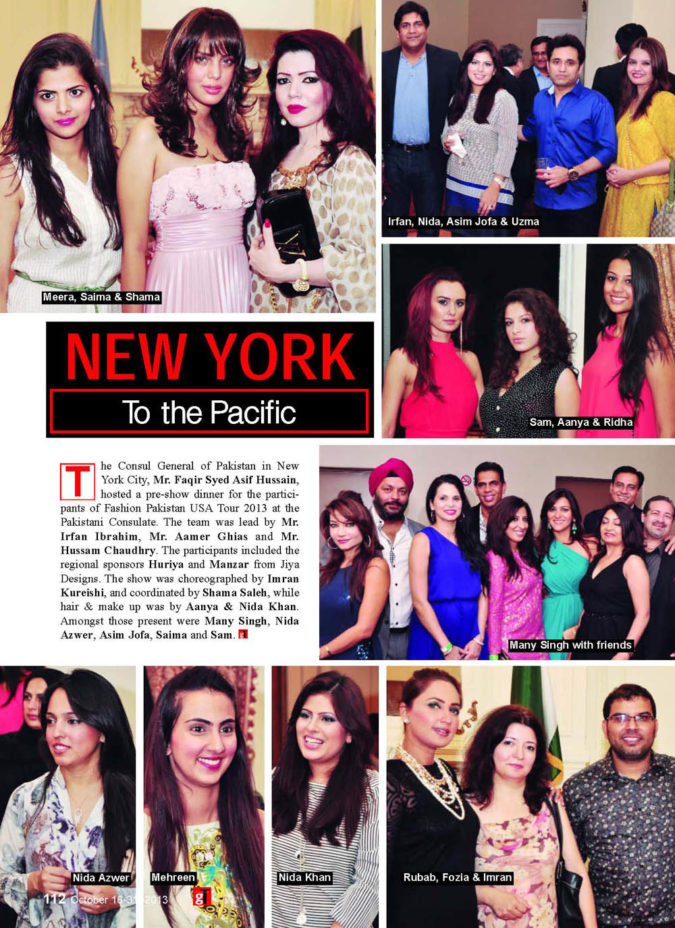
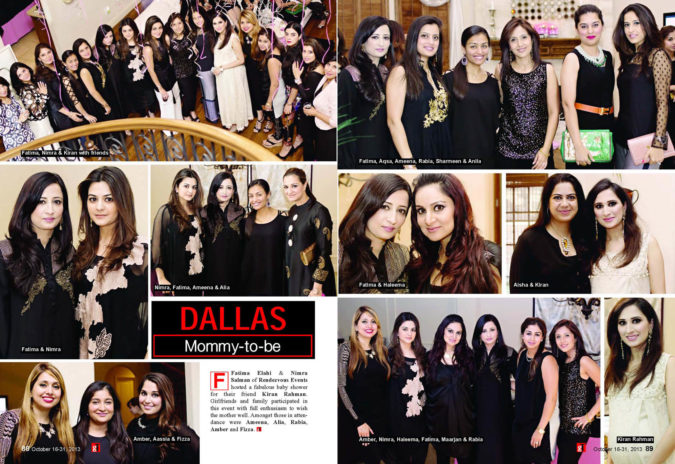
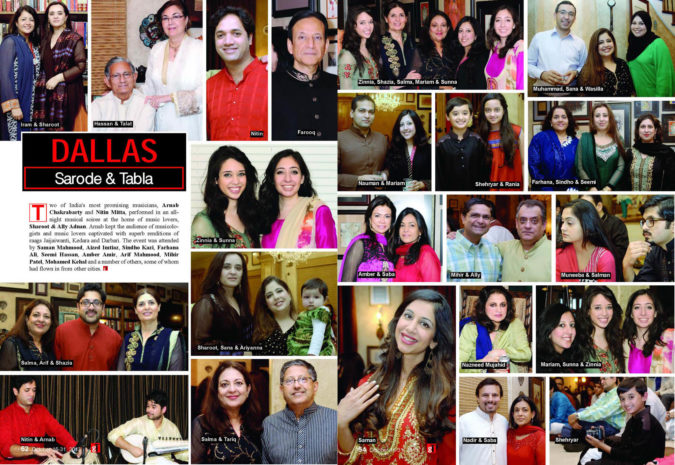

 Komail at his desk, with one of his pieces from last year in the background
For Komail Aijazuddin, a deep affinity with art was something he had been born with. Developing a relationship with painting, however, came later in his life. Growing up, Komail’s parents were quick to see that he demonstrated extraordinary ability as an artist. When they first saw his drawings at age four, it was instantaneously decided that Komail would be enrolled in art classes. During vacations, the family would take trips to museums — when other upper-class Pakistani families were taking their kids to Hamley’s, the biggest toy store in London. In his summer vacations, he studied with Colin David. But art was still a distant and seemingly obscure idea to Komail. It wasn’t until he went to college — in Canada and later in the US — that he began to see art as a profession. “My parents are art historians and collectors, so I grew up with a lot of paintings around the house,†he tells me when I meet him in his studio in Lahore’s St. John’s Park. There are oil paints all over the main room where he works, with motivating inscriptions on the wall. His gorgeous red-and-gold-leaf paintings are stacked against the wall (Komail will show his new work, which includes a stunning jharoka, at Khaas gallery in Islamabad from September 17 to 28).
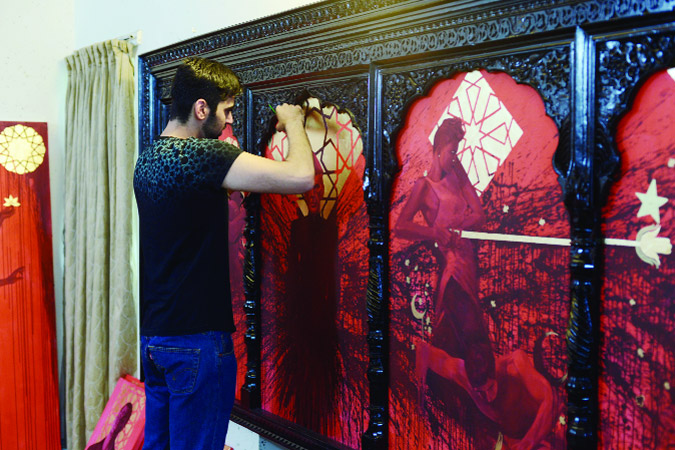
 Komail with his newest work, most recently exhibited in a solo show, “Red & Gold,” at Khaas Gallery in Islamabad
After Komail received his distinction in Art in the O Levels, he received two gifts from his father. The first was a sketch of Colin David, from the artists days at Slade. The second was a trip to Italy. His father took him to Rome to see the Vatican and the Sistine Chapel, with its iconic ceiling painted by Michelangelo.
During their vacations, the family would take trips to museums when other upper-class Pakistani families were taking their kids to Hamley’s, the biggest toy store in London
At college, Komail began in the liberal arts, but quickly made a switch to art history when he transferred from McGill to New York University. “The more I studied Art History, the more I realized that artists think differently and happen to be good at being able to read the history of art and distill information in a way that is different from most people,†he tells me. He studied Art History as a rigorous program that constituted mainly Greek and Roman art. Thus, in following, he began a string of stints in art and other creative pursuits.
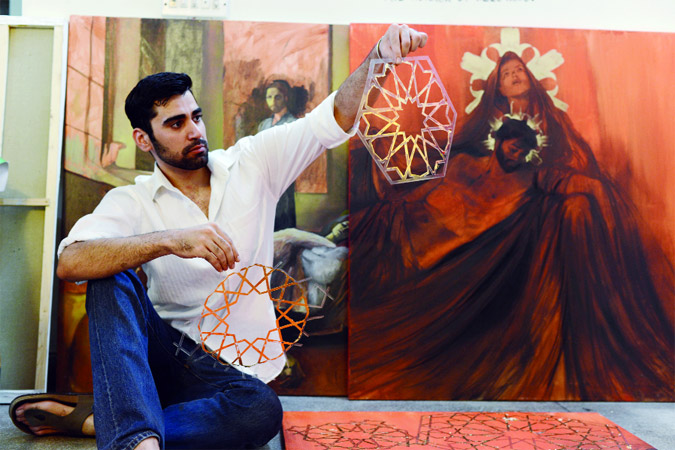
After a year of having worked for Amnesty International, he tested the waters and worked briefly at a magazine. “Writing was also something I really wanted to do because I write as much as I paint.†Komail was 21, in New York, and couldn’t see what it was that he really wanted to do. He worked at a gallery, an auction house, wrote about art, in addition to working as a theatre critic. At the age of 22, after having done a whole host of desk jobs, he had an epiphany: “If 9-to-5 is a very large part of your day, for the rest of your life, it is imperative you do something you really, really enjoy doing. And it seems arrogant, but whatever someone else will pay you to do something you don’t like is not often worth it.†Komail bit the bullet and enrolled in an MFA program at Pratt University in New York.

He realized that he became more and more interested in painting. “I started including the application of gold-leaf to my painting process and I started doing it as therapy almost,†he says. “I had stopped painting for a long time between 18 and 21, which for a painter is a long time. I felt this great betrayal for some reason. And the only way to rationalize that betrayal was to paint about it.â€
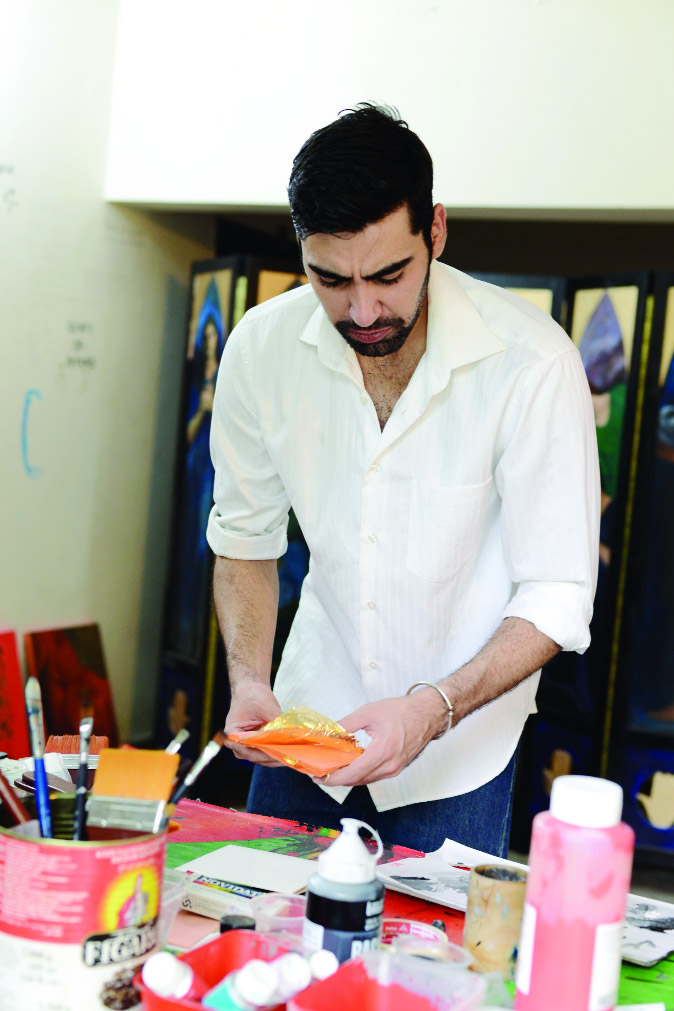
As one of the highlights of his career, at the end of grad school, Komail spent a year dealing in art and working in an Israeli gallery. It was a fun time in his life but for Komail it was clear that the microcosm of the art world would continue to exist in Brooklyn or in Chelsea. In other words, it was not relevant to him. The strength of his identity and earliest influences made him see that the art world and market in New York were self referential, academic and deeply rooted in American and Western Art History.
I probed Komail to tell me more about Pakistani Art. “I don’t know about Pakistani Art or artists, I think about Art in Pakistan,†he says. “I don’t know if we’ve developed a definition for Pakistani Art and what that is,†he says, with his classic mix of skepticism and intelligence. “The — isms of the west came and influenced our part of the world later, like reruns of old TV shows, but also in a way that was interpreted by local artists that resulted in distinctly different formal elements from the — isms from which they were derived.†He traces a lack of indigenous movements in Pakistani art as a problem. “The followers of influential artists are what make an art movement. Colin David doesn’t have followers right now in the way he should. I have adored his work and I will be a big proponent of it for the rest of my life.â€
‘I’m wary of the fact that Pakistani Art is topical right now because the country is war-torn, and as long as that continues, there will be an interest in it’
The strongest and oldest painting tradition of our region, to date, is that of miniature painting. With eastern techniques, the work is measured and thoughtful and skilled. “You try and imbibe something from whatever community you’re in but at the same time, painting is not a team sport,†says Komail. “It’s important to be aware of how you are considered and what other people are doing in this country, yet it is not a team sport,†he says, outlining the inherent contradictions of being an artist — a fundamentally solitary process, with years of history stretching behind you.

Komail attributes the dearth of more groundbreaking movements in Pakistani art to the sheer lack of painters. “Creative people from different industries can get grouped together under the same banner if they aren’t enough of them in their respective fields to advance individual schools of thought. The local Pakistani scene has little or no presence in the international Art world when it comes to galleries and curatorial prowess. If you go to Art Dubai or the Venice Biennale or Art Istanbul, you won’t find a Pakistani gallery there. There may be dozens of Pakistani artists, but almost no galleries from Pakistan, which speaks volumes.â€
 He has spent time understanding his relationship with Pakistan to solidify his own appreciation of creating work in the country. He uses traditional techniques that could only be made by local Pakistani craftspeople. The jharoka stands out in his most recent work as a distinctly South Asian element.
‘I have adored Colin David’s work and I will be a big proponent of it for the rest of my life’
After finishing up a show, Komail takes a breather, a small vacation or a short stint of doing absolutely nothing. It’s the well-deserved reward for someone who has bared their soul, creating art in a studio alone, day in and day out, with only one’s own thoughts and routine load-shedding as accompaniments! Later, once the work is out, “to defend and market your work can really churn your insides — from the time of the creation of the pieces till when they are sold,†he laughs. The good news is that Komail takes his painting seriously. It is a profession. “The risk of failure is high and truthfully and simply, artists should know where their strength lies. The other great thing about art, he says, is that “it’s a platform from which you can attack lots of different things. But I’m wary of the fact that Pakistani art is topical right now because the country is war-torn and as long as that continues, there will be an interest in it.â€
 Komail walks GT through his various processes
“The jharoka,†he continues, “is craft, but art here in Pakistan it is not only on a wall, it’s utilitarian. There is use to it. There is a tremendous amount of philosophy behind Islamic Art for example that is not based on craft.â€
I leave the studio in a bit of daze, having just been given a frighteningly intelligent and considered tour of Art History, and particularly the place and development of Pakistani Art in it. “You do what you do and if you do it well, your work will do well because at the end of the day, you have to defend yourself. My advice for painters is to tell the truth in their work. The closer you get to the truth, the better people respond to it. It is a brave thing to do, and it is not an easy thing to do in a country like Pakistan.â€
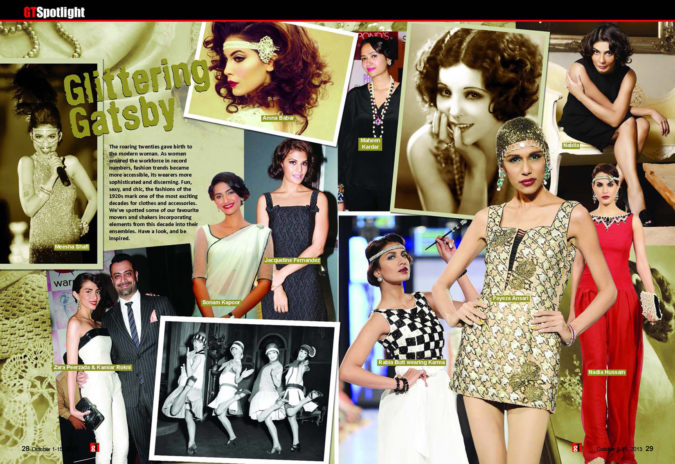

The roaring twenties gave birth to the modern woman. As women entered the workforce in record numbers, fashion trends became more accessible, its wearers more sophisticated and discerning. Fun, sexy, and chic, the fashions of the 1920s mark one of the most exciting decades for clothes and accessories. We’ve spotted some of our favourite movers and shakers incorporating elements from this decade into their ensembles. Have a look, and be inspired.
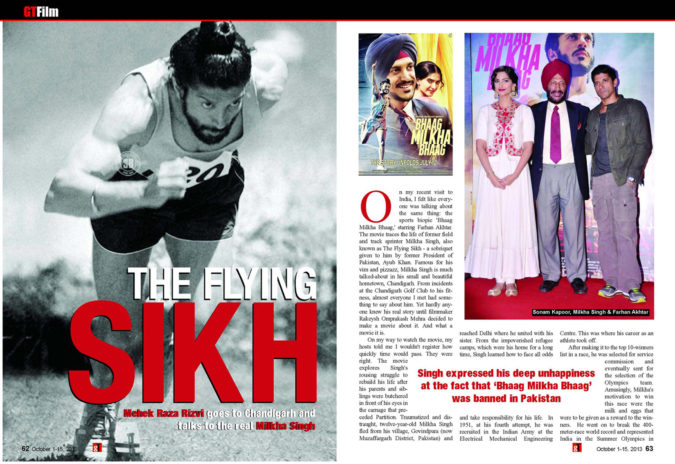
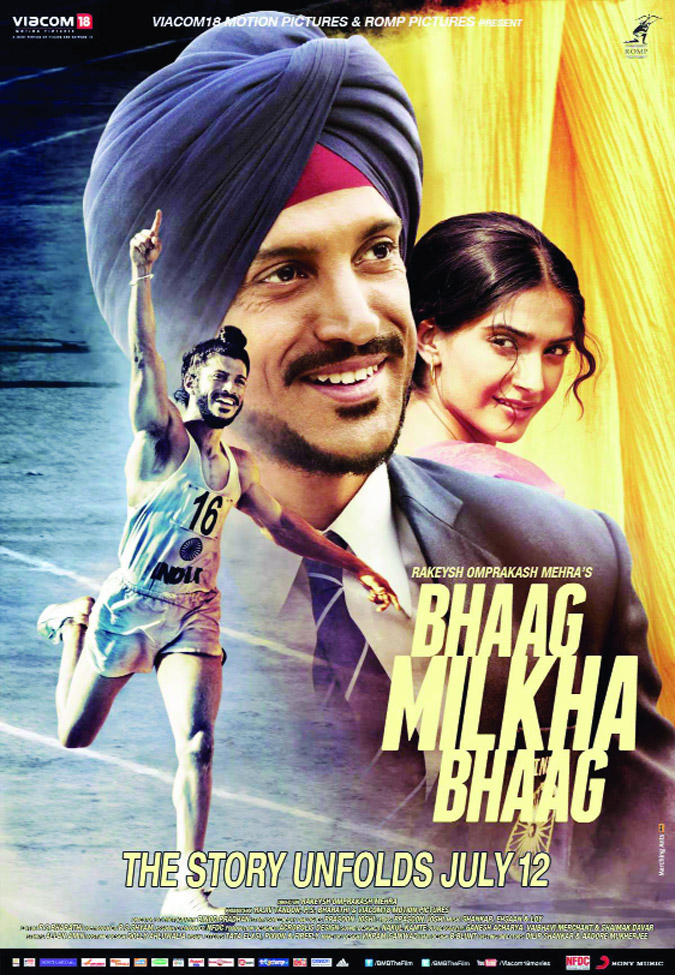
On my recent visit to India, I felt like everyone was talking about the same thing: the sports biopic ‘Bhaag Milkha Bhaag,’ starring Farhan Akhtar. The movie traces the life of former field and track sprinter Milkha Singh, also known as The Flying Sikh – a sobriquet given to him by former President of Pakistan, Ayub Khan. Famous for his vim and pizzazz, Milkha Singh is much talked-about in his small and beautiful hometown, Chandigarh. From incidents at the Chandigarh Golf Club to his fitness, almost everyone I met had something to say about him. Yet hardly anyone knew his real story until filmmaker Rakeysh Omprakash Mehra decided to make a movie about it. And what a movie it is.

On my way to watch the movie, my hosts told me I wouldn’t register how quickly time would pass. They were right. The movie explores Singh’s rousing struggle to rebuild his life after his parents and siblings were butchered in front of his eyes in the carnage that preceded Partition. Traumatized and distraught, twelve-year-old Milkha Singh fled from his village, Govindpura (now Muzaffargarh District, Pakistan) and reached Delhi where he united with his sister. From the impoverished refugee camps, which were his home for a long time, Singh learned how to face all odds and take responsibility for his life. In 1951, at his fourth attempt, he was recruited in the Indian Army at the Electrical Mechanical Engineering Centre. This was where his career as an athlete took off.

After making it to the top 10-winners list in a race, he was selected for service commission and eventually sent for the selection of the Olympics team. Amusingly, Milkha’s motivation to win this race were the milk and eggs that were to be given as a reward to the winners. He went on to break the 400- meter-race world record and represented India in the Summer Olympics in Melbourne (1956), Summer Olympics in Rome (1960), Asian Games in Tokyo and the Commonwealth Games in Cardiff.
Singh expressed his deep unhappiness at the fact that ‘Bhaag Milkha Bhaag’ was banned in Pakistan
He was also awarded the Padma Shri which is India’s fourth highest civilian order. Out of the 80 races he has participated in, he has won 77 and owns numerous medals, trophies and awards. However, his ultimate brush with success and global recognition did not come effortlessly. He trained tirelessly to increase his stamina and skill. His coach Havildar Gurdev Singh guided him through a training regime so intense that sometimes the young athlete would vomit blood. But mentioning his fatigue, bruises and injuries would be like detailing the everyday.

After the movie ended I knew I had to meet this man in person.
Two days later, I found myself sitting in Milkha Singh’s drawing room for an interview arranged by a dear friend (who happens to be Singh’s neighbor). Larger than life, gracious and genial, my host greeted me with a huge smile and offered refreshments. Around twelve journalists had just left his house and more kept calling throughout the course of our interview. After exchanging pleasantries I expressed my utter shock at how similar he looked to Farhan Akthar in the movie. “Yes, I get that a lot,” Singh laughed. “One of my daughters met Farhan while the movie was being shot and was just as stunned. Farhan is a wonderful actor and has worked very hard for this movie.

He’s done a great job.” I couldn’t agree more. Farhan Akhtar outdid himself. His performance was convincing and impassioned. I asked him how much of the movie is actually true and he told me it was complete truth. One of the most endearing parts of the movie was Milkha’s love affair with Biro, played by Sonam Kapoor. When asked about Biro, he smiled. “When you’re that young love is a very fascinating thing. She used to come to a tube well nearby to fetch water and I would follow her.” This romance however did not last as Biro got married to someone else and Singh got busy with his newfound love for running.

Milkha Singh got married to Nirmal Kaur, former captain of the Indian Women’s Volleyball team in 1962. The couple first met in Ceylon in 1955. Together they have three daughters and a son, Jheev Milkha Singh. Jheev is a renowned professional golfer and the first Indian golfer to make it to the European Tour. Clearly these athletes form a family of high achievers.
After exchanging pleasantries I expressed my utter shock at how similar he looked to Farhan Akthar
Singh expressed his deep unhappiness at the fact that Bhaag Milkha Bhaag was banned in Pakistan. “If you watch the movie rationally you will realize that in no way does it put Pakistan down. I was left scarred after my family was butchered right in front of my eyes, isn’t that natural? The movie depicts my sentiments at that time truthfully. This doesn’t mean I think of Pakistan as an enemy. I’m sure a lot Pakistanis my age went through the same trauma during partition, so they would understand this best. That was just not a good time.”

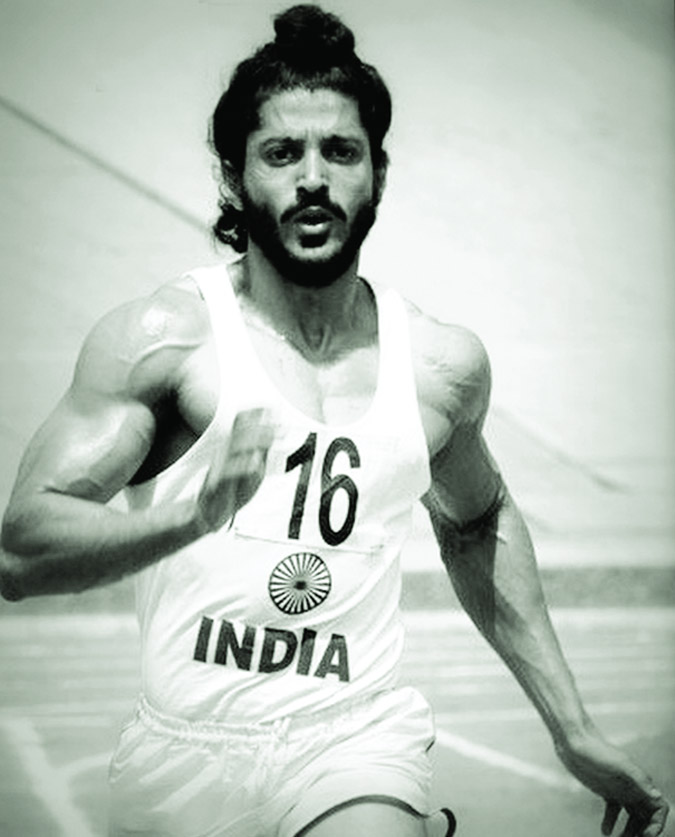
Talking about Abdul Khaliq, the Pakistani sprinter he beat in 1960, Singh shared that during the 1971 war when Khaliq was imprisoned, he went to meet him and made sure he was treated well.
 “When you return to Pakistan please give my message to everyone back home. I am very fond of Pakistan,” he said. “I was born in Pakistan and it is where I got the title ‘the Flying Sikh.’ After my race in Pakistan against Abdul Khaliq, President Ayub Khan told me that I did not run, I flew, and gave me this appellation.”
Milkha Singh has lived an inspirational life from which both Indians and Pakistanis can learn a thing or two. His discipline and passion are admirable and perhaps the key to his success and youthfulness. But most importantly, his story testifies to the fact that hard work and dedication go a long way.

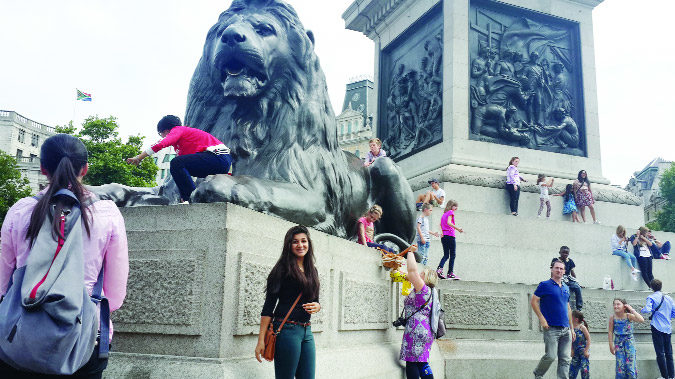
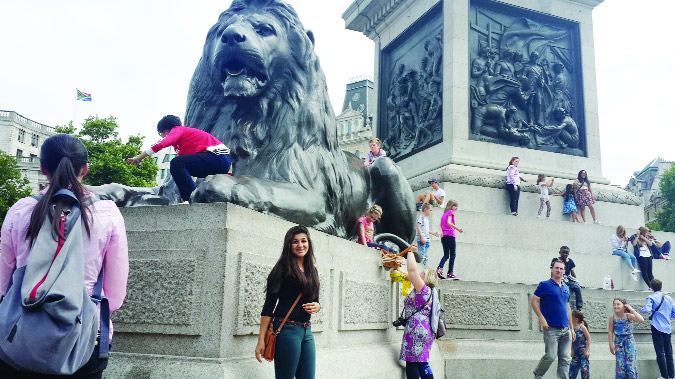
I’m back from my swanky vacation, and back into the swing of things. After a ten-day stint in Italy, I retired in good old Surrey for some much-needed R n R. How much can a girl party after all? Well, I flew to New York for the weekend to spend time with my buddies. Going to the US is a feat. I mean, isn’t everyone paranoid about Immigration in the US? The horror stories of people being interrogated for hours, some having to completely strip at arrival were made only too familiar by movies like “The Reluctant Fundamentalist†and “My Name is Khan.†After watching the “Welcome†video on American Airlines, I noticed that the same video ran at immigration. The Americans are really trying to ease tensions by presenting their “soft†image.

The video features a variety of Americans smiling and welcoming everyone to the US. It even has a hijab lady in it! Yours truly was equally nervous but I guess the Canadian passport worked magic. What did upset me was how my hand-carry bag was opened and a desi immigration officer randomly picked me just before boarding the aircraft. (Have you noticed that most immigration officers in London are desis?) She gave me a lecture on smoking but was most interested in my attire and shopping!

Now, there is no city like the Big Apple and one can’t do New York without a visit to the Metropolitan museum. I had been waiting to see the roof painting by Pakistan’s very own Imran Qureshi, and finally I got to see it. After lying down and posing on his painting I proceeded to see the “Chaos to Couture†exhibition. A low-key lunch at Bryant Park followed, after which I ran to dinner with Saqib Malik, Annie Ali Khan, and Mehreen Jabbar, downtown at the Bowery.
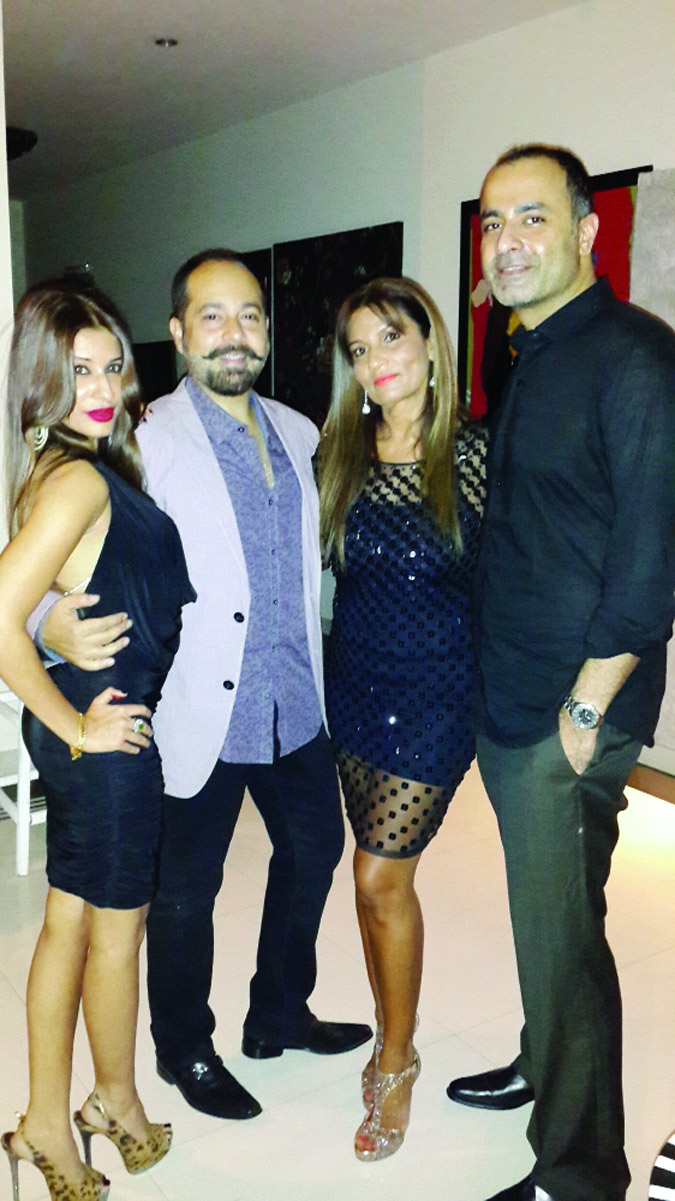
The next day I decided I had gone too long without detoxing. I took to the gym and decided to take advantage of the gorgeous view of the New York Palace hotel (made famous by the Gossip Girl episodes where it was used as their high school) and its view of the St Patrick’s church. More museum visits to the Guggenheim and Moma followed, after which I headed for rooftop drinks with Omar Rahim, my Guatemalan friend Douglas, Julia, and Saqib. I also squeezed in a play. “Sleep no More†was a treat. Set in a warehouse, it was one of those modern, interactive plays: one followed the actors and dancers through a series of rooms and halls!
The horror stories of people being interrogated for hours, some having to completely strip in arrival were made only too familiar by movies like “The Reluctant Fundamentalist” and “My Name is Khan”
Sunday was spent at Saks Fifth Avenue where I purchased my first Prada and Stella McCartney dress along with six other things. Maxing my credit cards, I took a flight to Toronto.

There is nothing like family. Seeing my brother, mother, niece, and daughter was a delight. My son had decided to spend his month in Scotland training for athletics. My poor brother was keeping 18-hour fasts and I found my mother addicted to “Wheel of fortune†and “The price is right.â€Â The weekend saw me check into Trump Towers. The annual Caribbean parade was spectacular and the evening was spent with friends Anu and Omar at the Prava club. The purely RED Russian-inspired club had pictures of Lenin and Stalin, they played the Russian national anthem and sang on top of the bar and tables. But, unlike New York, Toronto shuts its doors at 2am! The Louboutin Exhibition the next day, however, made up for Toronto’s general anemia compared to Manhattan.

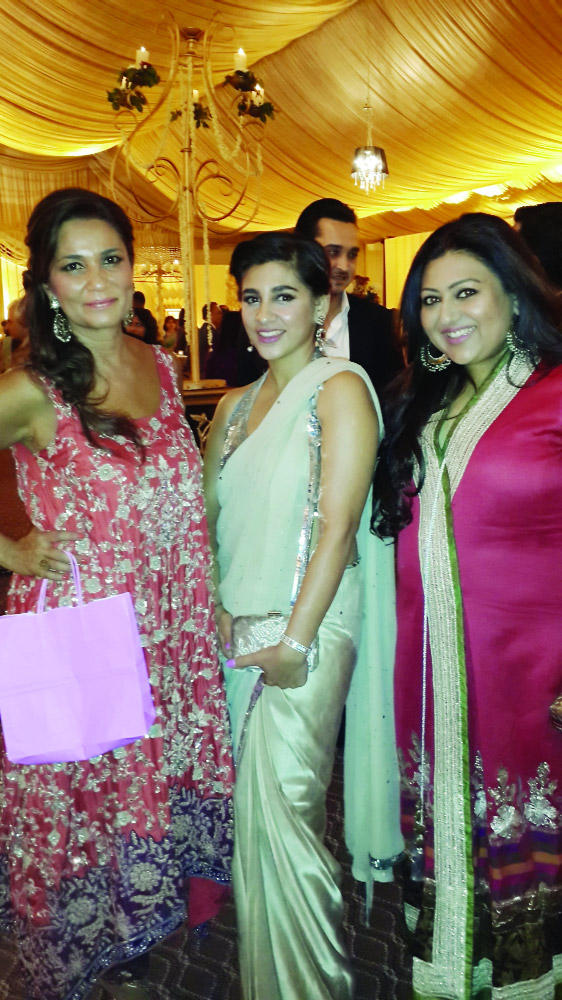
Heading to London I changed Parishes’ flight and took her to my friend’s place in Surrey. We dined at Ping Pong and spent the next day with my old friend Beena and her daughter. Finally, arriving in Pakistan I found my cell phone blocked! It appears the idea to put my cell-phone on roaming, from Europe to the US, took its toll. Deepak and Syma took me across to my friend Sadaf ‘s 40th birthday, which was done in style. I then ran to Feeha Jamshed’s wedding party and back to Sadaf’s for nashta: New York may never close down at night but neither does Karachi. After that, the jet lag kicked in and there was little sleep. But Feeha’s mehndi was fantastic. I dished out a 22-year-old Faiza Samee sari, and gauging from the complements, it looked as good that night as it did more than two decades ago.

I dished out a 22-year-old Faiza Samee sari, and gauging from the complements, it looked as good that night as it did more than two decades ago

This has to be the season of birthdays. I spent a lovely afternoon with Maria Wasti’s at Café Flo. I can’t get over how handsome Sikander, Florence’s son, is. Methinks I could produce a show like “the Bachelor†and put all the handsome guys of Pakistan in it!

GT friends, my tenure at the social diary is over for now. I hope you’ve enjoyed my rants, raves, flights of fancy, and of course, updates on the lifestyles of the rich and famous. You will still see me in GT as I intend to keep being photographed and event-planning. Adios for now and remember to live it up!


Even when our surprisingly-packed flight from Dubai touched down at Rome’s Fiumicino airport, I couldn’t fathom that Rema and I were actually in Italy. It had seemed just yesterday that this plan was a complete khyali palao — a plan for some unknown future time that we were not likely to reach.
But after the persistent and never-ending harangues of a friend, the greatest advocate for Italy there is, we were electrified into action. A few flurried days of calls to travel agents, and visa offices, as well as a couple of dozen visits to booking.com and lonelyplanet.com, and we were ready for our Great Escape from a load-shedding-inundated, politically-frustrating, nothing-seems-to-go-right and altogether exasperating Lahori summer.
We were ready for our Great Escape from a load-shedding-inundated, politically-frustrating, nothing-seems-to-go-right and altogether exasperating Lahori summer
From the outset, we were comfortable in Italy. Italians seem very much like Pakistanis in their love of life and of food, and especially in their concept of la dolce far niente — the sweetness of doing nothing. An alluring, relaxing aura was palpable as soon as we stepped into Rome’s city centre. We were further comforted by our incredible housekeeper Maria at our Bed & Breakfast — she left no stone unturned in making us feel truly at home at Urbana 33, a B&B we chose for its proximity to the train station, but in which we absolutely lucked out: it was lovely, as well as clean and modern.
 We set off for food almost as soon as we arrived, walking around the pleasant piazzas (squares) and streets nearby. That night I enjoyed the most incredible funghi (mushroom) pizza I’ve ever had. Throughout the rest of my trip I tried every pizza I came across, and none matched my first taste of Italy. After picking up a requisite gelato cone at a neighborhood gelateria (I had planned on trying the chocolate gelato in every city I visited), Rema and I walked to the colosseum — the colosseo — a mere 10 minutes from where we were staying. It was terrifically grand, especially at night, all lit up. And yet, ironically I suppose, it was also peaceful.
We were escorted to the train-station the next morning by our efficient housekeeper who made sure we were safely on our way before we said our regretful goodbyes!
Florence: Firenze. I cannot overstress the splendor and magnificence of this veritable open-air museum. At every turn, at every corner, all one sees is beauty, history, the Renaissance, art. And of course, tourists! Everywhere there are people, families with children on leashes and dogs in prams (yes!) and group tours, but it is not unpleasantly crowded, not by a long shot. August, apparently, is when peak season slows down.

Since we arrived on a Monday, and the museums were closed, we had the entire day to explore. Our hotel, Residenza Gambrinus, was right on Piazza della Repubblica, dead centre of the city and a five-minute walk from just about any of the main museums or sites.
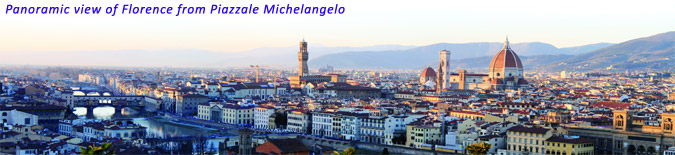
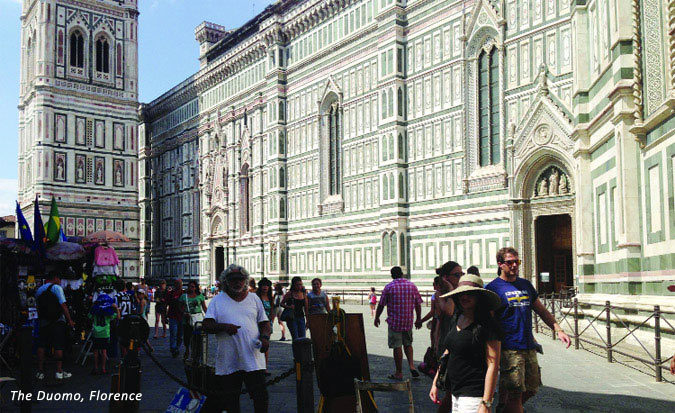
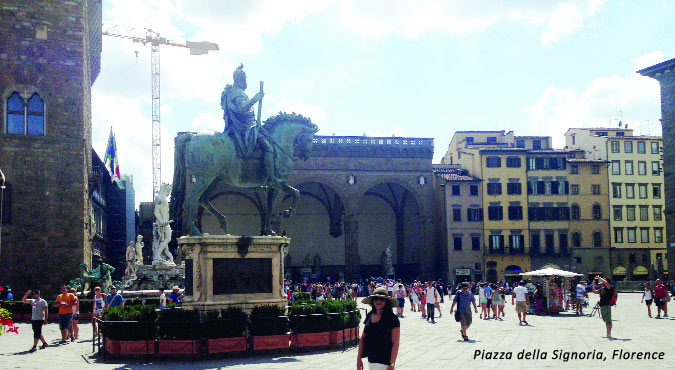
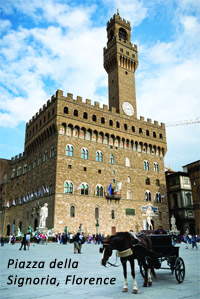
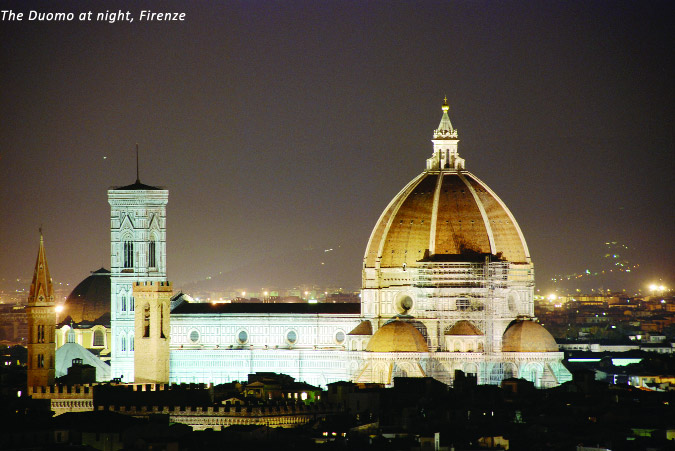
Florence is truly a city to get lost in; there are treasures at every bend. The il Duomo; the Piazza della Signoria with its open-air sculpture gallery, Ammanati’s Fountain of Neptune, and Palazzo Vecchio (the ancient seat of Florentine government). One can go on and on. Florence is a tangible masterpiece.
Italians seem very much like Pakistanis in their love of life and of food, and especially in their concept of ‘la dolce far niente’ — the sweetness of doing nothing
Another of Italy’s masterpieces, of course, is its cuisine: the mouthwateringly-baked bread, dough and pasta; newly-picked basil and moist, juicy, tangy tomatoes. There are no adjectives to describe how tasty the tomatoes in Italy are. Florence is no exception to this.
 In the evening we asked our concierge to direct to us to a place with a more “local” feel of Florence. He sent us to Negroni, across the Arno River and about a 20-minute walk from our hotel. This was by far one of my favorite food experiences in Italy. Unbelievable spaghetti. We spent hours on the outer terrace, taking in the ambiance. After dinner, we walked up the many steps to Piazza Michelangelo, and were treated to a panoramic night-view of Florence.

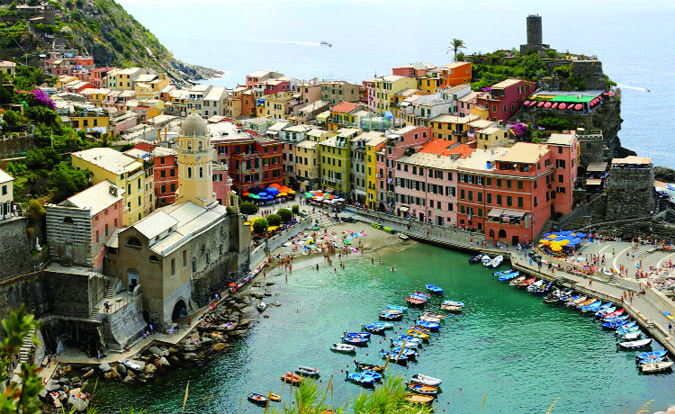
The next day we were off again for a day-trip to the coast. We caught a train and a few short hours later found ourselves in a wonderland patch of blue and green. We had arrived at Monterosso al Mare. This picturesque village on the Italian Riviera embraces its rugged terrain and cool water. We spent some time losing ourselves in its charm, including the winding streets and tiny stalls. This is definitely where the Italians escape to beat the summer heat. Eventually it was time to eat again! By sheer luck we sat down at Enoteca Internazionale. Again, I cannot overstate how good the food was. The seafood, particularly the antipasti al mare was utterly fresh as was our usual fare of spaghetti and pizza. Finally, it was time to hit the water, which was cold, but perfect to beat the heat of the simmering August day.

By the time we got back to Florence, it was time for dinner. Steak is a specialty here, and we ventured out to get some Bistecca di fiorentina. Rema and I were pleasantly surprised that even on a Tuesday night, people were out and about till quite late.
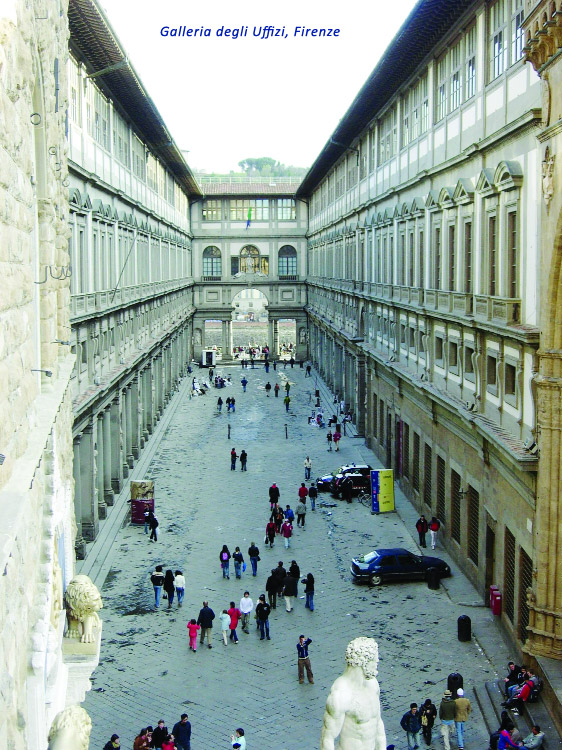
We came out of the museums a bit stunned: did we really just see works by Titian, Raphael, Da Vinci, and Michelangelo? Did ‘Art History’ just come to life?
The next day we finally decided to take on the museums —the Uffizi and the Galleria dell’Accademia. Although Rema and I were prepared for long queues and a crowd-filled day, it took us all of two minutes to get our tickets and enter. If you have the energy and the concentration span, I definitely recommend a tour. We came out of the museums a bit stunned: did we really just see works by Titian, Raphael, Da Vinci, and Michelangelo? Did ‘Art History’ just come to life?

After Florence, we were off to Siena. The convenient SITA bus deposited us in Siena a short while later and immediately, I was blown away. The town oozes charm. While not as extravagantly beautiful as Florence, Siena, in its delightful and unassuming way, was even lovelier. Everyone here was more relaxed, strolling through the cobblestone streets, just breathing in the magical medieval air. For the third time in a row, we were blessed with a great hotel (Hotel Duomo) and an energetic concierge.
He directed us to a great place for dinner, where we tried Siena’s specialty — Picci pasta — a kind of thick spaghetti. Again, it was one of the top contenders for my favorite meal, although it’s so hard to choose. Afterwards, we walked up to the astounding gothic Duomo, and then down to the Piazza del Campo, the main square, where the furiously-contended horse-race, the Palio, is held twice a year. On this night, however, with mandatory gelato in hand, the Piazza was just peace: people lying on the ground, looking up at the moon.

The next day cemented Siena as one my favorite European cities thus far. We roamed around, taking in the architecture, and after an hour or two we realized we had covered the length and breadth of the city a few times. We walked into a shop where a lady sat painting spectacular porcelain plates by hand. I glanced at the plates with intricate Italian names painted on them. I laughed and pointed one out to Rema. It said Nadia. Rema is the only person in the world who (for reasons known only to her) calls me Nadia. Suddenly she points to one nearby. “Remo” it says. And I am the only one of Rema’s friends and family who calls her Remo. We were stunned and delighted. To us, this was a sign from Siena: this was exactly where the two of us were supposed to be at that moment.