Category

GT Archives

Category

Kiran Chaudhary Amlani on witnessing the happiness of two people in love

gd1

Moving between India (where I now live) and Pakistan (where I still go back for work), I find myself constantly marveling at the opportunities that exist for cross-border collaborations in almost every field. Nowhere is this more obvious than in the realm of the aesthetic. Pakistan has a very refined sensibility in the creative space, whether its fashion, art or music.

We have seen how people all over the world love Coke Studio, how Sufi music is making waves worldwide, how New Yorkers flocked to see Imran Qureshi’s ‘Roof Garden’ commission at the Metropolitan Museum of Art. Pakistani fashion designers have made headlines internationally, the most recent example being a fashion show in Paris this month by the likes of HSY, Kamiar Rokni, Mohsin Ali, Muse, and others. Our creative pioneers are finally getting much-deserved recognition at the highest levels.

gd2 gd4

675

Although many Indians would still prefer to buy Indian masters, purely as an investment with an appreciating price tag, the fact that Pakistani art was of such high quality and so well-priced definitely made it an attractive proposition
gd3

gd5

gd25

These are all great honours for a country that is otherwise weighed down by the fight against terrorism. But perhaps more importantly, they are good indicators of how Pakistan can re-brand itself. I remember growing up in a Pakistan that was a safe and happy place to live in; there was a sense of pride and dignity in who we were. If Pakistan is to regain some of its lost self-esteem, the biggest opportunity lies in the realm of the arts.

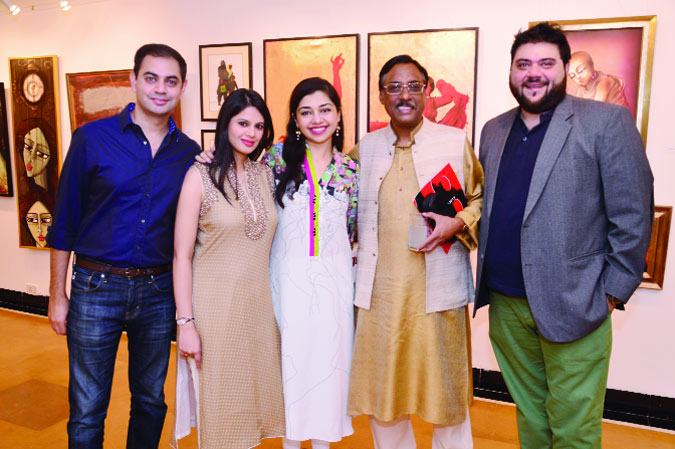
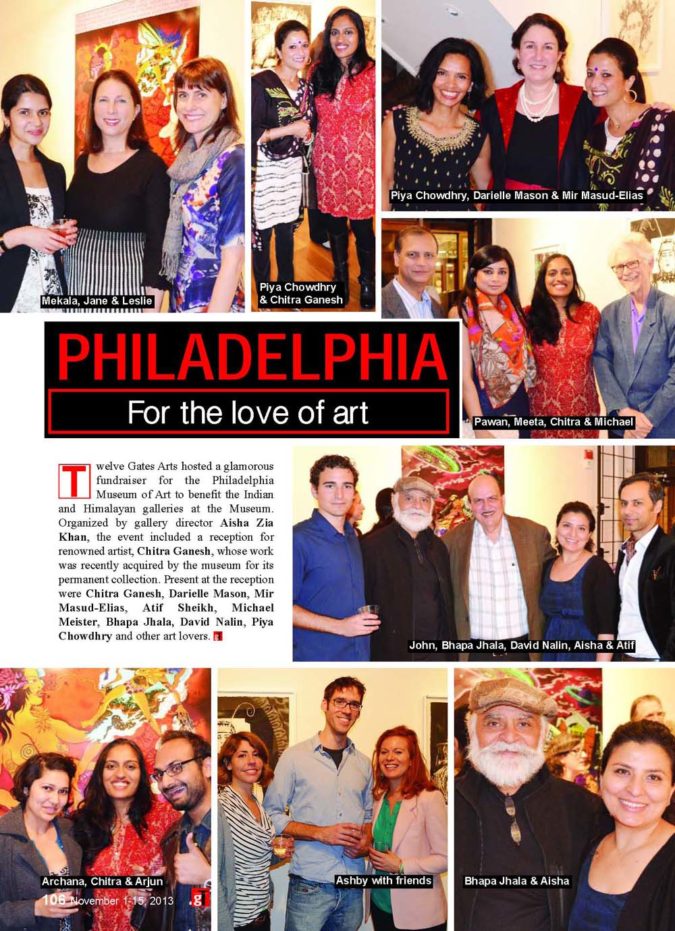
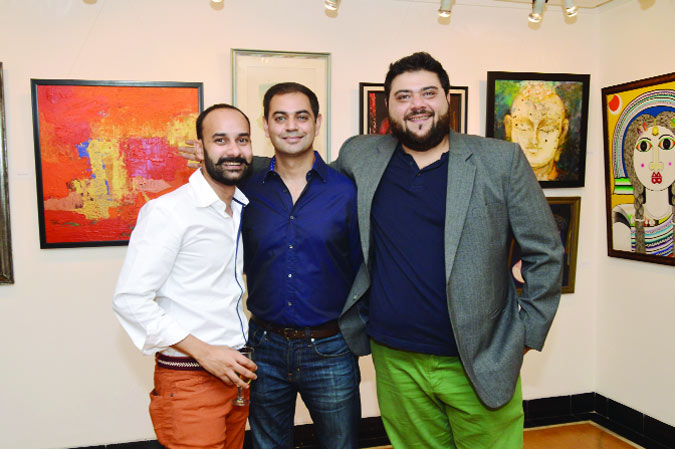
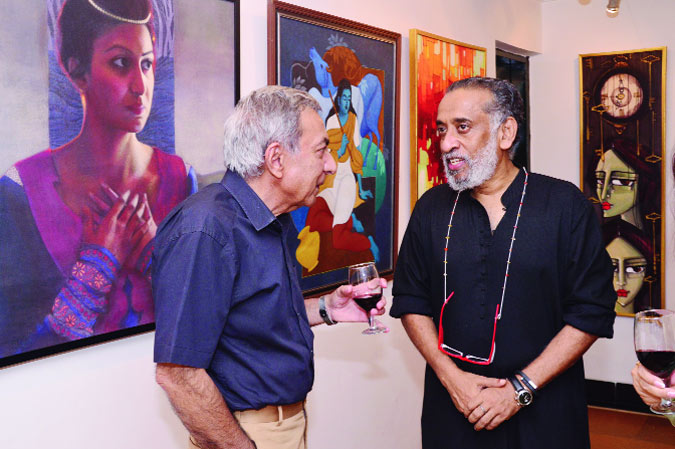
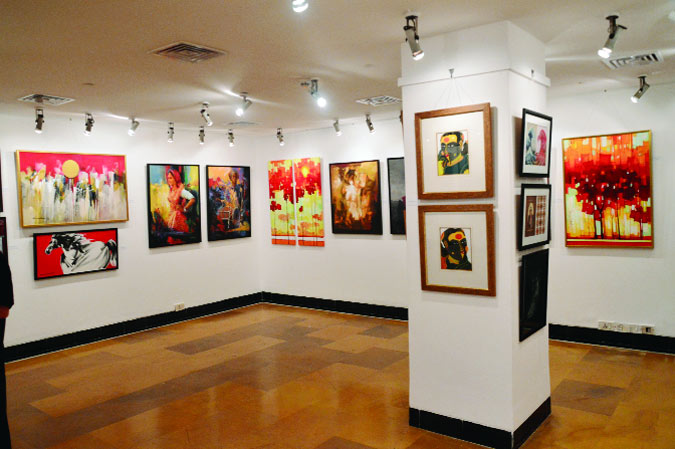
After the success of our multi-designer Pakistani fashion exhibition in Delhi in August, we decided to explore the art space as well. My husband Riyaaz’s business partner, Delhi-based Sid Mathur, and his beautiful wife Batasha Varma, had come to stay with us for a week or so in our seaside Bombay home. It proved to be a tremendously fruitful time, as we planned our very first art exhibition. It all began when they walked into my lounge and saw the Salman Farooqi abstract landscape on my wall. Both Batasha and Sid instantly fell in love with it (as most people do when they walk into my home). I then showed them some pamphlets from a gallery in Lahore showcasing some of the art coming out of Pakistan and they were both blown away. We decided that an exhibition in Delhi, featuring some of the best Pakistani art, would be a great idea. It just had to be done, if for nothing else than to show another narrative of what is happening in Pakistan right now.

I remember growing up in a Pakistan that was a safe and happy place to live in; there was a sense of pride and dignity in who we were. If Pakistan is to regain some of its lost self-esteem, the biggest opportunity lies in the realm of the arts

We decided to call the venture “Beyond Borders” and spent the next month or so sourcing some beautiful pieces from both India and Pakistan. The idea was to get the right people within the Delhi art circuit to come out through the lure of established Indian masters, and then to showcase some of the work coming out of Pakistan. Perhaps because the idea of an Indo-Pak art exhibition is so exciting for anyone in the art world on both sides, and also perhaps because artists and gallery owners are so supportive of each other generally, everyone was extremely helpful in making this happen.

gd7 gd8 gd9 gd10

gd11

Sid’s uncle is a gallery owner and helped us source some big names from India like Viakuntam and K. Ravi. My friend Sanam Taseer, of the Taseer Art Gallery, was an angel and personally took me on an amazing tour of some of the best galleries in Lahore and also lent me some gems from her incredible personal collection (amazing work by Dua Abbas, Amna Manzoor, Imrana Tanveer, Annem Zaidi, Yasir Waqas and Tahir Ali Sadiq). My friend Avantika Sujan — who I call ‘cupid’ because she introduced me to my husband on that fateful 2011 trip to Bombay that would change my life — lent me some prize pieces by Komail Aijazuddin and Salman Toor. Mahnaz Sukhera of Collectors Galeria was also very helpful in sourcing some amazing pieces from Mashkoor, M. A. Bhatti and Farrukh Shahab. My talented artist friends, Salman Farooqi and his wonderful wife Shazia Salman sent us some of their most beautiful pieces. While Salman Farooqi and Mashkoor were the bestsellers in India, Annem Zaidi, Yasir Waqas, Imrana Tanveer and Dua Abbas were hugely appreciated too.
gd12 gd13 gd14 gd15 gd16

All in all, despite the contemporary art scene in India being in a state of flux at this time, the exhibition was a big success. So many art collectors came out and expressed their excitement about the work coming out of Pakistan. Although many Indians would still prefer to buy Indian masters, purely as an investment with an appreciating price tag, the fact that Pakistani art was of such high quality and so well-priced definitely made it an attractive proposition. Naturally, the profile-building of Pakistani artists worldwide is critical, and already underway. It was heartening to see that in some small way, we had (quite literally) brought a beautiful piece of Pakistan to Delhi!

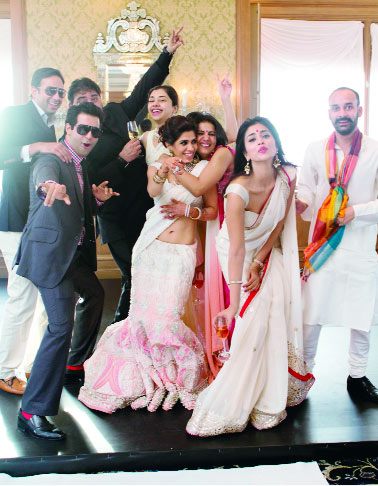
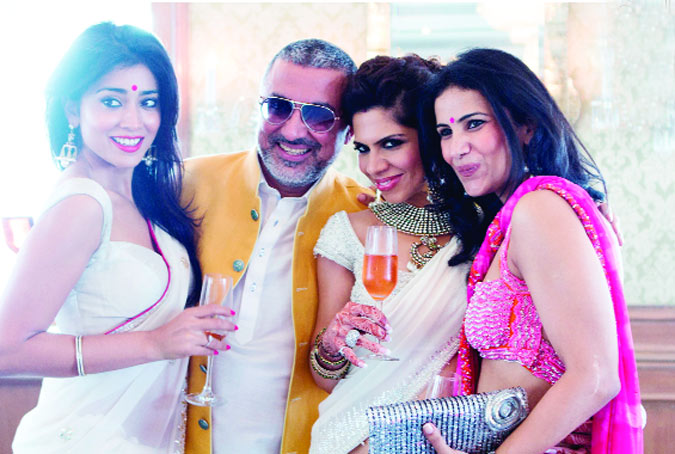
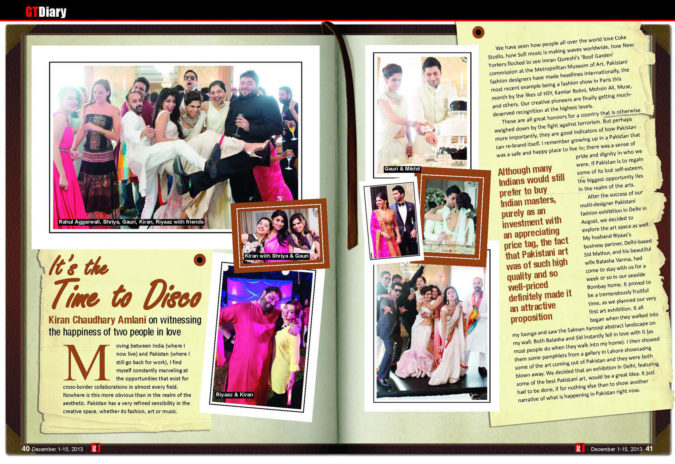
After all the work that always goes into an exhibition (making guest lists, inviting the right people, putting together the event, food and drinks) we were ready to let our hair down. As luck would have it, the wedding season had just begun and with several close friends of ours tying the knot, there was no lack of options to party.

The reason so many Indian girls have such amazing bodies is because they are usually on display. There is no way you can have anything less than a flat and toned mid-riff if you want to rock out in a ‘ghagara choli’

The exhibition wrapped up just in time for Hanisha Singh’s wedding to a lovely Parsi boy, Jamsheed Bhote. Hanisha is not only an amazing chef, but also Harmeet Bajaj’s niece (my partner in the Fashion business). She looked like she had stepped straight out of the 1920s and was every bit the ‘vintage’ Parsi princess in her gorgeous Sabyasachi saree and pearls. Suneet Varma, fashion designer extraordinaire, was also there and had all the family’s ladies looking fabulous in his creations.

gd18

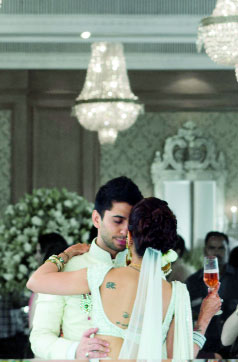
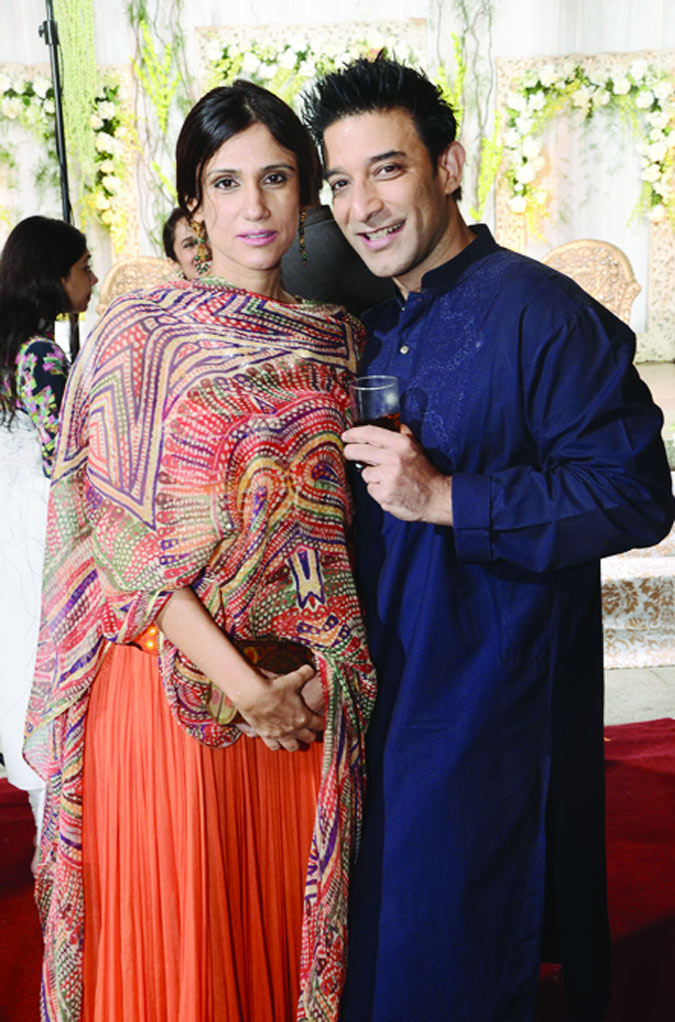
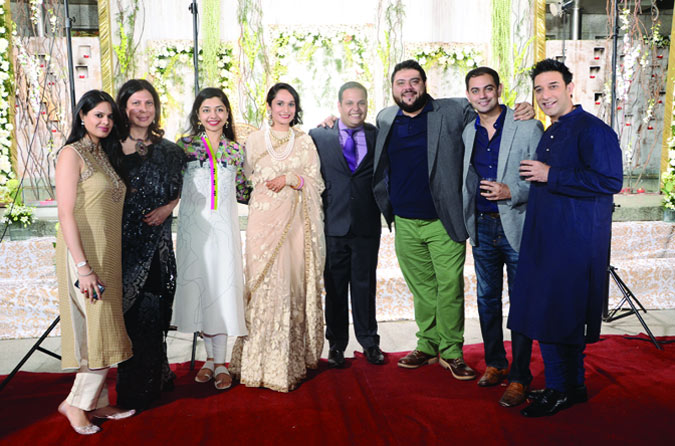
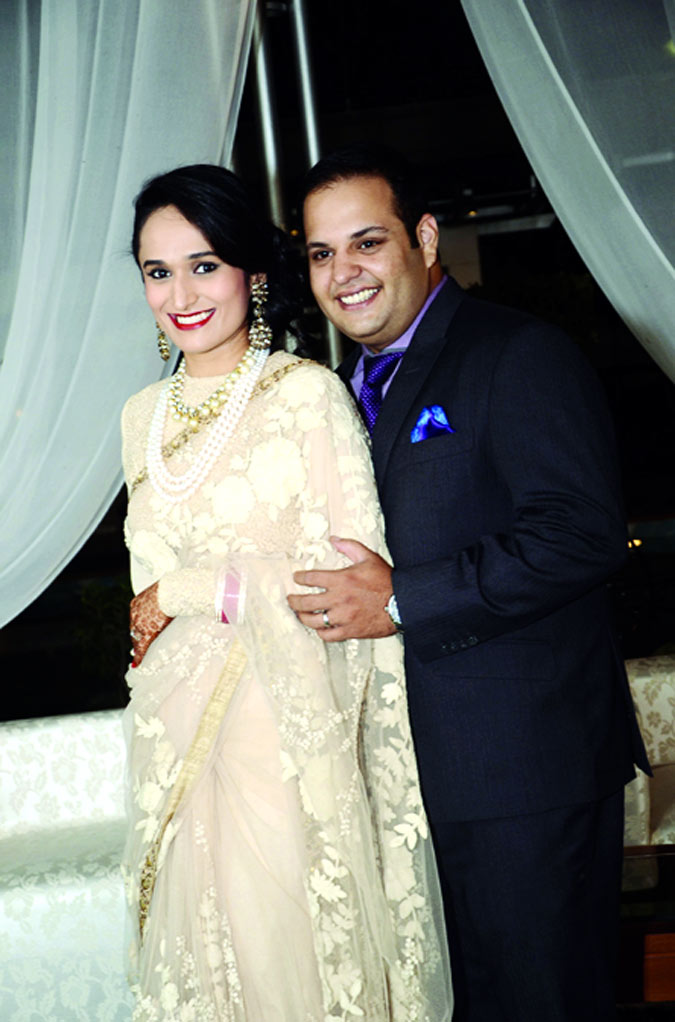
Next, Gauri Malhotra, one of my husband’s closest friends, also tied the knot with Mikhil Narang in a crazy, non-stop two-day wedding in Bombay at the amazing Taj Palace Hotel. Mikhil is another lovely Parsi guy who came back to India after several years in Paris, which gives him the rather attractive European suave that must surely have swept ‘G-Star’ (as Gauri is affectionately called) off her feet when they first met. He also, rather understandably, fell in love with this very sexy Punjabi girl who has the body of a goddess and a brain for business, being one of Bombay’s top PR ‘go-to’ girls. The two of them are so obviously in love that it was a treat to be part of this most intimate of nuptials.

During the reception, Mikhil’s aunt, a very dignified and well-spoken Parsi lady, spoke to me at length about how she longed to visit her own aunt in Karachi some day. She was worried that she might pass away before she would get a chance to see her again. When I promised to help with her visa, the excitement and gratitude that followed made me realize how tough it is, even for family, to connect with their loved ones across this most arbitrary of boundaries we call a border.

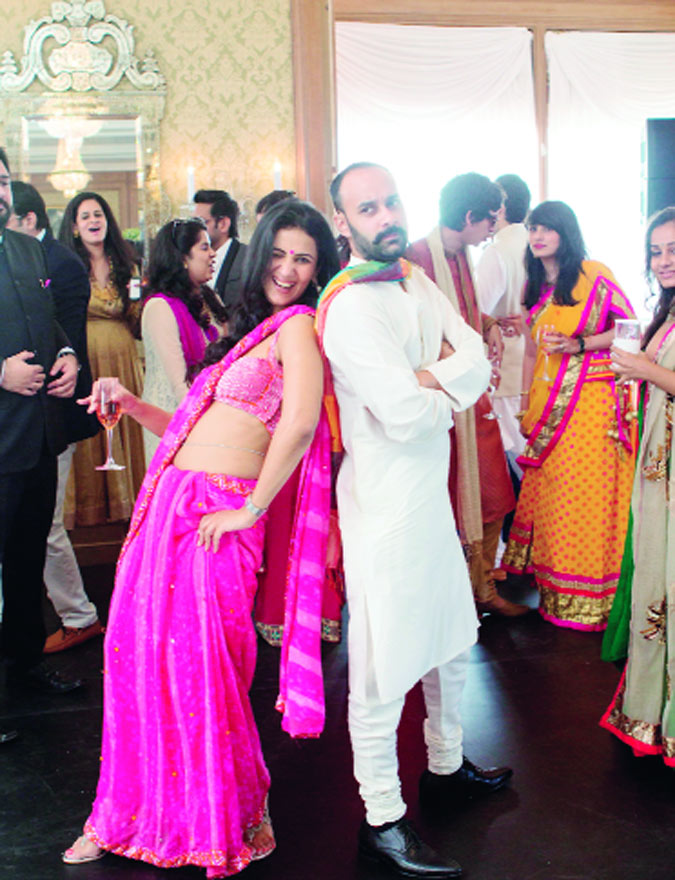
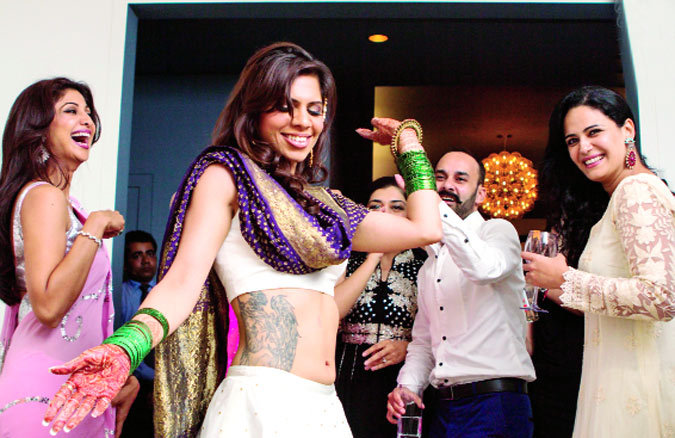
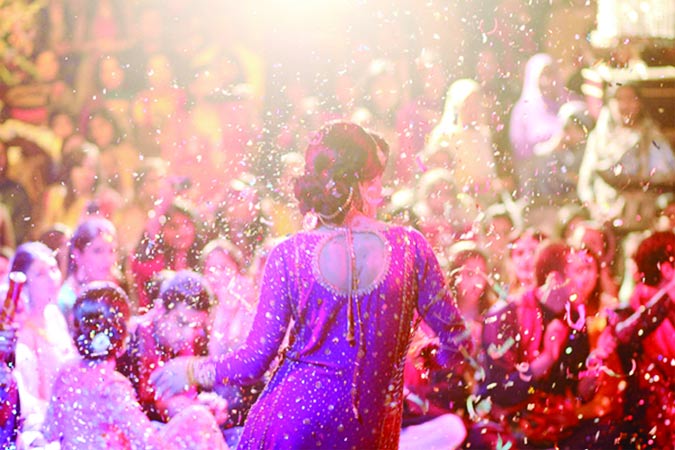
With these thoughts in my mind, I was easily distracted as everyone took to the floor for some rather crazy Bollywood dancing. I marveled at how absolutely gorgeous (and physically fit) Gauri looked in her tiny choli and low-cut lehnga. No doubt the reason so many Indian girls have such amazing bodies is because they are usually on display. There is no way you can have anything less than a flat and toned mid-riff if you want to rock out in a ‘ghagara choli’ which is usually the outfit of choice for girls at a Sangeet or Mehndi.

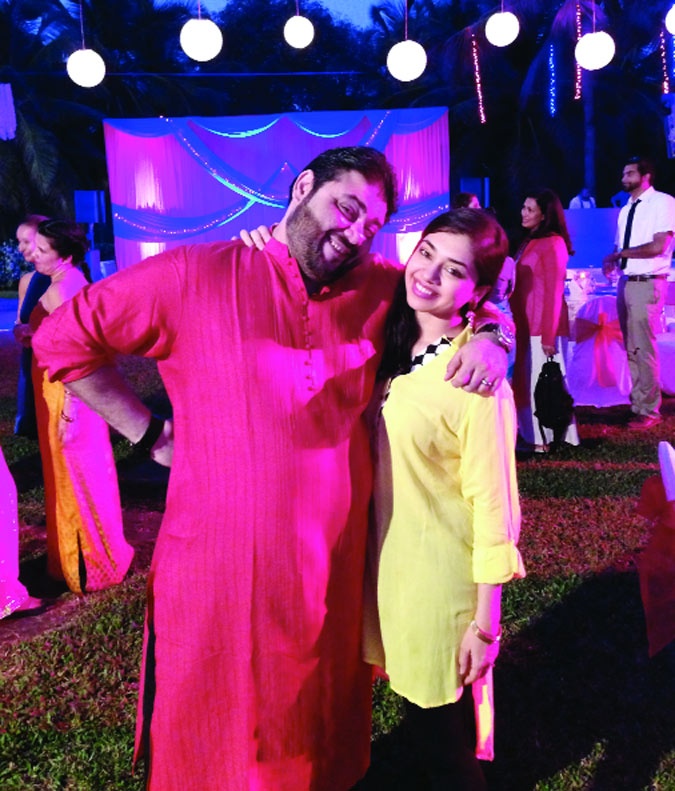
Just when I thought we were all partied out, we got the chance to relax in the most romantic setting imaginable for a wedding — Goa. Nadia and Varun’s amazing three-day wedding, set on the sprawling lawns of the Taj Vivanta in Candolim, was a truly magical experience. Varun is one of Riyaaz’s oldest friends, and it was quite the ‘old school reunion’ for the boys with the usual hilarious antics and anecdotes that only really old friends can share. Days were spent by the pool; the evenings were started with sundowners by the beach.
gd19 gd20 gd21 gd22

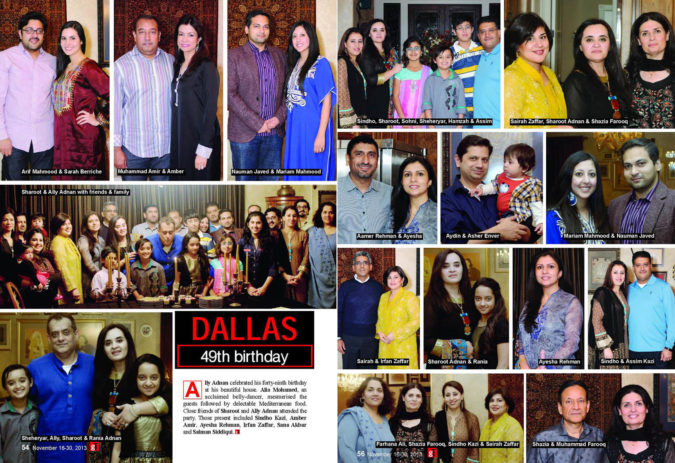
The first night we had an amazing Greek dinner at the fabulous restaurant Thalassa which became a mad ‘plate-throwing’ and dancing fiasco by the end (thanks to someone who decided to walk around with a tray of shots). The following day after the Mehndi, my husband got the party started at the Sangeet with his wicked dance moves, for which I suspect he is getting quite a reputation in both countries now.

The next evening was the Hindu marriage ceremony — soulful and magical. When I saw Varun and Nadia doing the ‘pheras’ around a fire, I could feel their bond, and I knew they were soul mates. Nadia was the love of Varun’s life (he has known her since college), but he was able to marry her only after waiting for many long years. When you meet Nadia it is easy to see why Varun would have fallen for her, and why he waited for her as long as he did. She is such a beautiful woman — strong, deeply spiritual, affectionate, drop-dead gorgeous and yet so down-to-earth.

I was left with a warm fuzzy feeling after all these weddings.  It is truly a joy to share the happiness of two people in love, uniting forever. But I have to say, when you throw in a beach, a pool and some sundowners it gets much, much better…

gd23 gd24

Makeup artist Leena Ghani is slowly shifting the conventions of bridal makeup

ms1

Walking into Leena Ghani’s studio in Lahore, I’m faced by a large canvas painting. As I look around, I see another and another. There are mirrors and lamps. But there’s hardly any furniture. Emboldened in the moment, I ask if she has plans to add furniture. “I like the place to be a wide space with lots of room to walk about and space to stare into,” she says. Spoken like a true free spirit. When Leena moved her studio from London to Lahore, she brought much back with her, not just great paintings.

You might recognize her name as the makeup artist from shoots such as Meesha Shafi for Hello!, Alizeh Waqar for Nickie Nina, and Amna Babar for Zara Shahjehan. She is a visual artist with an MFA in drawing from the Camberwell College of Arts after which she pursued an intensive eight-week diploma at The London School of Beauty & Make-Up. A young woman who’s driven and talented, Leena landed a stint at MAC cosmetics, the holy grail of makeup, and a brand beloved of women the world over. At the fountainhead of styling and makeup, Leena got her hands on all kinds of fun assignments, from magazine shoots to runway shows. At the salon at Harvey Nichols in London, Leena had clients like the late fashion muse Isabella Blow, who discovered Alexander McQueen.

Leena landed a stint at MAC cosmetics, the holy grail of makeup and a brand beloved of women the world over

ms2

From the glittering world of MAC and runaway shows, Leena has since kept a jazzy yet personable practice here in Lahore. She believes it is immensely valuable to get to know your clients personally in order to give them what they are looking for. “I only take appointments. Especially if it’s a bridal client, I want them to feel at home. Like going over to a friend’s house and doing the makeup together,” says Leena. For an appointment, a pre-session get-to-know-you cup of tea is essential for Leena. She doesn’t subscribe to the setup prevalent in Pakistan, where all customers and brides are treated the same—as a blank canvas on which to dump colour. Leena bristles as the thought of Pakistani brides looking more or less the same. She has opted for a different approach, one that involves patient observation and makeup application that actually responds to and compliments the client. “You’re a bride, it’s your big day. You should certainly look your best, but you should also feel comfortable,” Leena says.

ms3

Leena swears by Giorgio Armani’s foundation that she says has a great weight and feel to it. She also loves Armani’s master corrector, a primer that glides on and neutralizes the grays of dark circles. Like most artists, MAC is her go-to for lipsticks. GT had taken along one of its contributors, Aimen Khan, to Leena’s studio. To achieve Aimen’s look, Leena started out with a lightweight, gentle moisturizer; she applied foundation in tiny strokes and blended it with a small round brush. For the eyes, she used a base of black MAC pigment with a little water to make the colour stay. She glided a black pencil eyeliner over the lid, then smudged it is small circles with an eyeshadow brush. Leena applied the liner on the water line in circles, vigorously. The liner was topped off with mascara, which had a ball-shaped applicator as opposed to a straight one. A touch of highlighter went under the arch of the brows and a small amount of brown eyeshadow on the brows to complete the look. A sheer lip-gloss balanced the boldness of the eyes and brought a healthy pop to Aimen’s lip. Some blush on the contours of Aimen’s face, previously washed out by foundation, and viola! Aimen was ready to step out to a party with polished smoky-eyes.

ms4

ms5

‘When someone says to a bride that they look beautiful, that they look like a completely different person, I wouldn’t consider that a compliment!’

Leena has won the hearts of a growing crew of brides and party-goers who appreciate her personable style and who, most importantly, prefer makeup that is complimentary instead of painted-on. “When someone says to a bride that they look beautiful, that they look like a completely different person, I wouldn’t consider that a compliment!” laughs Leena. “What’s needed is the ability to look at a face and know what’s needed, how to enhance what that person already has.”

ms6

In collaboration with photographer Kuki, Leena has been working on The Pop Culture Series which features reinterpreted portraits. So far we have gotten to see Salvador Dali, Dorian Gray, and James Dean. When I asked who would be featured next, I was told I’d have to wait and see! With steady work that fills her planner, from bridal to party clients, Leena Ghani is diligently pursuing her calling. She continues to exercise restraint and independence, altering her techniques to suit the needs of each client. Now collaborating with a photographer in the true spirit of creativity, Leena Ghani is entering the most exciting of avenues: the exploration of makeup as art.

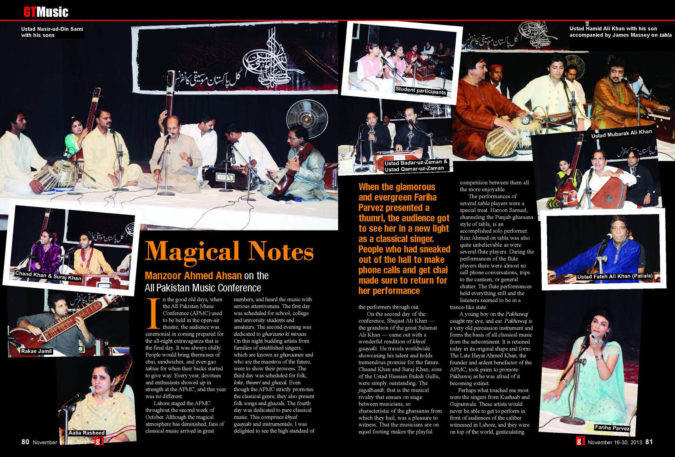
Manzoor Ahmed Ahsan on the All Pakistan Music Conference

gtm1

In the good old days, when the All Pakistan Music Conference (APMC) used to be held in the open-air theatre, the audience was ceremonial in coming prepared for the all-night extravaganza that is the final day. It was always chilly. People would bring thermoses of chai, sandwiches, and even gao takias for when their backs started to give way. Every year, devotees and enthusiasts showed up in strength at the APMC, and this year was no different.

gtm2 gtm3 gtm4

Lahore staged the APMC throughout the second week of October. Although the magical atmosphere has diminished, fans of classical music arrived in great numbers, and heard the music with serious attentiveness. The first day was scheduled for school, college and university students and amateurs. The second evening was dedicated to gharaano ki miraas. On this night budding artists from families of established singers, which are known as gharaanas and who are the maestros of the future, were to show their prowess. The third day was scheduled for folk, loke, thumri and ghazal. Even though the APMC strictly promotes the classical genre, they also present folk songs and ghazals. The fourth day was dedicated to pure classical music. This comprises khyal gaayaki and instrumentals. I was delighted to see the high standard of the performers through out.

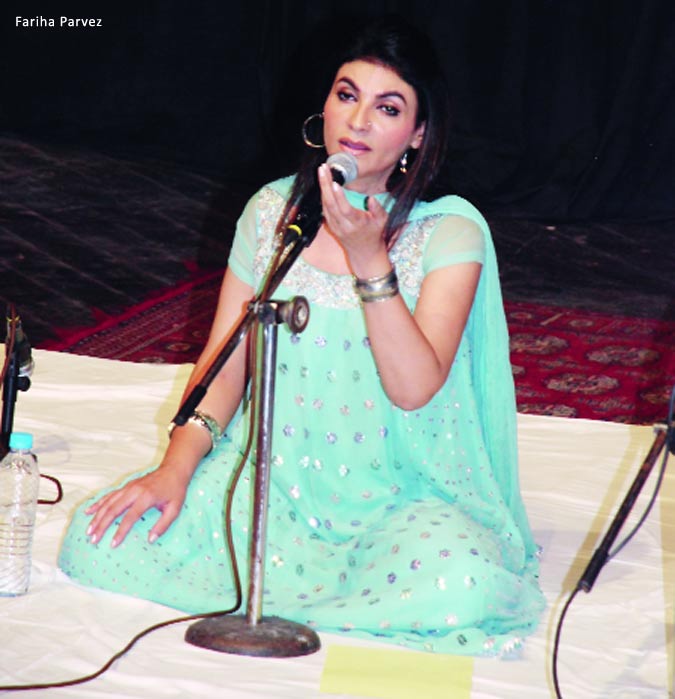
When the glamorous and evergreen Fariha Parvez presented a thumri, the audience got to see her in a new light as a classical singer. People who had sneaked out of the hall to make phone calls and get chai made sure to return for her performance

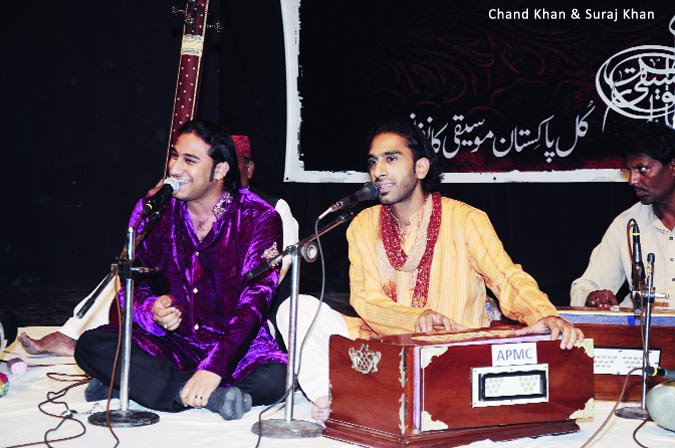
On the second day of the conference, Shujaat Ali Khan — the grandson of the great Salamat Ali Khan — came out with a wonderful rendition of khyal gaayaki. He travels worldwide showcasing his talent and holds tremendous promise for the future. Chaand Khan and Suraj Khan, sons of the Ustad Hussain Buksh Gullu, were simply outstanding. The jugalbandi, that is the musical rivalry that ensues on stage between musicians, so characteristic of the gharaanas from which they hail, was a pleasure to witness. That the musicians are on equal footing makes the playful competition between them all the more enjoyable.

gtm5 gtm6 gtm7

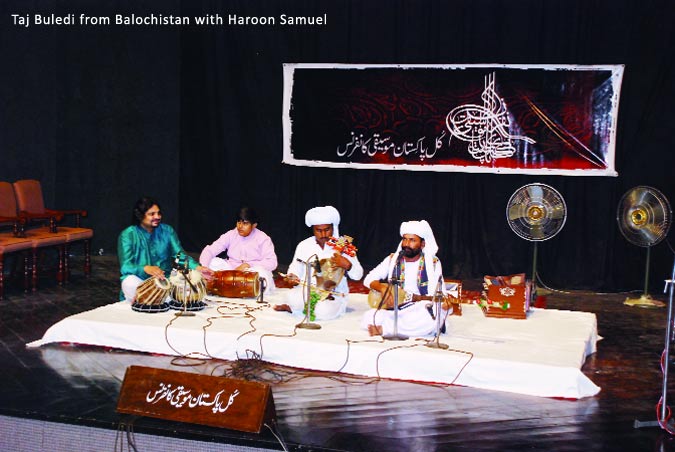
The performances of several tabla players were a special treat. Haroon Samuel, channeling the Punjab gharaana style of tabla, is an accomplished solo performer. Riaz Ahmed on tabla was also quite unbelievable as were several flute players. During the performances of the flute players there were almost no cell phone conversations, trips to the canteen, or general chatter. The flute performances held everything still and the listeners seemed to be in a trance-like state.

The evening ended at 9:30 am in the morning to a giddy, tired, and mesmerised audience

 A young boy on the Pakhawaj caught my eye, and ear. Pakhawaj is a very old percussion instrument and forms the basis of all classical music from the subcontinent. It is retained today in its original shape and form. The Late Hayat Ahmed Khan, the founder and ardent benefactor of the APMC, took pains to promote Pakhawaj as he was afraid of it becoming extinct.

Perhaps what touched me most were the singers from Kushaab and Gujranwala. These artists would never be able to get to perform in front of audiences of the caliber witnessed in Lahore, and they were on top of the world, gesticulating confidently and smiling.

gtm8 gtm9 gtm10

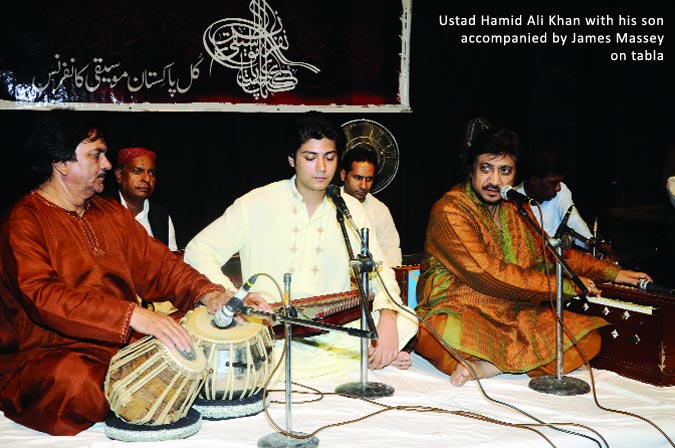
Ustad Hamid Ali Khan, the youngest brother of the Late Ustad Amanat Ali Khan, presented three ghazals of his late brother. These ghazals have attained permanence for any listener and connoisseur of music. Ustad Hamid Ali Khan put his heart and soul in the performance and it arguably was one of his best. I looked around and saw a rapt audience; some women even had their eyes closed in a kind of serene contemplation.

Akmal Qadri was accompanied by his teenaged son, also on flute, and they put up a magical performance

When the glamorous and evergreen Fariha Parvez presented a thumri, the audience got to see Fariha Parvez in a new light as a classical singer. People who had sneaked out of the hall to make phone calls and get chai made sure to return for her performance. She is a household name and has achieved much fame and success for her popular music.

On the classical night, we got to enjoy a flute performance by Haider Rehman. It is really amazing how far Haider has come and how he continues to impress. A banker as well as a committed musician, he has been entrancing listeners from an early age. Dr. Amjad Pervaiz, who used to sing folk songs earlier in his musical career and has lately taken to classical singing since the last about ten years, came out with a good performance of khyal gaayaki. Ustad Badar-uz-Zaman, and his brother, Ustad Qamar-uz-Zaman were their usual charming selves and came out with an outstanding performance. Ustad Badar-uz-Zaman has a PhD in music and is one of the most qualified and educated musicians on the classical music scene. And then Ustad Mubarak Ali Khan, who has a connection to Ustad Bade Ghulam Ali Khan, a very high profile musician of the subcontinent, presented. This too was received very well.

gtm11 gtm12 gtm13

On the final night, Taj Buledi and his group had come from Balouchistan and presented Balochi folk songs. This was followed by flute from Akmal Qadri, who is the ustad of Haider Rehman. Akmal Qadri was accompanied by his teenaged son, also on flute, and they put up a magical performance. A performance by brothers Javed Niazi and Babar Niazi, the sons of Late Ustad Tufail Niazi, sang one of the eternal hits of their father, Chirrian da chamba. Judging by the thunderous applause, the audience was unanimous in their impartiality to Tufail Niazi’s undying music. Noor Zehra on the Saagar veena was in a class of her own. She was followed by Jaffer Hussain on clarinet, which was also among the top performances of the conference. But an instrument missing in most of the music conference was the sitar. Rakae Jamil was one of the only ones and he presented an excellent but short performance and left me thirsting for more. Ustad Naseeruddin Sami, who belongs to the Delhi gharaana and is presently settled in Karachi, had travelled to Lahore for the conference and in the accompaniment of his son, an accomplished young individual, came out with the best performance of the entire music conference. His other son was on the harmonium. Their music is mellow, serene smooth-flowing; it takes you to a sublime place.

gtm14 gtm15 gtm16

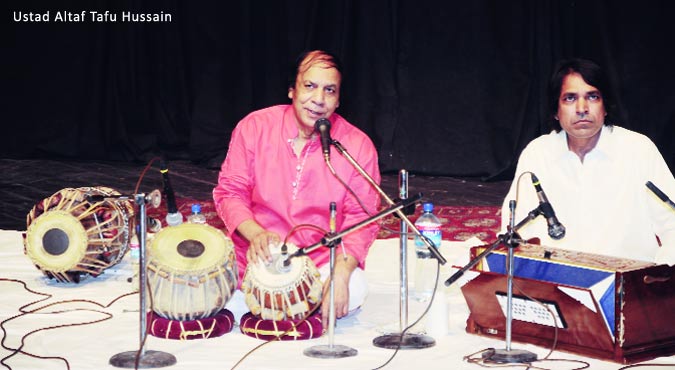
This year, there was a unique performance from Ustad Altaf Hussain, more commonly known as Ustad Tafu. He has provided music to over seven hundred films and is well-known and very respected in the film industry; this was his first tabla performance at the music conference. He was performing with two fingers, as well as with both hands on one tabla. The evening ended at 9:30 am in the morning to a very giddy, tired, and mesmerised audience.

A word about the audience. It was one of the most mature and attentive audiences I have witnessed in my many years of going to the APMC. People sat for hours spellbound and consumed by the music, critically appreciating every move, every taal, every sur. The hall was packed to capacity with no seats available, with many people sitting on stairs and standing on the sides. It made me think: this is what makes Pakistan shine. If only we had more music, more melody, in our lives.

Jalal Salahuddin traces the history of the modern Pakistani wedding

gd1

gd2Perhaps it was fate or simply an accident that got me into the event managing business. Luck came in the form of a new year’s eve party that most of my friends were too lazy, or disinterested in, to organise. I wasn’t and thus J&S was born. I left the boring and staid world of banking to pursue a career in something more exciting and creative: design, fashion and the opulent world of restaurants.

But that’s not exactly true. Twelve years on I’ve been involved with so many other projects and creative pursuits—some successful and some not—that I never thought I’d be doing. One of them has been the redefinition of the modern Pakistani wedding.

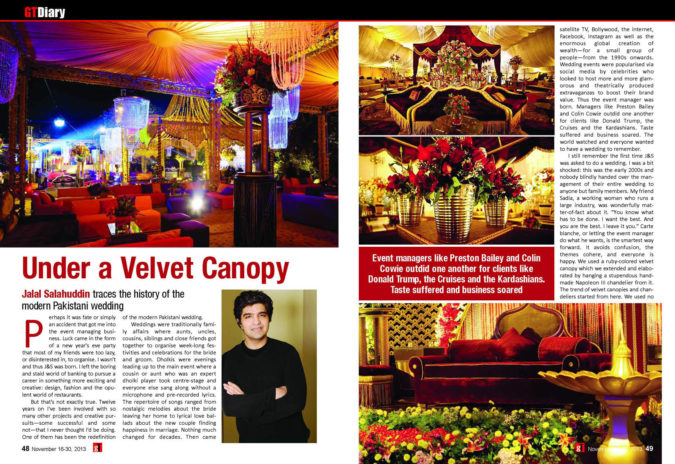
Weddings were traditionally family affairs where aunts, uncles, cousins, siblings and close friends got together to organise week-long festivities and celebrations for the bride and groom. Dholkis were evenings leading up to the main event where a cousin or aunt who was an expert dholki player took centre-stage and everyone else sang along without a microphone and pre-recorded lyrics. The repertoire of songs ranged from nostalgic melodies about the bride leaving her home to lyrical love ballads about the new couple finding happiness in marriage. Nothing much changed for decades. Then came satellite TV, Bollywood, the internet, Facebook, Instagram as well as the enormous global creation of wealth—for a small group of people—from the 1990s onwards. Wedding events were popularised via social media by celebrities who looked to host more and more glamorous and theatrically produced extravaganzas to boost their brand value. Thus the event manager was born. Managers like Preston Bailey and Colin Cowie outdid one another for clients like Donald Trump, the Cruises and the Kardashians. Taste suffered and business soared. The world watched and everyone wanted to have a wedding to remember.

Event managers like Preston Bailey and Colin Cowie outdid one another for clients like Donald Trump, the Cruises and the Kardashians. Taste suffered and business soared

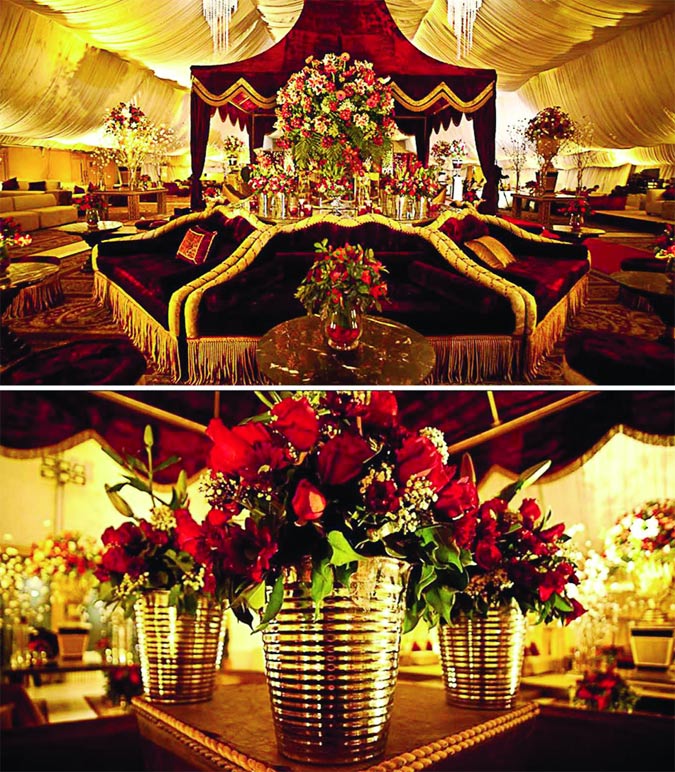
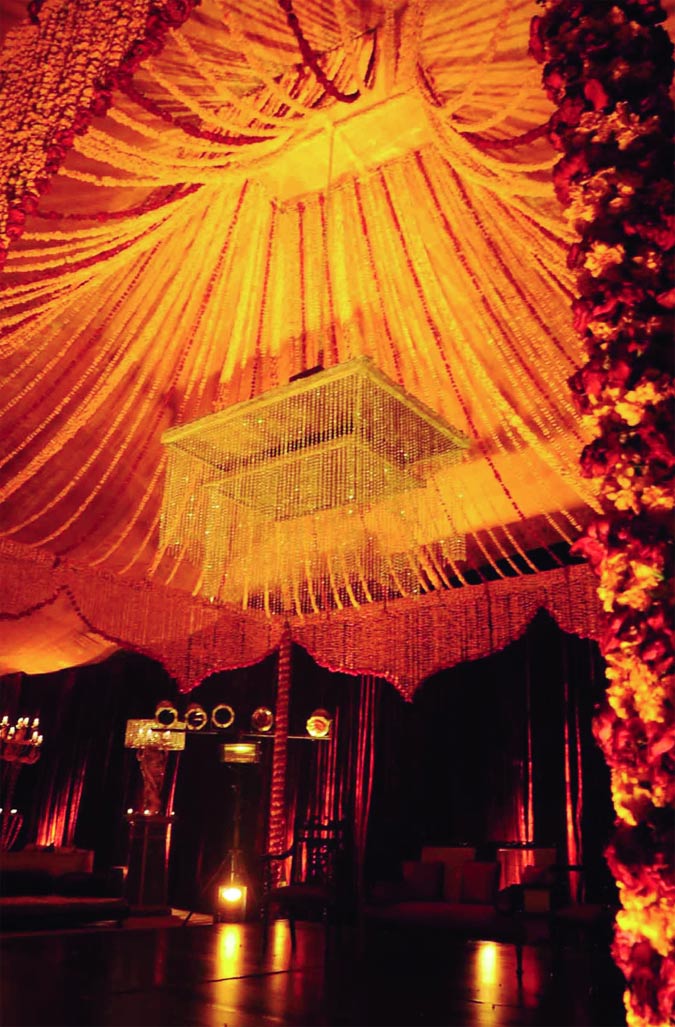
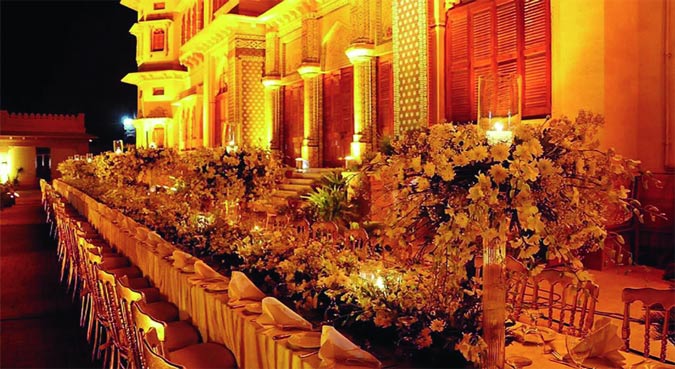
I still remember the first time J&S was asked to do a wedding. I was a bit shocked: this was the early 2000s and nobody blindly handed over the management of their entire wedding to anyone but family members. My friend Sadia, a working woman who runs a large industry, was wonderfully matter-of-fact about it. “You know what has to be done. I want the best. And you are the best. I leave it you.” Carte blanche, or letting the event manager do what he wants, is the smartest way forward. It avoids confusion, the themes cohere, and everyone is happy. We used a ruby-colored velvet canopy which we extended and elaborated by hanging a stupendous handmade Napoleon III chandelier from it. The trend of velvet canopies and chandeliers started from here. We used no catering chairs as all the seating consisted of specially-made lounges, divans and chaises. Classic European floral arrangements and twinkling candles in crystal votives adorned the cocktail tables. Casablanca lillies, tulips, hydrangeas and phylanopsis were flown in by the truckload from Holland, Paris and Thailand. Smoked salmon blini canapés were served to 1000 guests as Frank Sinatra and Nat King Cole wafted through the marquee. Guests were transported to another time and place. For the Mehndi, a 200-foot scalloped metal walkway of roses and marigolds delighted everyone as they walked under it to enter the enchanted evening. There was a palpable feeling that night that something different was happening; we were giving people a chance to do things in a novel way on one of the most traditional days of their lives. Phone calls followed and the next day we were in the wedding business.

gd3 gd4 gd5 gd6 gd7

From then on J&S has done some of the biggest and most extravagant weddings in the country. We’ve introduced innovative decor, food and entertainment to create a new style of wedding events in Pakistan. Many companies have followed suit. I’m happy as it gives more and more people employment, and it keeps the environment energized and competitive.

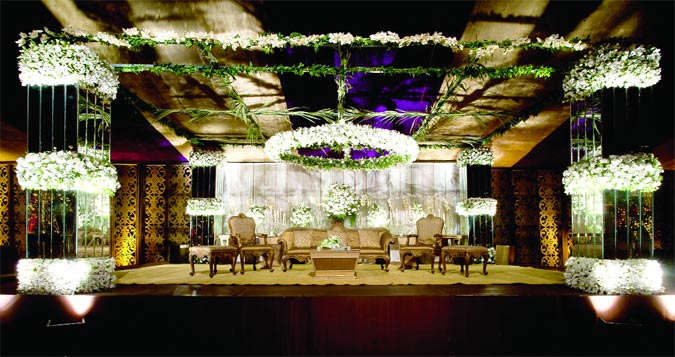
But now things are changing again. A whole new group of young professionals and a growing urban middle class want the J&S style but at a budgeted price. They want to see beautifully-produced themes and moodboards from which they can chose. People don’t want to spend months designing and redesigning their events. Hence we have moved forward and launched a new series of intricately-designed themes which include Mughal Splendour, French Provencal, Morrocan, Italian Rennaissance, Modern White, Truck Art, Mid-Summer Night’s Dream, Colourful Desi, Art Deco and one inspired by Ancient Hanging Gardens.  We have also added a new set of services which include destination management, professional photography and videography, traditional rasms, present and bid selection, sourcing venues, selecting choreographers, organising guest-relation officers and making appointments with designers, make-up artists and hairdressers amongst other things. These are coupled with round-the-clock client servicing for an increasingly demanding and discerning clientele. Our catering company Zaffron has created delicious and affordable menus and romantic table-settings, much sought after by brides and grooms.

gd8 gd9 gd10 gd11 gd12

There was a palpable feeling that night that something different was happening; we were giving people a chance to do things in a novel way on one of the most traditional days of their lives

As the global economy develops and new tastes and conventions trickle into Pakistan, the modern Pakistani wedding will no doubt change again. Though I am in the business of making each event unique and individualised, I can’t help but think of simpler days when brides didn’t wear makeup on their mehndis, when all you needed was a spoon and a dholak and an energetic khala to get the show going.

gd13 gd14

Laila Ghaffar on her annual trip to Pakistan

gt1


Arriving in Lahore is like plunging headlong into another world. The sights and sounds merge to form a head-spinning vibrant city. I was born and raised in London, a place of rules, discipline and order. It’s a place where traffic flows calmly, where you hardly ever hear a car horn, where the electricity never goes, where the skies are often grey, where people speak softly, where I have freedom to wear what I want and choose whichever identity. When I come on my annual winter visit to Lahore, it’s a different story.

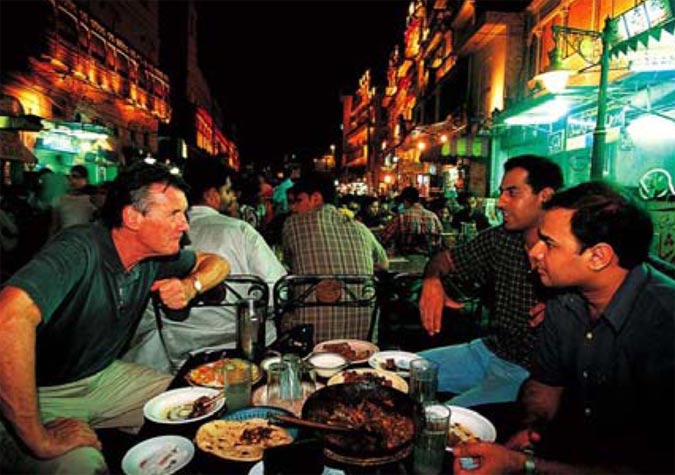
The first thing that hits me about Lahore is the poverty, noise and pollution. Piles of rubbish clog the city. Motorcycles weave through thick traffic, heaving under the weight of a family of five. I find it strange that women ride side-saddle on motorbikes, their heels almost skimming the road, dupattas trailing alarmingly close to the spokes of the wheels. People talk loudly, play their music loudly, honk loudly and even the birds, particularly the crows, call louder. The air has a rich ripe smell of traffic fumes, open drains and roasting meat. Many of the buildings, concrete boxes jammed together, appear unfinished. Thick tangles of electric wires loop across streets. And everything in Lahore is covered in a thick layer of dust. I’ve heard people describe it as a garden city but the ride from the airport to my grandparents’ house is not very scenic.

gt2

gt3

But Lahore has it charms. Lahoris are warm and friendly. In London, people tend to be distant. For instance at Heathrow, if you’re struggling to lift your suitcase off the carousel, they won’t offer to help. Here you just have to say, ‘Excuse me bhai sahab…’ to your moustachioed neighbour and before the words are out of your mouth he will have hoisted your suitcase on to your trolley. People are extraordinarily generous. They invite you to their homes without hesitation, even if they don’t know you very well. They heap food and drink on you and don’t mind going out of their way to pick and drop you. They will lavish time and attention on you and nothing is too much trouble. In London however, people just don’t have that kind of time or generosity.

I am used to being anonymous in London. That is good and bad. Good because it gives me freedom but the flip side of that freedom is that most of my interaction with strangers is impersonal. They don’t care about me. Here your identity is bound up with your family’s. Therefore people tend to treat you according to how much or little they like your family. I am lucky for in my case this means I am treated well most of the time. However this comes with a downside: no boundaries. If somebody feels they know your family well, they feel entirely justified in asking you a barrage of intimate questions. Should you choose not to answer, you are considered rude and stand offish. Should you answer, the next day a dozen people will know.

gt4

No boundaries includes staring too. From the moment I step out of Lahore airport I feel a thousand eyes upon me and that doesn’t let up the whole time I am here. Wherever I go, whether it’s the bazaar, library or even driving on the road, I am always ogled at. Usually it’s men but women do not hesitate to stare you out when they get the chance. I know it’s not just me. All the girls that I’ve spoken to say they also find it very irritating but that they’ve got used to it. Last night I went out to dinner and there was a man sitting at a table next to mine, who stared so much it was wonder he managed to eat at all.

gt5

I love the ‘come and go’ atmosphere in Lahore. It’s so different to the structured London way of things. You can be spontaneous here — just drop in on your friend uninvited for lunch, and leave in the same breezy manner as you came. It creates a fun, buzzing environment in each house. In London, I would have to tell my friend I was coming over the day before. I would then text them when I left for their house and text them again when I was five minutes away. A time for me to leave would have probably been negotiated the day before. It’s excessive but it means that less time is wasted. Londoners are punctual, and most Lahoris are not. To some people four o’clock means 5, to others it means 6. If you show up at 4, you are considered a bit lonely.

gt6

All in all, I find Lahore maddening, exhilarating, annoying, exciting and joyous. If there were three things I could change about it, I would like it to be cleaner, safer and more fair for everybody, particularly for those at the bottom of the heap. But even if I couldn’t change a thing, I would continue to love it as I always have.

Pin It