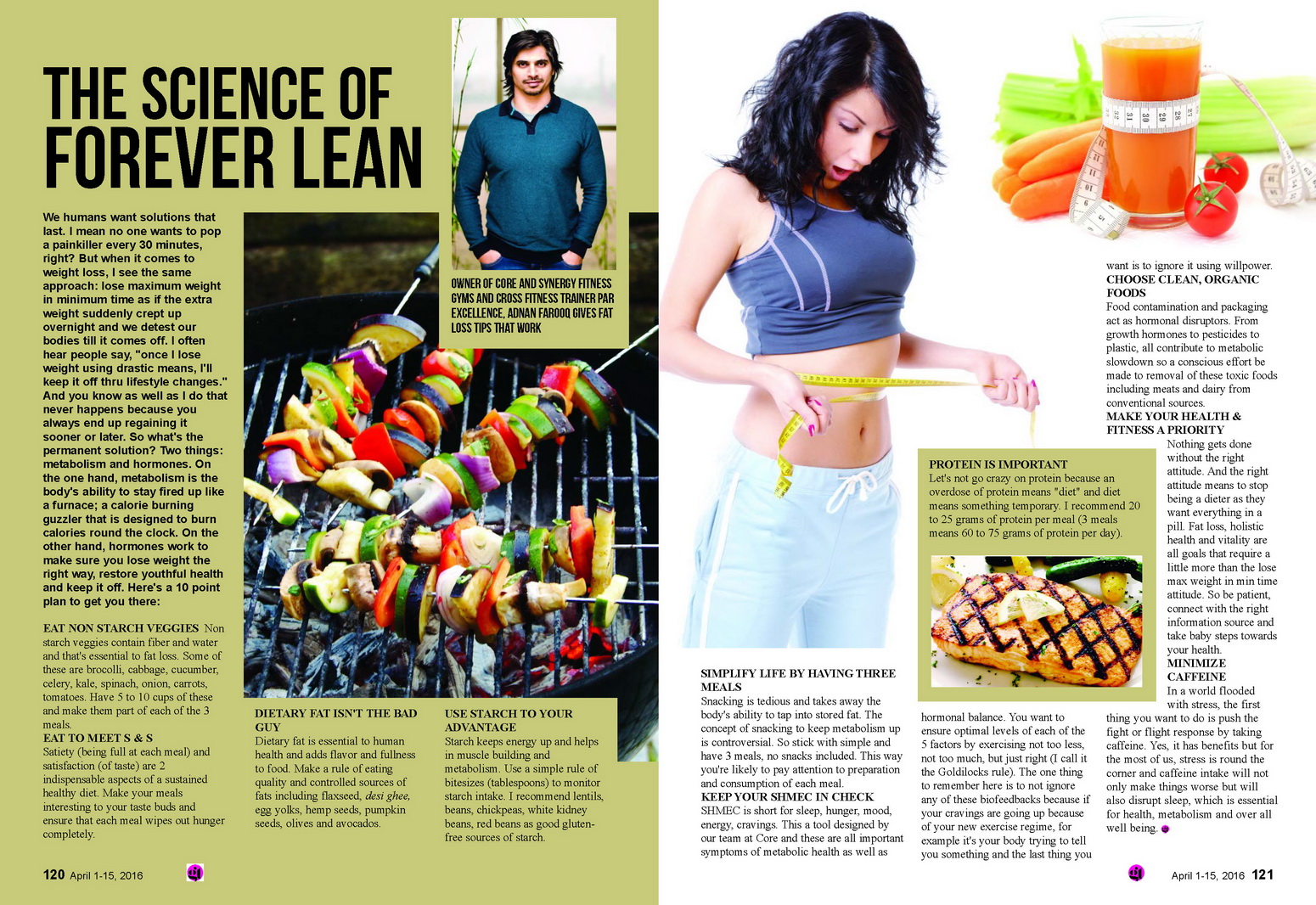




Hissam Haider, or Namoo as he is known to his friends, is ranked as Asia’s best polo player. He shares with Mahlia Lone his experience of playing professional polo at the best clubs and tournaments the world over
You are ranked in the top 5% of the world’s polo players and the best polo player in Asia. How much of this is inborn talent and how much hard work?
Polo has been in my family for a century almost so I think it’s a big part of my DNA apart from being my passion. You have to keep practising to stay ahead of the game and maintain or improve your handicap.
What is your typical day?
My typical day includes waking up and hitting the gym, then either playing a polo game or practising. Sometimes during the peak polo season I play multiple games a day. I try and fit golf in where I can too.

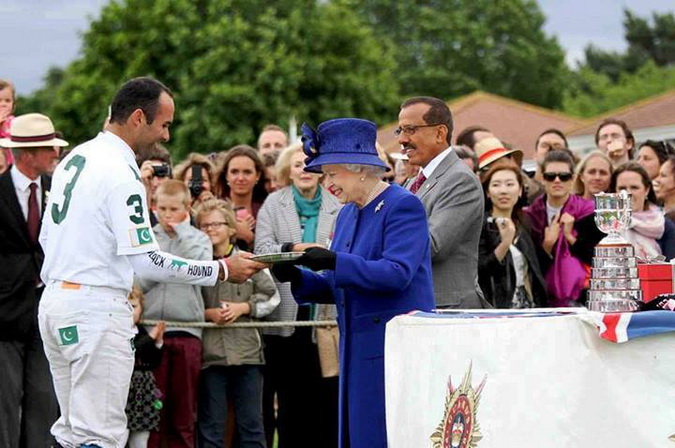
Receiving the trophy from the Queen at the Royal Windsor Cup 2013
You were taught to play by your father, who himself had a handicap of four. At what age did you start playing? How did you build on that skill and excel? your current handicap is six. Can you explain in layman’s terms what that means?
I started riding at 3 and was playing by 11 or so. I actually wanted to be a professional golfer when I was younger, but growing up on polo fields made this the obvious choice of profession. It just sort of worked out in my favour when I got a lucky break at 18.
Knowing how to ride well is essential as well being aware of your surroundings and being able to be a good team player.
Handicaps go up to 10, but that is quite rare in the world of polo and is in the 1st percentile. I’m a 6 goaler in the 5th percentile. You can well imagine that there are only a small number of us, especially compared to other sports in the world.

You have played snow polo also. Can you tell us about that experience? Is it slippery and treacherous with horses skidding or do they have special horse shoes, like cars have snow tires?
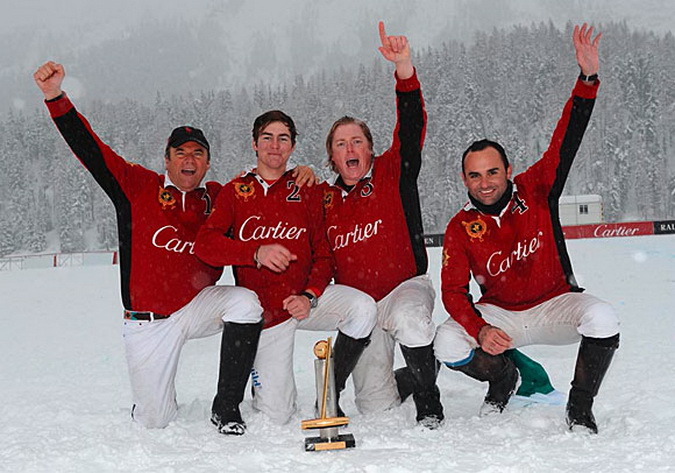
They have special balls at snow polo, which are much larger than the regular polo balls and bright orange. The experience of playing snow polo was amazing. I played for Cartier and I scored the winning goal. Playing on ice is very tough and it’s much harder to gain control of the ball. It was always my dream to play in St. Moritz and I’m glad we brought back the cup!
What are some exotic locations that you have played at? What are some differences you have noted in the polo clubs at these places?
Oh wow! Quite a few, Barbados though is on top of the exotic list, as is Chile. Argentina is a regular as well as I have an extremely enjoyable season there and play with an amazing patron and one of my close friends, Satinder Garcha.
Playing at Windsor, you hobnob with royalty on their home ground at a time when they are relaxed and enjoying their downtime. Please share some interesting anecdotes with us.
We see royalty often at Guards Polo Club, Windsor. Prince Philip is a regular, but is a very private person and does not like being disturbed. Tourists don’t understand this so we have seen some amusing interactions. In a public setting (e.g. at an event) he is a very witty man and quite fun to be around.
What about the junior royals, especially William and Harry? What are they like?
Prince Harry plays often and enjoys the polo scene; he’s a chilled out guy.
How was meeting the Queen when she awarded you a trophy at the Royal Windsor Cup 2013? What is she like? Is there indeed a regal aura about her?
She is the Queen! We see her often at the club as well. She attends the majority of the bigger tournament events. Being awarded the Royal Windsor Cup 2013trophy by her was an honour for me and even more so to have the Pakistani flag stitched on my shirt and jeans whilst receiving the trophy. That’s one of my favourite parts of the whole scene.

Tell us about the Thai Polo Open that you recently played in.
Had a fantastic time, again played with one of my closest friends, Aron Harilela and I always have a great time with him.
You also play golf. How are the two sports similar in their swings? Does one sport complement the other? Could that be one of the factors of your success?
It is possible, yes! I love golf and play a couple of times a week!
What is your diet and exercise regiment during training?
I gym a couple of times a week, play golf, polo practises, polo games and generally eat a balanced diet. I try to stay as fit as possible but can be hard when you’re in Pakistan during the Lahore polo season.

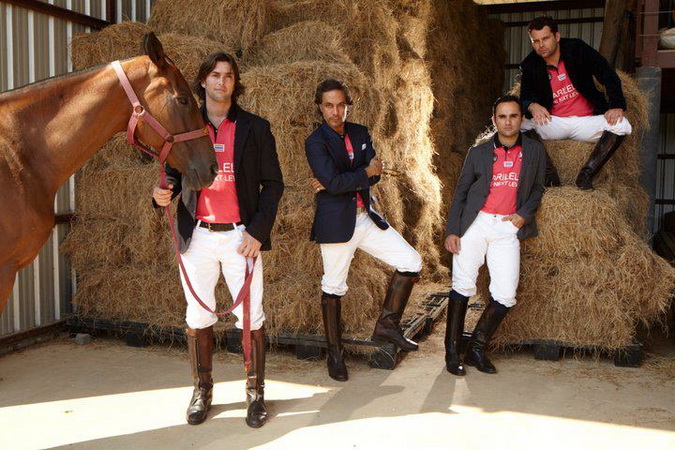
Team Cartier wins the Snow Polo Cup in St. Moritz
How does a professional athlete like you handle the mental pressure of playing in tournaments?
You can’t take too much stress or you will crack. You have to be a good sport and just play your best every time. I like watching the TV show Britain’s Got Talent before games, as it inspires me.
Tell us about polo groupies. What are the most extreme antics displayed by some?
Well polo is not only a sport but a kind of lifestyle and people get somewhat obsessed with it, so the diplomatic answer would be that you find some really interesting people hanging out at polo and trying to be a part of the scene. It’s definitely not all glitz and glamour, it’s a pro/amateur game and that means amateurs pay professionals to play for them. It’s the only sport in the world that has that build up of players, therefore, results are expected and that’s the reality of polo. You have to be on top of your game to stay booked.
What would you like to see improve in the Pakistani polo scene?
I like how the polo scene has evolved and become more professional. I think as time goes by this will happen even more so. My dad Irfan Ali Hyder is the president of the polo club currently, and I think he’s doing an amazing job, if I may say so myself.


You wear the Pakistani flag proudly on your uniform’s sleeve and jeans back pocket. What gave you that idea and has that ever elicited any comments, negative or positive?
I’m a patriotic person and love to show off my roots, I also have it on the horses padding on their backs and anywhere I can fit the flag in actually. Love being a walking, talking Pakistani representative (for lack of a better description). I think people in Pakistan love it. People in England didn’t even find out till recently that I’m actually a British citizen. In regards to negative comments, I never pay any heed. It is what it is and I am what I am!
What is the difference between playing and travelling when single as opposed to now with your wife Alyzeh?
There is definitely more routine in my life, and I cannot stress on how important it is to have a supportive life partner. Also we are best friends first and always have a great time wherever we go.

Anything else you would like to tell our readers?
Sports kept me out of trouble while growing up, it is so important for children to be well rounded, especially for this social media generation. Encouraging sports in a child’s life means the child will enjoy something other than textbooks or YouTube and actually go out daily, get some Vitamin D and focus on being a good sport and competitor.


By Mahlia Lone
The fourth Mughal Emperor Jahangir finally found 15 years of wedded bliss with his twentieth wife, Nur Jahan. Â This is the story of how a woman from a Persian immigrant family fallen on hard times used not only her looks, but also her intelligence and shrewd common sense to become the most powerful woman of her time
Nur-ud-din Mohammad Salim, born on August 31st, 1569, was Emperor Akbar’s eldest surviving son and heir, later to become Emperor Jahangir (World Conqueror).
Prince Salim was first married on February 13, 1585 to his cousin Rajkumari Manbhawati Bai, daughter of Bhagwant Das of Amer, the son of Raja Bharmal and the brother of Akbar’s Hindu wife and Salim’s mother Mariam uz-Zamani. The Rajkumari was renamed Shah Begum, and two years into the marriage produced a son Khusrau Mirza.
Though Salim was the heir presumptive from an early age, he was impatient for power and revolted in 1599 against his father Emperor Akbar, who was engaged in a campaign in the Deccan at the time, thus, setting the precedent for Mughal princes rebelling against their Emperor fathers. Though unsuccessful in his rebellion, he was pardoned due to the influence of powerful court ladies, such as his grandmother Maryam Makani. According to one theory, Akbar wanted Khusrau to succeed him due to Salim’s history of willful, impulsive behavior and revolt against him, which pitted the three generations, Akbar, Salim and Khusrau against each other. Due to the growing strife and trouble between her husband and son, a despondent and helpless Shah Begum committed suicide in 1604.

Nurjahan & Jahangir taking a moonlit stroll

Taj Bibi, nee Jodh Bai, Salim’s
(later Jahangir) third wife who he
married in 1586 and the union produced Khurram, later Shah Jehan
Akbar too died suddenly on 3rd October 1605 after a bout of dysentery and on his death bed named Salim as his successor. Salim ascended the throne in 1605 as Emperor Jahangir. During the first year of Jahangir’s reign, his eldest son Khusrau led a failed rebellion against him. However, Khusrau’s forces couldn’t fight the might of the Mughal Empire and he was defeated and brought to Jahangir bound in chains. The father did not show clemency as Akbar had done towards him and had his own eldest son blinded and thrown into prison. The Emperor also had 2000 rebels executed, so it was a bloody start to his 22 year long reign.
Jahangir’s reign proved to be strong and stable and he was successful in consolidating the Mughal Empire. Like Akbar, he too was religiously tolerant, but was beset with a growing addiction to alcohol and opium that later was to leave him in a befuddled state.

Mehr-un-Nissa was of Persian descent

Emperor Akbar & Prince Salim
Emperor Jahangir is celebrated for his patronage of the arts, architecture and culture, and was a keen horticulturist, botanist, ornithologist, bird watcher and even interested in the sciences. His rule saw many advances in these fields. Some of the impressive achievements due to his patronage include Kashmir’s Shalimar Gardens, the world’s first celestial globe, painter Ustad Mansur’s methodical documentation of animals and plants, and the advancement of portrait painting through the establishment of a royal studio.
Jahangir writes of his own art appreciation skill and his discerning eye in his autobiography Tuzk-e-Jahangiri, or Jahangirnama:
“…my liking for painting and my practice in judging it have arrived at such point when any work is brought before me, either of deceased artists or of those of the present day, without the names being told me, I say on the spur of the moment that is the work of such and such a man. And if there be a picture containing many portraits and each face is the work of a different master, I can discover which face is the work of each of them. If any other person has put in the eye and eyebrow of a face, I can perceive whose work the original face is and who has painted the eye and eyebrow.â€

Jahangir with his celestial globe

Emperor Jahangir weighing his son
Khurram in gold, circa 1605

Emperor Jahangir playing holi at his palace
Jahangir married a string of pretty girls from princely Mughal, Rajput and Kashmiri families. One of his earlier favourites was the Rajput Princess Jagat Gosain Begum, who he renamed Taj Bibi Bilqis Makani upon their wedding in 1586. She gave birth to Prince Khurram, the future Emperor Shah Jahan, Jahangir’s successor. However, Jehangir’s twentieth and last (disputed, he may have married five more times according to one historian) wife is considered to be the love of his life, who wielded considerable power over his heart and his realm.
Nur Jahan, nee Mehr-un-Nissa, was born in Kandahar, present-day Afghanistan, into a family of Persian nobility and was the second daughter and fourth child of a well born couple who had fallen on hard times in their homeland. At the time Mughal India had a thriving, robust and prosperous economy that attracted immigrants looking for a better life. One such was an impecunious Persian aristocrat Mirza Ghias Beg. Taking his pregnant wife Asmat Begum and his three young children with him, the young family made the arduous journey from Persia to India on mules. On the way, they were attacked by robbers who stole their money, possessions and all but two mules. In these dire circumstances, while travelling through Kandahar on 31 May 1577, Asmat Begum gave birth to their second daughter, a beautiful baby girl. As luck would have it, fortunately, the merchant noble Malik Masud asked the family to join his caravan. Believing that their lovely new baby was responsible for the sudden reversal of their fortunes, the couple named her Mehr-un-Nissa (Sun among Women).

Nur Jahan was the power behind the throne

Silver One Rupee coin bearing Nur Jahan’s name of Patna Mint
 When they finally reached India without any further hardship, Malik Masud assisted Ghias Beg in finding a position in the service of Emperor Akbar. Showing promise and skill in administration, Ghias Beg was quickly promoted and appointed the royal diwan (treasurer) for the province of Kabul. In time, Akbar awarded him the title of Itimad-ud-Daula (Pillar of the State). Because he and Asmat Begum had descended from an illustrious Persian line, they chose to invest their newly found good fortune in their children’s education. Even the daughters were taught Arabic, Persian, art, literature, music and dance and were groomed into fine ladies.
In 1594, at the age of 17, Mehr-un-Nissa was married by royal consent to Ali Quli Beg Ist’ajlu, also a Persian immigrant, who had been forced to leave his country after the death of Shah Ismail II whom he had served. Ali had joined the Mughal army under Akbar as a companion to Prince Salim. As a reward for his loyalty to the prince, Akbar arranged his marriage to Mehr-un-Nissa, whose family by now was considered a well settled Persian family and was also in the Emperor’s employ. Though their union produced no children, Ali had a daughter Ladli Begum from a previous marriage that his young wife doted on and brought up as her own.
One day, on a royal hunt in Bengal, a ferocious man-eating tiger jumped to attack Akbar riding on the back of the elephant. Quick as lightening, Ali leapt up, tossed the tiger off and then slayed it when it fell to the ground. The hero of the day, he earned the title Sher Afghan (Tiger Tosser) and was made a captain of the Imperial Guard in Bengal by a grateful monarch.
According to popular belief, two years after Akbar died; Jahangir spied the beautiful Mehru-un-Nissa and sought to add her to his harem. She, however, spurned the Emperor’s overtures and was faithful to her husband. Yearning for her, Jahangir had Sher Afghan conveniently killed in 1607 under the cooked up circumstances of his rebelling against the Governor of Bengal. His widow and daughter were then summoned to court by the Emperor and made ladies-in-waiting to his stepmother, Empress Ruqaiya Sultan Begum, Akbar’s first wife and daughter of the Mughal Prince Hindal Mirza.

Jahangir’s durbar
Dutch merchant and travel writer Pieter van den Broecke wrote in his travelogue, Hindustan Chronicle, “The Begum conceived a great affection for Mehr-un-Nissa; she loved her more than others and always kept her in her company.†The two became extremely close. Meanwhile, Mehr-u,Nissa’s family was not doing so well. Her father, a diwan to an amir-ul-umra (provincial governor), stood accused of embezzlement and her brother of treason. Under these circumstances, according to the official story, in 1611, while accompanying Empress Ruqaiya to the palace meena bazaar (funfair) during the Nowruz (New Year) spring festival, Jahangir met the 34 year old widow, was smitten and immediately proposed. They were married on 25th May. The Emperor gave her the titles of Nur Mahal (Light of the Palace) and Nur Jahan (Light of the World) to match his name Nur-ud-Din Jahangir.
The poet Vidya Dhar Mahajan praised Nur Jahan as having a piercing intelligence, wit, charisma, a volatile temper, but sound common sense. Soon, winning her husband’s trust, she became the most powerful woman in the Mughal Empire then at the peak of its power and glory, no mean feat considering she was barren and didn’t produce any heirs for Jahangir. A fast decision maker, Nur Jahan is considered by historians to have been the real power behind the throne for more than fifteen years sitting alongside Jahangir behind a discreet jharoka (overhanging enclosed balcony) to receive audiences. She wielded more power and was granted more honours and privileges than any other Mughal Empress. For example, she was the only Mughal Empress to have coinage struck in her name; not only was she present when the Emperor held court, but even held court in his place when he was absent or indisposed; she oversaw the administration of several jagir (land parcels) and consulted with ministers; she was given charge of the imperial seal, and her consent was necessary before any document or order gained legal validity; she was consulted by the Emperor before he issued any orders; she was even decreed a Nishan, a privilege reserved for royal males. As his dependence on alcohol and opium grew, so did his reliance on his Empress. Nur Jahan had first her father and then her brother Asaf Khan appointed the Grand Vizier (Prime Minister). To consolidate her family’s position, Nur Jahan arranged for her step daughter Ladli to marry Jahangir’s youngest son, Prince Shahryar and her niece, Asif Khan’s daughter, Arjumand Banu Begum (later known as Mumtaz Mahal) to marry Prince Khurram (Jahangir’s third son and the future Emperor Shah Jahan). The family’s future prosperity was, hence, assured.

The Emperor & Empress of Hindustan
Additionally, Nur Jahan was a great huntress. She often accompanied Jahangir on royal hunts and was renowned for her courage, temerity, marksmanship and boldness. On one occasion, she killed a tiger with her first shot, which even the official royal huntsman Mirza Rustam couldn’t do. On another, she is famously reported to have shot down four tigers with six bullets during a single hunt. Jahangir writes, “As a reward for this good shooting I gave her a pair of bracelets of diamonds worth 100,000 rupees and scattered 1,000 ashrafis (gold coins) over her.â€
 A poet on the spot spouted a spontaneous a couplet in her honour, as recorded by Syed Ahmad Khan: “Though Nur Jahan be in form a woman,
In the ranks of men she’s a tiger-slayer.â€
Nur Jahan was a great philanthropist as well, arranging the marriages and dowries of countless orphan girls and aiding those in need. A woman with many talents, she herself designed lovely outfits, veils and ornaments, decorated the palaces and arranged grand feasts and entertainments. She was even a poetess. Persian arts and culture flourished in the land during this time. However, it was her love and the care that she took of the Emperor that won her his heart. He writes, “I did not think anyone was fonder of me than Nur Jahan Begumâ€.

In 1621, when Jahangir fell seriously ill, she assiduously nursed him back to health. Later, he writes “Nur Jahan Begum, whose sense and experience exceeded that of the physicians, in her kindness and devotion, exerted herself to reduce the quantity of my potations. Although I had before discarded the doctors and their advice, I now had faith in her attention. She gradually reduced the quantity of wine I took, and guarded me against unsuitable food and improper things.â€
Dutch merchant Francisco Pelsaert who worked for the Dutch East India Company at the time, writes in his book Jahangir’s India: the ‘Remonstrantie’ of Francisco Pelsaert, “when the last cup has been drunk, the King goes to bed. As soon as all the men have left, the Queen comes with the female slaves, and they undress him, chafing and fondling him as if he were a little child. This is the time when his wife, who knows so well how to manage him that she obtains whatever she asks for or desires, gets always ‘yes,’ and hardly ever ‘no’ in reply.â€
Another time, it was Nur Jahan’s turn to fall ill and Jahangir’s chief hakim (physician) brought her back to health. For this service, Jahangir bestowed on him three villages and his weight in silver such was his devotion to his wife.

Jahangir’s mausloeum at Shahdara Bagh, Lahore

Emperor Jahangir’s tomb

Nur Jahan’s mausoleum at Shahdara Bagh, Lahore
The heir to the throne and Jahangir’s favourite son Prince Khurram obviously resented his stepmother’s undue influence and the fact that it was to her rather than the heir that the Emperor turned to for advice. Moreover, Nur Jahan clearly favoured her son in law Prince Shehryar (Khurram’s half brother) to be next in line. When the Persian forces besieged Kandahar, Nur Jahan ordered Khurram to march to save the city, but he refused to follow her orders fearing that in his absence he would lose his position. As a result, after a 45 day siege the gateway city was lost to the Persians for which he was blamed. Tensions mounted even further, erupting in open rebellion by Khurram in 1622. Jahangir’s army chased Khurram’s rebel troops all over India until he surrendered unconditionally in 1626. The family strife further weakened the Emperor’s already deteriorating health.
Then, in a dramatic turn of events, in 1626, Jahangir was captured by rebel leader Mahabat Khan while the Emperor was on his way to Kashmir to recuperate. Quickly organizing an attack on the enemy to rescue the Emperor; Nur Jahan herself courageously led one of the units on top of a war elephant that was hit. Surrendering to Mahabat Khan, she too was placed in captivity with her husband. While imprisoned, the wily Empress organized a cunning plan and succeeded in their escape.
Jahangir died aged 58 on 28th October 1627 on the way back near Sarai Saadabad, Kashmir. He was buried in a mausoleum in Shahdara Bagh, Lahore.
A brief war of succession followed in which Nur Jahan’s brother Asaf Khan betrayed her in favour of his son in law Khurram, Khurram had his half brothers Shehryar and the blinded Khusrau executed to leave no possible contenders to the throne. His other half brother alcoholic Prince Pervaiz was considered too weak and ineffectual to be much of a threat. Khurram took the imperial throne of Hindustan and was crowned as the Emperor Shah Jahan.
Though Nur Jahan lost her power and influence at court, she was pensioned off by Shah Jahan with a sum of 2 lakhs and a comfortable mansion in which to live with Ladli Begum. She remained faithful to Jahangir’s memory, wearing only simple white clothes and attending no entertainments. Her only extravagance was erecting fine Mughal buildings. She first constructed her father’s mausoleum, now known as Itmad-ud-Daulah’s Tomb in Agra, the first Mughal structure built of white marble. Built on the banks of the River Yamuna, it is said to resemble a silver jewel box placed in the centre of a garden and is said to have inspired Shah Jahan’s Taj Mahal. She also built Nur Mahal in Sarai, Punjab, and Nur Afshan Garden, Agra. She continued to compose Persian poems under the pseudonym Makhfi.
Nur Jahan died on 17th December 1645, aged 68. Buried in a tomb, she herself had constructed near her beloved husband’s in Shahdara Bagh, she had on it inscribed the epitaph:
 “On the grave of this poor stranger,
Let there be neither lamp nor rose.
Let neither butterfly’s wing burn, Nor nightingale sing.â€