



By Sana Zehra
Ali Rashid breaks all the clichés we have of what a politician looks like. The youngest ex MPA of his tenure at the Sind Assembly & now one of the youngest MNAs, stylish, poised and well put together are some of the many adjectives that I think of when I look at this dashing young man.
Ali has achieved so much at such a young age; he’s a lawyer by profession and currently a consultant for all the major multinational companies in Pakistan because of which he is also one of the highest tax payers in the National Assembly. Most of all he’s an impeccable human being as many tell me.
The first time I met Ali Rashid was at a get together and he introduced himself as just Ali, and not with his title at that time that many were proudly introducing themselves as.
So here is Ali in the hot seat for GT.
So Ali Rashid what’s your story?
No story as such. I’m just a common man with some ideas and dreams of wanting to make Pakistan a better place and doing my bit.
having studied from the Karachi American School and then doing law from London, people from your circle usually stay away from politics. Why politics and why the MQM?
It may sound cliched but I always wanted to make a difference by doing something for the country. All the parties are breeding grounds for family/dynastic politics. The only party which doesn’t have that and promotes on merit is the MQM, a party in which having wealth and a political linage are not prerequisites. I have been fascinated by the founder and leader of MQM, Altaf Hussain who founded a major political party at the age of 25 and by the time he was 31 his party was ruling Karachi, Hyderabad, etc. with Mayors, Senators, MNAs, MPAs. He never took any public office himself nor did he give one to his family members. All these things are admirable. In this day and age, many can talk the talk but very few can walk the walk.

There are many presenting issues about women in Pakistan what is one issue that is very close to your heart and why?
Domestic violence, honour killings, rape, harassment, etc. I feel all of these issues are close to my heart and need immediate attention of the government. As men, we should respect women. A man is born through a woman, he is raised by a woman, he falls in love with a woman, marries a woman. I am surprised at the man who doesn’t respect women.
With three titles under your belt (lawyer, consultant and politician) which one do you enjoy being/practicing the most and why?
I don’t consider myself a politician. I prefer being called a political worker. Politics is something I enjoy the most because it is very fulfilling. Nothing feels better than being there helping out the poor and the downtrodden people. You can easily judge the character of a man by how he treats those who can do nothing for him.

I read a very interesting paper by Omar Ayub Khan where he has suggested that MNAs should focus on the real job that has been assigned to them by the constitution once they are out of the “district council syndrome” and not be entitled to funds or any developmental projects regarding Sui gas, electricity etc. What would you like to say about that?
I agree with him. It’s the job of the third tier of the government to do these things i.e. local government. Unfortunately, in our country the lust for power prevented the provincial governments to have local bodies elections although it is part of the Constitution. Finally, we will have a Mayor in Karachi and things will change for the better. We shall make Karachi clean and green like we did last time we had the Mayorship.

What do you think are the underlying causes of violence in Pakistan?
Illiteracy, unemployment and more than anything else, disregard for the law. There should be rule of law and no one should be above the law. The law should be the same for the poor, middle class and the wealthy. If the traffic warden stops a guy on the motorbike for not stopping at a red light, he should do the same to a person in a SUV or a Merc.
There is a misconception about you that whereas other MQM workers and MNAs like Haider Rizvi choose to sit on the floor, you maintain a distance from the common. Would you like to shed some light on that?
As the question states itself, it’s a misconception. I am a commoner myself, hence, cannot distance myself from the common. It’s just I prefer to stand than sit. If you ever visit me at my office or see me at events, I’m always on my feet, walking around, rarely sitting.

Do you believe in falling in love more than once? Do you believe in monogamous relationships or is polygamy something you favour as well?
I believe love defies reason or logic hence anything is possible. But yes I am a strict advocate of monogamous relationships. If it’s not working out, end it and move on, then you are free to do whatever you want.
What song best describes Pakistani politics
Sab ganda hai per dhanda haiyeh. (Everything is dirty and a profession.) Doesn’t apply to the MQM of course.

Being in your position, having everything going for you, I am sure you attract a lot of attention from the opposite sex. How do you handle it?
(Smiling) I don’t know what you are talking about.
What is one misconception people have about you.
Apparently, that I don’t like sitting down on the floor, according to you. Haha!
If you were to become one superhero what would you become.
Superman. Although I will have a very difficult time changing into my superhero outfit due to the lack of telephone booths in Karachi.
You took a selfie while resigning your seat. Were you really that happy tendering your resignation?
It was just a selfie, I didn’t get why the channels had to show it as breaking news and play selfie songs in the background. It was not about being happy. But yes I wasn’t sad either. Positions mean nothing to us. The pretext of resigning was that we were not being able to deliver to the masses due to hindrances created by the government, so we were not interested in ceremonial positions and decided to resign.

How honest are you?
As honest as one can be in a given situation.
What item is in your closet that you wear the most
My pjs, I change into them as soon as I get home, even if I’m only home for an hour or two.
What is on your nightstand?
I get to read a lot of non fiction material because of the field I’m in. For leisure I read mostly suspense thriller novels. Dan Brown, Harlen Coben, Lee Child, James Patterson, Simon Kernick, Paulo Coelho, etc. are a few of my favourite authors. I’ve read every single book of these authors.
If you were to hire a fashion designer to make your whole wardrobe who would it be and why?
Maybe Giorgio Armani. I think Pakistan has a lot of talent. Some of the Pakistani designers are doing a fantastic job such as AsimJofa, Deepak Perwani, HSY, Nomi Ansari, Amir Adnan, Zari Faisal, HumayunAlamgir, etc.

People generally have this misconception about Parliamentarians that they are difficult to meet. How accessible are you to the general public?
I’m very accessible. Our leader has taught us that a position in the MQM is a responsibility, not a privilege. I am very active and responsive on social media. I interact with my constituents and the general public on Facebook, Twitter, Instagram and there have been many instances where I’ve resolved their issues without them having to physically come to my office.
Having said that, I have a walk-in MNA office in my constituency. Anyone can come to see me without a prior appointment and it’s on a first come first serve basis, we don’t have a parchi culture where important people get to jump the line.
What do you think about Mustafa Kamal’s comeback?
No comment.
Stylist: Rao Ali Khan
Hair & styling: Clippers for men
Photography: a.bilgrami studios


Secret Shopper is the brainchild of two wonderfully resourceful and enterprising expats Bushra Taimur and Hina. What started off as a favour to friends has now become a personal shopping phenomenon with a global clientele. Their offerings for the next season are typically diverse: iridescent blue miniauderies with sea life charms by Sophia Webster, various Valentino lace espardilles in macaroon shades, jewel hued Manolo Blahniks, fluro medusa Versace flip flops and of course an imperial Birkin as the proverbial cherry on the cake. They vow to hunt down your most coveted objects, and to bring all your fashion reveries to fruition right here in Pakistan. Afshan Shafi brings you an exclusive tete a tete with these well heeled wunderkinds and gets an insight into their individual tastes
Please tell us about what motivated you to start Secret Shopper? Do you have a background in fashion or was it a personal passion?
Bushra: Secret Shopper started almost four years ago when I was visiting Lahore. I was asked to help pick out a present from a store that had been defined as the only authentic designerwear store in the city, and was shocked and dismayed to see the over priced, counterfeit items available. I had to ultimately source the gift from London and that is when the seeds of Secret Shopper were sowed as a viable option. Being extremely passionate about shopping and the latest trends, I reached out to my friend Hina who not only shared the same fervour but also lived in London. Initially, we started off small, procuring for only close friends and family. At that point, we couldn’t even fathom that the idea would catch so much attention and blossom into a blustering business. It made sense though, instead of paying good money for fake items that hold no value, why wouldn’t anyone want the ease and convenience of their favourite designer’s authentic goods being delivered to their doorstep, and that too in Pakistan?
Hina has a great eye for trends and we were able to get several orders from just posting a few items on Facebook. That’s when we both realized the potential of developing this into something big. Online shopping barely existed in Pakistan at this point and the concept of buying through Facebook was unheard of. We had very strident ethics from the start and our unintended promotion through word of mouth spread like wild fire and successfully positioned us high on the scales of trust and reliability. My business acumen from having worked as a banker for over a decade and Hina’s accountancy background helped in establishing the business on very professional standards from the start. This further aided in strengthening our reputation and before we knew it, we were delivering on a global basis. It has been a challenging journey, but it has definitely been an exciting one. We’ve come a long way since then and are very proud of our growing team, store presence and established brand reputation.

Hina: I used to shop for my close family in Pakistan for designer and high end products, so I was quite familiar with the whole process. When Bushra approached me with the idea for Secret Shopper, I knew it had a lot of potential. We decided to materialize it by starting a personal shopper service for our friends and family and gradually, with all the feedback and word of mouth, it went places. I must say it wasn’t an easy journey to change people’s mind from buying things from stores to online shopping but with great teamwork, we have managed to make this venture successful.
What would people be surprised to know about the business of personal shopping?
B&H: It’s a lot harder then you can imagine. A lot of clients tell us they would love to have our jobs, and although we are very grateful for what we do, it is actually a lot of hard work. With the elements of export/import in the equation, there are a lot of logistics that need to be managed and several parts cannot be controlled. We source goods from UK, USA and across Europe and we deliver worldwide as well. Each country/region has its own dynamics with customs clearance and currency/payment management, so it really is a lot more complicated than simply buying from a store and posting to a client. Then of course there are the dynamics of dealing with lots of customers who demand individual attention. As all the items we sell are high value goods, there are a lot of expectations. Being personal shoppers, we have no control over manufacturing, so it’s not always easy meeting high expectations.

Bushra with Sophia Webster
Personal shopping as a field is relatively new and really coming into its own. Retailers and designers had picked up on the importance of providing an individualized service to VIP clients, but this is now slowly filtering through to even high streetwear. Traditionally, concierge services were and still are, in a several cases, provided only for very high value goods and to a very select client base. Certain types of personal shoppers operate under the radar as they sell items that are not allowed to be sold by other businesses and these items sell at high mark ups.
We want to change all of this and give personal shopping its right value in the fashion industry. We believe every individual should be able to avail a customized service and benefit from its benefits. We want to ensure retailers and designers recognize the importance attached to this new form of selling, and thus are always actively speaking to a number of fashion industry leaders to create mutually beneficial relationships. At present, we are proud to be formally associated with four renowned retailers and four design houses, including the acclaimed Sophia Webster and Judith Leiber, and are working on adding many more to our panel. There are many further avenues that we wish to explore and we want to be pioneers in revolutionizing the shape of personal shopping.

Bushra & Hina at London Fashion Week
B&H: Clients expect designerwear to be perfect in all aspects given they have spent so much money, so we deal with all sorts of issues on a daily basis. We take all issues very seriously no matter how outrageous the complaint as we understand that the purchase means significantly to the customer and always go the extra mile to help resolve the matter. However, sometimes matters do become humorous like the time when a customer messaged me two years after her purchase for a refund. She demanded that her designer shoes had not shown wear as well as she had expected and after two years of use, the heel was now looking shoddy. Unfortunately, there’s no way we can help with an item used for two years except maybe advise a good cobbler but she demanded a full refund from us.
How does the taste of clients from different countries vary? Are there any specific brands or designers to which customers from different regions are loyal?
B&H: Client tastes do tend to vary with the country. There are seasonal implications to begin with and buying spends also vary with currency differences. Countries with their own traditional clothing also show a higher preference to purchase accessories instead of designer clothing. Asian countries also show a higher preference for discounted items regardless of the season, as the customers from here are more price conscious and love a bargain. There is a more negative connotation associated with discounted goods or sales in the European market where customers are more wary about such purchases and prefer new season goods.
You always see the higher luxury European brands like Chanel, Hermes and Louis Vuitton retain their pull on a global level. These brands produce collections that only cater to a specific income strata that most people aspire to reach and, hence, they remain brands of preference. However, local brands like Mulberry, for example, being a British brand is a lot more popular in England then the rest of the world. The Pakistani society, on the whole, is of course more familiar with older more recognized brands like Prada and Gucci but there is a definite increase in awareness with a lot of people now willing to experiment and try younger, newer brands like Sophia Webster, which became a huge craze last year and continues to gain popularity.


Bushra & Hina with Sophia Webster
How would you sum up the preferences and style of Pakistani women? Do you think there is a satisfying variety or is there a prevailing sense of similarity in what local customers desire?
B&H: We feel that there’s a great mix of all sorts of women in the Pakistani society. There are the very conscious clients who are committed to the latest trends and extremely keen to establish their own style; thus, they want only the very hard to find, exclusive and latest season items. Then, there are a large number of women who only want to wear what is popular and need guidance in finding their own style space. However, it is clearly evident that there is a growing number of empowered women who are in charge of their finances and able to make decisions. These women want to be able to follow latest trends (mostly local) and it’s great to see that they are able to feel accomplished and look great. The Pakistani woman is now a very conscious consumer and she does not settle for less in fashion, whether its personal or borrowed style.
Which upcoming designers or niche brands do you see taking Pakistan by storm?
B&H: Pakistan is ready to take on the world and show that we are not behind in fashion. We foresee niche brands like Ralph & Russo setting standards high with customized and exclusive accessories and footwear. Aquazzura has been picking up steam since the last 15 months or so in the footwear arena internationally and this trend will now start showing in Pakistan, especially with their Wild Thing Sandals that were sold out previously but has now been restocked globally. For clothing and the cheaper end of the market, brands like Kenzo are increasing in popularity.

Most cherished possessions
Bushra: This would have to be a pair of small earrings I bought my grandmother from my first pay cheque more than a decade ago. She wore them frequently and when she passed away, she left them for me. They remind me of her and the loving bond we shared.
Hina: My most cherished item is my great grandmother’s necklace that has been passed down in my family and was given to me two years ago to wear on my wedding day.

Bushra with Jimmy Choo
Are there any pleasant memories associated with some of your items? Please elaborate
Bushra: We once organized a groom’s entire wedding package that included his clothes, accessories, footwear at the events along with his new wardrobe. We were working on a very tight timeline and there was a lot to be done. However, miraculously it all went according to plan and everything was a perfect fit too. It was a real joy to see their wedding pictures and see how happy it made the new couple. All the items we bought for them were really special for us because we knew the importance attached to them.
Hina: I completely agree with Bushra on this as it was a mission to get everything done in a limited time period especially buying the groom’s suit and shoes for his reception and also ensuring they were delivered on time to them without any hiccups. It brings us great pleasure and comfort when we see our customers looking so confident and pleased on the social media wearing goods bought through us.
How would you define your personal taste? Which design houses do you think mirror your own aesthetic?
Bushra: My personal style is all about comfort and feeling good about myself. I like to keep things elegant, minimal and on straight lines. I do enjoy adding a bit of fun and colour to my wardrobe but don’t think I get too experimental. I would like to say that Lebanese designer Ellie Saab mirrors my aesthetic. I love that he uses simple designs to create fairytale pieces full of beautiful embroideries, jewels, sequence and lots of fine details. Given my roots, I have a strong calling for all things with intricate workmanship and truly appreciate his work. His latest collections have been a bit more hip with a younger look and I love that he is now broadening his reach. Either way, I simply adore his elegant creations and feel he truly knows how to make a woman feel special as that’s all it’s about when you get dressed.

Hina
Hina: My personal style is a mix of comfort and elegance. I love wearing high street brands like Reiss and Massimo Dutti and then complementing my attire with exquisite jewellery pieces. I am a big fan of Chanel’s accessories as they are both classy and seasonal .
Whose wardrobe would you love to help shop for?
Bushra: I would love to shop for Kendal Jenner. She has an amazing street style that’s super chic and fresh. Moreover, she knows how to carry herself with a lot of confidence. It would be really fun to experiment with her, plus the publicity won’t hurt either.
Hina: I would love to shop for Kate Middleton. She is very beautiful and everything she wears looks amazing on her. She has a perfect dress sense by mixing the high street brands with luxury designers.
What would your personal wish list look like?
Bushra: I think my personal wish list changes every day. Currently, I’m on the look for some decent maternity wear, there seems to be a real dearth in the market. I’m also always on the lookout for the perfect day bag and shoes. Daily essentials must always be upgraded frequently to keep things fresh and fun.
Hina: My personal wish list is never ending since I have a craze for buying shoes and accessories and I’m  constantly adding to my collection.
What is your most favorite place to shop in the world and why?
Bushra: I would have to be loyal to London as we know the city so well and have established a great network here. Hina: My favorite place is Paris as some brands like Hermes, Chanel and Louis Vuitton have their best collections in their Paris flagship stores, which are completely different from everywhere else in the world.Â
What are your future plans for Secret Shopper?
B&H: We have lots of exciting plans for the future. This will be the year that we truly establish ourself as the company we have become and make our mark as pioneers, developing the new face of personal shopping. We recently set up our first ever personal shopping kiosk in Islamabad, partnered with Ensemble. Customers can now walk into one of the leading multi brand stores in Pakistan and complete their entire look by pairing outfits with the perfect shoes, bag and accessories. They will have an unlimited option of items to choose from and a personal shopper to help them perfectly put it all together.
We are now also all set to launch the very first of its kind website for personal shopping and are finalizing minor details currently. This is an entirely new form of customized shopping and we are very proud that there is no other website like this. We are also further growing our team and will soon be announcing the addition of a celebrity stylist to Secret Shopper. Members will now have the option to have their very own stylist at hand to give professional advice on buys specifically catered to their body types and preferences.
For the latter part of the year, we have a very special event planned for Lahore, Karachi and Islamabad with the trunk show of an internationally renowned design house. Customers will be able to experience the very best of designer accessories in person and place orders. So stay tuned for this announcement.
We have many other plans in the pipeline, so I would definitely say that if you are into designerwear and enjoy shopping, then we’re a company to watch out for!

By Mahlia Lone
Yesteryear filmstar Neelo and socialist filmmaker Riaz Shahid are Pakistani superstar Shaan’s parents. Both were two strong-minded creative individuals who have bequeathed to the nation a memorable filmography. Their real life love story, packed with politics, romance, song and dance, villains, melodrama and tragedy could easily inspire a movie. Let’s delve more into the life of these two stars, who left their mark on Pakistan’s film history
Cynthia Alexander Fernandes (later Neelo) was born in Sargodha pre-Partition officially in 1945, and unofficially in 1941. She grew up in a Punjabi Christian household and not much is known of her early life. She came on the radar when she was recruited to play a reporter for the Hollywood classic Bhowani Junction in 1954, starring Ava Gardner and Stewart Granger. The film is based on actual historic events during the Independence struggle when Congress Party workers laid down on railway tracks to protest British rule over India. However, the film’s producers were denied permission by the Indian government to film in the country as a Hindu revolutionary is portrayed as the villain in the film. The Pakistani government readily agreed and the MGM film crew came to Lahore for the outdoor shooting staying at the Faletti’s Hotel, which still has a suite in Ava Gardner’s name where she stayed at the time. Filming began at the Lahore Railway Station where the sign Bhowani Junction was put up. Somehow Parveen Alexander (as Neelo was known in those days) managed to get the part of playing a budding reporter in the film, paving the way for her future in Pakistani films. She subsequently appeared in a grand total of 134 Pakistani films to date in Urdu as well as Punjabi.
In 1956, the teenager under the screen name Neelo appeared in the Pakistani film Sabira. Her breakout role came the following year playing a flower seller in the mega hit romantic comedy Saat Laakh, lip syncing and dancing to the perennial song sung by Zubaida Khanum:
“Aaye mausam rangeelay suhane
(The weather is colourful and pleasant
Jia nahi mane,
(I’m feeling restless)
Tu chutti lay kar aaja saajan.â€
(Get a holiday and come visit me my love.)
The song became immensely popular and is still played to this day. Neelo, the round faced girl with two braids and large, sparkly eyes, became an overnight sensation. Soon film offers started pouring in and there was no looking back to her former life of anonymity. Many of her films celebrated silver, gold and diamond jubilees at the box office and she became a bankable star, known as the Princess of Romance and Fatal Attraction.


Born in 1930, Sheikh Riaz, nicknamed Shahid, was educated at Islamia College, Lahore, and then started working as a journalist at the Urdu newspaper Chataan. After this, he joined Faiz Ahmed Faiz’s weekly Lail-o-Nihar. Faiz Ahmed Faiz, a world famous Pakistani agnostic, humanist philosopher, poet and communist leader, wrote lyrical poetry supporting worker unions and denouncing the tyranny of military dictators. For this reason, he was celebrated in the Soviet Union. Shahid developed his socialist leanings working under the poet. As a natural progression of his literary career, Shahid wrote a novel Hazar Dastaan, before turning to script writing. In 1958, Riaz Shahid started his film career as a script writer for the film Bharosa. He was the writer, director and producer for the film Susraal in 1962.
In his article Socialist Cinema for a local newspaper, Zulqurnain Shahid describes the memorable working partnership between Riaz Shahid and left wing symbolist poet Habib Jalib. Their first collaboration took place on the film Khamosh Raho, released in 1964. They were both taraqqi pasand (progressive) literary figures who supported anti-imperialist fighters from Muslim backgrounds. The film’s plot was ostensibly about a brothel owner’s system of bonded prostitution, but it was multilayered. On a deeper level, it portrayed the similarities between arranged marriages and prostitution. Remarkably, it also predicted the 1965 war between India and Pakistan. Only political insiders knew at the time that President Ayub Khan was going ahead with Operation Gibraltar inside Indian-held Kashmir. Jalib’s lyrics of:“Main te to preet nibhai sanwarya re†(I have been faithful to my sweetheart) were not just about a woman singing to her soldier fiance, but also Pakistan’s soil rallying the troops to protect the sanctity of her borders, safety within the borders and an ominous warning about the coming invasion.


Additionally, Jalib’s poem, Dastoor (The Constitution) that he read at Liaquat Bagh (Pindi) against Ayub Khan and for which he was jailed, was included in the movie after a slight alteration. The lyrics to the song ended in:
“Tum nahee charagar,
(You are not the remedy)
Koee maney Magar,
(Whether someone believes it or not,)
Main naheen manta.â€
(I don’t believe it.)
The song managed to pass the censor board even though it was against martial law. Shahid wrote the characters and dialogue inspired by events being reported in the press. The brothel madam is based on Aqleem Akhter Rani, nicknamed General Rani, a woman who infamously procured women for those in power. According to the plot, the madam of the brothel uses the character played by Mohammad Ali (newly into acting he received much acclaim for this role) to kidnap young village women for feudals and military officers. Eventually, his conscience smites him and he fights from within the brothel for justice. When the film’s main protagonist, a soldier played by Yusuf Khan, arrives to break up the brothel, he tells him, “Tum sarhad kee hifazat karo, andar hum sambhal lein ge.†(You safeguard the border, we’ll protect it from the inside). In this way, Shahid illustrated the link between the civilian government and the military throughout Pakistan’s political history. Thus, the two writers were fearless in their anti-establishment sentiment.

Eldest daughter Zarqa, Neelo & Riaz Shahid

In 1966, he wrote and directed the Punjabi movie Mr. Allah Ditta, in which Neelo was cast. During filming their romance began. For his film Zarqa that he produced, directed and wrote, Shahid again cast Neelo. Halfway between filming of the movie, a dramatic incident occurred. Renowned for her dancing, Neelo, who by this time had won two Nigar Awards for Best Supporting Actress in 1959 and 1963, was peremptorily summoned to dance for the Shah of Iran on an official visit to the country in 1965. Reportedly, the incumbent Governor of West Pakistan,  Nawab of Kalabagh, Amir Mohammad Khan threatened her and demanded she dance for them at the Governor’s House. Knowing that Riaz Shahid would not approve, a reluctant and nervous Neelo collapsed on the floor while dancing and feigned unconsciousness. Some even claimed that she had tried to commit suicide, swallowing an overdose of sleeping pills on the way to the Governor’s House. She was rushed to the hospital where doctors revived her. Thus, Neelo demonstrated her faithfulness and loyalty to Shahid.
Habib Jalib immortalized this incident in his poem titled Neelo:
“Too ke nawaqif-i-aadab-i-shahenshahi thee
(You are unaware of the tenets of imperialism!
Raqs zanjeer pehen kar bhee kiya jata hai!â€
You can also dance in fetters)
This poem was adapted and used in the film Zarqa. Soon after this incident, Riaz Shahid married Neelo and gave her his protection. She converted to Islam and was given the name Abida. Zarqa was released in 1969 the same year that President Ayub Khan handed over the reins of power to General Yahya Khan and it became the defining film of Neelo’s career. Shahid’s film, based on the Palestinian-Israeli conflict, is a parable. Neelo, in the titular role of Zarqa, is a Muslim Palestinian follower of Yasser Arafat and prisoner of war who has been captured by the Israelis. She is forced by an Israeli general, played by Taalish, to dance and upon refusal she is soundly whipped and burnt with lit cigarettes. This scene was influenced by the real life incident, which Riaz Shahid bravely incorporated in the film. The wordings of Jalib’s poem were changed in the song to:
   “Too ke nawaqif-i-aadab-i-ghulami hai abhi
(You are unaware of the tenets of slavery!
    Raqs zanjeer pehen kar bhee kiya jata hai!†(You can also dance in fetters!)
At the end of the song “Aaj qatil ki ye marzi hai†(Today the murderer is demanding this) Zarqa utters Allah with such palpable pathos and pain that the audience also suffers with her. Through symbolism Shahid and Jalib depicted the Palestinian plight and a victimized Neelo’s real life humiliation, sadness and suffering, making this the most popular scene of the movie. Zarqa became such a big hit that it became Pakistan’s first diamond jubilee, meaning it played for more than 50 weeks at the cinemas and Neelo received her first Nigar Award for Best Actress.
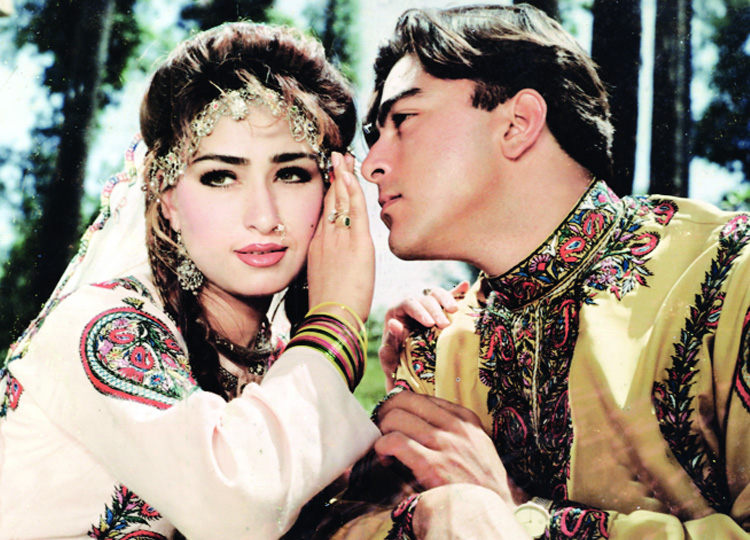
Reema & Shaan in his first film Bulandi
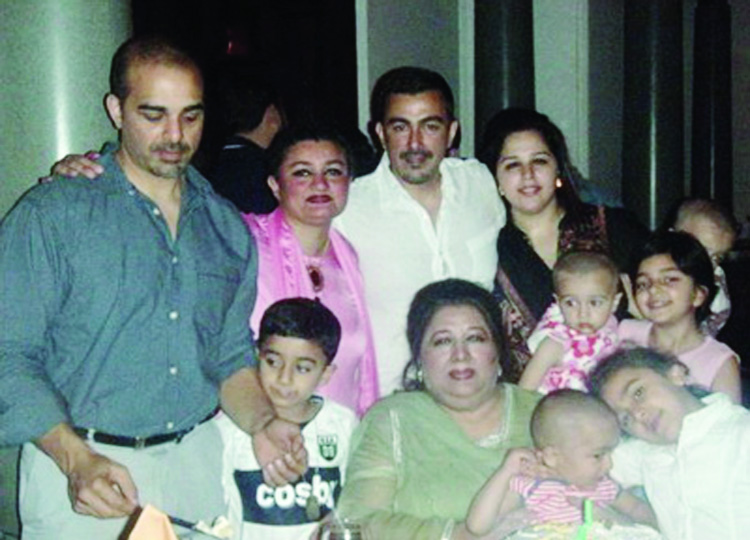
Family photo
After this, Neelo retired in favour of domestic life. Shahid and Abida named their eldest child, a baby girl, Zarqa who is now married with children of her own. Then, came Shaan, named Armaghan at birth in 1971, followed by the youngest, Sarosh who has also appeared in two films.
Shahid’s final movie was Yeh Amn, a movie on Kashmir. Jalib penned a few of the songs for this film, including the hit song Zulm rahey aur amn bhee ho,  sung by Noor Jahan and Mehdi Hasan. Shortly after the film was released, Shahid Riaz died of leukemia in 1972.
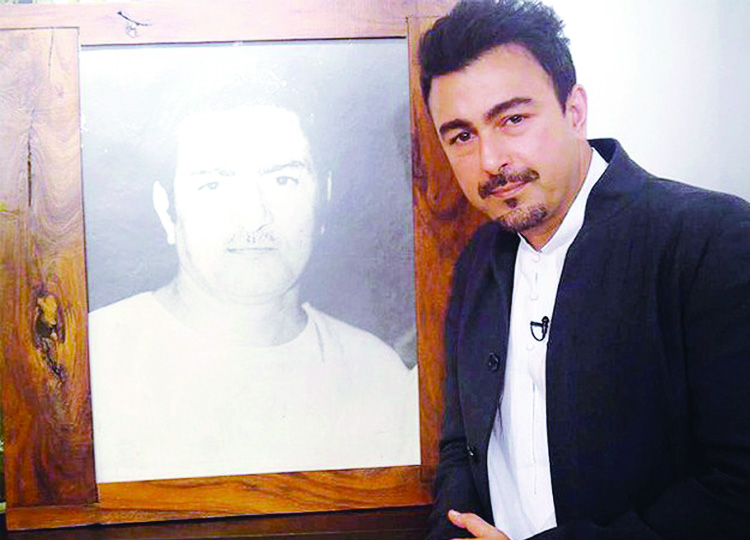
Shaan with his deceased father’s photograph
Though devastated, life had to go on for Abida who had to take care of her very young children. In order to support her family, she resumed her career by starring in the hit movie Khatarnaak, another diamond jubilee film, in 1974 for which she was again awarded a Nigar for Best Actress. She also continued to produce films under her husband’s banner with Baheesht (1974). She won two more Nigars for Best Producer and Best Film. Her last Nigar was for Jat Kuryan Tu Darda (1976). In 2013, she appeared in Waar, a Shaan starrer.
Shaan, the most popular Pakistani film star of our times with more than 500 films to his credit, made his film debut in1990 starring in Javed Fazli’s film Bulandi opposite Reema Khan. He has won many awards including one Pride of Performance, four National Film Awards, fifteen Nigar Awards, five Lux Style Awards, and one each Pakistan Media Award and ARY Film Award. He carries on his parents’ legacy.
Images provided by Guddu Film Archive