


Mahlia S. Lon
If you love to hear from the stars themselves, then boy do we have an issue for you! We have up close and personal interviews with…wait for it: Mahira Khan, Sheheryar Munawar, Amna Ilyas, Mira Sethi, Ayesha Omar, Osman Butt and Aditi Singh. Phew! All packed together for your reading and viewing pleasure.
Young tech entrepreneur Shan Rizvi who rose from humble beginnings to co-found not one but two tech solution companies tells us what our kids should learn in order to be ahead of the game in today’s fiercely competitive world.
For our Memorable Romance feature, we take you back in time to small town life in the late Mughal era as we relate the tragic romance of Sohni Mahiwal.
Last but not least, Iran’s National Team Melli may not have made it all the way at the FIFA World Championship but they played like the heroes that they are and we bring you their backstory leading up to the FIFA Cup.
Enjoy the latest issue of GT, filled with more reading material than most other local magazines. Health and happiness!

Who? Nooray Bhatti
Why? The model is wearing Fahad Hussayn’s funky maxi kameeze

Who? Esha, Imaan & Danya
Why? A matching girl squad. What’s not to like?!

Who? Amna Ilyas
Why? Red hot!

Who? Shehryar Munawer
Why? Look at the cute teddies on his loafers

Who? Mahira Khan
Why? The mixing of different styles works, making for an unusual look


One of Pakistan’s most successful male models, Usman Butt has been graced fashions shows, print advertisements and television commercials for more than four years and will soon debut as an actor in the upcoming television serial, Dilaara. The handsome young man tells Ally Adnan why he is more than just a pretty faceÂ

Your first television serial, Bol Entertainment’’s Dilaara, will be on air soon. Are you excited?
I’m excited and truthfully also a little anxious.
Why are you anxious?
Dilaara marks my debut as an actor. I have seen success as a model and hope to find it as an actor as well but sometimes worry that viewers may not like me on television. I have seen rushes of the play and am satisfied with my work. But it still feels just like waiting for the results of an exam that I think I’ve done well in, hence, the anxiety.
What’s Dilaara about?
Dilaara deals with the subject of loveless marriages. A large number of marriages in our country are the result of coercion, deception and blackmail, both emotional and physical, and not of love. Dilaara tells the story of one such marriage and its devastating consequences.
Do you feel that Dilaara will be a hit amongst television viewers?Â
Yes, I absolutely do. The topic of Dilaara is important and relevant. Forced marriages, though common in Pakistan, have rarely been explored on television as a subject in a serial. Bee Gul’s phenomenal script delves into the subject with great intelligence and sensitivity. The serial tells a poignant and social relevant story. I believe that Dilaara will strike a chord with audiences and become a huge hit. The serial has many strengths.

What are these strengths of Dilaara?
Dilaara tells a very good story and tells it well. The characters are rich, real and nuanced. Khalid Ahmed has directed the serial with great skill and elicited some truly remarkable performances from the actors. Abid Ali and Kinza Razak are brilliant in the serial. I believe I have done well as an actor too. The production design is good. It has been shot well and the score is excellent. A lot of good poetry has been used judiciously in the serial. Dilaara will be one for the ages, in my opinion.
Tell us about the character you play.
I play the role of a kind and sensitive young man named Shuja who finds himself drawn into a forbidden relationship and has to make a choice between following his heart and behaving in an honourable manner. His decision is not an easy one; it is made difficult by the social, cultural and religion norms of Pakistani society, his own sense of right and wrong, and the thinly-veiled mendacity that pervades the world he lives in.

How did you land the role of Shuja?
Khalid Ahmed auditioned me for the role.
You started your career in show business with modeling. Was it difficult to make the transition to acting?
Yes, it was. Acting and modeling are vastly different. I had to work hard to learn acting and get comfortable in front of the television camera. Three people: Actor/director Khalid Ahmed, and writers Bee Gul and Faseeh Bari Khan, gave me invaluable advice, guidance and encouragement during the process. They are my mentors in the world of show business.
How are modeling and acting different?
The business of modeling is very different from that of acting. The duration of projects, payment structures, industry economics, and career management – virtually everything – is different in the two fields.
The primary requirement for a model is good looks whereas that for an actor is histrionic ability. A model’s thought process, while performing, is generally outward. He opens himself up for the camera. An actor’s thinking is inward. He largely ignores the camera. A model conducts himself with confidence and assurance whereas an actor needs to have both humility and vulnerability. A model has to play a part for a short period of time and does not need to immerse himself in the character that he plays. An actor, on the other hand, has to play a character for extended periods of time, learn lines, and have an understanding of the whole story.


Does it help to have both acting and modeling skills?
Yes, my acting ability helps me a great deal in modeling, especially when I work in commercials. As an actor, I benefit from the confidence, sense of style and poise that I have cultivated in my years of modeling.
Which do you like more, acting or modeling?
Acting, without a doubt.
Why?
Modeling is mostly about having good looks. If one has the right genes, a sense of style and no fondness for food, little else is required to do well as a model. I believe there is more to me than my good looks. I have acting talent. I am hardworking, disciplined and driven. I understand cinema and television. And I have a natural flair for acting. I cannot be content with just modeling.
Additionally, I am more comfortable in the world of acting. Modeling is intensely competitive. People in the fashion business tend to be unfriendly and cold. I guess the short duration of modeling gigs does not allow one to forge meaningful relationships and friendships. I find people in television to be warm and friendly. They work together as a family and offer each other a lot of support, help and guidance. I like the congenial and friendly atmosphere of the world of television.

Do you plan to give up modeling if and when your acting career takes off?
No, as much as I prefer acting, I could never give up modeling. Frankly, it’s very lucrative, relatively easy and a lot of fun. I love the energy, excitement and exhilaration of walking the ramp. I relish wearing good, fashionable clothes. I enjoy seeing myself on billboards, in publications and on television. And I like the perks – gifts of clothes, luxury travel, and many others – that come with modeling.
What do you like to do when not working?
I am a fitness freak and believe in eating well and staying fit. I spend a lot of my time in the gym. Not only does working out keep me healthy, happy and energetic, but essentially in my line of work, it also helps me manage my weight and keep fit. I cannot imagine a day in my life when I would not spend a few hours in the gym.
I enjoy travelling alone as it clears my head; I process my thoughts and find peace. I like places that are off the beaten path and tend to avoid tourist destinations. I love the sights and sounds of new places and foreign lands. Adventure and discovery are exhilarating, educational and enjoyable.
In a recent interview, you spoke very candidly about the prevalence of sexual harassment and abuse in the world of show business. Did you experience any backlash because of your comments?
No, not really. A couple of people who had hit on me, in the past, called and asked me if I was going to name them as predators in future interviews.
Are you going to name and shame them?
No, I am not. The people that I mentioned had backed off when I refused. They never offered to help me in exchange for favours received and did not threaten to hurt my career after I refused. They have not propositioned me since and have remained nice and friendly towards me. They had a right to ask me as did I to say no; we exercised our rights as adults and moved on. No harm was done. I don’t think it would be right to out and publicly shame them. They don’t deserve it.

Now that the shooting of Dilaara is complete, are you looking at other acting projects?
I want to take a month long break before taking on a new acting project. Working in Dilaara was great fun but it wore me out nonetheless. I need to spend time with my family, rest, relax, and recoup my energy before I resume work.
Have you been offered any acting work recently?
Yes, I received an offer to work in a soap from a major television channel a few weeks ago but turned it down because I am not sure that I want to do soaps. I find the quality and content of regular television serials to be generally higher than that of soaps. I’m also in the early stages of a discussion about working in a film about the fashion industry. It has a promising story and script. And, I just received a call about working as the lead in a telefilm that will be made in Islamabad. I believe that I will get more – and better – offers once Dilaara starts airing. I put my heart and soul into the serial and hope that it will open many doors for me. Fingers crossed.
Photographs by Mohsin Khawar
Ally Adnan lives in Dallas and writes about culture, history and the arts. He tweets @allyadnan and can be reached at allyadnan@outlook.com.


A Punjabi and Sindhi folk tale
By Mahlia Lone
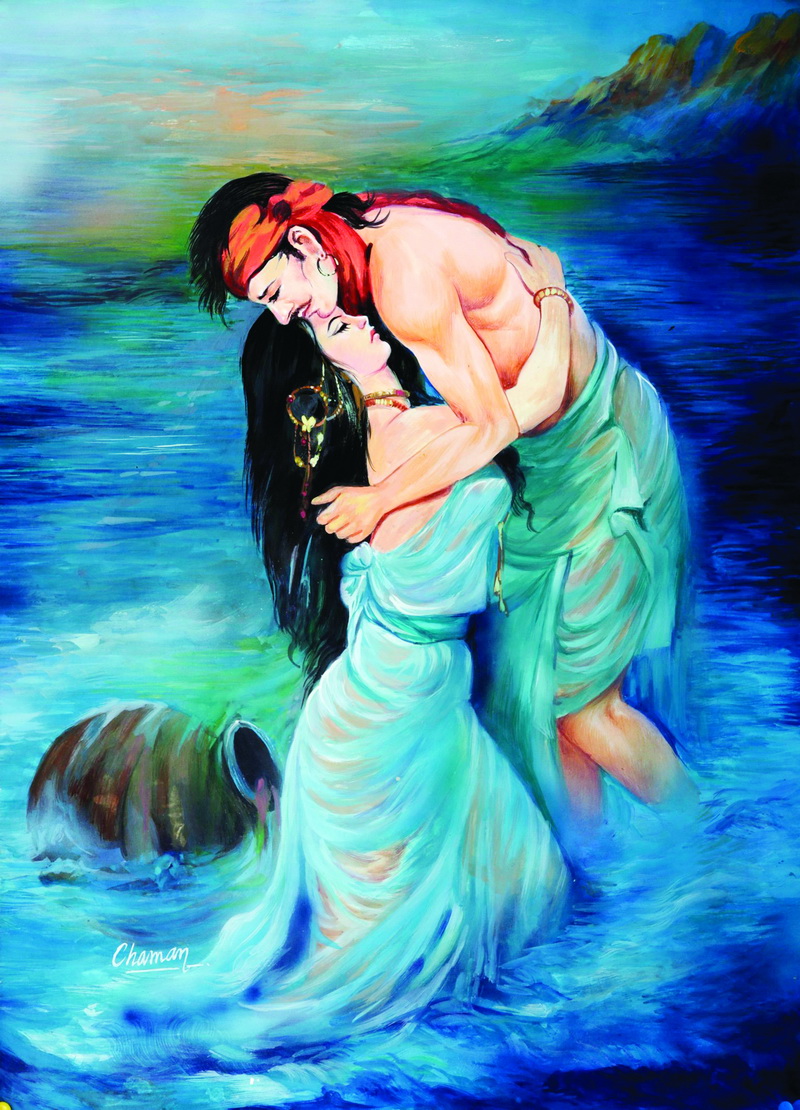
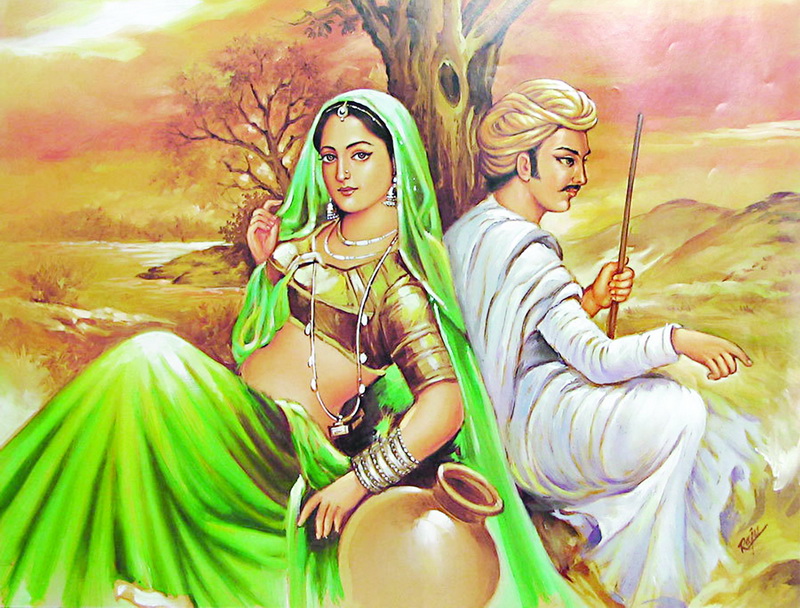
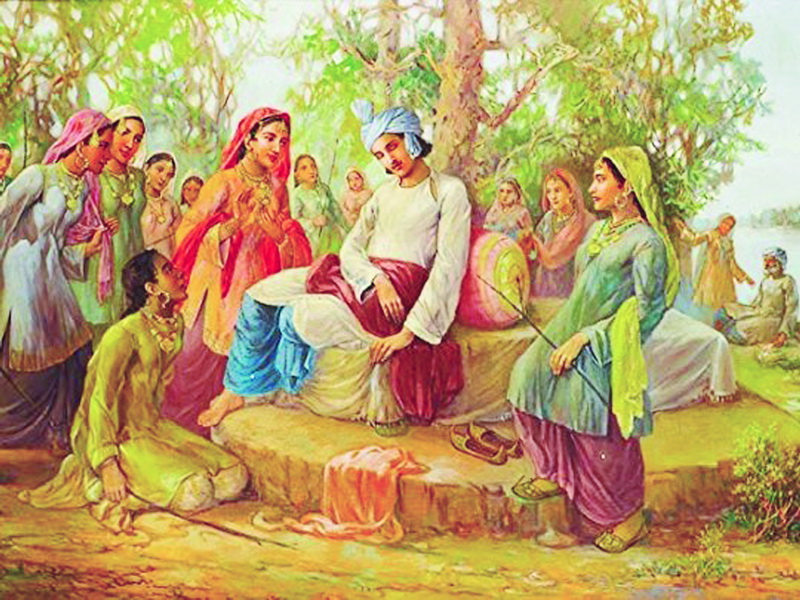
One of the four timeless tragic Punjabi romances is the story of Sohni Mahiwal set in Gujarat in the 18th century (late Mughal period). The love affair to melt the hearts of countless generations grew between Sohni, potter Tulla’s beautiful and artistic daughter belonging to the Kumhar caste (generational potters) and her Uzbek migrant trader turned buffalo herder, Izzat Baig, nicknamed Mahiwal. Strategically positioned on the River Chenab, Gujarat a the time was an important caravanserai on the trade route between Central Asia and India.
A Sindhi version of the story Sohni Mehar is attributed to the Sindhi Sufi poet Shah Abdul Latif Bhittai and was immortalized in his poetic compendium or collection called Shah Jo Risalo, written in pure Sindhi replete with Sufi symbolism. It’s one of the seven Sindhi tragic romances known as Seven Heroines. In this version, Sohni belonged to the Jat tribe living on the western bank of the Indus River, while Dam, Sohni’s husband lived in Samtia on the river’s eastern bank. During the marriage procession over the river, Mehar gave Sohni a drink of milk and the two fell in the love at first sight.

Let’s return to the Punjabi story popularized in films. Tulla created the most beautiful and sturdy of earthenware pottery painted with lovely designs. As his lovely daughter grew up, she took to painting the pots while her father crafted and baked them. One day, a merchant caravan coming from Bukhara and heading to Delhi stopped en route in Gujarat. A young and rich trader came to inspect Tulla’s famous pottery. There he spotted Sohni with her head bent over a small pot for sweets, using a fine hair brush to paint the patterns meticulously with tiny strokes. Izzat Baig fell in love with her at first sight and desired to buy the pot she was cradling.

Tulla replied that that pot needed to be baked to make it resilient before it could be purchased. The young man returned the next day for it and kept returning every day after that. He was so smitten that when the caravan set off for Delhi, he decided to stay behind. Soon his money ran out, and Tulla hired him as a water buffalo herder. Izzat Baig began to be known as Mahiwal, the buffalo herder.
Deluged with positive attention from the lovesick youth, Sohni too had fallen in love. Whenever he was late, she got depressed but as soon as she would see him coming up the road, she felt elated. Pining in each other’s even momentary absence, the two lovers began to meet in secret.

As we know, at the time it was strictly forbidden for girls to marry out of their caste. When rumours about Sohni Mahiwal spread in the village, her family hastily arranged her wedding to a well to do pottery merchant who travelled long distances to sell the Gujarati potters’ wares.


On the day of the barat (wedding night), Sohni was piled into a doli (palanquin) and carried off forcibly to her husband’s neighbouring house.
Grief-stricken, Mahiwal wanted to be as close to his lady love as possible and started living in a small mud hut across the river from Sohni’s house. Now that she was married, he still didn’t want to leave for his land and his previous life, believing that the earth under Sohni’s feet was his dargah (shrine). He renounced all worldly life and started to live the ascetic life of a fakir (hermit) just as Sufi fakirs do in their love for Allah.
At night, Sohni would sit by a window and look at her lover sitting outside his hut across the river. When her husband left for a long trip to sell pottery, one night she stole out of a house and decided to cross the river. Because she didn’t know how to swim, she turned one of her father’s sturdy garrha (water vessel) upside down to aid her to stay afloat as she crossed the river. Without the pot to keep her afloat as she kicked her feet, she would have gotten swept away by the gushing river. Seeing her risk her life just to meet him, Mahiwal swam and brought her to his side of the river.


Now swimming makes you hungry. Mahiwal caught a fish and roasted it on an open fire to feed his famished girl. Feeding the soul and the body, their bliss was complete.
Sohni Mahiwal continued to meet like this for many nights. Their love madness was growing exponentially. One night Mahiwal hadn’t been able to catch a fish. In a gruesome act of self-mutilation, he carved out a piece of his thigh, roasted it and fed it to his Sohni. When she consumed his flesh, she could taste that she wasn’t eating fish and spying Mahiwal’s black blood soaked dhoti (he had a wrapped a black one so she wouldn’t see the blood) was struck by how crazy in love with her he was.
That night Sohni’s sister in law who lived in the same house discovered her nocturnal secret. Shocked, she went and told Sohni’s mother and mother in law. Sohni’s mother felt ashamed at her daughter’s scandalous behavior. For a Muslim girl to run out of her husband’s house every night to meet her lover at his house was unthinkable. But the girl had become too headstrong and rebellious to heed her mother’s warning.
Sohni’s sister in law decided to take matters in her own hands. She felt she owed it to her brother to save his honour. She devised a plot to make it impossible for Sohni to cross the river and replaced her garrha with one that hadn’t been baked as yet, figuring that it would crumble as soon as it touched the water. Sohni would not dare to cross the river without the aid of a float.
Unaware of the fate that lay before her, the next night, Sohni took the unbaked garrha and began to wade across the swift river. When she was a quarter of the way across, the garrha began to disintegrate in the water. She called out to Mahiwal for help. Mahiwal jumped in and swam towards her, but his leg started bleeding. At the halfway point in the river, he reached Sohni whose head was bobbling up and down as she thrashed in the water, her arms and legs flailing desperately. Weakened by the loss of blood, his body wasn’t strong enough to swim with her against the current. While holding on to each other, they both drowned in the Chenab River.
Mere mortals could not tear apart the lovers joined by God who reunited them in death, forever to lie in each other’s arms.
Legend has it that 75 km. from Hyderabad, Sohni Mahiwal’s graves lie in a tomb located at Shahpur Chakar Road, Shahdadpur. The shrine is visited by lovers who pray for their loves to be restored to them.
For a Muslim girl to run out of her husband’s house every night to meet her lover at his house was unthinkable

Most Pakistani actors dream of working in Bollywood. However, Indian actress Aditi Singh has crossed over to our side with her movie Wajood. Belonging to a family of Bollywood actors, she’s the daughter of Jainendra Pratap Singh and niece of Aditya Pancholi, and started her career with the Telugu movie Guppedantha Prema. Sana Zehra asks Adhiti all about nepotism, love and her movie new Wajood

What was the response to the trailer launch of Wajood like?
Well I wasn’t here in Karachi when the launch took place, but after it, I received so many messages praising the trailer of Wajood and my look in it that I was overwhelmed. Though I was miles away, people really made an effort to convey their liking.
Does other people’s approval matter to you?
Not in my personal life, but when it comes to my professional life, of course it does. My audience’s appreciation makes me into the artist I am. I won’t ever want to do anything that makes them feel any less love for me. Whatever I do, I do to entertain my fans and their approval matters. The happier my fans are with my work, the longer and more successful my career will be. Simple!
How do you deal with the uncomfortable questions about your personal life?
When a person decides to become an actor, he/she should be well prepared because once you put yourself out there, your personal life isn’t so personal anymore. I started acting at the age of 16, and I accepted whatever was part and parcel of my field.
Having said that, yes some things are private and I keep them that way. I guard my privacy, am not an open book and like to keep certain aspects of my life mysterious. But I still have to give some insight in to my personal world. It adds a personal touch to my story.
Have you signed anything new?
There are a few things in the pipeline, which I’ll disclose them soon.
What is the one thing that you look forward to every day?
I look forward to doing what I love every day, which is performing in front of the camera.
Who, according to you, is the best dressed actor in Pakistani cinema?
Javed Sheikh, Shehryar Munawar and Humayun Saeed.

Who, according to you, is the worst dressed woman in Pakistani cinema?
Nobody. Pakistani fashion is graceful and the actresses are so elegant.
Any infamous incident of the past that still haunts you?
Yes, I lost both my grandparents within a month in 2008. I was the closest to them.
Do you admit that the film industry operates on a flawed system of nepotism, one that blatantly prefers family over genuine talent?
What ultimately decides an actor’s fate is purely his/her talent and luck. Nepotism is not only in the film industry but in every industry. Parents prepare their children to take over the family business. The film industry too has this system. This does make it easy for bagging the first film, but thereafter only capability decides stardom.
Acting is not inherited; it’s inherent and gifted by God.
What drives you to act? Is it the attention, the perks, or the joy of experiencing different lives every time you play a new character?
Experiencing different lives every time I play a new character is a great feeling. Also the high and happiness I receive, when I succeed at making the character believable and entertaining. That happiness is immeasurable.
Strangest rumour you heard about yourself?
Still waiting to hear something strange. (Haha)
If you wake up one morning and found out that you turned into your costar what would you do?
If I woke up and turned into Danish Taimoor, I would straight up go to Rayaan (his son) and cuddle him all day. He’s so cute!
If I woke up as Sheikh Sahib, I would commission a biography on myself.

What would your matrimonial ad say?
“Priyanka hai pheeki,
Theek thak hai Kareena Kapoor,
Kudh ko khushnaseeb samjhein janaab,
Main hoon Kohinoor!†(Hahaha)
(Priyanka is plain,
Kareena is OK.
Think yourself fortunate,
I’m the Kohinoor!)
Acting is not inherited; it’s inherent and gifted by God
One thing men should know about women?
Give a woman respect, and you’ll have her world.
Meanest thing anyone has ever said to you?
You’re not good enough to be an actor.
Do you believe in true love?
ABSOLUTELY, without a doubt
Which writer would you like to write your biography?
Stephenie Meyer, author of the Twilight series
Which film would you like to have directed?
The Queen
Which book would you like to turn into a film?
The Untold Story of Rekha, I’d make it into a biopic.
Which film would you like to watch over and over again?
Wajood
One TV show you would have liked to produce?
Mohabbat Tum Se Nafrat Hai
What makes you cry?
Onions
Greatest work of art?
All the music created by Nusrat Fateh Ali Khan Sahib
Which colour describes you best?
Red because it signifies power and fire
What gives you pleasure?
Travelling and spending time with the people I love
Whose body would you inhabit while keeping your own mind?
Mahira Khan
The five most important things in life?
Family
Respect
Love
Luxury
Ambition
The most difficult question you could be asked?
How to fall in love

Studio Z owner Zara Bari makes every client feel like a star. Zara gives Sana Zehra great tips for achieving red carpet hair and glowing skin

What products do you use/recommend and why?
I think product usage varies on individual preference and correlation with the environment, i.e. climate. However, the non-negotiable that I insist upon in a healthy regular routine are:
- Regardless of the number of times, varying from person to person, one must wash hair, sulphate free shampoos and conditioners are the way to go. Simply eradicate the use of detergent or other lustre regressing components.
- A good sunscreen is a must use/must have at all times.
- We are fortunate to be in a country where organic items are accessible. Go organic!

There are so many salons opening currently. What does Studio Z have that others don’t?
It’s true that the industry is going through a mushrooming effect. As a result it’s essential to stand apart.
We are a small and involved team, staying ahead of the pack by ensuring product authenticity and specification of needs in accordance with clients. We don’t pursue clients by cross selling impulse driven products or services neither by joining the trend or hype bandwagon.
What is your take on having great hair?
It’s essential to know how to handle your own hair. You can get the colour you want; you can get the style you want; but think how much you want to put you hair through.
At Studio Z, we discourage over colouring, over bleaching and over styling. You may walk in with a makeover agenda for your hair but if the hair strength is compromised, we make it our business to take you through a journey to rebuild, and strengthen your hair first.
Can you please tell us how to keep our skin healthy throughout the year?
Other than sunscreen, it is imperative to know your skin well. Hydrate your skin by drinking plenty of water and adopt a skincare routine according to the weather. Your routine cleansing must be detailed. Wash your face at intervals, use the right cleaning products, and remove makeup thoroughly. Know your skin well. All the basics!
What is one beauty trick you swear by?
I wish we could sell water bottles as skin tonics. Keep yourself hydrated; no product matters if there isn’t adequate amount of water in your system to cleanse you inside out. When facing breakouts, dryness, roughness of hair notice your water intake and fix it.

What are the current beauty trends making the around?
- Make a personal statement.
- Stay subtle but stunning.
- Keep and carry natural hair texture, brushed up brows and even toned natural skin.
Bare breathable skin with a pop of colour on eyelids.


What are the three makeup items one should not leave out?
- Moisturizer
- Mascara
- Tint
How has makeup evolved in the last few years?
In today’s technologically advanced and research friendly world, a lot of detailing and knowledge of product range availability is needed to make informed choices. The makeup market is highly competitive and extends from drug store brands to high end makeup products. Now makeup is all about individuality unlike earlier s where it was skewed toward the trending colour palette.
“You can get the colour you want; you can get the style you want;
but think how much you want to put you hair throughâ€
What’s most important for brides to remember for their wedding day makeup?
Makeup artists are there to enhance your beauty, and not transform you into somebody else. Embrace your skin tone and your flaws that make you unique. You can carry a look off confidently, if you are comfortable with yourself. Don’t insist on being a photocopy of someone else. Find your own statement look. We can help you with that.
“No product matters if there isn’t adequate amount of water in your system to cleanse you inside outâ€
How would you describe your signature look and what is it about your style that sets you apart from other makeup artists?
We don’t overdo or over complicate but emphasise on completing your look. Makeup is no short cut and supposed to be a detailed job. Customisation and personalisation is key. We look at the face, type of person, desired look and style accordingly.
Changing skin tone is a popular request. However, if you try to change your skin tone, you will start looking grey, which is a very common problem. We look towards winning customer trust and try to be on the same page style wise.

Who would you like to give a makeover?
My dream come true would be Shahnaz Sheikh and Marina Khan.
Do you have any favourite makeup products? We’d love to hear!
Here are a few of my favourite makeup products:
- Musarrat Misbah Foundation. It’s perfect for our skin tones so you may not need a colour corrector with it.
- Christine Dior Skin Star Foundation. It’s SPF 30 and long wearing.
- Giorgio Armani Luminous Silk Foundation
- Laura Mercier Translucent Powder
- Lancôme Monsieur Big Mascara
- Becca Highlighters
- A Girl Pro Conceal & Contour
- Estee Lauder Pink Kiss Satin Blush
- Urban Decay Makeup Setting Spray.
Photography by Arsalan Bilgrami of A.Bilgrami studio

1. Nando’s
Nando’s special sauces are great for chicken, aromatic rice, crispy wedges, etc. We love their Wild Herb sauce the most. It’s so yummy and appealing to your taste buds. Any how can one even leave out Peri Bites? With a recipe from heaven, the special sauce gives you major cravings.

2. Paisely Maze B from Sapphire’s Deco Life CollectionÂ
Relive old world-charm and sophistication with Sapphire’s Deco Life Collection. Available online and in-store from July 6th.

3. Too Glam to give a Damn!
Girls! Brace yourselves because cheetay.pk now has the best makeup products from top international brands on their website (delivery at the moment for Lahore only). We’re going gaga over their offers because they’re giving 20% off on all products. They’re 100% authentic and what’s best is that your favourite makeup brands are now only a click away. So head over to the Healthcare section on their website. Glam up your life and place your order now!


1. Next’s Summer ’18 collection
Next’s Summer ’18 collection is all about style and glamour this year. We can’t get enough of this beautiful red embroidered Boho blouse with frill sleeves featuring a fusion of traditional embroideries, modern designs and a vibrant colour palette. Look out for your favourites as the collection is now available in stores.

2. Uraan
Uraan; a clothing line exclusively designed for Eid, will be exhibited from the 3rd of June from 4pm-10pm till Chaand Raat at TRIMMERS Salon For Women, 96 R Commercial Area Phase 2 DHA Lahore.


3. Marina Home Interiors: Nest Pendant
Wonderful to look at and even better to illuminate, this stunning, large, pendant light, made of burnished brass, exudes a futuristic, nucleus-like design. A real showstopper, this gorgeous and surprisingly versatile item deserves pride of place in the main rooms of a house or office and will pair well with a range of interior design styles.


By Sana Zehra
Recently Citrus Talent Agency’s’ Fahad Hussain on Facebook accused Iqra Aziz of breaching their contract by signing with another talent agency. Iqra denied all accusations and allegations against her. It’s now all water under the bridge as the two sorted out their “misunderstandings†and “miscommunications†and released a joint statement.

Rumour has it Amy Schumer compared the royal wedding to a Westminster dog show. Ouch!

Rumour has it Imran Abbas is all set to make his Hollywood debut in the movie, The Trojan Horse, playing a spy of Syrian-Moroccan descent. Read more about Imran in our archives.

Rumour has it that actors Aditya Roy Kapoor and Katrina Kaif might be dating. The two shared screen in Fitoor earlier this year, and are now touring the U.S. I guess we will have to wait and see how it turns out.

Rumour has it that Priyanka Chopra and Nick Jonas are dating. Despite a 10 year age gap, the two get along well and are all sultry smiles when togther.
Rumour has it that Moammar Rana compares himself to Rambo, nope not the cockroach killer. We are talking about Sylvester Stallone’s John Rambo and people of course did not take it well. We are not too sure where the resemblance is but a lot of people are eye rolling on this one.

Rumour has it that Danish Taimoor is all set to make his TV comeback after five years with Sanam Chauhdry in Ab Dekh Khuda Kia Karta Hai.

Rumour has it that Hrithik may just bag another big one with Sanjay Leela Bhansali. The two recently had a two hour long meeting together regarding Bhansali’s upcoming period film tentatively titled, Prince. If the actor gives his nod to the project (and we seriously hope he does), this will be his second collaboration with the director.

Rumour has it Kim Kardashian has caused a ruckus yet again. This time fully clothed! She posted a picture while sucking on an appetite suppressing lollipop. Actress Jamila Jamil blasted Kardashian calling her “a terrible and toxic influence on young girls,†adding that the whole family makes her feel actual despair over what women are reduced to. Tsk tsk some people will never learn.


Disclaimer: The information, view or opinion expressed in this article/post has not been verified by us and does not necessarily reflect the opinion of GT magazine.

Reesham landed her first commercial at the age of 8 and Her father protectively accompanied her to the shoot. By age 15, she was a radio jockey at FM 100. Throughout her college years, the young actress was actively involved in theatre and bagged the award for Best Actor at the Pakistan Theatre Festival 2005. since then, her performances in Khoat Muntazir, Ghareeb Zaadi and Dil-e-Nadan have also been praised by drama critcs. Recently, her work in Sajjad Ali’s Lagaya Dil has been making waves. Reesham lets Sana Zehra get to know her on a personal level

If you weren’t in the industry, what would you be doing right now?
I would love to host corporate events; I’d also love to interview people from politics and such.
How did you enter this field?
I entered this field at the age of 8. My teacher saw my dramatic and introduced me to her husband who was at the time running PR company, Publicis. I did my first TV commercial for Maggi Noodles and after that, there was no looking back. I thoroughly enjoyed most of the work that came my way.
What is your most loved work to date?
Muntazir
Piece of advice you received 10 years ago that is coming true now?
You need to be very persistent and need to work hard each day in order to achieve your goals.

How does your husband handle your success?
He’s been my strength. We need more men like him who takes pride in his woman’s success. 🙂
Nickname that really annoys you?
Reshma
Weirdest habit you have?
I boss people around.
One film you’ve watched more than 5 times?
Dilwale Dulhania Le Jayenge

A character you wished you would have played?
Rani Mukherjee in Black
Lipstick shade you wear most often?
Nude
Early or late?
Early
One thing you would like to change about yourself?
I think I am pretty happy the way I am.
One thing you just won’t eat?
Indian squash
Reesham admits she’s bossy




React in one word to the following:
Marriage
Blessing
Being human
Sallu bhai
Awards
Motivating
On screen romance
Chemistry
If you wake up as the following actresses what would you do?
Kareena Kapoor
I would kiss baby Taimur he is so adorable!
Sarwat Gillani
Not too sure (Laughs)

Funniest thing that happened to you recently?
After the song Lagaya Dil became a hit, people started sending me all these weird messages. I was a little taken aback from them. Some of the messages were super creepy.

Hair & makeup:
Studio Z Salon and Spa
Photography:
Arsalan Bilgrami of a.bilgrami studio

By Mahlia Lone
You cannot separate the story of Heer Ranjha from that of the author who immortalized their love in Punjabi verse, Waris Shah. The Sayyidzada was an eighteenth century Sufi poet belonging to the Chishti order who settled in Pakpattan where he is buried. Perhaps in part inspired by his youthful unrequited love for a girl, Bhag Bhari, in 1766 he wrote the intricately detailed and lengthy poem replete with realistic and charming depictions of Punjabi village life set within the greater political situation of the day. In addition, the language he used is considered a veritable “treasure-trove of Punjabi phrases, idioms and sayings†passed down to coming generations. Last but not least, Waris Shah elevated the story of romantic love into “a poetic expression of the mystical love and unrelenting quest of the human towards God,†in the Sufi tradition. Like in all fine art and literature, his masterpiece in verse works seamlessly on several different level.

Historical Background
It is widely believed that the real life lovers of Heer Ranjha lived towards the end of the Lodhi dynasty (an Afghan dynasty that ruled the Delhi Sultanate from 1451 to 1526) before Shehnshah Babur supported by Rana Sanga, the Raja of Mewar, and head of the Hindu Rajput Confederacy in Rajputana, defeated Ibrahim Lodi’s 1,000 elephant and 100,000 thousand strong men massive army at the Battle of Panipat, using muskets and artillery never before seen in the Indian Subcontinent.
The story
Born into a wealthy Kharal Jatt family belonging to the Sial tribe in Sial Sharif, Jhang, Heer (named diamond for her astonishingly good looks) grew up to be a beautiful girl. Dheedo, a Jatt of the Ranjha tribe, hailed from the village of Takht Hazara (old name Khajjiyan Wala) by the Chenab River. The youngest of four brothers, he was spoilt and cossetted being his father’s pet. Though his older brothers were kept hard at work toiling on their ancestral agricultural lands, Dheedo led a life of ease. He whiled away his time playing his bansuri (flute).


Trouble began when Dheedo’s father died, leaving his sons to divide up his land at will between them. His brothers resented Dheedo’s idle ways and thought him a fool, so they gave him barren land and their wives refused to give him food. Ranjha tried but failed to work his land, fought with his family and left his village to find his luck elsewhere.
One night, Ranjha took shelter in a masjid (mosque), and started playing his or flute to help him sleep. Soon the villagers gathered round him listening to the melodious music. The maulvi (cleric) admonished him to stop playing his flute, saying he was desecrating the mosque with the haram (not sanctioned by Islam) music. Ranjha, as he began to be known as, replied boldly that his music was not a sin compared to the hypocrisy of the so-called holy men: “You and your kind, with your beards, try to pretend to be saints, but your actions are that of the devil. You run around after women in mosques… you are like curses clinging to the house of God.†The mullah was seething but the villagers refused to back him up, as from in their hearts they agreed with Ranjha. Dumbfounded, the maulvi let him stay the night if he left the next day.
In the morning, Ranjha wandered in the direction of Jhang. Spying a large, verdant field with lush crops and cows grazing, he decided to ask the landlord for work. The owner was Chaudhry Chuchak, chief of the Sayyal clan, who hired Ranjha and housed him in the stables as a hired hand. Heer, the Chaudhry’s fair daughter, had a full moon-shaped face considered pretty at the time, shiny eyes that sparkled like precious gems, jasmine white teeth, ruby red lips and a nose as straight and sharp as Imam Hussain’s sword point. She was delicately built, yet strong and fit.
From Love to Love is a postmodern, subjective short film , available for viewing on YouTube, about a girl who discovers the tale of Heer Ranjha and starts to question what love is as portrayed in contemporary media.

“As a film director and a woman what pulled me towards the tale was the character of Heer, a girl living in the 16th century challenging traditions of a patriarchal society. Through her love for Ranjha, she stands against capitalism and class system prevalent in Punjab at the time. Even now, Heer is an archetype of a strong, resilient woman who stand against the status quo and epitomizes purity of love, often translated as Sufism. Heer’s tomb in Jhang, is still a symbol of love, devotion and spirituality,†said Sayeda Alina Ali, documentary filmmaker based in Lahore and an MA Graduate in Cultural & Creative Industries from King’s College London. She is an Assistant Professor at the NCA.

Heer checked out Ranjha. He had long hair, not an ounce of fat on him and was musical to boot. She was smitten. Both were at the age when one is ripe for falling in love. Always in proximity with each other and easily meeting up attended or in seclusion, “their love flourished, as did the crops.â€
Years went by swiftly, with the two lovers enraptured with each other and no one discovered their feelings for each other, till one fateful day Kaido, Heer’s uncle, spotted them together canoodling. Incensed, that family respect and pride was at stake, he tattled to her parents who confronted their errant daughter. Though seemingly respectful towards them, she was a resolute and strong willed girl; she was determined that she was in love with Ranjha, their hired hand, and only he was the only man for her.
Not knowing what to do, Heer’s parents called the qazi who judged village issues according to Sharia law. He reminded her that as a righteous Muslim girl it behooved her to respect her parents’ wishes and their honor.
Still Heer was adamant, saying that just as drugs and alcohol cannot be taken away from addicts, Ranjha could not be pried apart from her. Only Allah had that power. Holding up her hand, scarred with an iron burn, she said, “True love is like a mark that a hot iron burns onto the skin or like a spot on a mango. They never go away.â€
“Ranjha, Ranjha kardi ve main aape ranjha hoyi
Ranjha, Ranjha saddo ni mainu heer na aakho koy†—A. R. Rahman
(Repeating Ranjha, Ranjha all time I myself have become Ranjha.
No one should call me Heer, call me Dheedho Ranjha.â€)
Heer’s parents arranged her marriage to Saida Khairra without consulting their headstrong daughter. At the nikkah ceremony when Heer was asked by the qazi if she accepted this proposal, she defiantly replied in the negative. Frightened by the family dishonor she would bring them, her father went ahead and signed the nikaah papers anyway without his daughter’s consent. Heer declared that she was already married to Ranjha, with the nikaah witnessed by Allah and His prophets. But she was forcibly carried off by her relatives to Saida’s house in another village.
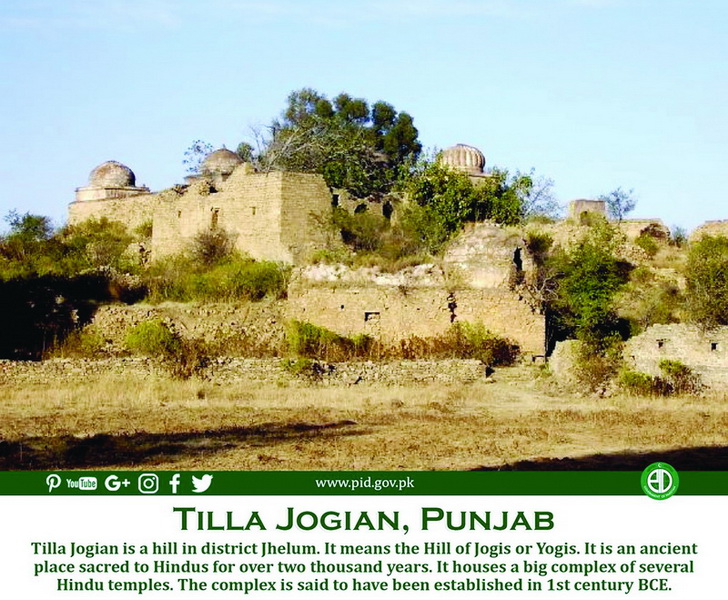
Hearing of this, instead of taking action, Ranjha started wandering aimlessly, distraught because he could not bear to think of Heer in another man’s arms. Reaching a wooded area forested with olive, pine, and Acacia trees, he met the famous Shaiva Jogi (ascetic) Gorakhnath, the founder of the Kanphata (pierced ear) sect of jogis at Tilla Jogian. The was the site of the 1st century BCE Hindu temple, monastic complex and sacred pond created, according to Hindu mythology, from the teardrops of the Hindu god Shiva and was located in the Salt Range near Bhera, Sargodha, in proximity to the Rohtas Fort, and the Katas Raj Temples.


Giving up worldly life, Ranjha too became a jogi and covered his body with ash, had several ear piercings and holding a begging bowl, went from village to village reciting “Allah hoo†and begging for food and alms. One day, he knocked unknowingly on the door of Saida’s house. Sehti, Heer’s sister-in-law, answered the door and saw the handsome, young jogi. Sehti had heard Heer’s entire story and believed that her brother had sinned by marrying an unwilling girl. Performing or participating a nikkah without the ready consent of either party she believed was haram (not sanctioned by Islam). So Sehti took it upon herself to right her brother’s wrong and help Heer escape with Ranjha.
Despite her best intentions, unfortunately, the two lovers were caught escaping by the Raja’s men who took them to their lord. The Raja appointed a qazi to deal with the trangressing lovers and the qazi decided to send Heer back to her husband.
Ranjha cursed the villagers in his fury, warning that Allah would not stand for injustice. Lo and behold the town caught fire. The townspeople and the Raja got scared of the wrath of Allah and allowed Heer Ranjha to get married and leave town together.
Heer’s parents acquiesced to the Raja’s order. But humiliated at their loss of face, Kaidu and his co-conspirators plotted to kill Heer. Ranjha returned to Takht Hazara to fetch his family for his barat (bridegroom’s wedding procession). The Sayals returned to Jhang with Heer to prepare for the wedding.

On the night of Heer Ranjhas marriage, the Sayal clan presented a basket of poisoned laddus (lentil sweetballs) to the newlyweds. Happy that her family had finally relented and had blessed her union with her beloved, just as Heer bit into a laddu, she fell down dead. Realizing what had happened; Ranjha took the half-eaten poisoned laddu from her limp hand and stuffed it into his mouth, dying next to his beloved Heer. The star crossed lovers were buried in Heer’s hometown, Jhang. Their tomb continues to be visited by sad souls seeking to marry their beloved.
The deeper meaning that Waris Shah conveyed in Ranjha’s search for Heer as a jogi was man’s quest to find and understand God. Just when he thought he had finally attained her upon the eve of their marriage, she escapes his hands through death. It signifies that the moment you think you understand Allah, your faith will be tested. It’s an unending journey to a higher self and greater undersanding.
The version with the happy ending popular in India
“According to Professor Indu Banga of the Department of History, Punjab University, in Chandigarh, India†wrote S. Conceicao “the earliest ‘kissa’ (story) in Punjabi was that of Heer-Ranjha, written by Damodar Gulati in 1605 during Akbar’s reign. His work was rewritten by Ahmad Gujjar in the 1680s and then by Shahjahan Muqbil in the second quarter of the 18th century and again by Waris Shah who built upon Muqbil’s work and the status of a classic was accorded to his 1766 composition.â€
The following story has been concised by S. Conceicao and is based on folklore, transcribed from an oral rendition of the Jatts from the Patiala State, collected by R.C. Temple and published in the second volume of Legends of the Punjab in the 1880s:
Before she met Ranjha, the strong personality of Heer was illustrated by an incident. Ludan is an old ferryman employed by a landlord named Sardar Noora from the Sambal community to look after his fleet of boats, including his brand new stately river barge. One day without the landlord’s permission Ludan took some men aboard the barge. Noora was furious and publicly upbraided old Ludan who felt wrongfully disgraced after years of faithful service. When the Sardar was away from, in revenge Ludan took the flotilla and “sailed through the night like a vagabond and kept crying, ‘Is there a lord, born of a lady who can take me into his fold?’ The gentlemen heard him; silence was the response as nobody uttered a word. Why to enkindle the fire, why to start fresh feuds! It is inappropriate to do battle and get people killed for this flotilla. Hearing of Noora no one let the sailor drop anchor—.

Heer along with a bevy of girls hears the cry and acts like a mighty gracious queen, ‘cast your anchor along the side of our bank, you will not lack anything here. Who is this monster Noora, the owner of the vessels? No one can shelter you except me, the daughter of Chuchak.’â€
Fearless, Heer gave the old man refuge. Sardar Noora was enraged at this incident. Summoning his friends and servants to his aid, he set off to catch and punish Ludan. On refusal of Heer’s father to return the boats and Ludan, Noora conducted a raid and to his utter surprise found females led by Heer ready to confront his party, which proved to be an even bigger disgrace for him.
When Heer’s brothers found out about the incident out they asked her in concern, “If a mishap had befallen you why didn’t you send for us?â€
Without batting an eyelid she answered, “What was the need to send for all of you? Emperor Akbar had not attacked us.†This was the strength of character of the indomitable young Heer who acted defiantly in a repressive, patriarchal society.
In the story, having left his home, when Ranjha reached the banks of the River Chenab, the sun had begun to set. He asked Ludan to take him aboard and row him to the city of Jhang on the other side. But Ludan refused, thinking Ranjha was a thief who planned to rob him. Ranjha sat down on the river bank, and started to play a melancholy tune on his flute. Moved to pity, and cajoled by the young man, Ludan’s heart softened and he agreed to ferry him across.
Ranjha boarded and made himself comfortable on a luxurious red and white couch. Ludan admonished him saying the couch belonged to Heer, but Ranjha didn’t pay heed and soon fell sleep on it. The next morning, Heer and her girlfriends arrived at the river like “a hailstorm sweeps over a field.†Noticing Ranjha asleep on her couch, Heer blamed Ludan and threatened to have Ranjha beaten for his insolence. But when Ranjha opened his lovely eyes, Heer changed her mind. They spent the rest of the day together and Ranjha told Heer his life story. By the end of the day, Heer swore to be Ranjha’s forever.

The next day Heer brought Ranjha to her father, Mihr Chuchak, saying “Father, I have found someone to herd the buffaloes.†Her father was skeptical because Ranjha with his beautiful long oiled hair and smooth skin looked more like a rich man’s son than like a common herder. He hired him regardless to please his daughter. Every day, Heer brought Ranjha food that her family ate: Milk, bread, rice and sweets. They would spend as much of the day together alone in the forest as they could. Heer neglected her spinning and other household chores, and hardly saw her girlfriends.
The villagers started speculating about the mysterious buffalo herder who Mihr Chuchak’s daughter took food to and who herself oiled his long hair with a quart of ghee. The gossip reached the ears of Kaidu, Heer’s uncle, who began to lurk in the forest, trying to catch the two together.
One day Kaidu found Ranjha alone in the forest, and came up to him, pretending to be a beggar. Ranjha, remembering his days on the road when he, too, had to beg for food and shelter, gave Kaidu half a pastry, which Heer had made for him. Kaidu took the pastry and brought it before the village elders as proof of Heer’s disobedience and wanton behavior. “I have seen Heer and Ranjha in the forests, and I tell no lies. Ranjha will take away Heer, and there will be shame to the Siyals,†he said showing his proof.
The elders went to Chuchak and told him about Kaidu’s accusation. Believing in his daughter’s innocence and moral rectitude, Chuchak furiously refused to believe his brother in law, “Kaidan is a talebearer and a liar. He chases moths all day.â€
Kaidan then went to his sister, Heer’s mother, urging her to use her influence to ward off the scandal. Chuchak finally called Ranjha to him one night after he had returned with the buffaloes dismissed him from his service.


“For twelve years, I have tended your buffalo and now you turn me away without wages!†Ranjha threw his staff down, turned on his heel and left.
They say you can never please everyone. The villagers now started criticizing Chuchak for dismissing Ranjha without even paying him his wages. Heer was also crying inconsolably. Chuchak relented and took Ranjha back into his service and before 70 Khans and 72 nobles Chuchak betrothed Heer to Ranjha, saying: “As long as thou shalt live, she is thine, and when thou art dead she will not deny it. If anyone tears Heer from thee I will bear witness against him in the Court of God.â€
Heer’s mother and uncle were not appeased however and brought Heer before the qazi who reminded her of her duty to respect her family and honour their standing in the village. But Heer refused to give up her buffalo herder, citing, “As wine-bibbers cannot desert the bottle, as opium-eaters cannot be without their drug, so I cannot live without Ranjha.â€
The qazi finally told the Siyals that Heer was too stubborn, and to avoid further scandal they should marry her off right away. The Siyals called a clan meeting. Chuchak’s decision to let his daughter be married to the herder was overruled. Even if the buffalo herder was actually a Ranjha of Takht Hazara, he was from too lowly a family to marry a Siyal. Instead, the family decided to marry Heer off to Saida, of the Khera clan.
On the day of the wedding ceremony Heer refused to say, “Kabul hai†(I accept) when asked if she gave her permission for the nikkah to be performed by the maulvi. Instead the bold girl cried out that she had been betrothed to Ranjha and that their union had been blessed by Heaven and the saints. â€Muhammad (PBUH) formed the marriage procession and Brahma set up the posts of the marriage canopy. The angels sang songs of rejoicing and fairies brought the henna. The Panj Pir (Five Saints) performed the ceremony and the Khizar was the witness.â€
Not heeding her cries, Heer’s parents signed the marriage papers, and the Kheras took Heer back to Saida’s house in Rangpur.
A heartbroken Ranjha had returned to his native village of Takht Hazara, but couldn’t forget his lady love. So he set off to search for her. On the way, he crossed Tilla Jogian, the temple where the jogi Gorakh Nath lived. Bowing before him, Ranjha asked to become a jogi, but Gorakh Nath doubted that Ranjha had the humble nature and ascetism of a true jogi. Ranjha stole the jogi’s conch with which he called his followers for their evening meal and buried it, committing it to the care of Mother Earth and Khizar. Without the conch, Gorakh Nath couldn’t summon his jogis and feared they would keep waiting for their call and thus starve. To prevent this, Gorakh Nath agreed to let Ranjha become a jogi. Ranjha dug up the conch and blew it, once to the east and once to the west, to summon the jogis to their meal. Gorakh Nath rubbed Ranjha with ashes, shaved his head, pierced his ears, and gave him a begging bowl. He told Ranjha, “Call the young women ‘sister’ and the married women ‘mother.’ Beg throughout the city and bring no shame on the profession of begging.â€
Ranjha threw away the begging bowl and earrings and rubbed off the ashes. He didn’t want to call Heer either his mother or his sister.
“I was right about you!†exclaimed the guru.
Ranjha laughed at him, “We Jatts are cunning — we use all means to get what we want. What can I do with a beggar’s bowl, whose heart is set only on plowing? How can I call her ‘mother’ for whose sake I would become a jogi?â€
At first, the guru was angry, but soon he realized that Ranjha was deeply and desperately in love. Moved to pity, he blessed him and prayed that he would achieve his heart’s desire.
Gorakh Nath sent his crow to search for Heer. The crow flew from town to town, from house to house, until it arrived in Rangpur and found Heer, wasting away in Saida Khera’s house. The crow talked to Heer and told her of Ranjha’s faithfulness to her. Then the crow returned to Tilla, bringing news of Heer’s whereabouts to Ranjha. He set off for Rangpur, dressed as a jogi, begging at each village. In Rangpur, all the women flocked to the beautiful young jogi and poured out their troubles to him. They complained about their in-laws, husbands, neighbors, etc. Ranjha listened sympathetically and patiently and counseled the women. He also kept looking for Khera’s pretending to be begging for alms. When Heer’s sister-in-law Sehti answered the door, she saw Heer’s and Ranjha’s reactions when they saw each other. Putting two and two together, she agreed to help them if they would help her escape and join her lover, a Balochi camel driver named Murad.
Together the two wily women made a plan. Heer cut her foot as the two women walked in the garden, and pretended that she had been bitten by a snake. Sehti told the family that Ranjha was a wise jogi who could cure her. Saida brought him to their house and Ranjha pretended to cure Heer of her pretend snakebite. The couple planned their escape. Sehti asked to go with them, and begged Ranjha to help her find Murad. Ranjha blew on his conch. The sound reached far and wide. Murad heard it as he slept. He dreamt that Sehti had called him, asking him to come to her. When he woke up, Murad set out at once for Rangpur.
The following Sunday night in June, the three escaped and met Murad who put Sehti on his camel and crossed the River Chenab. Heer and Ranjha fled to Qabula, the city where Raja Adali ruled.
When the next morning their escape was discovered, the Khera men set off to find them. Murad and Sehti had made it safely back to Murad’s Balochi tribe who drove back their Khera pursuers. Heer and Ranjha weren’t so lucky however. The Kheras captured them and beat Ranjha unmercifully. They brought him before Raja Adali, demanding that Ranjha be put to death.
Heer’s uncle Kaidu testified against Ranjha, while her father Chuchak testified on his behalf pleading that he had betrothed Heer to Ranjha, “I tell no lies. Before 70 Khans and 72 nobles I gave Heer to Ranjha. Ranjha grazed my buffaloes for 12 years and took no pay at all from me. My brethren thrust him away, and seizing Heer married her to the Kheras. If there be a lie in this ask Heer: She is in thy Court. If there be a lie in this may I be punished in the Court of God.â€
Raja Adali called Heer to the stand. When she walked into the court, unveiled, Adali saw how beautiful she was and said to Ranjha: “Thou too art a liar: Heer was first of all betrothed to me!â€
He took Heer to his palace to make her his. Heer prayed to God for protection. When Adali came to her bed that night, he burst into flames. But he managed to save his life by dousing himself with water.
Meanwhile, Ranjha played his flute in supplication to heaven. “The sound of the flute reached Mecca and 70 saints came from there. The sound of the flute reached Multan and the five saints came from there. The sound of the flute also brought the Mother, the Goddess Durga, on her lion to Ranjha. At the sound of the flute came Sakhi Sarwar the Warrior, galloping up on his mare Kakki. At the sound of the flute came Hanuman, the leader, with his army. The army cut down the garden of Adali and left not a tree remaining….All the saints collected took burning logs and set fire to Adali’s city. Burning went Adali into the reservoirs and water was thrown over the people. And when the water reached the fire it blazed forth twofold!â€
The Raja’s advisors told him to return Heer to Ranjha and save the city. Raja Adali sent for Ranjha and agreed to marry him to Heer. In gratitude, Ranjha blew on his conch, and the goddess Indra made it rain. Raja Adali himself gave Heer a way to Ranjha, and the entire city attended the wedding.
Ranjha married his Heer because God willed it. Raja Adali stopped taking bribes and became a just ruler. All the people in Adali’s city lived in happiness. The two lovers rode away into the sunrise, and (like Sehti and Murad) lived happily ever after.

Mehreen Arshad tells Mahlia Lone how she helps children with special needs, with learning disabilities and those who have been sexually abused

What’s your background?
I have a Masters in Applied Behavior Analysis, a branch of Psychology from USA. My specialization is Developmental Disabilities, and Organizational Behavior Management. I also have research experience in working with children who have been sexually abused and children in foster homes. I worked for a number of years in the U.S. before moving to Pakistan and taking the initiative to open a non-profit, center-based program providing treatment to children with special needs.
What kind of therapies does your clinic provide?
Therapies provided at the clinic are based on evidence-based best practices in the field of Applied Behavior Analysis (ABA). In other words, only therapies, which have been proven by research to be effective in the field of ABA, are implemented. Home-based services are also available now in order to maximize the number of therapy hours provided to clients.
Are there any other services provided by your clinic?
Another thing I focus on is staff training. Since ABA is not offered as a program in Pakistan as yet at the graduate or doctoral level, new hires have to be taught everything from the very basics. I also provide training and supervision at clinic sites that are out of Pakistan. I recently visited an autism clinic in Indonesia to provide staff training. It was an eye-opening experience because it made me realize just how much there is a lack of effective treatments available in other nations worldwide. While it is important to give back to our own community in Pakistan, I think it is also impertinent that we help out people in other nations; this will make us proud Pakistanis!
Moreover, in August 2018, I am launching a training program for practitioners, students, and parents that will focus on teaching treatment strategies for children with developmental disabilities with hands-on training. This training program will also include workshops for teenagers on topics such as child sexual abuse and domestic violence.

“Applied Behavior Analysis is not offered as a program in Pakistan as yet at the graduate or doctoral level”
What are some signs that should alert parents that their child may have special needs?
A child can now be placed at risk as early as birth even though a formal diagnosis is not provided until a few years later. Early risk factors include poor or lack of the following: Eye contact; gaze shifting in which the infant looks at the caregiver and then at an object in the environment that the caregiver is pointing at; joint attention in which the infant and the caregiver share attention on an object such as a toy. Therefore, treatment can begin as early as infancy in which infant reflexes and skills are targeted.
Children may also have motor skill deficits, such as a weak grasp. Children with a developmental delay or disability also have language delays. They may not speak a lot of words or sentences.
How do you help these children?
Firstly, I encourage parents to get their child assessed as early as possible since early intervention has the best treatment outcomes. Through behavioral assessment, skill deficits are identified, which then become the goal of treatment. Since every child is different, individualized treatment plans are then developed and implemented. The goal of treatment is to bring these children up to the functioning level of their peers so that they may become independent and integrated in the community.
Is parent involvement important in the treatment of children?
Parent involvement is an integral part of treatment. I conduct parent training with the caregivers or anyone in the child’s home who spends a significant amount of time with the child. It is important that parents are taught to implement treatment protocols with their child as well in the home as that is where the child is spending most of the time.
Which are some schools you work with?
In the past I have conducted workshops at Beaconhouse National University and Government College. I also conduct teacher training for clients upon request. It is important to ensure that the child is getting the required support at the school.
What are the different challenges in children that your clinic addresses?
Treatment is available for children with speech and/or developmental delays, Autism Spectrum Disorders, and Mental Retardation. Children with the mentioned diagnosis usually have behavior problems such as stereotypic behaviors in which the child repetitively engages in an action such as hand flapping. Treatment protocols are put in place that target these behaviors. Moreover, there are other 7 other major domains in which skill deficits occur: Language & Communication, Social Skills, Play Skills, Gross & Fine Motor, Cognitive/Academic, Self-Care, and Community Involvement. Treatment plans that are put in place address challenges that children face in all these areas.

I would also like to add that sometimes a child is developing normally but may start losing previously learned skills. This is termed regression; so, as a parent, if you notice that your child doesn’t talk so much anymore or is not interacting with you or others then you should definitely get your child assessed.
“There is a correlation between cousin marriages and the children being born with birth defects and/or a disability that has a genetic link (such as Down Syndrome)”
Do you see more developmental problems with children due to cousin marriages?
There is a correlation between cousin marriages and the children being born with birth defects and/or a disability that has a genetic link (such as Down Syndrome). The prevalence of autism is 4 times greater in boys than girls so there is definitely a genetic link although there is no known cause of autism as yet. There are also certain environmental factors (such as lack of a nourishing environment and infant-caregiver interaction) that may play a role in the child developing a problem.
Is ADHD a myth or a reality? Do you train teachers and counselors at schools on how to handle it? Should parents put their children on drugs like Ritalin or are there exercises they can do to help the kids focus on task at hand?
ADHD is not a myth; however, I do not recommend putting young children on medication as it impairs learning. Behavior problems that children, adolescents, and even adults with ADHD have can be managed with behavioral interventions. ABA-based interventions are available for teachers in schools that can help manage behavior problems associated with ADHD.
In your opinion, what issue affects the most children in Pakistan?
Well, if I’m to mention the prevalence of autism then I would say it affects 1 in 88 children in USA. Although there has been no research conducted in Pakistan on its prevalence, I would say the rate is approximately the same. It’s difficult to pinpoint what issue affects children the most here as a lot of times children also get misdiagnosed in Pakistan and families also tend to hide the fact that their child has a certain problem due to social stigma.
Just to give an example of this I’d like to mention that child sexual abuse occurs in 1 in every 5 girls and 1 in every 7 boys approximately worldwide. These high rates are present in the U.S. as well, where there is a lot of awareness and legal repercussions on this issue. A lot of issues that children or teenagers face are not even reported in Pakistan.
I would also like to add that raising awareness is not always effective unless it is followed by a plan of action. If the goal of an awareness campaign is to just add to someone’s knowledge then that can be easily achieved, but if the long-term goal is to bring about a change then running an awareness campaign is not enough.
What about school stress–how does that affect children?
A small amount of stress is sometimes good for children, especially in school where homework has to be submitted on time and children need to prepare for exams. Every child’s stress threshold is different. What children need to be taught is how to manage stress so there is equilibrium in their life between positive and negative or stressful situations. Extreme stress can cause children to either act out or to withdraw into a shell and avoid social interactions. Stress can also affect children’s health, for example, a loss of appetite may occur.
What are simple measures parents can do that improve the emotional well-being of their child?
Parents should engage in positive interactions with their child and also participate in activities that the child enjoys. The trick is to find a balance between stress and positive activities for the child. Also, parents should recognize areas of strength of their child and encourage those instead of imposing on the child to excel in an area that might not be the child’s greatest strength. The parent should also encourage positive social interactions of their child among peers. Having an open communication environment in the home is very important. In this way, if the child is facing a problem then he/she is likely to reach out to the parent for help. There are certain stress management techniques that the parent can teach their child too.
“In August 2018, I am launching a training program for practitioners, students, and parents that will focus on teaching treatment strategies for children with developmental disabilities with hands-on training”
You only deal with children 2-12. What about troubled teenagers who are challenged plus have hormones compounding their problems?
Yes, my area of focus is on children with developmental disabilities up to the age of 12. To help teenagers, there is a large amount of parent and community involvement that is required. Unfortunately, that is not available so much in Pakistan at the moment due lack of university programs that can provide variety of specializations that target a specific population. I continue to provide current clients/parents with on-going support and consultation even beyond the age of 12.
Take home message:
Denial of a problem only sets the child back. The best recommendation is to start intervention as soon as the parent sees concerns. Waiting takes away time you’ll never get back. Time is of essence for children. Pre-established behaviors are difficult to change once they have been constantly reinforced. Best time to support children is when they are small and behaviors are easier to change.

By SFK Bridals
By Afshan Shafi
Fawad Khan and Mahira Khan indulge our senses with their sizzling chemistry for couturier Sadaf Khan’s creations!
Photography: Faiza Murad
Makeup (Fawad): Shamal Qureshi
Makeup (Mahira): Biancahartkopf
Location: Bab-ul-shams resort Dubai
Brand: SFKbridal


GT Books
The New River Press Yearbook
Year of the Propaganda Corrupted Plebiscites
The dynamic New River Press, founded by the husband and wife team of Greta Bellamacina and Robert Montogomery, is bringing modern poetry to a whole new audience. Their annual poetry yearbook comprises the work of truly current and brave new voices from all over the world. Read on for selections from the yearbook and more on some of the contributors
ROBERT MONTGOMERY
Robert Montgomery is best known for his billboard poems. Black and Blue Literary Journal has said of his work: “To encounter the work of Robert Montgomery is to make a tender encounter whose tenderness is enhanced by the public, communal quality of his work. To encounter his work is to have your body filled with a sad thunder and your head filled with a sad light. He is a complete artist and works in language, light, paper, space. He engages completely with the urban world with a translucent poetry. His work arrives at us through a kind of lucid social violence. No one has blended language, form and light in such a direct way.”

GRETA BELLAMACINA
Greta Bellamacina published her first collection Kaleidoscope in 2011. In 2014, she was short-listed as the Young Poet Laureate of London. The next year, she edited A Collection of Contemporary British Love Poetry, a survey of British love poetry from Ted Hughes till now, featuring the work of Wendy Cope, Emily Berry, Annie Freud and Sam Riviere. She has been a writer-in-residence at the Chateau Marmont Hotel in LA. and Andy Warhol’s Interview Magazine says Greta, “is garnering critical acclaim for her way with words and her ability to translate the classic poetic form into the contemporary creative landscape.” Greta’s new collection Perishing Tame is a dazzling and frank meditation on motherhood, female identity, ennui and love. Greta and her work have featured in The Guardian, The Times, The Evening Standard, Dazed & Confused, I-D Magazine, Interview Magazine, British Vogue, Elle , Wonderland, and Hunger Magazine. She has performed her poetry on CNN, BBC World News, BBC Radio 4 , BBC London, BBC Radio 2 with Jonathan Ross and BBC Radio 3 on The Verb poetry show.

ROSALIND JANA
Rosalind Jana is a poet, author, and journalist. Having studied English Literature at Oxford (writing her debut non-fiction book Notes on Being Teenage alongside her studies), she’s also written for places including British Vogue, BBC Radio 4, AnOther, Dazed, Broadly, Refinery 29, Buzzfeed, So it Goes, and Suitcase. Now in her early twenties, her first collection Branch and Vein has a poise and silvery assurance that belies her youth. A poem from the collection, Hollow, was highly commended by the Forward Prize 2018.

AFSHAN SHAFI
Afshan Shafi lives in Lahore and has studied English Literature and International Relations at the University of Buckingham. Her poems have regularly appeared in international poetry publications, such as Poetry Wales, Blackbox Manifold, Flag + Void, and others. They have also appeared in the anthology Smear: Poems for girls (edited by Greta Bellamacina), the upcoming anthology Halal if you hear me (edited by Fatima Asgher and Safia Elhillo) and The New River Press Year Book. In addition, her debut book of poems Odd Circles was published by Readings (Pakistan) in 2014. Afshan has served as a poetry editor for The Missing Slate and is a senior contributing editor at the Aleph Review an assistant editor at GoodTimes magazine.
This young poetesse’s collection of poetry (with illustrations by Samya Arif, Ishita Basu Mallik and Marjan Baniasadi) titled Quiet Women is out soon. Vahni Capildeo has described the book as a collection of “vividness and beauty, sensual and bloody and lavender and fiery.â€

LISA LUXX
Lisa Luxx is a writer, performer, philosopher and activist of British Syrian heritage. Broadcasting on BBC Radio 4, VICE, TEDx, BBC Radio Leeds, ITV she has been heralded as one of the UK’s top four queer poets by Diva magazine. Winner of the 2018 Outspoken Prize for Performance Poetry, she was also shortlisted for the Peace Poetry Prize and Saboteur Awards Best Spoken Word Performer 2017.
Her work has been published in magazines, books and newspapers internationally, by the likes of: i-D, Tate Britain, The Daily Telegraph, The International Times, Tribe de Mama (US), The Numinous (US), The Sunday Times, Verve Poetry Press, Wasafiri, and Sage Press (India).
In 2017, Luxx released a collection of poems and essays called The 4th Brain; a journey for connection through sisterhood, internet and revolution. Dazed and Confused Magazine said of her work: “Her poems are sensitive and revolutionary – always kind, always fierce.”

ZIA AHMED
London laureate Zia Ahmed recalls a childhood growing up in Cricklewood and Kilburn where poetry was common practice: “I have a vivid memory of being around seven, walking into a room where a group of Pakistani men sat around quoting poetry to each other, almost as a release for them after a day’s work.”
Spurred on by that same sense of catharsis, Zia describes the act of reading aloud his poems about being a young, working class, British, Pakistani, Muslim in London as “a release of tension. When you get on stage, that’s your space, your time.”
After watching a friend perform as part of the 16-25 year old Roundhouse Poetry Collective, Zia knew he had to join. Three terms and one fruitful year later, Zia had built himself a name on the spoken word circuit. “Spoken word is a springboard into so many different forms,” he says. “You start off with spoken word and can progress into music, stand up comedy, theatre.”
( From I-D magazine)

BARBARA POLLA
Barbara Polla began her career as a medical doctor and scientist working at Harvard and University Paris V René Descartes. She is the author of hundreds of academic papers published in The Journal of Clinical Investigation, The American Journal of Physiology and The Proceedings of the National Academy of Science, USA. She was a Liberal MP in her native Switzerland, fighting for the abolition of prisons and abortion rights. Today, she is a curator and owner of the innovative gallery Analix Forever in Geneva. She has written extensively on science, art, and gender in both French and English as well as several novels and various poetic prose.

Selections from the Yearbook
Seven Sisters- Greta Bellamacina and Robert Montgomery
“You are beside me, winter trees, a comrade to the world, a home, the TV is playing war, we hope for peaceful sunlight.
A whole heart of blood, resting on a whole heart of bloodâ€
Home —by Zia Ahmed
“looking for a shape that’s whole mera joota hai japani
home is where your heart is yeh patloon inglastani nah
home is where your heart lifts sar pae lal topi russi nah
home is where your a*se fits phir bhi dil hai nahâ€
Spines —by Rosalind Jana
“I don’t think this is what Woolf
meant when she talked of things
‘lit, half-way down the spine’
designating the soul’s seat
somewhere beneath the shoulder –
bladesâ€
The Unicorns of Punjab
—by Afshan Shafi
“Impression recorded by a street peddler:
a blue and pink beast
a fettle of oxygenâ€
The Unicorns of Punjab
—by Afshan Shafi