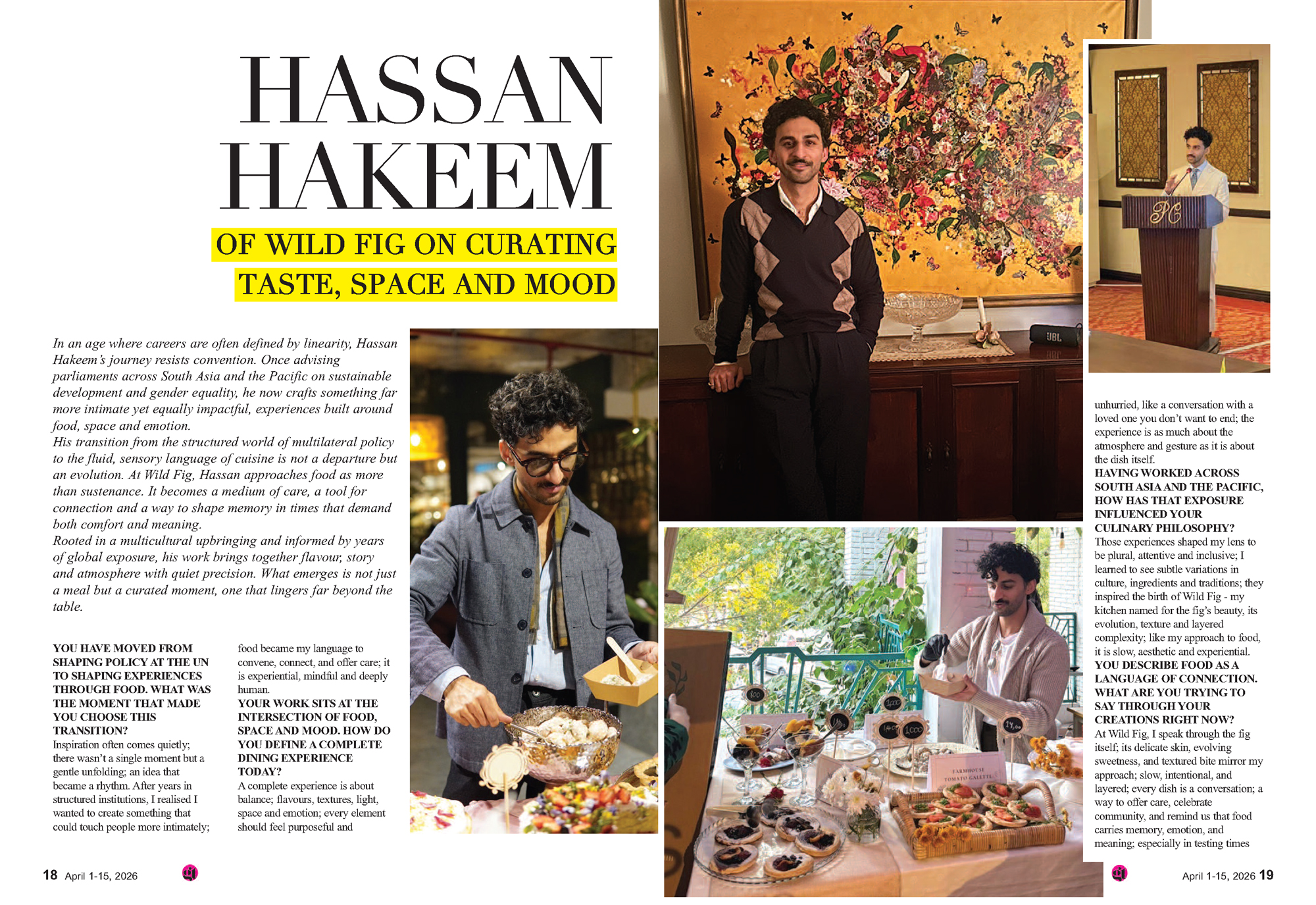
In an age where careers are often defined by linearity, Hassan Hakeem’s journey resists convention. Once advising parliaments across South Asia and the Pacific on sustainable development and gender equality, he now crafts something far more intimate yet equally impactful, experiences built around food, space and emotion.
His transition from the structured world of multilateral policy to the fluid, sensory language of cuisine is not a departure but an evolution. At Wild Fig, Hassan approaches food as more than sustenance. It becomes a medium of care, a tool for connection and a way to shape memory in times that demand both comfort and meaning.
Rooted in a multicultural upbringing and informed by years of global exposure, his work brings together flavour, story and atmosphere with quiet precision. What emerges is not just a meal but a curated moment, one that lingers far beyond the table.


You have moved from shaping policy at the UN to shaping experiences through food. What was the moment that made you choose this transition?
Inspiration often comes quietly; there wasn’t a single moment but a gentle unfolding; an idea that became a rhythm. After years in structured institutions, I realised I wanted to create something that could touch people more intimately; food became my language to convene, connect, and offer care; it is experiential, mindful and deeply human.
Your work sits at the intersection of food, space and mood. How do you define a complete dining experience today?
A complete experience is about balance; flavours, textures, light, space and emotion; every element should feel purposeful and unhurried, like a conversation with a loved one you don’t want to end; the experience is as much about the atmosphere and gesture as it is about the dish itself.


Having worked across South Asia and the Pacific, how has that exposure influenced your culinary philosophy?
Those experiences shaped my lens to be plural, attentive and inclusive; I learned to see subtle variations in culture, ingredients and traditions; they inspired the birth of Wild Fig – my kitchen named for the fig’s beauty, its evolution, texture and layered complexity; like my approach to food, it is slow, aesthetic and experiential.
You describe food as a language of connection. What are you trying to say through your creations right now?
At Wild Fig, I speak through the fig itself; its delicate skin, evolving sweetness, and textured bite mirror my approach; slow, intentional, and layered; every dish is a conversation; a way to offer care, celebrate community, and remind us that food carries memory, emotion, and meaning; especially in testing times when food can be weaponised through famine or blockades, it becomes a profound reminder of its value and responsibility.


There is a strong sense of intentionality in Wild Fig. How do you curate menus that feel both personal and culturally expansive?
Menus begin with reflection; I consider the seasons, ingredients and the story I want to tell; I source locally and ethically; each dish balances intimacy with exploration, honouring both the ingredient and the experience it creates. The result is mindful, curated and culturally expansive.
From advising on gender equality to building a food brand, do any principles from your policy work still guide you in the kitchen?
Absolutely; listening, observation and intentionality are constant; policy work taught me the stages of legislative development and accountability; in the kitchen, the same applies: pre-taste, the construction, palatability and the post-taste reflection; every dish requires foresight, iteration, and inspiration, just policy; every choice from ingredient to presentation carries meaning.


Your aesthetic leans toward edible art. Where do you draw inspiration from, whether it is architecture, memory, travel or something more internal?
Memory and travel sit at the core; spices, textures and moments from childhood or a distant market; every plate is a canvas, from texture to tone, where boutique food and couture cakes become experiential art. I take cues from architecture and light to create harmony between food, space and mood; each dish is curated to feel familiar yet unexpected, mindful and immersive.
In a fast moving, trend driven food culture, how do you stay rooted in meaning rather than momentary hype?
By moving slowly and intentionally, Wild Fig has never been about shortcuts or fleeting trends; vanilla pods instead of essence; herbs over heat. In a world of fast food and air fryers, I remain grounded in creating mindful experiences that last in memory rather than in momentary excitement.


You mention cooking as an act of care. How does that philosophy translate into your client experiences?
In the testing times that the world lives in, food has been weaponised through starvation, blockades and sieges. This gives a deep appreciation of its value; every plate, every bite is curated with attention, the menus, the pacing, the presentation – they are all gestures of care; cooking becomes a way to nurture, comfort and create connection beyond the food itself.
What has been the most challenging part of leaving a structured institutional career for a creative and entrepreneurial path?
In institutions, rules guide you; in creativity, you must rely on instinct, patience, and a strong belief that things will work out; that trust has become a daily practice. There is beauty in trusting the unknown and embracing the rhythm of creation.


Pakistan’s food space is evolving rapidly. Where do you see boutique and couture dining experiences heading in the next few years?
There is a growing appetite for authenticity and thoughtfulness; people will increasingly seek curated, personalised and immersive meals that tell a story, connect communities and honour ingredients; dining will be as much about feeling as it is about taste; experiential cuisine will define the next phase of boutique dining.
If you could design a meal that represents your entire journey from the UN to Wild Fig, what would it look like?
A starter of stuffed zucchini flowers with pistachio ricotta and herbs; a main of slow-cooked lamb shank with plum glaze, served with pickled scones; and a dessert of almond and poached pear tart with crème anglaise; each dish is slow, intentional, ultimately an offering of care and connection; together, they echo beauty, evolution and texture.