

Q1) How important is it to dress for the event?
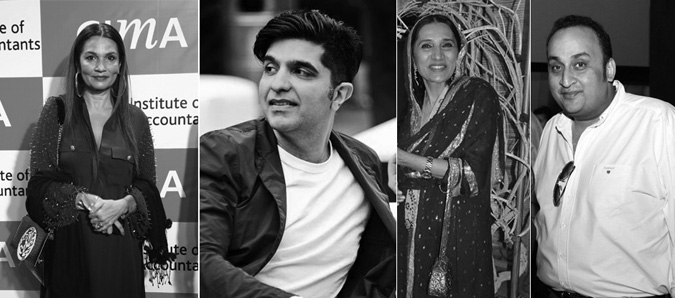
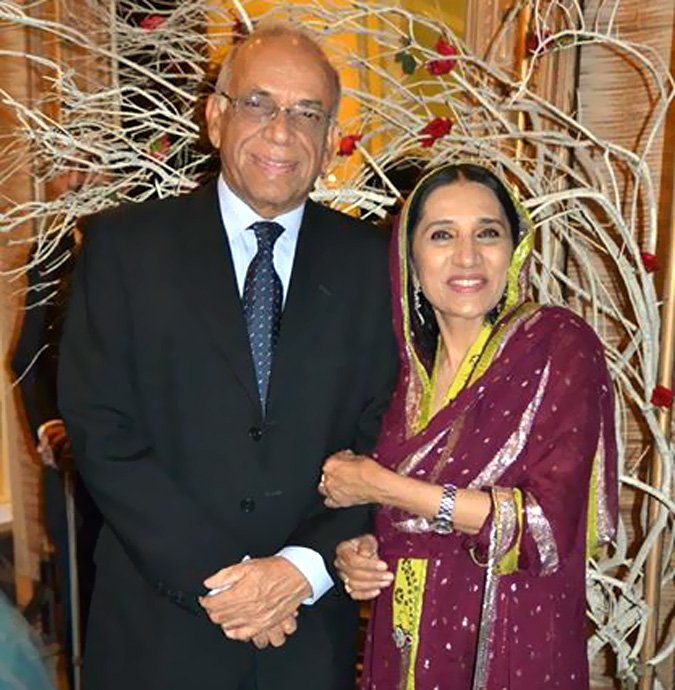
Frieha Altaf: I’m in fashion and I do believe it’s extremely important. You can’t wear black tie to a white tie event. Glamour and comfort go hand-in-hand.
Zahra Aslam: I think it’s very important to dress for the event. For all kinds of people — young, old, middle aged — if you’re not dressed up, you may lack the confidence you otherwise would have had. Dressing up is very much a part of the subcontinent.
Aamir Mazhar: Dressing up for an event is very important. With the ongoing trend of red carpets and style-spotting by different magazines, I make sure that I have dressed up as per the occasion. You feel good when you have dressed up right and people at events give you compliments too.
Jalal Salahuddin: An event is an empty shell made by the people that fill it. The way people are dressed and how smart and beautiful they look of course adds to the life and energy of the event and sets the mood. So yes, it is very important.



Q2) There is an increasing trend of having bigger and bigger haan and nikkah functions. How does this make you feel?
FA: Personally, I don’t believe in big meal weddings. It should be about close friends and family.
ZA: In Islam, the most important events are the haan and the valima. The other things we have added are not necessarily what our religion demands. This is why I always encourage my clients to have a very nice nikkah or to have it with one of their important days. Because the number of people who’re doing the dua for the nikkah is what really matters.
AM: Bigger and better is the mantra people want to follow when it comes to any wedding event, especially nikkah and haan functions. Gone are the days when it used to be for close family and friends. Now a lot of nikkahs happen in Wazir Khan Mosque or Badshahi Mosque followed by a grand dinner at home where everyone is invited and general decor is done in white and dress code is ethnic. For haan events, a lot of people are opting for dinners with a musical performance by a well-known singer.
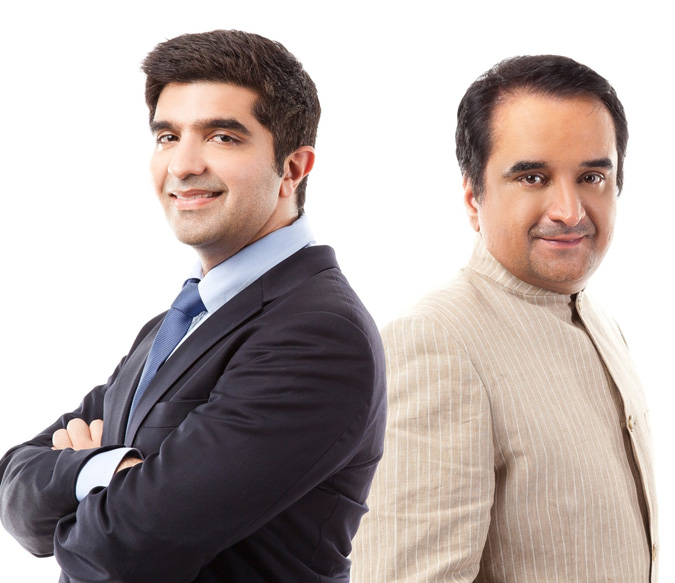
JS: It makes me feel like there is more business. But on a serious note, there is more competition and people want to make each function as beautiful as possible, so yes, I think this trend will grow.




Q3) How mainly does hiring an event manager benefit the host?
FA: Weddings are stressful and one is so worried about arrangements and entertainment and guests that one does not have a good time. Hire us! We will look after it all for you!
ZA: I think it’s very important to have a mature and organized event manager, someone who knows what he or she is doing. The newer people in the business are using the senior people’s pictures and saying this is our work. We are doing thousands of events and we know exactly what, when,and how things happen. With my events for example, I always cordon off a certain area for the baratis and it’s not just ribbon, it’s big net rolls so that people don’t jump across and sit. These little things only really experienced event managers understand. And I make sure that my guests come as my guests. Whatever time they come, the garlands are sitting on the stand, the rose petals and mehndi thaals are ready, the candles are ready to be lit. So either you drive yourself crazy before the wedding or you hire a reliable event planner and relax and enjoy the wedding. In Europe and America, all weddings — big or small — are done by event planners. Over here, people are realising that it’s important.
AM: An event manager knows the job and guides the host in a proper way and takes away all the headache or hassle from the task. In the first meeting I always tell my clients what to do and where to spend their money. The client has to put all his faith in the event manager and just show up at the venue at the required time.
JS: First, I think it entirely the changes the host’s mood. For example, J&S is a 360 degree company. We handle card designs, destination management of any guests coming in from abroad; we handle food, creative and anything in between, so it gives the family more time to enjoy their wedding rather than concentrating on planning things. A level of professionalism comes to the table that a layman cannot bring.
For example, at J&S we have an entire creative team that only works on floral design and table layouts, which are customized to each event and the client’s requirements.
Q4) For product launches, what’s the recommended way? Is there such a thing as too much hype? Is a soft launch advised?
FA: There is no such thing as a soft launch! If it isn’t blasted in adverts, the launch is not visible. Soft launches happen when clients are not ready or have poor planning.
ZA: This totally depends on what the product is. If it is a big restaurant or a new food chain launch then obviously they need a big launch. Launches have now become extremely important. If it’s a soft launch, it only touches very few people.
AM: I don’t recommend soft launches. It’s always better to be operational a few days before the launch so that the staff is trained to handle the rush and you can remove any operational bottlenecks. A minimum of two weeks are required for a launch to get the invites designed and work on media and social media and invite all your guests and send reminders. Two weeks gives you an ample time frame to work on event logistics and production. Too much hype is always good because it generates better footfall at the launch.


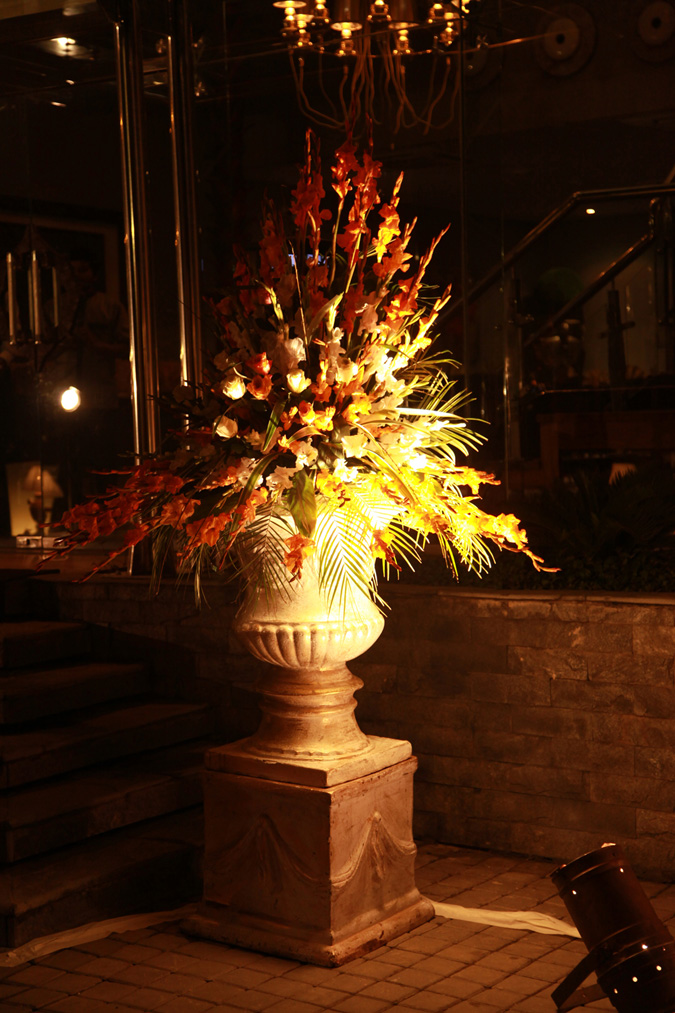
JS: To have a soft launch or not depends on the product. Perhaps if you are launching a new service, restaurant or a salon a soft launch is recommended but any desirable product should be brought in with a complete marketing strategy, entertainment, launch, and guest list.
Q5) Any guidelines for wedding décor?
FA: Do not get odd! I love elegant functions and destination weddings. Lots of parties & a mehndi where everyone dances including the bride & groom.
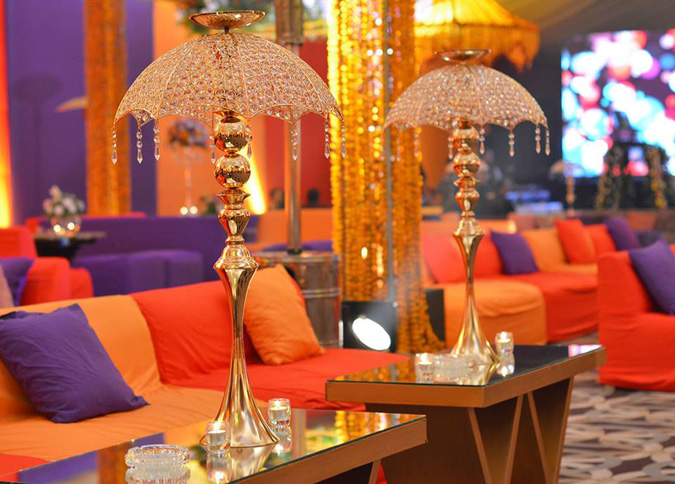
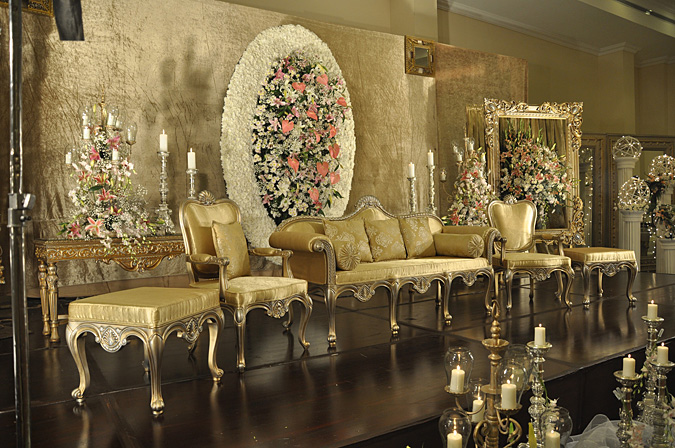
ZA: I’m a fine artist as well so I see my event as a big painting. I first find out what my bride is wearing and then I make a painting around that. If the bride is in bright colours, I keep the stage very muted and as I move further away from the bride on stage, I start to add hints of colour. A wedding I did recently featured red heliconias hanging from huge white trees ending in a console full of accessories, candles and candelabras, and tea lights all in red, the busier it got the further the eyes moved away from the bride and the stage. My teacher Anna Molka would always say that a stroke of colour here and there completes the painting. Lighting is also crucial. If the flowers are white, they get washed out by too much light. The event will last two or three hours but the memories are for life. The photography should be perfect.
AM: First and foremost you need to see your budget. You can do a lot even with smaller budgets as long as you know what you want. White is my favourite color to play with on weddings. The entrance is the focal point at a wedding and it is imperative that all important corners are highlighted in the hall and the stage must be the center of attention.
JS: Wedding décor should always be exuberant, elegant but also have an element of surprise. I feel clients in Pakistan should now start concentrating on the dining area, like they do in the West and perhaps concentrate on controlling the number of guests invited, which of course is usually not possible but with a smaller guest list one can concentrate on the finer details more effectively.
In a larger setting, you need large statement pieces added in the décor to make an impact amongst the 1000 or 1500 guests. Nonetheless, an enchanting and successful wedding must be a thing of beauty to transport the guests and make them feel like they are in a magical place.


Q6) Fashion weeks or solo shows?
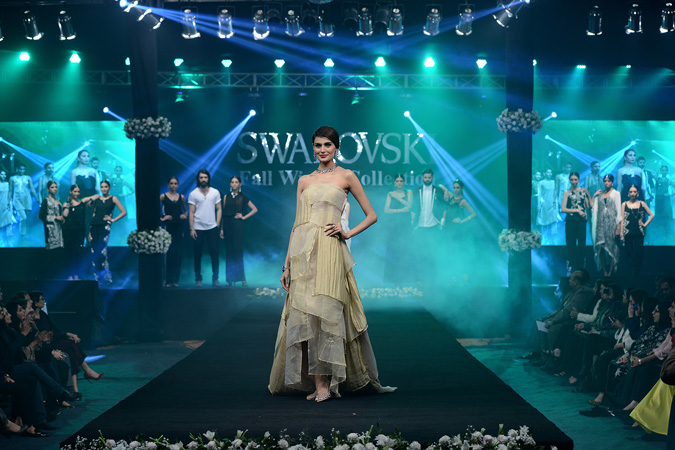
FA: Both! All big designers need to do solo shows. Fashion weeks are fine for the new crop.
ZA: Totally depends on the designer and what they are aiming for. If it’s someone like Bunto Kazmi or Nasreen Humayun, she can just go on the ramp for a minute and create a real impact. With fashion weeks, there’s more hype and media and it’s a consortium. Even for artists, solo shows are done by those who are well-established. The newer artist will probably go into a show with a bunch of other artists.
AM: Solo shows definitely as you can work on the ambience as per the collection. You also control the guest list and can avoid the unnecessary delays that you see at fashion weeks. Fashion weeks need to work on punctuality, the designers showcasing should be properly selected and the guest list has to be screened properly.
JS: Both, because fashion weeks promote the business of fashion whereas solo shows are a real expression of a designer’s aesthetic and creativity and can often be more intimate and personal.
Q7) How different are events from city to city?
FA: Very different. A Peshawar event really can’t be modeled on a Karachi event unless it’s a private one. When in Rome do as the Romans do!
ZA: Very very different. I am a member of WAFA (World Association of Flower Arrangers) and our members coming from Karachi to Lahore are always amazed by how much Lahoris spend on their events. Islamabad for the most part features events of a smaller scale. Lahoris, they love food and they love spending money on good events. From local workers, florists, carpenters, and lighting teams, the success of event managers has helped open up the flow of money. When I got married, it was just some garlands and Shaadi Mubarak on red velvet!
AM: Events vary from city to city. Karachi events are bigger, classier and grander as compared to Lahore events. Isloo events have a dose of diplomats and are not as loud as Lahore events. Having said that, I would also like to add that PR is relative from city to city. For example, an event manager from Lahore cannot necessarily manage the event to the same standard in Isloo.
JS: In Pakistan, especially in Punjab as well as in North India, the events are always grander and more showy: Punjabis like to spend as much as they can and that’s great for an event manager!
In Karachi, for example, the taste is more western and due to limited spaces the events are more contemporary and toned down. It’s always interesting to see the difference between north and south Pakistan. At J&S we love both aesthetics.


What is your idea of style for the modern woman?
Something without fuss — usually a pair of jeans and a T-shirt
Which living person do you most admire for his or her signature style?
Gayatri Devi but she passed away; now Jane Fonda
What is the trait you most admire in people?
Diligence and determination to see an idea through

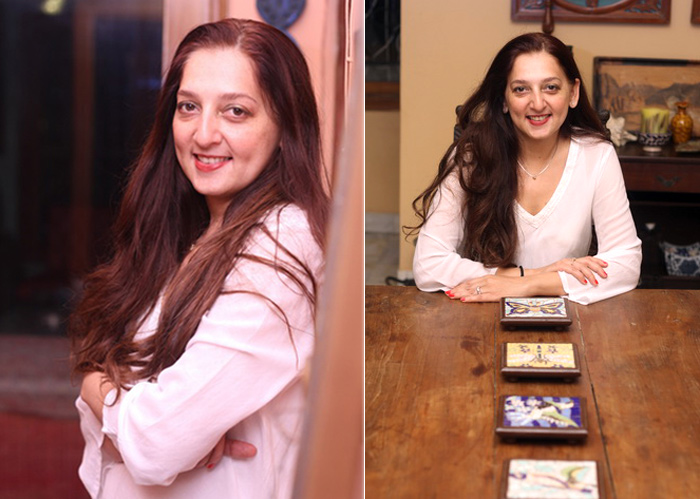
What is your greatest extravagance?
Power tools for The Craft Company
What is your favorite journey?
Climbing an impossible hill and then coasting down effortlessly
What do you consider the most overrated virtue?
Humility
How are you using your medium to promote and maintain Pakistan’s culture?
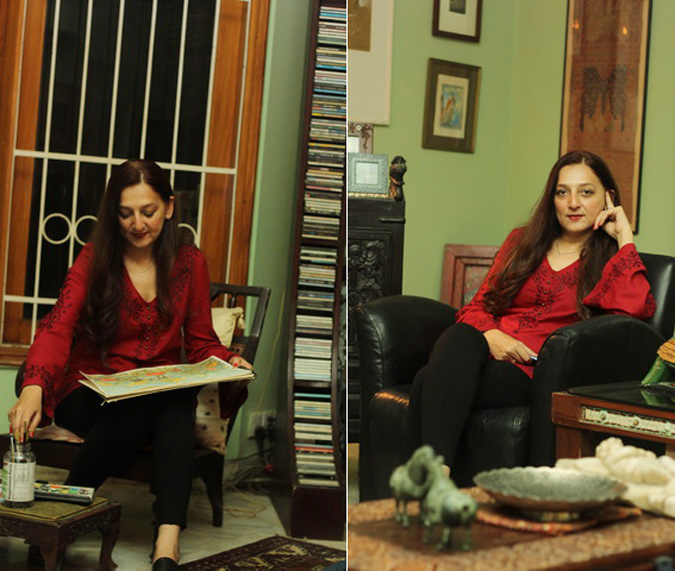
My craft business, The Craft Company, aims to promote and preserve the art and craft of Pakistan. As an artist my paintings are all about the colour and feel of eastern sensibilities, about the eastern woman and her aesthetic

Which living artist in Pakistan inspires you?
So many to name!
Which words or phrases do you most overuse?
It is what it is
What is your greatest achievement?
To always be true to my art, whether it is my creations at The Craft Company or my paintings
What or who is the greatest love of your life?
Not a singular answer
What in future do you consider your greatest achievement?
Probably to keep painting and writing and maintaining the Craft Company
If you were to die and come back as a person or thing, what do you think it would be?
A superhero who can fly!

What is your most marked characteristic in the world of art?
I think whatever I paint has to be woven with design so that it is a delicate balancing act
What is the quality you most like in a woman?
Elegance and tenacity
What advice would you like to give teenage girls?
Never think you cannot achieve your dreams
Name an essential quality an artist-turned-entrepreneur needs in an emerging market.
Logic, pragmatism and careful selection of what is achievable and what is a long-term goal
Where do you see yourself as an artist and an entrepreneur 5 years from now?
The Craft Company continues to expand in Pakistan and overseas. My paintings have a life of their own and i continue to be as compelled to make them
Name a local home-grown brand whose success you admire.
Khaadi
Name a budding brand that you feel hasn’t received the recognition it deserves.
I think the handmade craft business in general is relegated to this, like APWA, Behboud et al
Text | Marium Ali Khan
Photography | Arsalan Bilgrami

What makes Good Morning Karachi different from your other films?
Good Morning Karachi reflects what has been happening in Pakistan over the past 10 years with the opening up of the media and how that has afforded opportunities to young people. Literally overnight, some 32 TV channels cropped up. We don’t have a major film school, a TV academy, no notable learning ground, since our country has never invested in any of that. Yet with so many channels coming up, there has been a need for directors, producers, camera people, anchors, hosts, the works. The fashion and beauty industries have grown alongside with the media industry. We don’t have modeling schools, our models haven’t been taught how to walk the catwalk. And yet, all the people working in the industry are extremely talented and have learnt on the job. This was the inspiration behind Good Morning Karachi. Shandana Minhas wrote a beautiful novella called Rafina which became Good Morning Karachi. Shandana had herself been a model for a very short period and all those experiences came into Rafina which we then made into a screenplay. If you look back to ten or twelve years ago, what were the possibilities for a woman like Rafina? If she was ambitious, bright, talented, good looking, what could she do besides getting married? She could possibly become a receptionist somewhere or a teacher. These were the two mainly respectable employment opportunities. What would she really do with that? But now, with the opening up of the media and fashion and beauty industries, it meant that women like Rafina could dare to dream. They could dare to see themselves being economically independent, calling their own shots, living life on their own terms and simply enjoying themselves. Women like Rafina don’t have to say yes to marriage because they have come into their own and that is what I wanted to show in Good Morning Karachi. It has an understanding of how our culture is evolving, the urban middle class is growing and how these new industries are allowing that to happen.


How did you know you wanted to be a filmmaker?
I knew quite early on that I wanted to be a filmmaker. Film to my mind is the only art form that has the power to change the way people think about the world and about themselves. When I say it’s the only medium, there are other art forms that are very powerful too, but film is a mass medium and it reaches very far and wide. The atmosphere at home, growing up, was always full of literature, poetry and music. My parents, believers in Sufism, brought us up with stories from Rumi and Hafiz and a lot of Farsi poetry too. So I grew up with the sense that storytelling is a powerful thing and that stories can change the way we think about the world. We can actually humanize societies. It was with this thought that I started making documentaries. I wanted people to reflect and to think about the stories I was telling.
How is fiction more persuasive than factual storytelling?
I do narrative feature films because the story often tells itself better as fiction. Khamosh Pani started out as a documentary initially. But when I came across women who had been through the trauma of being abducted during partition, who were now languishing in ashrams in India, or living what had initially been very difficult lives in Pakistan, my thoughts changed. For a documentary, I would have to bring these women out to talk to me about what had happened to them and that would be scratching their wounds. It just didn’t seem right to me. So I thought: how can I use my research material to tell their stories but not have to rely on their specific truths? It worked out very well because then I distilled all my research into the story of Ayesha, a Sikh woman who lived in Pakistan. And I was also able to look in into the Islamization process in Pakistan in 1979. So the whole dramatization of these facts became what is Khamosh Pani. I think it’s a powerful story.


Tell us something funny that happened on the set of Good Morning Karachi?
We had a partly Dutch and Pakistani crew and it was nice to see these guys learn from each other. Everything was working really well. One day we had to put up a billboard of Aamina Sheikh, who plays the cardgirl in the film and we had one of those rickety old ladders — it looked hellishly dangerous. Martin, our Dutch gaffer (head electrician) was entrusted to go up the ladder to do some lights when our German production designer rushed up to me say, “Martin is a father and what if something were to happen to him?â€In the meantime, the local light boy had rushed up the ladder, fixed the lights, and come back down. And he probably had many children himself!
Why the focus on Karachi?
Because it’s as much about Rafina as it is about Karachi the city. The movie is very much in the context of a violent and hostile yet beautiful place. Karachi is a commercially thriving city that offers great opportunity. It has beauty and horror mixed into it. That’s the context in which Rafina operates and you can’t leave the city out of the story.


Omar Rahim meets the brains behind Canvas gallery
As she runs her hand through her lustrous hair in her new purpose-built art gallery in Karachi, it’s hard to believe that just eight years ago Sameera Raja underwent chemotherapy in her battle against cancer. The diagnosis came at a critical mid-career moment for her: she had established Canvas seven years earlier, painstakingly developing a market for contemporary art in Pakistan’s commercial hub, a city more accustomed to splurging on traditional Masters than investing in a fresh art graduate’s experiments. As a single mother with a young son and a business not yet fully on its feet, one might think that Sameera would have lost her nerve. But one would be very wrong. Like the hair that grew back thicker and shinier, Sameera recovered from her illness and came back stronger, smarter and more focused, building Canvas into what is unquestionably one of the foremost contemporary art galleries in Pakistan.
Canvas’s list of artists is a virtual who’s who of Pakistan’s contemporary art superstars: Rashid Rana, Imran Qureshi and Aisha Khalid, Hamra Abbas, Risham Syed, Naiza Khan, Adeela Suleiman the list goes on and on. In fact, in an overwhelming show of support from the community, 37 of the country’s top artists contributed work under the curatorial guidance of none other than Rashid Rana for the grand opening of the new premises in November 2013. When asked how she managed to be a catalyst for so many artists whose careers are currently at the apex of the global art scene, Sameera credits her time at the National College of Arts in Lahore, where she studied architecture. Being at NCA gave Sameera a solid understanding of art history and practice, enabling her to become a gallerist who can engage artists with empathy and understanding, (not to mention the added advantage of developing friendships with many of the artists she went on to exhibit and promote.) After all, she was one of them.


And yet she was different. Sameera understood the intricacies of balancing art with commerce early on — an understanding that eludes most artists. Realizing that her gallery’s relevance and long-term survival required Canvas to be more than just a cash-and-carry shop, Sameera provided exposure for riskier work even when she knew it wouldn’t sell immediately. She regularly curated group shows in which younger experimental artists were paired with established seniors, nurturing the careers of new talent while serving the buyers and artists who kept the gallery in business. It was part of a larger strategy and mission: Sameera utilized Canvas as a platform for educating audiences in the understanding and appreciation of contemporary Pakistani art. Beyond the obvious humanistic value of her modus operandi, Sameera’s intuition proved to be keen business insight — not only has the local art market grown to a multi-million dollar industry, Pakistani contemporary artists are now part of virtually every important private and institutional collection in the world and many of them got their first big break at Canvas.
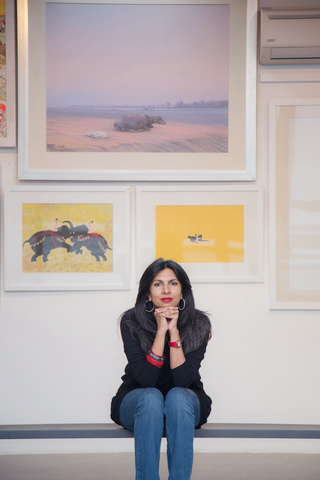
When asked to discuss some highlights from her career, Sameera describes an unusual recruitment scene. In December 2013, senior officials from the Sindh Government requested her to design and curate a festival that projected the dynamic contemporary art scene of Sindh and Pakistan. The only catch was that she had less than three months to pull it off. Undeterred, Sameera surprised her hosts by upping the ante by suggesting the exhibition be held at ‘Frere Hall,’ one of Karachi’s most famous landmark buildings that also serves as a public park in the center of the city. Thus began the ambitious Sindh Art Festival that took place in February 2014. Her eyes light up when she describes how 15,000 of Karachi’s citizens from all walks of life engaged with cutting-edge contemporary art and performance work produced by 63 innovative artists during the Sindh Art Fest. “We brought art to the people,†Sameera says proudly, without mentioning the fact that she didn’t collect a fee for her enormous effort. She repeats brightly, “We brought more and more people into the fold of art.â€
When pressed to describe her next goal, Sameera thinks for a moment, then fires: “I want to set up a Museum of Contemporary Art in Karachi. I want to work closely with a panel of art patrons who want to invest in an institution that will give back to society.†Coming from any other person, one might find such pronouncements bombastic or far-fetched, but sitting across from Sameera Raja, it sounds not just plausible but inevitable. Of course Sameera will establish Pakistan’s foremost contemporary art museum. The real question is who will have the wisdom and foresight to join hands with Sameera as she applies herself to achieving her next milestone.
Photography | Jaffer Hasan