



Wata Satta is a concept whereby a brother and sister are married to another brother and sister. The authority one girl maintains in one household, the other can leverage in her own. It sounds nice to the ears — the families stay within one another and the bayzabaan bahu fears less as the saas’s own daughter could be subject to the same treatment. But where does the heart lie in all these mathematics? Does love really matter? These are the questions that A-Plus’s drama serial Marasim explores.
“Marasim touches the finer chords of human relations and its subtle dimensions,†says Owais Khan, the director. The serial features Ahsan Khan as Daud and his sister Deeba played by Sadiya Faisal. Daud and Deeba have both been “promised,” at birth, to their first cousins. We learn that the mother of their cousins, Sheher Bano (played by Naila Jaffery) along with her mother, unabashedly made life hell for the bahu, Geeti Ara — Daud and Deeba’s mother — played by the formidable Saba Hameed.
The lovers are forced to break the lifelong ties they had
held so dear
When Deeba’s engagement is summarily dismissed by her fiancé, Geeti Ara cannot find it in her to let her arch nemesis nund win once again by having her own daughter happily married while her own sits at home mourning over her lost love. It is the lovers then who are subsequently hit and forced to break the lifelong ties they had held so dear. The title song rings true here: Silsillay tor gaya woh sabhi aatay jaatay.


Even Urwa Hocane, who comes into the serial a little later and plays the very majboor Nayab, has had her share of heartbreak. Her lost love was not only forced out of her life because she was forced to marry Daud, but he also happens to die from a broken heart! Marasim‘s message seems to ring loud and clear: the more relations you make within a family, the more complicated things get. The result is endless heartache.
Saba Hameed, the thespian, was simply mesmerising
to watchÂ
In Owais Khan’s able hands, the repetitive and mindnumbing saga of saas and bahu is explored with subtlety. Geeti Ara’s pent-up aggression and resentment toward her saas is passed onto her own bahu. Saba Hameed’s acting is superb here, as she modulates her tone from cajoling to threatening as the situation demands. The viewer slowly picks up the change in Geeti Ara’s attitude, from humble to scheming to manipulative and, finally, power hungry. Her change is truly manifest when she, who herself was from a poorer family than the one she married into, says that girls from poorer families should be given money, love and status with serious checks and balances or else they begin to disrespect authority. To which Ahsan Khan delivers the cutting statement that his mother has taken to repeating the sayings and actions of his unreasonable dadi.

“I read the script carefully before I say yes to any project. It had been quite a while since I had seen a truly great script. So when I read Marasim, I was impressed by the story line and the dialogues. I instantly said yes. Our director Owais Khan has worked very hard to create an emotionally resonant but not over-the-top drama.â€
—Ahsan Khan
Marasim‘s message, bleak but firmly tethered to Pakistan’s reality, is that most people in our society are bound by a higher societal power that they cannot disobey without in some way destroying their lives. Everyone is majboor, from Nayab’s sister Almas (played by Hajira Khan) who can either uproot herself from her family and end up entirely helpless, to Momina (played by Sonya Hussain) who can either digest her mother’s embarrassment in front of Geeti Ara, or break all ties with her mother on account of her own desires.
It is in the bittersweet exploration of how to see relationships through that Marasim will break your heart. At the same time it will leave you with the elated feeling that if such strong feelings of love will not kill you, they will only make you stronger.


Owais Khan, the director, talks to us about Marasim, the cast and crew:
Marasim was an experience with its own joys and agonies. The thing that hooked me on to this project was the script. I thought it was simply brilliant, written by Zanjabeel Asim Shah who I think is the best television writer to emerge in the last five years.
With the support of Sadia Jabbar, the production house Six Sigma, its team headed by Humayun Saeed and Nadeem Baig, and my incredible DOP Qasim Ali, Marasim is enjoying extremely favourable reviews. Qasim turned out to be a blessing not just for the talent of his work with lights and visuals but also in terms of his positive energy that swept through the whole project. When I look back, it is hard for me to imagine Marasim without Qasim Ali Mureed.
I was fortunate with the set of actors that I got to work with. As it seldom happens, all the major actors were people I was working with for the first time, despite being a veteran of fifteen years. Ahsan khan was a revelation. He is an actor to learn from as far as supremacy in acting is concerned. Other than this, he remained a great support in my high and low moments during the project. This, too, is important.
Saba Hameed, the thespian, was simply mesmerizing. To watch her play this character, and to direct her, was a treat.
Sonya Hussain, in the spectrum of her emotional ability, is the finest actor of the new generation. She actually stunned me at times with her depth of feeling. Urwa was a surprise to me in her own self: she proved that she is not just a pretty face but a confident performer as well. With her beauty and brains she added to the charm of the serial.
As director, I tried to stay true to the content and to bring the emotion of the whole serial in its entirety. How well I have been able to do, viewers will decide!


On a warm June afternoon I walked into Arjumand Amin’s cool, dimly-lit office and breathed a sigh of relief. There she was in the corner, scribbling something on a notepad. I have been to many offices of executive types, and I have to say: rarely have I seen a working space so calm and yet so purposeful. The room is stacked with art books — tools of the designer trade. There is a drape of colour swatches, as well as stretched canvases of gorgeous fabric. In the corner, a wire mannequin makes itself useful.
Perhaps the most important way in which Lahore-based Arjumand distinguishes herself from the ever-increasing slew of designers is her drive for perfection. Her brand, Mahnoush, is Persian for somebody who seeks beauty or perfection. Laughing, Arjumand tells me she wanted to become a designer  emphatically not because every other person was doing it. Those around her noticed her knack for creating something different and goaded her to take up making clothes professionally. In 2010, Mahnoush was born. It’s hard to believe, but when Mahnoush was launched, there were just a handful of lawn pioneers competing in the market — Sana Safinaz, Mausummery, and Gul Ahmed to name a few. The easy, breezy fabric that is lawn is utterly wearable, and has a growing clientele. While talking to Arjumand, it was clear to me that like any thoroughly involved business owner, her mind is in ten places at once: she talks and thinks fast.
The existing format of making lawn entails collaboration between a textile mill and a designer, whose name and brand drive the product forward. For Mahnoush, the fabric is produced at Samin Textiles, the family business; the designs are done in-house while everything else, including the printing, is outsourced. Specifically, the printing is done in Faisalabad, and the chiffon dupattas are flown in from China. “I’m trying to pick the best from everywhere,†Arjumand tells me. “I had always told myself that I’d never do textiles. Never say never,†she smiles.

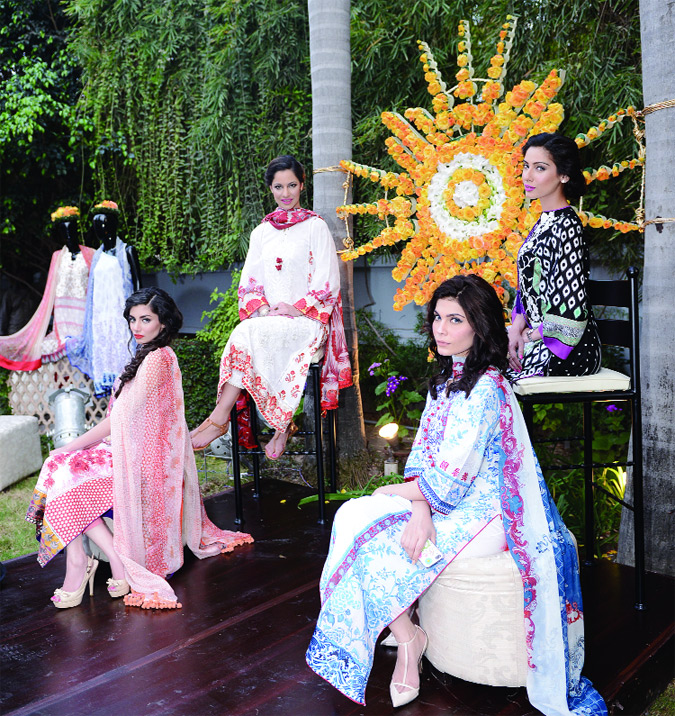
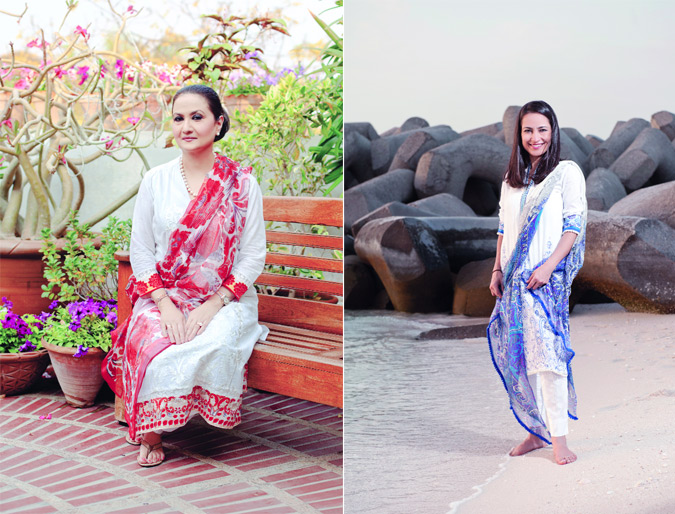
Earlier, Mahnoush chose five iconic Pakistani women — designer Bunto Kazmi, artist Shazia Sikander, athlete Naseem Hameed, filmmaker Shameen Obaid, and entreprenuer Roshaneh Zafar as the faces of the brand and to highlight their outstanding accompilshments in their respective careers. Mahnoush had another delicious lawn launch this summer, with the top models of the industry including Cybil and Zara Peerzada, modelling the clothes. As always, the collection emphasized prints (Mahnoush’s bird motifs in her first collection 4 years ago were a big hit among other bold and risky designs.) The lack of add-ons, which I personally find unbearable and suffocating in our scorching heat, is one of the reasons Mahnoush is my go-to choice for lawn: their speciality lies in screen-printing with stunning borders, necklines and back motifs. I still remember Mahnoush’s collection from 2011 that included embroideries on sheer organza and chiffon. I bought a peach-coloured outfit with white-on-white embroidery on the back. One felt ethereal floating in it.
I still remember Mahnoush’s collection from 2011 that included embroideries on sheer organza and chiffon
What does running a business entail? “Interacting with production people in Pakistan is like groundhog’s day,†Arjumand tells me. She’s referring to the type of overconfident and proud man in the production sector whom she has to really push to produce work on time. She has a hilarious drill memorised when allocating work, with snippets like “you are the best†and “we are what we are because of you!â€


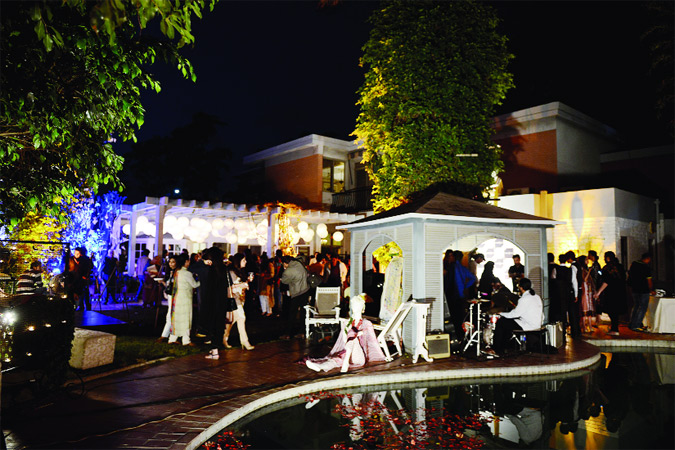

With Mahnoush’s heavy emphasis on prints, I asked Arjumand about her sources of inspiration. “Inspirations come to you in the world you inhabit,†she says. While travelling, she finds herself noting the visual treats on offer. The next step is “channelling the design†— translating the designs from computer to printing. Distribution, she says, can be crazy. Stocking at stores takes some edge off the tedious details of retailling, but adhering to the summer rat race is particularly enervating. “But this is the reality of Pakistan,†I say, to which she sighs and smiles. If there were one word to describe Mahnoush, it would be meticulous. I’m looking forward to Arjumand’s venture into winter wear and pret.


What’re your favorite shopping haunts and why?
Zara Khan (Associate at KPMG)
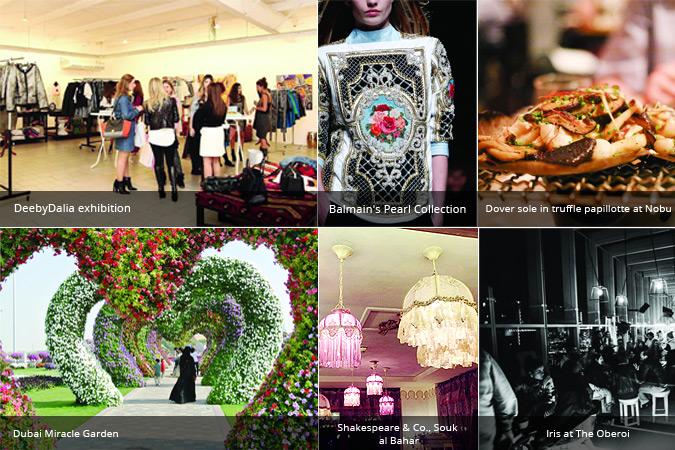
I love exploring the collections of the Lebanese designers that sell their clothes and accessories through private trunk shows here. My favourite nowadays is a label called DeebyDalia because of the fabrics they use for dresses and tops.
Zunaira Tamur (Homemaker)
Harvey Nichols, Boutique1 and Massimo Dutti. I can always count on them to have just what I need.
Alina Talha Rizvi (Entrepreneur, Founder at Allure)
I love to explore new and different designers. I don’t like wearing or shopping for what is easily available in the Mall. I like to pick up dresses from Ayesha Depala, Entre Nous and sometimes from Aizone. These days, I love Balmain’s Pearl Collection.
What do you love about Dubai? What do you dislike about it?
Zunaira Tamur
It truly is the best of both worlds. You have both the comfort of Pakistan and the taste of Europe all in one place. It’s the land of opportunity and something new is always taking off. But I dislike the superficiality of some of the people here. It starts getting to you after a while.
Zara Khan
The thing I love the most about Dubai is that it is home away from home, yet it has the perfect touch of everything I love from the West. But I absolutely hate the traffic!
Gull Zeb
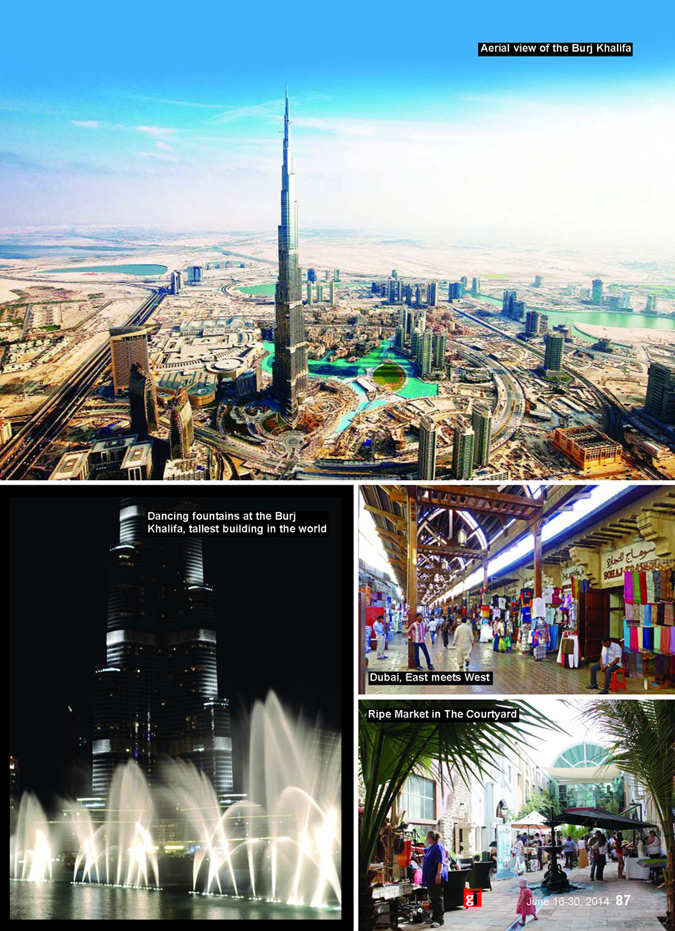
Dubai is my second home after Lahore and the best description for this place is that it’s the perfect mix of East and West. The weather is the biggest issue, but hey, it’s hard to hate Dubai!
Alina Talha Rizvi
I love all the options for entertainment and the complete sense of security one has living here. Also, I love to travel spontaneously, just pick up my bags and set off. Dubai is so easily accessible to any destination in the world. But I do hate how almost everyone here is so materialistic.


I remember talking to an older Emirati trader who talked so fondly about Karachi from the 70s that it brought tears to my eyes
What’s your favorite Dubai night out? What’s your go-to dinner place?
Zunaira Tamur
I love to go out anywhere in Dubai, really. It just comes down to what I’m in the mood for. A great night out can be a house party, a club or even sometimes a nice meal in a good restaurant. I’m a real foodie so restaurants are always a go-to for me. My favorites are Nobu, Zuma, Sass Cafe, Buddha Bar and Okku.
Zara Khan
A nice relaxed evening with friends and family beats everything else. My latest restaurant obsession is Sass Cafe that recently opened up.
Gull Zeb
The best, most chilled-out place during pleasant weather is for sure 101 in the one and only Palm Hotel. For a casual, laid back night, it’s definitely Souk al Bahar which has great eating places like Shakespeare and Cafe Habana.
Alina Talha Rizvi
Favourite nights out include mostly yacht parties and fine dining. I loved Iris when the weather was nicer and these days, my go-to is Roberto’s.

For many Pakistanis living in Dubai, it’s a home away from home. Many things are similar: the heat, the help, and the fact that you can hear an azaan mostly everywhere. How far do you think this is true and what do you think you would like to see from your life in Pakistan included or excluded in your life in Dubai?
Zunaira Tamur
Despite loving my life in Dubai, I really miss my family being here.
Zara Khan
Dubai is definitely a home away from home. I love the freedom and sense of security in Dubai, something that is missing in Pakistan.
Gull Zeb
The reason I decided to settle down in Dubai was to be closer culturally to my homeland. I lived in London during my university days and it used to give me pangs of homesickness, but in Dubai I hardly ever get that feeling.
Alina Talha Rizvi
My lifestyle in Dubai is very similar to Lahore. Yes, the heat, the help, the azaan, exist in Dubai too. Socially too, I’m busy in both Lahore and Dubai. The only difference is that I don’t have my parents here with me. I miss them terribly.

Amina Ajaz (Lawyer)
I remember having mixed feelings when I moved to Dubai six years ago. People would talk almost exclusively about what car they had just bought, what property they were planning to invest in, and what holiday they would take. I missed my friends in London terribly, and compared to our hangout spots in some wonderful dilapidated nooks and corners of Russell Square, Dubai seemed crass, commercial and a bit too shiny.
But then I remember one of my Emirati friends, who could not speak a work of Urdu, randomly belt out some 80s Indian song from an Amitabh Bachan movie. I remember going to Barasti and loving the live music, the food, the beach and the chilled-out crowd. I remember standing for the first time on the extensive coastline of the man-made Palm Jumeirah and could not believe this all used to be the sea. I remember talking to an older Emirati trader who talked so fondly about Karachi from the 70s that it brought tears to my eyes. And I remember the taxi driver who refused to take money when he found out that I too was Pathan.
I began to realize I was in a really interesting place. Michelin star restaurants, the Rolling Stones, Prince, and Eric Clapton in concert, Formula One weekends, the most incredible restaurants on the beach, lavish brunches, man-made islands with your villa opening up to a private beach, having a buffet in a palace, a meal in a hut in the sea and dinner in the sky. You name something outrageously extravagant and it exists in Dubai. Once you decide to partake in the luxury—Dubai will just offer you more and more wonderful surprises.
Often I feel like moving to Lahore in the hope of “making a difference” but get strictly told off by friends living there not to even think about it because of how unsafe it has becomeÂ
But the best thing about being in Dubai is that you are so close to home. On my way back from Lahore to Dubai I distinctly remember the chaotic airport, the shuffling and pushing, someone always smoking in front of the no-smoking sign, endless hours of load shedding but as I entered Dubai I could see every single building flashing with stroboscopes and a 6-lane highway lit up like it was day-time. The contrast between Pakistan and Dubai is upsetting and jarring. Often I feel like moving to Lahore in the hope of “making a difference” but get told off strictly by friends living there not to even think about it because of how unsafe it has become and how frustrating it is to live there with the load-shedding, broken work ethics, etc. Even your mother who misses you all the time lectures you to stay away.
In Dubai you will see women wearing short dresses. But you will also get invited to Pakistani parties where the wives sit separately from the men discussing their challenges in procuring the right bag. As you walk into a Mall in Dubai you can see the peaceful coexistence of the loud and the modest, the sophisticated and the kitschy, and most importantly, the liberal and the conservative.