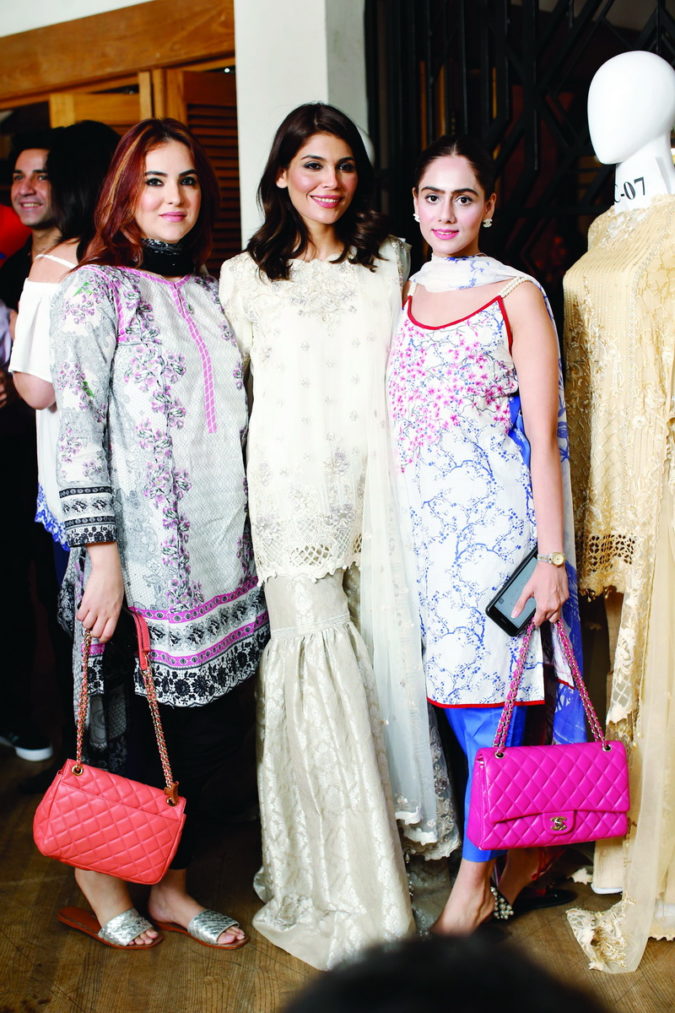
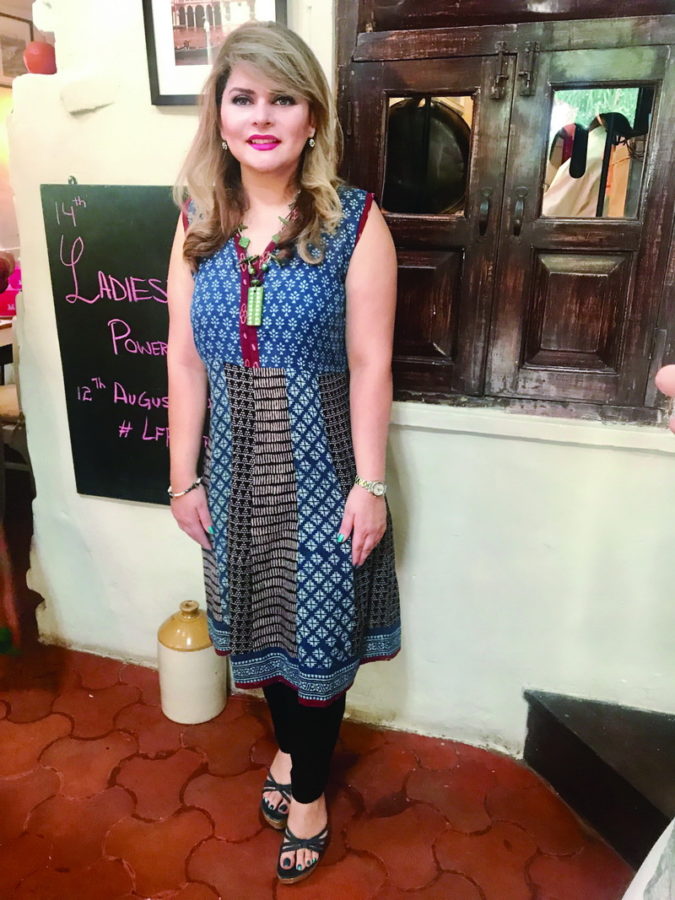
White is here to stay! No other colour is as sublime and as classic. Lending a touch of class to eastern and western outfits, fashionistas in the know use white to great advantage. Dressed up or dressed down, make this colour an integral canvas for all your ensembles
An essential part of a well dressed woman is her handbag. Bottega Veneta is one such name known for handbags of outstanding elegance and unique craftsmanship. Bottega Veneta (trans. Venetian shop) has had an obsession with its knots since its inception in 1966. But ever wonder what the story behind the classic knot is? Let’s take a closer look at the unique knot clasp and intrecciato design including how it really all started
By Sana Zehra
The design house of Bottega Veneta, known internationally for its quality and artisanship, was founded in north east of Italy in a small-town of Vicenza by Michele Taddei and Renzo Zengiaro. The brand has celebrated its golden jubilee—50 years, and is still best known worldwide for its signature design.
“When your own initials are enoughâ€
As the story goes, the unique approach of leather weaving was designed using regular sewing machines originally by Bottega’s artisans. The machines had been designed to sew delicate fabrics but stitching leather required durable machines, which the sewing machine couldn’t handle, resulting in artisans weaving together strands of delicate leather by which they were able to craft pieces with strength and beauty that became a hallmark. Bottega Veneta opened a specialized school in 2006 to train leather craftsmen. Thus, it becomes clear why true craftsmanship and artisans are still the heart and soul of the brand.
We love Bottega for not having an in your face logo and for its classic style, which never goes out of style.
Bottega intrecciato and clasp design is a logo in itself staying true to its brand’s motto, which is: “When your own initials are enough.â€
The thin strips of woven leather appear luxurious and simple, but the truth is the basket weave requires hundreds and hours of labour by master craftsmen. Though copied by many designers local and international, the precision and quality is hard to duplicate.
It was a turning point in 2001 when the company was attained by the Gucci group with Tomas Maier heading the creative director of the team in June of the same year. He presented his most critically acclaimed Spring/Summer collection and from there on the fashion house aesthetic design was redefined for a customer who is sophisticated and self-assured.
The new Bottega shoulder bag comes in several styles with the famed knot hardware
Bottega Veneta has ventured into exciting new projects, like fragrance, fine jewellery, watches, furniture, and home accessories while continuing to offer envy-worthy handbags, shoes, eyewear and other leather goods.
Princess charlene carrying a Bottega clutch
The knot is another trademark that is a symbol of Veneta. After joining, Tomas Maier took a look at the old clutch and decided to give it a new look by including the clasp as its main motif and now it’s one of the most recognizable icons of the design house.
The Women’s Fall 2017 collection introduced the iconic knot to the handbag making it more practical for everyday use and still with plenty of form.The new shoulder bag comes in several styles with the famed knot as a part of the design feature. The Knot is here to stay and one thing is certain: The Knot will never fail to amaze us.
The basket weave requires hundreds and hours of labour by master craftsmen. The Bottega hobo is Cameron Diaz’s arm candy
Qurram Hussain, or Q as he’s popularly known as, is a Canadian musician with roots in Karachi; he’s a member of the popular band JoSH, a Montreal-based South Asian band that’s a favourite amongst bhangra lovers because of its fusion music of Punjabi folk with Western pop. Qurram, the official brand Ambassador for Gibson Guitars, has just released his new hit song Aaja Na in collaboration with Maria Unera, as well as the trance track Kama. Q tells Sana Zehra how he makes music
Biggest risk you’ve ever taken?
Biggest risk was going into music full time and I believe that paid off so I’m OK with that.
Accomplishment you’re most proud of?
I think in entertainment you have to stick with it every day and constantly come up with new ideas. I’m quite proud of that.
What potential do new singers have to make to make a change in the world?
All artists have a unique connection with everybody that they touch emotionally through their art whether it’s music, etc. Singers in particular have a strong following, They get to have a voice, so if they want to be the instruments of change these are great people to look up to.
If you could play any character in any movie what it would be?
It would be a romantic lead with Deepika Padukone or a villain.
What’s your favourite TV show?
It changes quite often. If I had to name one, it would be The Office (British version).
l JoSH is amongst the leading Bollywood/South Asian bands in the world and has collaborated with leading international recording artists worldwide. l JoSH is amongst the leading Bollywood/South Asian bands in the world and has collaborated with leading international recording artists worldwide.
The band’s second album, Kabhi, won four international awards, while the third album Mausam won six international awards.
JoSH became the first international band to be chosen to perform in Coke Studio, Pakistan in 2009.
In 2006, JoSH remixed Maneater and Promiscuous Girl with the popular international artist Nelly Furtado, and got world wide acclaim for it.
What are you doing right now?
I’m doing an interview for GT magazine and we’re also doing promos for Aja Naa with Maria Unera.
“I love that my roots are in Pakistan. People consider me a Canadian musician but in reality, I’m as Pakistani as I can get!â€
Is there any one book that you’ve read as an adult that you wish you could share with your younger self?
That’s interesting. Well, I think things happen at the right time.
To be honest I don’t think that I would have appreciated something as much, had I read it or absorbed it sooner. There is a time and place for everything. So no!
How did you start believing in your own work?
That’s a tricky one. If I’m really having a good time making a song, for example, then I think I’m doing something right.
Have you ever been offered a movie?
I’ve only been offered one role and it was really very bad part so I said no. I don’t get many offers to do movies.
If you post a picture and didn’t get enough likes, would you delete it?
No, I’m okay with not many likes. I’m not a like-fiend.
What was your last Google search?
It was for Aja Naa. I wanted to see who was talking about it and what was being said.
Would you rather be with Angelina Jolie or Nargis Fakhri?
Nargis Fakhri
What is the weirdest thing you’ve ever made your assistant get for you?
Can’t share that here. (Laughs)
What would be your room service order on a regular day?
These days it’s very healthy, silly salads and all that kind of stuff but what I would rather it be just like biryani, nehari and four parathas. Unfortunately, I’m trying not to do that these days.
Would you ever wear Kanye West’s Yeezy collection?
Yeah! I wear Kanye West’s Yeezy collection.
If you could play any person live or dead who would it be?
That’s a toughie. I would either be playing Slash or I would be playing some sort of villain.
There’s a saying; “boys rule or they drool.†Which one do you believe?
They do both. I think there is a time and place for drooling and a time and place for ruling.
Spanks or no thanks?
No thanks. Be positive, be yourself.
What’s your I’m so tough I could beat up the rock song?
Animal by Pearl Jam.
What does GT mean to you?
GT means Sana Zehra. (Laughs), Good times. It’s always fun, casual and weird questions. (Laughs)
The Aleph Review, a literary anthology launched earlier this year by Mehvash amin, Showcases the work of Pakistani writers and artists. this vibrant and well put together compendium of poetry, prose and experimental works offers an original perspective on South Asian writing. The team take Afshan Shafi (also a contributing editor on the Review) on their editorial journey
What was the experience like putting together Vol 1 of the review? Were there any revelations or surprises during the editorial process?
Mehvash: Exhilarating, trying, enervating, tiring, uplifting – the first issue was all that and more.
There were some really serendipitous moments, as when Taufiq Rafat’s son Seerat Hazir gave me a thin college magazine, circa 1968, with his father’s seminal essay Towards the Pakistani Idiom in it.
The surprise: how genuinely good some of our young writers are.
Ilona: Putting together this particular issue took a long time. There were various obstacles—not a lack of good writing, as from the beginning we received excellent submissions, but financial and also physical as our publisher and chief editor broke her leg in the early stages of the project.
Mehvash Amin—Publisher & Editor-in-Chief
“All of us are poetsâ€
Despite all the delays, we discovered that even established, senior writers were enthusiastic about submitting their work to The Review. This included local as well as diaspora writers, and artists, since art is and will continue to be an integral part of our publication.
Mahboob: The meetings, the process of reading some excellent pieces of prose and poetry, the anxiety over publishing, and then the exhilaration of finally holding The Aleph Review are going to have a bearing on how I view literature from this point onwards.
Ilona Yusuf—Associate Editor
“Many people are unfamiliar with the development of Pakistani poetry in English from Partition onwards”
I have always been fascinated by the choices which Pakistani writers in English have to face, and the risks they take. To be a part of such choices revealed more complexities than I had anticipated.
What do you think are the greatest strengths of the Review?
Mehvash: I wanted to archive the works of some of our excellent bygone authors, while looking to the future with fresh, raw writing.
I think we managed the first with the excellent collection of essays by and on Taufiq Rafat, and the new writing that we published in spades, from screenwriting to poetry to fiction, is there for all to appreciate.
Ilona: I feel that the essay and poetry sections of the review are its greatest strengths. Both sections comprise work by senior as well as young writers. The essays include memoir, academic and personal pieces. Besides this, a set of short, pithy interviews give the reader insights into our new novelists.
Mahboob: The Review combines the old with the new.
However, we have not tried to sell old wine in new bottles.
By including both established and relatively unknown writers, The Review has laid the foundations for future anthologies in which more and more young writers would find space to be recognised.
Mahboob Ahmed—Contributing Editor
“We have not tried to sell old wine in new bottlesâ€
What, in your opinion, distinguishes Pakistani writing from other international writing? Can you identify any particular themes?
Mehvash: Well, I would hope that it is not the tired subject matter of bombs and fundamentalism.
I would hope that it is that our writers are good, indeed excellent, even if they are treating universal themes.
Ilona: That’s a difficult question! In prose, I would say that the over-riding theme has been of politics, and in the recent past of history, sometimes related to contemporary events. These themes are explored in the novels of Kamila Shamsie, Mohammed Hanif, Sorayya Khan, Hussain Naqvi and Nadeem Aslam, among others.
Shadab Zeest Hashmi’s work takes a different tangent exploring the way in which cultures overlapped at various points in history.
Mahboob: Pakistani writing is, admittedly, somewhat less mature when compared with other international literatures — Indian, African, and Latin American — which are currently the focus of literary inquiry in the world.
However, the Pakistani writer is uniquely placed in his proximity to the changing socio-economic and political world order. Pakistani writing in English is particularly alert and responsive to the globalisation of literature, as well as the need to root such literature in the here and now of the indigenous.
Afshan Shafi—Contributing Editor
I believe that Pakistani writers’ engagement with the themes of loss and fear generated through ever-increasing religious intolerance, and their adherence to promoting tolerance and pluralism in spite of this, are the great strengths of Pakistani writing.
The editorial board of the Review consists entirely of poets. Do you think the poetic sensibility of each of the editors served as a constraint when selecting work from other genres? Or the inverse?
Mehvash: Yes, all of us are poets. I think for the coming issue, some of the editors are going to try their hands at prose, and we have a new kid on the block who writes prose, Hassan Tahir. I think we are all good at sniffing out good writing even if we are largely poets by definition.
Mahboob: I think it was limiting in a way, particularly in the poetry section itself. We do not ascribe to similar schools of thought about poetry. So, we did not agree on several things, particularly on the relative merits of some of the submissions. However, what that has ensured is that the poems or other pieces we have chosen are of a quality that surpasses the normal level that one would find in other places where Pakistani writing is published (for example, in journals and university and college magazines).
Please tell us more about the choice of Taufiq Rafat as the cover feature? How important is the act of revisiting the work of local literary figures and why?
Mehvash: Oh, hugely, hugely important. How do you create a literary landscape if you are not aware of who has come before you? No one writes in a vacuum.
The Aleph Review will always have a section archiving the work of poets and writers gone by.
As for Taufiq Rafat, not only was he a personal mentor, but an excellent poet. I think for Pakistani English writing, he is probably one of the first names that comes to mind.
Ilona: In my conversations with young poets, and even readers of poetry, I’ve come to realize that many people are unfamiliar with the development of Pakistani poetry in English from Partition onwards.
In this context, revisiting the work of local literary figures in various genres is important for writers of the future; they need to be conversant with the evolution of local literature in English, whether they choose to adopt the tone, theme or style of a particular writer, or to disagree and develop their work in a different direction.
Rafat’s importance lies in his efforts to steer poets away from the English canon, towards imagery rooted in the poet’s own experience and surroundings.
Mahboob: I completed my MPhil thesis on the poetry of Taufiq Rafat at Punjab University, and it was the first attempt to analyze his work. So for me this choice was special on a personal level. Given the inherent bias in favour of British and American literature in many of our older English departments, it becomes frustrating to meet students who do not know anything about the very rich tradition of Pakistani writing in English. This is compounded by the fact that several incompetent administrators deliberately hand courses in Pakistani literature to faculty members without any expertise or interest in Pakistani literature. That is why we must revisit our senior generation of writers, and keep highlighting their importance and contribution.
What kind of work do you aim to showcase in the future? What can we expect from Vol 2 of the Review?
Mehvash: We already have some amazing contributions. I don’t want to give anything away, but we are working on a fabulous theme, which will give The Aleph Review 2018 an intense undercurrent – all I am willing to reveal right now!
Ilona: We will continue to focus on creative non-fiction; the graphic novel or story; and to our range of essays we will add food, food memoir, and travel.
Translation has gained a new significance, particularly in the West, where collaborations between writers and translators who are poets or writers themselves, have made for very successful translations. We now have several excellent translators, whose work will be featured in this issue.
Mahboob: I would like to see more young writers finding this platform for publication.
Maria Fatima Unera Qureshi, a half Pakistani, half Philipina singer, has recently dropped a romantic duet Aaja Na with Qurram Hussain. In the past, she has worked with big names in the industry including Cornetto Pop Rock and Nescafe Basement as well as in stage productions such as The Lion King and Grease. Singing since she was in high school, Maria dreamed of a music career. She promised her late mother that she’d quit music if she didn’t make it big in three years and worked hard to fulfill her ambition. Maria tells her story to Sana Zehra
Maria what’s your story?
Oh gosh! My story is super long. (Laughs)
I’ve been singing since I was a little kid; I realized it when I was sixteen years old that I wanted to be a musician. My mother was a Filipina and my father is Pakistani and I think music is in my blood.
When I turned eighteen I realized this is what I really wanted to pursue. I went to my mom and asked her if I could drop out of school and pursue music because I used to jam around in random cafes, street jams and people used to enjoy it. She made a deal with me that if in three years I was not successful she would send me to boarding school. She was a cadet and she wanted me to be one too.
I agreed to the terms of our agreement; I truly worked my butt off to make my dreams a reality and ended up getting signed up with Nescafe Basement. That is how working in the music industry.
What was your first major record deal?
First major deal was with Nescafe Basement. I did two seasons of the show, and in my second season we had an all-girl band song that went crazy viral. We sang John Newman songs, which he himself shared online with his fans.
If you weren’t a musician what would you be?
Jeez! I don’t know. I think I would be a doctor. You know how Filipino moms are they either make you nurses or doctors or teachers.
Best career advice you ever got?
My mom is my biggest inspiration and she told me never put yourself down. As it is people will try to bring you down because the world is cruel. I often think of her words.
Most gracious response to a rejection or to a career setback?
Maria: I’ve been told that life goes on and whatever happen, happens for a reason so yeah.
Most difficult career decision you ever made?
I was always into English music. When I was working on my first proper Urdu song Aaja Na I would ask Qurram if I’m pronouncing the word OK. Shifting from English to Urdu was daunting and I didn’t know how people would respond. So far so good!
Favourite perk of the job?
You get to sing for thousands and thousands of people. The audience sings along with me. It’s the best feeling ever.
Worst part of being into music?
No sleep
Change you’d like to see in this music industry?
Appreciate more, criticize less.
Who do you admire the most?
I admire my mother not because she is my mother but because she really pushed me to be better. When she made the three year deal with me, it was not to scare me but to motivate me and push me to follow my dreams.
What was the last thing you binge watched?
The new series 13 Reasons Why
What song would always make you cry?
Tears in heaven
What song would you want to be played at your funeral?
Jeez! I don’t know, nothing really.
What was the first album you bought?
Interesting! I listened to my mom’s collection of albums of Ray Charles, Tony Bennett and Perry Como. So I really didn’t buy my first album.
Lipstick or lip-gloss?
Lipstick
What should every woman try once in her lifetime?
Paragliding
How would your perfect day end?
My perfect day would end with music.
Name one thing you are exceptionally good at?
I don’t want to brag but I think I can sing.
One thing you are really bad at?
Speaking in Urdu
Superhero power you’d want to have?
I’d like to fly please.
Something nice you did for yourself recently?
Not for myself but in the month of Ramadan I donated a lot.
Beauty essential during those cold winter days?
I don’t know maybe I will just sit in front of the heater.
3 qualities in a partner
Honesty
Fun
Loyalty
Advice to women with a broken heart?
One piece of advice would be: don’t let anyone try to bring you down.
Have you ever been in love?
Yes!
Craziest thing you did for love?
Nothing! If it’s worth then just go for it.
What would your high school boyfriend say about you now?
Shit, man! Shouldn’t have let her go.
What is your favourite Disney princess?
Cinderella
What does Gt mean to you?
Fun, man! I’m having so much fun.
“My mom is my biggest inspiration and she told me never put yourself down. As it is people will try to bring you down because the world is cruelâ€
Award winning architect Attiq Ahmed, an alumnus of the NCA, got his Masters degree from Columbia University in Urban Design before returning home to Lahore. Here he set up his architectural, engineering  and design boutique firm AEDL as well as Turning Tables, a furniture and lighting studio.not only does Attiq design buildings and interiors but also the furniture and lighting fixtures that go within, creating a truly integrated space.Â
The journey began when I moved home from New York and set up office in 2004. Since then our office has grown from an architectural design studio to a multi-disciplinary design practice. I couldn’t be more pleased with the result.
Tell us about your design aesthetic?
Minimal
Eclectic
Vernacular
What would you call your design style?Â
Effortless and elegant (at the risk of sounding too pretentious)
Architecture, furniture and art merge in your work. Elaborate?
Design is a way of thinking; these are all interconnected facets of that thought process. It’s only natural that they would merge.
What’s your pet peeve that you see often done here?
Aggressive ornamentation and a relentless desire to become Dubai at the cost of our own identity.
A house in Lahore, the design studio produced both the architecural space and did the interior and product design Photo courtesy: Faisal Farooqui
“(My Pet Peeve is) aggressive ornamentation and A relentless desire to become Dubai at the cost of our own identityâ€
How has your business evolved?
The business really began to evolve after a design commission from Samina Rahman and her son Zaki. It was the first house that I feel was aesthetically true to our office’s design outlook and it was very popular with people in the city.
Tell us about your fussiest client?
I once had the misfortune of working with someone who wanted an H plan house because she was slightly enthusiastic about Hermes.
Which project have you particularly enjoyed doing?Â
A house for Taimur Rafique and his wife Insha Bukhari. Also, Samina Rahman’s house before that
Which has been your most ambitious project to date?
The proposal for building a wall-like building around Lahore’s old city to solve its space problems.
What are you most proud of?
The design for my own residence. It was a struggle in more ways than one and I am relieved I didn’t do a bad job.
A courtryard for a house in Lahore, using concrete and marble on the floor and red bricks on the walls–this project was realised in a historic 1950s property taking design cues for the new architecture from the old house Photo courtesy: Attiq AhmedAn arboretum or green house designed for a house in Lahore features large ficus trees and custom made aluminium screens. Photo courtesy: Ahmad Tahir
What are you working on currently?
Designs for both public institutions and private residences are currently on our drawing board.
What are the latest trends and techniques in the furniture market?Â
We believe in aesthetic elitism for all. Cane!
“I once had the misfortune of working with someone who wanted an H plan house because she was slightly enthusiastic about Hermesâ€
What are some points people should consider when doing up their homes/offices?
Scale, proportion and appropriate space allocation should be considered initially.
Furniture made by Attiq’s design studio Turning Tables for an interior he designed in Lahore
Whose home/place of business would you love to do up the most?
So far, I have had the fortune of working with everyone I would have liked to, but I’m always open to more.
How are men and women different as clients?
Women know what they want, but someone needs to pay for it.
All furniture for this interior in Lahore was designed and made by Attiq’s furniture design practice Turning TablesFor this light filled house in Lahore, Attiq’s office made all the furniture seen in this image and did the architecture as wellAttiq’s office designed this bathroom for a house in Lahore using a bespoke mosaic marble floor that is inspired by traditional Hunza carpets Photos courtesy: Faisal Farooqui
Diamonds maybe forever but fashions certainly aren’t. Rizwanullah has made his mark in the fashion industry with his combo of ethnic and edgy design along with his quirky sense of style. Future proof your collection by adding these daring whites to your wardrobe
Before the War of Independence in 1857, after which India became part of the British Empire, many British men working for the East India Company, who had come to India to make their fortune, got married to local women and settled down to raise families. William Dalrymple documents this lesser known fact in his entertaining history book The White Mughals; he tells the tale of the romance between James Achilles Kirkpatrick, the British Resident at the court of the Nizam of Hyderabad and his Muslim wife Khair-u-Nissa Begum for whom he converted to Islam and with whom he had two children. Because he had “gone native,†the British mistrusted him and thought he was a double agent
By Mahlia Lone
James Achilles Kirkpatrick was a bit of a hybrid Brit, born at Fort St. George, Madras in 1764 but sent back to Britain where he attended Eton College. To make his name and his fortune, the ambitious young man returned as a “cocky young imperialist intending to conquer India†by working for the British East India Company and became a Lieutenant Colonel in the Company’s Army. His colourful and unusual story is told by William Dalrymple in his entertaining history book The White Mughals, which many of you may have read.
To understand the context of the story, it’s important to look at the geopolitical situation of the time.
Panoramic view of the Chaumohalla Palace at Hyderabad, photographed by Deen Dayal in the 1880s
Nizam-ul-Mulk Nawab Mir Nizam Ali Khan Siddiqi Bayafandi Bahadur Asaf Jah II reigned Hyderabad from 1762 to 1803; he belonged to the Asaf Jah dynasty founded by Mir Qamar-ud-Din Siddiq, a Mughal appointed Viceroy of the Deccan. When Mughal control collapsed after Shehnshah Aurungzeb’s death in 1707, Asaf Jah declared himself independent and in control of Hyderabad in 1724.
Following the decline of the great Mughal Empire, the Hindu Maratha Empire rose in the Deccan. Maratha warrior Baji Rao I expanded his empire by defeating the Mughals in Delhi and Asaf Jah’s forces in Hyderabad. The Nizam lost all the major battles that he fought against the fierce Marathas. After the conquest of Deccan by Bajirao I and the imposition of chauth (tribute tax) by him on Hyderabad, the Nizam essentially became a tributary of the Marathas.
Chowmahalla Palace
The East India Company meanwhile was fighting against Hyder Ali and later his son Tipu Sultan in Mysore who were supported by the French. Four Anglo-Mysore Wars were fought to establish the Company’s control over this region.
The grand interior
During the First Anglo-Mysore War (1767–69) the British convinced the Nizam to attack Hyder Ali, but the Nizam changed sides at the last moment and supported the Sultan. When Hyder Ali attacked Madras, the British convinced the Nizam to sign a new treaty with them in 1768 to maintain the balance of power: the British, Marathas and Hyderabadis on one side and Mysore on the other.
Nawab Mir Nizam Ali Khan Asaf Jah II, the Nizam of Hyderabad
James was initially appointed as the translator at the Nizam’s court during his elder brother William Kirkpatrick’s tenure as the Company’s Resident (ambassador) in Hyderabad. In 1795, savvy and skilled at diplomacy, at only 33 years of age, he replaced his brother as the Resident. Said to be a good looking and charming young diplomat, he was responsible as the East India Company’s Resident in Hyderabad for nurturing relations with the State’s rulers and keep them on the side of the British.
Taking his diplomatic tasks very seriously, he fluently conversed in Persian, Hindustani, Tamil and Telegu and immersed himself in Hyderabadi Indo-Persian culture.
One his first tasks was to build a stately Residency at Hyderabad. The Palladian style house was designed by Lt Samuel Russell of the Madras Engineers, the son of the Royal Academician John Russell.
The plan was submitted for approval to the Nizam since he would be granting the 60 acres land plus paying for the construction. Not used to western scale plans, the Nizam at first refused to sanction such a huge building. It seemed to him that the Resident was trying to appropriate a vast area of the Nizamate under the pretext of building a house. Wily Kirkpatrick cleverly had the identical plan redrawn on a much smaller scale as a tiny as a postage stamp, and the Nizam fell for the deception. The finished house bore a resemblance to Gov General Wellesley’s then newly finished Government House in Calcutta. The architecture and scale of the house impressed the viewer with the power and control of the East India Company in India.
The British Residency at Hyderabad engraving by William Miller
In 1799, James was depicted in “Hindostanny dress,†draped with long ropes of pearls, and with khussas on his feet. James smoked hukkahs, chewed paan, attended mujras and even had a zenana, living the life of a veritable White Mughal. He fathered many children with various local women that he kept there, just like the Hyderabadi elite. “Thanks partly to these women,†wrote a contemporary Hyderabadi historian, “he was always very cheerful.â€
Living like a Hyderabadi out of choice, Kirkpatrick related to them and understood their point of view, which he would present to his superiors. The Nizam awarded him with titles like Mutamin ul Mulk (Safeguard of the kingdom), Hushmat Jung (Valiant in battle) and Nawab Fakhr-ud-Dowlah Bahadur (Governor, pride of the state, and hero).
James Kirkpatrick in a Mughal angarkha
In 1798, Lord Richard Wellesley, Earl of Mornington, later Marquess Wellesley, had been appointed as Governor-General of India. After Great Britain lost her American colonies, the British government under Prime Minister William Pitt the Younger, Earl of Chatham, turned its attention fully towards India with the ostensible aim of limiting the East India Company’s corruption but actually with the conscious design of extending British power by acquiring a great empire in India.
Britain’s main rival was France. Mornington came to India with the express design of annihilating French influence in the Subcontinent. Soon after his landing, he learned of the alliance between Tipu Sultan and the French Republic that was seen as a direct threat to British interests in India. Mornington immediately ordered preparations for war and disbanded the Nizam’s French troops. This time the Nizam would have no choice but to stick to his alliance with the British. “Wellesley was an imperialist determined to reduce the Nizam to subservience,†wrote one historian.
During the Fourth and final Anglo-Mysore War, Mysore was attacked on all sides. Tipu Sultan’s forces were outnumbered by 4:1 and the Army chose as his adversary, Mornington’s younger brother, Colonel Arthur Wellesley who later became Field Marshal, 1st Duke of Wellington, responsible for defeating Napoleon. The war concluded with the death of Tipu Sultan and his kingdom being carved up by the three allies. This was the geopolitical situation at the time, precarious with alliances betrayed, espionage, and backdoor diplomacy.
After his experience in the Deccan, Colonel Arthur Wellesley warned authorities in Calcutta that Kirkpatrick seemed to be so solidly “under the influence†of the Hyderabadis that “it was to be expected that he would attend more to the objects of the Nizam’s court than those of his own government.†The Company officers took heed of the victor of the hour who had succeeded in finally taming “The Tiger of Mysore,†and started to keep a closer eye on Kirkpatrick.
Hyder Ali, a steel engraving from the 1790’s
While all this mayhem was going on and the fate of nations being decided, James had other matters on his mind when in 1800 he met the fourteen year old granddaughter of the Vizier of Hyderabad, Nawab Mahmood Ali Khan. Though Khair-un-Nissa (the incomparably beautiful) was kept in strict purdah (veil) during the betrothal ceremonies for her elder sister, she saw Kirkpatrick in the court and fell in love. She somehow managed to leave the confines of the zenana (ladies’ quarter) one evening, presented herself before Kirkpatrick and pleaded her love. In a letter to his elder brother William, Military Secretary to the Governor General at Calcutta, James Kirkpatrick justified h
A rendition of the Anglo-Mysore War
imself: “I, who was but ill-qualified for this task, attempted to argue this romantic creature out of a passion which I could not, I confess, help feeling myself something more than pity for. She declared to me again and again that her affections had been irretrievably fixed on me for a series of time, hat her fate was linked to mine.â€
Tipu Sultan
Not only did Khair-u-Nissa belong to the ruling family, but she was also a Sayyida, a descendant of the Prophet, and of Persian descent. If he wanted to be with her, he would have to marry her and for that he would have to first convert and become a Shia Muslim.
Kirkpatrick met all the conditions plus the Nizam made him his adopted son. The couple was duly married in a nikkah ceremony. Kirkpatrick was elevated to the ranks of Hyderabadi nobility. The couple became known in Hyderabadi circles as Sahib Begum and Sahib Allum (The Little Lord of the World, and the Lady of High Lineage).
Governor General of India, Lord Richard Wellesley, Earl of Mornington
James built a separate zenana in the Residency compound for Khair-u-Nissa who still observed purdah. The couple lived “in an enchanted world of scented gardens (scent was believed to be the ‘food of the soul’), luscious fruits, cooing pigeons (the sound of which was thought to stimulate the mind), sparkling jewels, veils fluttering in the balmy evening breeze,†wrote Kate Chisholm poetically in The Telegraph.
Field Marshall Arthur Wellesley, 1st Duke of Wellington
Living in his own world, immune to the changing world around him, James nearly completely eschewed wearing English clothes for all but the most formal of occasions, and now “habitually swanned around the British Residency in what one surprised visitor had described as ‘a Musselman’s dress of the finest texture.’†Another noted that he had hennaed his hands and even had Indian “mustachios.â€
Khair became renowned for her fair complexioned, delicate featured beauty. Her portrait was said at the time to do no justice to her good looks.
William Dalrymple
The good looking couple had two children: a son, Mir Ghulam Ali Sahib Allum, and a daughter, Noor-un-Nissa Sahib Begum. The leading artist of the British community in India, George Chinnery, painted a portrait of the siblings in Madras in 1805 that is regarded as one of the masterpieces of British paintings in India.
Shortly after the marriage in as early 1801, a major scandal broke out in Calcutta over the nature of Kirkpatrick’s role at the Hyderabad court. His reputation had become iffy of late but it was not unheard of British officers to dress and even live like the natives. However, in James’ case his loyalty was questioned.
Rumours started to float about Kirkpatrick’s interracial liaison. There was a steady stream of reports that he had “connected himself with a female†of one of Hyderabad’s leading noble families. The girl had become pregnant and given birth to his child. The girl’s grandfather was understandably livid and had ‘expressed an indignation approaching to frenzy at the indignity offered to the honour of his family by such proceedings, and had declared his intention of proceeding to the Mecca Masjid (the principal mosque of the city)†where he threatened to raise the Muslims of the Deccan against the British. Worse, Kirkpatrick had formally married the girl, by converting not just in name but in deed and had become a practising Shi’a Muslim.
Governor General Wellesley was not kindly disposed to Kirkpatrick’s relationship with the Nizam. Wellesley was responsible for welding British India into an integral entity and the process necessarily involved gaining ascendancy and control over the Indian Kingdoms, or Princely States as the British had begun to dismissively referring to them. Wellesley, having decided to dismiss Kirkpatrick, summoned him to Calcutta.
The authorities in Bengal started questioning Kirkpatrick to determine whether his political loyalties could still be depended on or had he in fact become a double-agent.
Upon questioning, James at first denied his marriage with Khair un-Nissa, but upon the Company’s further investigation into the matter he confessed that he had married her in an Islamic ceremony. He was summarily dismissed and as a punishment for his religious conversion it was decided that his two Anglo-Indian children would be taken away from the parents and sent to Britain to be raised as Christians.
The same year, following the British victory in the Second Anglo-Maratha War, the Nizam of Hyderabad had come under the protection of the British East India Company. Though he was the premier Prince of India, Hyderabad being the largest and most prosperous state of all princely states, the Nizam’s kingdom was now a protectorate. Moreover, Hyderabadi citizens were 85 per cent Hindu so their ruler could easily be replaced. The Nizam was shrewd enough to keep quiet about Kirkpatrick’s fate.
A tearful Khair-un-Nissa had secured a settlement of £10,000 each on five year old William and three year old Kitty, a substantial sum at the time. When they were taken from their parents, the children spoke little or no English only Urdu, the language of their mother.
James, perhaps already perhaps terminally ill, died of a fever in 1805 in Calcutta shortly after his kids were shipped off. “He had lasted longer than the proverbial two monsoons allowed to the British in the India of those days but still died young, aged 41,†wrote Sudarshan in a blog.
Khair-u-Nissa heard of his death 18 days later. In his will, Kirkpatrick stated: “the excellent and respectable Mother of my two children for whom I feel unbounded love and affection and esteem.â€
Dalrymple describes George Chinnery’s painting of the Anglo-Indian Kirpatrick siblings: “Two of them in their Hyderabadi court dress, standing at the top of a flight of steps…. Sahib Allum – an exceptionally beautiful, poised, dark-eyed child – wears a scarlet jama trimmed with gilt brocade, and a matching gilt cummerbund; he has a glittering topi on his head and crescent-toed slippers. Round his neck hangs a string of enormous pearls. His little sister, who is standing one step from Sahib Alum, and has her arm around her big brother’s shoulders, is discernibly fairer-skinned, and below her topi is a hint of the red hair that would be much admired in the years to come. Yet while Sahib Alum looks directly at the viewer with an almost precocious confidence and assurance, Sahib Begum looks down with an expression of infinite sadness and vulnerability on her face, her little eyes dark and swollen with crying.â€
The two children were transported under the care of a Mrs Ure and a retinue of “black†servants. Their baggage included shawls, jewellery and valuables worth £2000 and Captain George Elers, a fellow passenger, bribed the customs officials at Portsmouth twenty guineas to clear their baggage unopened.
Without her children and her husband, Khair-un-Nissa turned for protection to Kirkpatrick’s assistant Henry Russell who replaced him as the Resident in Hyderabad. After spending a few years with the widow, Russell tired of her and married a younger half-Portuguese heiress he had met in Madras. Hyderabad aristocracy hadn’t approved of Khair-un-Nissa’s suspected liaison and banished to the coastal town of Masulipatam for a while. She died heartbroken at the young age of 27 in 1813.
Our story doesn’t end there. We follow the children to England where they had been sent to live with their grandfather Colonel James Kirkpatrick at his London residence and country estate in Keston, Kent. Upon arriving in London, they were baptised at St. Mary’s Church, Marylebone Road, and christened as William George Kirkpatrick and Katherine Aurora “Kitty†Kirkpatrick. Henceforth, they became Evangelical Christians and never again saw India or any members of their maternal family.
Calcutta harbour
Tragically, William fell into a copper of boiling water seven years later. His burns were so bad that doctors had to amputate his arm and he became a recluse. He graduated from Oxford in 1820, married and had three daughters, before dying in 1828 aged only 27.
Kitty’s story is more interesting. She was educated privately with the aid of a governess, like most girls of her social class, and brought up to be a typical Christian Victorian lady. After the death of her brother, grandfather and other close relations, Kitty became an heiress with £50,000, a huge sum in those days. Like most mixed race children and with such good looking parents, Kitty was extremely fetching.
After the death of her grandfather, Kirkpatrick lived with several of her aunts and married cousins all of whom were well connected. She lived in the homes of Clementina, Lady Louis, the wife of a naval hero and baronet; Julia, the wife of Edward Strachey (grandfather of the writer Sir Lytton Strachey) and Barbara Isabella, the wife of an M.P.
St. Mary’s Church, Marylebone Road in London where the Anglo-Indian Kirkpatrick children were baptised
In 1822, while staying with her Strachey cousins at Shooters’ Hill, near London, she fell in with the children’s Scottish tutor, Thomas Carlyle who went on to become a famous philosopher, satirical writer, social commentator, author and historian. After Kitty travelled with the family to Paris in 1824, Carlyle seems to have fallen head over heels in love on the trip.
Watercolour sketch of Thomas Carlyle
The romance was encouraged by Kitty’s cousin Julia Carlyle but the rest of the family didn’t think the impoverished writer was a suitable match for the wealthy, beautiful and well-connected girl despite her mixed blood. At that time, if an Anglo-Indian was fair and looked English, they didn’t have a problem being accepted. Those that were born darker, however, were left behind in India.
Bitter after being rejected, Carlyle later immortalized Kitty in his 1836 novel Sartor Resartus (The Tailor Retailored), posthumously published in 1887, as the Calypso-like Rose Goddess Blumine. In Greek mythology, Calypso is a nymph who lived on the island of Ogygia where she kept Odysseus captive for several years to make him her immortal husband.
Carlyle immortalised Kitty as “fairest of Orient Light bringers,†“many-tinted, radiant aurora,†and “a strangley complexioned young lady with soft brown eyes and floods of bronze-red hair, really a pretty looking and amiable, though most foreign bit of magnificence …. that answers to the name of ‘Dear Kitty’.†He described her as lovely but suspicious due to her mixed-race ancestry:
It was a blessing in disguise for Kitty that she didn’t marry Carlyle because he developed ulcers and became a cranky, argumentative, and angry man . His cantankerous personality was reflected in his prose. In 1826, he married fellow irascible intellectual Jane Baillie Welsh.
In 1829, the famous beauty and considerable heiress, Kitty married James Winslowe Phillipps, a dashing army officer in the 7th Hussars Regiment. They were well matched. Phillipps, a member of the Kennaway family of the west country, too had Indian connections.
The Kennaway Baronetcy of Hyderabad was created in 1791 for John Kennaway, British Resident at the Court of Nizam Ali Khan, Asaf Jah II, Nizam of Hyderabad, in recognition of his services in the negotiation of the 1790 alliance between the Nizam and the East India Company against Tipu Sultan.
Kitty’s father in law had thus been the British Resident at the Nizam of Hyderabad’s court before her uncle and father, although his stint was vastly more successful than theirs.
With so much in common, their union was a happy one and blessed with seven children. The four who survived to adulthood were Mary Augusta, John James, Emily Georgina, and Bertha Elizabeth.
Kitty wrote in a letter to her grandmother Sharaf-u-Nissa in Hyderabad:
“My dear Grandmother, I received many years ago, your kind letter of condolence with me on the death of my beloved brother. I was very grateful to you for it, tho’ by my not answering it, I am afraid that you may have thought that I little regarded it. But indeed I did, & the more so, because I felt that you too mourned for him I loved so well & that you too were connected with him by the binding of blood ties.
Two years after his death I was married to a nephew of Sir John Kennaway’s. My husband is of my age & is Captain in the English army.
I have 4 children living, my eldest daughter is 11 years old. She is exactly like my husband. I have a boy of 8 years & a half, then another girl of 7 and a half who is exactly like my mother’s picture & one darling infant of 19 months. I have had 7 living children – 1 sweet boy and two sweet girls are gone, but I am blest in those that survive. My boy is so striking an image of my father that a picture that was drawn of my father as a little boy is always taken for my boy. They have a good intellect & are blest with fair skin. I live in a nice pretty house in the midst of a garden on the seacoast. My dear husband is very kind to me & I love him greatly.
I always think of you and remember you and my dear mother. I often dream that I am with you in India and that I see you both in the room you used to sit in. No day of my life has ever passed without my thinking of my dear mother. I can remember the verandah and the place where the tailors worked and a place on the housetop where my mother used to let me sit down and slide.
When I dream of my mother I am in such joy to have found her again that I awake, or else am pained in finding that she cannot understand the English I speak. I can well recollect her cries when we left her and I can now see the place where we sat when we parted, and her tearing her long hair – what worlds would I give to possess one lock of that beautiful and much loved hair! How dreadful to think that so many, many years have passed when it would have done my heart such good to think that you loved me & when I longed to write to you& tell you these feelings that I was never able to express, a letter which I am sure would have been detained& now how wonderful it is that after 35 years that I am able for the first time to hear that you think of me. And love me, and have perhaps wondered why I did not write to you, and that you have thought of me cold and insensible to such near dear ties; I thank God that he has opened for me a way of making the feelings of my heart known to you.
Will this reach you & will you care for the letter of your grand child? My own heart tells me you will. May God bless you my own dear Grandmother.â€
And in other she wrote:
“I often think of you and remember you and my dear mother. I often dream that I am with you in India and that I see you both in the room you used to sit in. No day of my life has ever passed without my thinking of my dear mother. I can remember the verandah and the place where the tailors worked and a place on the house top where my mother used to let me sit down and slide. When I dream of my mother I am in such joy to have found her again that I awake, or else am pained in finding that she cannot understand the English I speak. I can well recollect her cries when we left her and I can now see the place where she sat when we parted, and her tearing her long hair. What worlds would I give to possess one lock of that beautiful and much loved hair! How dreadful to think that so many, many years have passed when it would have done my heart such good to think that you loved me & when I longed to write to you & tell you these feelings that I was never able to express, a letter which I was sure would have been detained & now how wonderful it is that after 35 years I am able for the first time to hear that you think of me, and love me, and have perhaps wondered why I did not write to you, and that you have thought me cold and insensible to such near dear ties.â€
A portrait of the beautiful heiress Katherine Kirkpatrick, ca. 1830
Back in India, the Third Anglo-Maratha War (1817–1818) and the final and decisive conflict between the British East India Company (EIC) and the Maratha Empire had left the Company in control of most of India. The British government’s aim of fully colonizing India was coming to fruition. They were now nearly fully in charge. Only Maharaja Ranjit Singh still held out in the Punjab.
With the rise of the Victorian Evangelical movement in the 1830s and 40s not only mixed race unions but also intermingling of Indian and British ideas, religions and ways of life became increasingly frowned upon.
Mixed race unions were on the decline. Wills left by East India Company officers show that while one-in-three wills between 1780 and 1785 were made in favour of an Indian wife and Anglo-Indian children, these shrunk to one-in-four between 1805 and 1810, one-in-six by 1830, and all but disappeared by the middle of the century.
After the War of Independence, the British executed the entire top rank of the Mughal elite and fully imposed the British way of life on India as a means of stamping out Indian national identity.
For these reasons, Kitty too had been forbidden by her grandfather from maintaining any contact with her family in India. Decades after leaving India, in 1830 with the help of her father’s former assistant and mother’s reputed lover, Henry Russell, Kitty began a correspondence with her maternal grandmother Sharaf-u-Nissa in Hyderabad. Although they never met in person, they wrote each other emotional letters for six years till the old lady’s death. Although Kitty was only a toddler when she left India, she has still retained vivid memories of her childhood.
In 1846, Kitty, now Mrs Phillips, made a chance visit to Swallowfield, the home of Sir Henry Russell and and spotted the Chinnery portrait of her and her brother. The painting had come into his possession and, at his retirement, he had brought it back with him and hung in his country home, Swallowfield, in Berkshire. Moved at the memory of her brother (who had died in 1828) and of her grand, but barely remembered, mansion in Hyderabad, Kitty started bawling inconsolably. This moved Sir Henry to bequeath the painting to her after his death.
Till the end, Kitty had a special place in Carlyle’s heart who wrote of her in his Reminisces published in 1881, “ Amiable, affectionate, graceful, might be called attractive (not slim enough for ‘pretty’, not tall enough for ‘beautiful’); had something low-voiced, languidly harmonious, placid, sensuous, loved perfumes & c; a half-Begum in short; interesting specimen of the Semi-Oriental Englishwoman. Still lives, near Exeter (the prize of some idle ex-Captain of Sepoys), with many children, whom she looks after with a passionate interestâ€.
Kitty went on to live a happy, full life and died at her home, the Villa Sorrento, in the charming seaside town of Torquay, Devon, in 1889, having outlived her husband by 20 years.
Four years after her death in 1893, Sir Edward Strachey, the son of Kitty’s cousin Julia, wrote an article in Blackwood’s Magazine under the exotic title, The Romantic Marriage of James Achilles Kirkpatrick Sometime British Resident at the Court of Hyderabad. He recounted the romantic, but ultimately tragic story of James Kirkpatrick and Khair-u-Nissa.
Strachey described her, “She (Kitty) was ten years my elder, but I remember her from girlhood to old age as the most fascinating of women.â€
Telling her story, Strachey added poignantly, “in after years the daughter told her own children how long she and her brother had pined for the father and mother they remembered, and longed to get away from the cold of England to Hyderabad, and were sad at hearing that they were not to go there again, which was all they could understand of their father’s deathâ€.
The sensational story created a stir in the late-Victorian era, a time when the British Empire with its clear demarcation between the white master and brown colonist was at its height and Indian born and bred Englishman Rudyard Kipling wrote, “Oh, East is East, and West is West, and never the twain shall meet.â€
According to Dalrymple, “James was among the last of the English officials in India who found it possible to truly cross cultures.â€
Talent knows no boundaries. In this issue, we showcase award-winning Indian fashion designer Dhruv Kapoor’s creations. He dresses some of the biggest stars in Bollywood in his western avant garde high fashion outfits. He tells us his design story, as does Lahore-based award-winning architect Attiq Ahmed. Attiq designs not only the building, but also the interior and even the furniture and light fixtures within it producing a truly integrated space. The sophisticated and unique homes he has designed are truly a work of art.
Maria Unera, a very pretty, young half Philipina half Pakistani, singer is newly becoming famous in the country. This hard working girl relates how she got into the music industry. By sheer determination and grit, she has learnt to stand on her own two feet in a fickle profession.
For those interested in history, this fortnight’s Memorable Romance is on a late eighteenth-early nineteenth century British East India Company Resident James Kirkpatrick and his aristocratic Hyderabadi Muslim wife. Not only did the Resident adopt the language, culture and dress of the Hyderabadi court circles, but he converted to Islam as well. Find out his fate at the hands of his Company superiors for “going native.â€
Acclaimed director, Christopher Nolan wrote and directed this historical thriller about the Dunkirk evacuation during the early days of World War II. When 400,000 British and Allied troops ended up trapped on the beaches of Dunkirk, France, following a terrible defeat, a number of civilian boats set out from Britain to rescue them before they are killed by approaching Nazi forces.
Starring Tom Hardy, Harry Styles, James D’Arcy and Kenneth Branagh amongst many others, this is a war film without the nationalistic, feel-good trappings so common in the genre and really brings the reality of war to the big screen.
TV Series:
Ozark
Netflix’s latest original drama starring Jason Bateman is a deeply gripping drama and is a must watch for any crime-TV fans.
As a money launderer for a Mexican drug cartel, Bateman’s character Marty Byrde finds himself in the crosshairs of his shady employers after his business partner is executed. To try and get out of the danger he’s put them in, he uproots his family from Chicago to a sleepy mountain town in Missouri, Ozark.
The series follows his attempts to get himself out of the mess he’s landed himself, his depressed wife and two teenage kids all the while dealing with the idiosyncrasies of Ozark, where all is not as it seems.
Music:
HOT 100
TOP 5
#
Song Name
Artist
1
Despacito
Luis Fonsi & Daddy Yankee Featuring Justin Bieber
2
Wild Thoughts
DJ Khaled Featuring Rihanna
3
That’s What I Like
Bruno Mars
4
I’m The One
DJ Khaled Featuring Justin Bieber, DJ Khaled Featuring Justin Bieber, Quavo, Chance The Rapper & Lil Wayne
5
Believer
Imagine Dragons
Books:
This House of
Clay and Water
—By Faiqa Mansab
This House of Clay and Water, written by Lahore’s own Faiqa Mansab and published by Penguin Random House India, has a stirring narrative that explores forbidden love in the city of Lahore.
“It was difficult for me to stop writing this book,†said Faiqa. “It was difficult for me to let go of Nida and Bhanggi. I’d lived with them for so long, I was afraid there would be no others. That I’d hear no new voices and no new stories would reveal themselves to me. But one has to stop editing or the story suffers. And once I had, once I stopped listening to the whisperings of the ghosts of the old story, new voices clamoured to be heard. The new neighbourhood is quite interesting too.â€
The novel has received warm reviews in many prestigous publications, including including the Times of India “Faiqa Mansab’s promising debut This House of Clay and Water is a mesmerizing tale of three souls in search of love, freedom, and identity. Mansab’s book brings to light a fresh brilliance from Pakistan, with a storytelling so sophisticated, it exudes radiance. The novel, set in Lahore, chronicles the city, its repressed femininity looking for a louder voice, and its aspirations in need of a jovial push.â€
Wedding season is just around the corner and we can’t take our eyes off this stunningly worked classic red bridal by Republic Womenswear. The immaculate craftsmanship is drool worthy.
2. The Light Blue Jumper
Lahori author Sidra F. Sheikh’s debut sci fi novel The Light Blue Jumper appeals both to young adult and the more mature reader. On one level it’s a comedy of errors set in space and on another it’s an allegory about the political climate of our time. Get your hands on this sold out book published by Mongrel Books from Liberty Books or read it on your kindle by downloading from Amazon.
3. Garnier’s Moisture Bomb Sheet Masks  Â
These hydrating sheet mask drenched with Hyaluronic Acid are absolutely amazing. In only 15 minutes, they make your skin fresh, glow and youthful. The application is full proof too. Just cover your face with the nutrient rich mask and a few minutes later, voila, you look like you spent a relaxing day at the spa!
4. Azadi Promotion especially for GT readers
Harley Street Aesthetic & Liefstyle Clinic is offering the Ultimate Red Carpet Package From The Stars of Hollywood at a special discounted rate. It includes:
Thermi Smooth Tightening
with PhotoFacial Whitening
and Glow Skin Peel @ 20,000 only.
Normally valid nntil 14th August only. but for Good Times readers valid until 31st of August. on first come first served. basis.
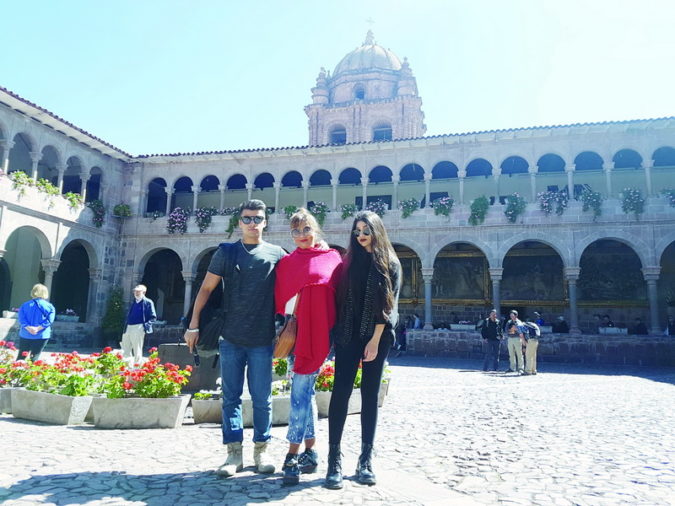
Frieha Altaf shares the highlights of her South American and Caribbean trip with Fatima Sheikh
Why did you choose this itinerary?
I like to go to places off the beaten path. Machu Pichu in Peru is very spiritual and one of the top surviving man made sites that is included in the Seven Wonders of the Ancient World. Argentina is a wonderful country and Buenos Aires is a magical metropolis. The last place I visited was the Cayman Islands in the Bahamas, which was truly a treat for the eye and the mind.
What is the best time to visit?
Best time to visit is in June because it’s not rainy. Most parts of Peru is a rainforest area and the Amazon is wet throughout.
Where did you stay?
We stayed in six different hotels in Peru. Mila Flores was top notch in Lima, Reserva Amazonia in the Amazon and Ritz Carlton in Cayman Islands.
Five essentials you cannot live without when traveling?
1. Sunglasses
2. Sneakers
3. Backpack
4. Baseball cap
5. Jacket
Favourite Restaurant?
Malecon Larcomar, which was located in Lima
How to get around?
Seriously! 10 flights, trains, boats and by foot. Lots and lots of travelling
Where to stay?
Park Hyatt Palacio Duhaui. It’s a palace and I recommend the old wing.
What did you get up to during the day?
Swam with stingrays
Scuba dove at the Kittiwake Wreck in the Caymans
Canopy walk in the Amazonia
Scaled Machu Picchu, a 15th century citadel in Urubamba province.
Suleyman was the only son of Sultan Selim I the Resolute responsible for increasing the Ottoman Empire in size by 70 per cent during his reign (1512-1520) by conquering the Mamluk Sultanate of Egypt and the Middle Eastern heartlands. Selim I became the guardian of the pilgrimage routes to Mecca and Medina and is generally remembered as the first legitimate Ottoman Caliph. Sixteenth-century Italian historian Paolo Giovio who compiled a book on Turkish history wrote it was inconceivable to expect that “the dauntless lion would leave his throne to mansuetto angelo (a timid lamb).â€
Another European historian of the Ottoman rulers called Selim and Suleiman: “Patris fortis filius fortior,†(a courageous father of an even more courageous son).
In September 1520, twenty-six years old Suleyman’s carefree life as governor in the Manisa province came suddenly to an end when he was called back to Constantinople after the accidental death of the Sultan; he succeeded his father and subsequently established the classical Ottoman state and society; he made important new conquests in the East and West, including Belgrade, Rhodes and much of Hungary all the way up to Vienna; he overhauled the legal system; he also patronised artists and writers at his court so the arts and culture scene flourished. Thus, with his reign began the golden age of Ottoman history.
Sixteenth century Venetian chronicler, Marino Sanuto in Tome XXXV of his historical chronicles quoted a report of the Venetian ambassador: “His not being prone, in contrast to his father and many other Sultans, to pederasty (homosexuality) made his majestic dignity and nobility of character shine even brighter.†Rather in his case, it turned out to be the love of a fair Ukrainian slave girl that was to enslave this Sultan for life.
Hafsa Valide SultanSultan Selim I the Resolute
Intelligent, benevolent and erudite but also a sound military tactician, Suleyman, in contrast to his father who expanded his Empire to include other Muslim realms, began his rule with campaigns against the Christian kingdoms in Central Europe and the Mediterranean, starting with Belgrade in 1521 that led to a large-scale advance north of the Danube. The Island of Rhodes ruled by the Knights of St. John was conquered in 1522. In 1526, Suleyman defeated the combined Hungarian-Croatian-Czech forces and took over Hungary. Hungarian King Louis II drowned ignominiously in a bog during the battle. A Turkish historian wrote at the time that “there has never been a battle like this since ancient times.†Turkish soldiers piled 2,000 heads of their enemies (eight heads belonging to bishops) in a heap close to the Sultan’s tent as a tribute to the victor. Suleyman drove the Habsburgs from all of Hungary and besieged Vienna in 1529, but could not sustain the siege. Facing problems with supply, transport, and military organization, the Sultan wisely realized he had reached the limit of possible Ottoman expansion in the West.
Expansion of Ottoman Empire by Sultan Suleyman the Magnificent (r. 1520-1566)Ottoman dignitaries on horseback during a march
Though Ukraine was never conquered by the Ottomans, it became a steady source of white slaves for the Ottoman Empire. Back then just as now, Ukrainian women were highly prized for their fair skin and delicate bone structure. Muslims, it was argued, were barred by the Quran for capturing fellow Muslims as slaves, but non Muslims were fair game. The Crimean Tartars flourished in this lucrative trade of supplying white Christian slaves. Mykhailo Lytvyn, a Ukrainian diplomat in the service of the Lithuanian government, wrote in his memoirs (1548–1551) that the krymchaky (Crimean Tartars) engaged only in two trades: cattle-breeding and capturing Ukrainians to be sold to the Ottomans as slaves. “The ships that often come to their ports from across the sea, bring weapons, clothes and horses, which are exchanged for slaves who are loaded onto these ships. And all the Ottoman bazaars are full of these slaves who are sold and bought to be used in the households, to be resold, to be given as presents….There was one Jew, amazed at the great numbers of these slaves to be seen at the slave markets who asked whether there were any people left in the land where these slaves are brought from.â€
Holy Roman Empire’s Charles V Versus Ottoman Empire’s Suleyman IThe heir apparent’s room
From among the countless virgins captured during military raids and auctioned at the slave markets, the rare gem of a girl was handpicked for the Sultan’s harem. One such was the adolescent daughter of a Ruthnian (Russian) Orthodox priest. According to the Polish poet Samuel Twardowski who visited Turkey in the sixteenth century, Roxolana, the girl from Roxolania or Ruthenia, was born in the town of Rohatyn, 68 km southeast of Lviv, a major city of the Ruthenian Voivodeship in the Crown of the Kingdom of Poland (today in western Ukraine). Reportedly named either Aleksandra or Anastasia Lisowska, she was captured by Crimean Tatars during a regular raid who transported her to the Crimean city of Kaffa, a major centre of the slave trade. Then the little slave girl was shipped to Constantinople, where she was selected by Valide Sultan Hasfa Sultan as a gift for her son Süleyman and taken to his harem in the old palace in Beyazit, 2 kilometers away from Topkapi.
Imperial RoomStained glass window
Portrait of Hurrem Sultan titled Rossa Solymanni Vxor, c. 18th century (Topkapi Palace Museum)
Modern reproductions of Hurrem Sultan’s jewellery
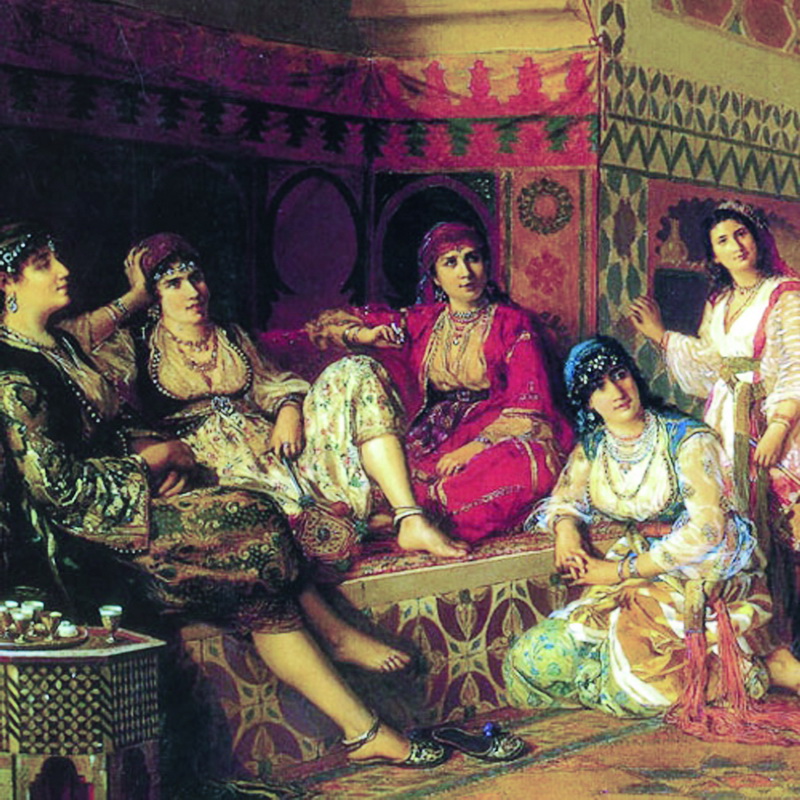
The Sultan’s harem was strictly cloistered, guarded by eunuchs and ruled by harem hierarchy and full to the brim with nubile beauties that had “dark burning eyes like black olives, big sensuous lips, and ample, zaftig, curvaceous and voluptuous figures.†The newly acquired slave girls were first taken to the hamam where they were inspected for diseases and flaws, and then deloused, scrubbed, polished, massaged, oiled and clothed. Then, their extensive grooming and training process started. Looks were not enough to ensure success at the harem as there were countless virginal beauties on display. Under the supervision of the kagia-kadin, the top female attendant in charge of the harem, the virgins were trained in housekeeping, gardening, sewing, embroidering, dancing, singing, playing musical instruments, manipulating puppets, reciting fairy tales; they were also taught the basics of Islam, literature and philosophy; last but not least, they were given pointers on the essential the art of erotic love. The trainees had to pass through several stages in mastering these skills before they could take part in the final selection: the adjemi (novice), jariye, shagird, gedikli and usta. At this final stage, the Sultan’s mother, the Valide Sultan would carefully pick only the best to offer up to her son at the Topkapi Palace.
Roxolena & the Sultan (1780) by Anton HickelHurrem Sultan holding court in the haremLa Sultana Rossa (c. 1550s) by TitianLetter from Hürrem to Sigismond Auguste complimenting him upon his acsension to the Polish throne (1549)
Unlike the West where royals married into other royal houses to make strategic alliances, Ottoman Sultans used slaves for procreation so that there would not be any other family to gain prominence or aspire for power in the empire. Moreover, the established imperial harem principle of “one concubine mother — one son†was designed to prevent both the mother’s undue influence over the Sultan and the feuds of the blood brothers for the throne. Once the Sultan’s son reached maturity at 16-17, he was sent to a far off province as governor with his mother and could only return on his ascension to the throne after the death of his father. There was no formally designated heir. Once the new Sultan’s ceremony of girding the sword had taken place, his half brothers were killed. This seemingly cold system ensured the longevity and stability of the Ottoman realm.
GulbaharSehzade Mustafa, her son with Suleyman and the heir apparent who was later assassinated
Concubines from the imperial harem not chosen for the Sultan were given as gifts to his favourites or high ranking government officials. Some got married to these men and became the head of their own household. Those that had been “promoted†to the imperial harem were given separate rooms and servants. The haseki lucky enough to bear the Sultan sons were clothed expensively in silks, brocades and furs, allowed to publicly kiss the Sultan’s as a mark of high status and received the title bash-kadin. The girls in the harem were ranked as Gözde (the Favourite), Ikbal (the Fortunate), Kad?n (the Woman/Wife) and Valide Sultan (Queen mother). As can be expected, there was intense rivalry between the women of the harem. Additionally, there were strict rules to be followed. For example, if a harem wife was walking from one part of the seraglio to another, heard the click of the Sultan’s silver-studded shoes, she would have to quickly get out of the way and hide as unsanctioned meetings with the Sultan were considered a gross violation of the harem rules and offense to the Sultan. Offenses or violations of the harem hierarchy were punished severely, even by death.
Suleyman & Hurrem’s daughter Mihrimah SultanTheir Croat born son in law, Grand Vizier Rustem Pasha
After being educated and trained according to palace etiquette, Roxolana was renamed Hürrem, meaning the cheerful or joyful one in Middle Persian, due to her smiling face and good-humored personality. Süleyman met fifteen year old Hürrem the same year that he succeeded to the throne and hit it off with her nearly immediately. She was pretty, but not beautiful and on the short side. “Giovane ma non bella†(young but not beautiful) , “graceful and short of stature,†a Venetian ambassador was told in 1526.
A fawning love letter penned
by Hurrem for her Sultan:
After I put my head on the ground and kiss the soil that your blessed feet step upon, my nation’s sun and wealth my sultan, if you ask about me, your servant who has caught fire from the zeal of missing you, I am like the one whose liver (in this case, meaning heart) has been broiled; whose chest has been ruined; whose eyes are filled with tears, who cannot distinguish anymore between night and day; who has fallen into the sea of yearning; desperate, mad with your love; in a worse situation than Ferhat and Majnun, this passionate love of yours, your slave, is burning because I have been separated from you. Like a nightingale, whose sighs and cries for help do not cease, I am in such a state due to being away from you. I would pray to Allah to not afflict this pain even upon your enemies. My dearest sultan! As it has been one-and-a-half months since I last heard from you, Allah knows that I have been crying night and day waiting for you to come back home. While I was crying without knowing what to do, the one and only Allah allowed me to receive good news from you. Once I heard the news, Allah knows, I came to life once more since I had died while waiting for you. My dearest sultan! If you ask about Istanbul, the city still suffers from the plague; however, it is not like the previous one. God willing, it will go away as soon as you return to the city. Our ancestors said that the plague goes away once the trees shed their leaves in autumn. My dearest Sultan! I am begging Allah for you to send me your blessed letters. Believe me when I say this: if I cannot hear a word from you for more than two weeks, the world collapses. There will be rumors about your well-being around the city. Please do not think that I want to hear from you just for my own sake.â€
The complex of Haseki Hurrem Kulliyesi, the first in the Ottoman Empire named after a woman, designed by Mimar Sinan Aga (1539), also included darussifah (hospital), imaret (soup kitchen), mosque and hamamThe Haseki Hürrem Sultan Hamam
Since her arrival, she had voraciously gathered as much knowledge as she could in Ottoman language, mathematics, astronomy, geography, diplomacy, literature, and history. She was even interested in alchemy. During recent excavations in the Edirne Palace, some of her tools for the preparation of perfumes were discovered. Additionally, the Ottoman Empire’s economy was largely based on textile production and trade of carpets, silks and cottons mainly with Europe to which women confined to their homes contributed by spinning cloth and embroidering. The finest, most intricate embroidery in the empire came from the imperial harem and other harems of high officials. Hurrem’s embroideries, or partly done under her supervision, that was gifted in 1547 to Tahmasp I, the Shah of Iran, and in 1549 to King Sigismund II Augustus have survived to this day and can be viewed at the Topkapi Palace.
The clever girl with the strong survival instinct transformed herself into a fit companion for the Sultan. It only took a few months from the day that she first met Sultan Suleyman to the moment when she became the most important consort in the harem. This strengthened her position in the Palace so much that she initiated a new order in the harem.
The next year she gave birth to their first son, Sehzade Mehmed. As per tradition, the harem girls who became mothers to Shehzade (a sultan’s son) were given the title haseki (mother of a prince), meaning has gelin (the royal bride). Hürrem too was now called Hürrem Haseki. Loath to part from her, Hürrem was exempted from the rule of one haseki one son and was allowed to give birth to more than one son. Soon after their only daughter Mihrimah Sultan, Sehzade Abdullah, Sultan Selim II and Sehzade Bayezid followed in quick succession. Their last child Sehzade Cihangir was born later and had a hunchback. Mehmed became Süleyman’s favourite child but he died at a young age after contracting an infectious disease. In his memory, Süleyman built the Sehzade Mosque in Istanbul.
One day Suleiman’s jealous former favourite, Mahidevran, also called Gülbahar (Rose of Spring) got into a fight with her chief rival Hürrem and beat her badly. To punish her, Suleiman banished Mahidevran to the provincial capital of Manisa with their son and the heir apparent, Mustafa. Officially, it was not called and exile but was portrayed as the traditional training of heir apparent, Sancak Beyli?i. After this, Hürrem became Suleiman’s unrivalled favourite haseki.
Mausoleum of Sultan Suleyman in the Süleymaniye Complex
Hurrem was hardly the odd Slav out at court. Due to the expansion, an ever increasing number of Slavs had become integrated into Ottoman life not just as part of the Janissaries (armed forces) and harems but even the ruling elite. Serbian language could be heard spoken from bazaars to the Sultan’s court and was used in official documents in addition to Turkish. The Polish traveler Strijkowskij wrote that when he was in Istanbul he heard with his own ears kobzari (bards) singing songs in Serbian in the streets and in the taverns about victories of valiant Muslims over the Christians.
Giovio wrote: “At the court (of Suleyman The Magnificent) several languages are spoken. Turkish is the language of the ruler; Arabic is the language of the Muslim Law, Koran; Slavic (Sclavonica) is mostly used by the Janissaries, and Greek is the language of the populace of the capital and other cities of Greece.â€
Selim IISelim The Sot
Bassano, an Italian visitor to Suleyman’s court, claimed that “he (the Sultan) respected and highly valued his wife (Roxolana) and understood her native language to some extent.†One of the Sultan’s viziers was Rustem Pasha, a Croat.
Oleksiy Pyvovarenko, head of the Lviv Club of Socionics in his article about the psychological portrait of the couple Suleyman-Roxolana, wrote that they were “duals,†two persons who ideally matched each other in character. The Sultan became faithful to Hurrem whose main asset was her mind. She was able both to entertain the Sultan with clever and witty talk and give good and sound advice. Due to her excellent education, she also became Suleiman’s chief adviser on matters of state and had a considerable influence upon foreign affairs and international politics. For example, she took care of maintaining the peaceful relations between the Ottoman Empire and Polish state with a Polish-Ottoman alliance. Two of her letters to King Sigismund II Augustus of Poland have been preserved and survive to this day. According to Crimean historians, she also intervened to control Crimean Tatar slave-raiding.
During their 200 year long dynasty, on the rare occasion the Sultan married, his legal wife would belong to a foreign royal house or a distinguished Ottoman family. Suleiman was about to break with that tradition, carefully manipulated by Hurrem who did not outright ask him to marry her. In 1533, she confessed to him her growing love for Islam and how badly she wanted to convert to the true faith. He was thrilled and readily consented. After converting to Islam, Hurrem did not allow the Sultan to come to her bed, citing that now it was against the teachings of the Quran. After three days of being kept at a distance, the Sultan capitulated and married his concubine in a magnificent formal ceremony. She received the title Haseki Sultan (Empress) becoming the first consort to hold this title. An Ottoman Sultan had married a haseki for the first time in history. The title of Haseki Sultan was used for the next century and reflected the great power of imperial consorts (most of them former slaves) in the Ottoman court, elevating their status higher than Ottoman princesses. In this case, Süleyman not only broke the old custom, but created a new tradition. With Hurrem’s new title came a stipend of 2,000 aspers a day, making her one of the highest paid hasekis. Sultan started to be viewed by his people as being dominated and controlled by his foreign wife.
After becoming the legal wife of the Sultan, Hurrem Sultan was exempted from harem rules. She became the first woman to remain in the Sultan’s court for the duration of her life. In the Ottoman imperial family tradition, a sultan’s consort only remained in the harem until her son the Sehzade came of age and following the practice of Sanjak Beyligi, both mother and son would leave for a faraway province. The Sultan kept Hürrem close to him at Topkapi Palace, even after three of their sons were sent off.
“The current wife of the Turkish Sultan who loves her dearly is a woman who was captured somewhere in our lands,†wrote Mykhailo Lytvyn, ambassador of the Grand Duchy of Lithuania to the Crimean Khanate.
The Venetian ambassador, Navagero, also reported in 1533, “There has never been a woman in the Ottoman palace that had more power than she.â€
When Hafsa Valide, Süleyman’s mother and the daughter of the Khan of Crimea died, Hürrem became the sole female power in the Topkapi Palace.
Traditionally, to avoid rebellions and civil unrest, it was the prevailing Ottoman custom called kardes katliami that when a new Sultan gained the throne, all of his brothers were killed in order to ensure the stability of the empire. This is why one haseki was only allowed to bear one son. Mahidevran’s son Mustafa was the eldest of the Sultan’s sons and preceded Hürrem’s children in the order of succession. To avoid the eventual execution of her sons, Hürrem used her considerable influence on the Sultan to eliminate those in power, like Süleyman’s Grand Vizier Pargali Ibrahim Pasha who supported Sehrezade Mustafa’s accession to the throne; she flexed her muscle to push for his 1936 execution after he had made some tactical blunders. Later, 1544 onwards, the post of Grand Vizier was held by Suleyman and Hurrem’s wily Croatian born son in law Rustem Pasha who was in cahoots with his mother in law.
When the Sultan left for military campaigns through which he annexed Persia, Mesopotamia, Central Asia, Yemen and Abyssinia (in total he spent 10 years out of 46 year reign away from court on military campaigns) Hurrem Sultan was left in charge by him to oversee palace order, head state affairs, deal with foreign emissaries and even be his eyes and ears gathering intelligence for him. She apprised the Sultan of the latest news through her constant stream of neat, grammatical letters, interspersed with sentimental poems. One such read: “My lord, Your absence has kindled a fire in me that cannot be put out. Take pity of my suffering soul and write a letter to me as soon as You can so that I could find at least some consolation in it. My lord, I hope that when You read these words, Your wish to write to us will be fortified and You will express all Your longing to see us again. When I read Your letter, Your son Mehmed and Your daughter Mihrimah were close by my side and tears were rolling down their to the Sultan.â€
The Sultan replied:“At last we shall unite in souls, in thoughts, in imagination, in will, in heart, in everything that I have left of mine in you, and have taken of you with me, o my only love!â€
In the public realm, Suleyman won the title of Muhtesem (The Magnificent) for his military exploits and political success. He was also referred to as Suleyman Kanuni (the Lawgiver) as he had all the archaic laws of the empire updated and reorganized and was compared to the Biblical King Solomon because of “his wisdom and the splendour of his court.†In addition, Suleyman became known as “the creative conquerer†who wielded a pen as well as a sword. His reign became known as the Ottoman Golden Age. Culture and the arts flourished. The architect Sinan, the poet, thinker and writer, Fuzuli, the mathematician, painter and cartographer, Matrakci Nasuh, and the innovative illuminator Karamemi all lived and worked under his patronage.
When Hurrem was fifty and well past her prime, the Venetian ambassador Navagero wrote: “His Majesty the Sultan loves Roxolana so much that never has in the Ottoman dynasty been a woman who would enjoy a greater respect. They say that she has a very nice and modest appearance, and that she knows the nature of the great ruler very well.†Though the Europeans were very impressed by the slave girl turned Empress because she favoured them; however, the Turks felt otherwise about Hurrem.
Handsome and brave Sehzade Mustafa had grown extremely popular amongst the common people due to the generosity he lavished upon them and amongst the soldiers that he led valiantly in many successful campaigns. He reminded the people of his grandfather Selim I and was generally expected to succeed Süleyman even though there was no formal succession system in the Ottoman Empire. As Süleyman ruled for 46 years, the younger generation wanted Sehzade Mustafa to take the throne instead of his elderly father, but Hurrem knew this meant the death of her sons.
In 1533, during Suleiman’s Persian campaign, the Sultan halted his army in Eregli on the Black Sea where his Grand Vizier and son in law/husband to his daughter Mihrimah, Rüstem Pasha invited Mustafa to join his father’s army. Duplicitously, Rustem convinced Suleyman that Mustafa was coming to kill him. Not realizing he was being double crossed, Mustafa assembled his army to join his father’s. Suleyman thought he was revolting and ordered the execution of his son. When Mustafa entered his father’s tent to meet with him, Suleyman’s guards attacked the Sehrzade and after a long struggle strangled him using a bow-string.
Angered at their warrior leader’s senseless murder, Mustafa’s Janissaries and Anatolian soldiers railed against Suleiman’s peremptory decision. Suleiman dismissed Rüstem from his position as Grand Vizier and sent him back to the capital, but even there the people blamed Hürrem, Rüstem and Mihrimah for their cunning plot and the Sultan for being duped by them. That year—1553, Constantinople was filled with tension and fear. Topkapi Palace was attacked by thousands of angry protestors crying out against the foreign “witch.†To appease them, Suleiman ordered that Mustafa be given a state funeral with a full week of lying in state at Hagia Sophia for the people to pay their respects. Mustafa was laid to rest in a large mausoleum in Bursa. After the death of her son, Gulbahar lost her high status and moved to Bursa. It is said that Cihangir, Hürrem’s youngest hunchback son died of grief a few months after the news of his half-brother’s horrific murder that lay at his mother’s door.
Mustafa’s execution had caused great unrest in Anatolia, especially in Amasya, Manisa and Konya where he been a just governor. The people remembered him as Sultan Mustafa, even though his life had been cut short before his ascension to the throne, and his legend grew to become a part of Anatolian Turkish literature. The poet Taslicali Yahya composed a haunting elegy for Mustafa that read:
“The slander and the secret grudge of the liars shed tears from our eyes; ignited the fire of separation
He never murdered anybody, but his life was drowned in the flood of calamity, his comrades were disbanded
I wish I had never seen this event. What a shame: my eyes didn’t approve this treatment to himâ€
Rustem Pasha strove to get Yahya executed as punishment. The Sultan prohibited his execution but instead deprived him of his offices and banished the poet to the Balkans. In 1574-75, while in Bosnia, Yahya met Mustafa Âlî, a well known Ottoman historian and bureaucrat who referred to him as “a poet too talented to be supported by jealous politicians and subsequently condemned to exile in the border provinces.â€
Both Hurrem and her son in law the Grand Vizier Rustem Pasha made a deadly team successful in cut throat court politics and intrigues. They were the outsiders not only surviving, but flourishing at the Ottoman court. Suleyman himself lived to regret both the executions that of his Grand Vizier and of his son and heir. European historians argue that Mustafa did not deserve the throne. Although he was courageous, he lacked two important qualities for a ruler, patience and cautiousness. After Mustafa’s death Selim, his son from Hurrem, became the heir apparent. Though obedient to his father, he was unpopular for being cruel and an alcoholic. Süleyman and Hürrem did not hesitate to execute their own son Sehzade Beyazid and grandsons in 1561 when they revolted over the issue of succession, such was their tenacious grip on power and control.
Given the grisly backdrop of the bloodshed, in 1554, Dominico Trevisano wrote about the Sultan and Hurrem’s continued love affair: “His Majesty the Sultan loves her (Roxolana) so much that, as they say, he has refused to be with any other woman but her; none of his predecessors had ever done that and such a thing is unheard of among the Turks who have a custom of sleeping with many wives.â€
Because of her inordinate amount of power and influence from which even Suleiman’s own children from other women were not safe, her meteoric and unprecedented rise and her unassailable position for forty years, Hurrem Sultan was widely believed to be a witch who had put a hypnotic spell on the Sultan using voodoo incantations and potions. At the time, this was not a farfetched theory. Only a century later, Louis IV’s mistress Madame de Montespan would be disgraced and banished for visiting the witch La Voisin to perform rituals by killing babies to make love potions used on the French King. Similarly, the Austrian ambassador Busbek wrote in 1554 that he was told of women in the capital who supplied Hurrem Sultan with bones from the skulls of hyenas which were believed to be a very strong aphrodisiac. After investigating the claims, he wrote, “But none of them agreed to sell these bones to me saying they were meant exclusively for Hurrem Sultan who, they said, made the Sultan continuously attached to her by making love potions and other magic means.†It was a wide-spread popular belief that Suleyman was so obedient to his wife and putty in her hands because of the magic spell that she put on him. She, people said, was behind the Sultan’s decisions to execute Ibrahim, his closest friend and vizier, and Mustafa, his first-born son and heir to the throne. Her children had directly benefitted from these heinous crimes.
One day, Hürrem became suddenly very ill and perhaps deciding to atone for her sins, curry favour with Allah and win people’s approbation, she dedicated herself to charitable works. Inspired by the Caliph Harun al-Rashid’s consort Zubaida, she commissioned many public works including two domed mosques built in Istanbul’s Haseki neighborhood along with fountains and madrasahs, a poorhouse and the Haseki Hospital for women near the women’s slave market of Avret Pazary that is remarkably still functional. She also commissioned a bath, the Haseki Hürrem Sultan Hamam, to serve the community of worshipers in the nearby Hagia Sophia and Suleyman’s mosque. This Hamam also continues to function today. In 1552, she went on to establish the Hasseki Sultan Imaret in Jerusalem a public soup kitchen to feed 500 needy twice a day. Ironically, the money to build the mosques had come from the customary tithes that the Christian pilgrims had to pay for visiting the holy sites in Jerusalem. Suleyman imposed fees on the use of mosques as well, when the need for extra money arose usually to fund a military campaign.
Hürrem died in 1558 and was buried in a purpose built domed mausoleum türbe built by Mimar Sinan Aga the Grand Architect and decorated with exquisite Iznik tiles depicting the Garden of Paradise in memory of her joyful nature in the courtyard of the Süleymaniye Mosque. It is said that Suleyman was so sad that he did not regain happiness for the rest of his life and pined away for his wife. Eight years later in 1566 the aged Sultan too died while besieging the fortress of Szigetvar in Hungary and was laid to rest in a somber mausoleum adjacent to that of his beloved.
Their remaining son ascended the throne as Selim II and ruled the Ottoman Empire until his death on December 15, 1574. One of his first acts was to save Mahidevran from penury and put her on a lavish salary. Despite all of Hurrem’s machinations, her son did not make a good ruler, in fact he became the first sultan who took no interest in military matters. Instead he lived a debauched life steeped in alcohol and orgies, earning him the sobriquet Selim The Sot (the drunkard). He left all state matters in the hands of his Grand Vizier Mehmed Sokollu, a Bosnian native.
Hurrem Sultan, the slave girl who became “The Wife of the Sultan of the World†caught European imagination and inspired many paintings, musical works (including Joseph Haydn’s Symphony No. 63), an opera by Denys Sichynsky, a ballet, plays, and several novels mainly in Ukrainian, but also in English, French, and German. In 2007, the Muslims in Mariupol, a port city in Ukraine, opened a mosque to honor Roxelana. In the vastly successful Turkish TV series Muhtesem Yüzyil (Mera Sultan), Hürrem Sultan is played by Turkish actress Meryem Uzerli.
Suleyman’s faithful love and ardor for Hürrem is best illustrated by the love poems he sent to her when he was away on campaigns. The book of Suleyman’s poems Muhibbi Divani written in Talik inscription by the calligrapher Mehmed el-Serif and illuminated with beautiful and evocative illustrations by Karamemi is a testament to his love for her. Suleyman’s love poems to his wife were signed Muhibbi (lover or sweetheart) and include the following:
Throne of my lonely niche, my wealth, my love, my moonlight.
My most sincere friend, my confidant, my very existence, my Sultan, my one and only love.
The most beautiful among the beautiful…
My springtime, my merry faced love, my daytime, my sweetheart, laughing leaf…
My plants, my sweet, my rose, the one only who does not distress me in this world…
My Istanbul, my Caraman, the earth of my Anatolia
My Badakhshan, my Baghdad and Khorasan
My woman of the beautiful hair, my love of the slanted brow, my love of eyes full of mischief…
I’ll sing your praises always
I, lover of the tormented heart, Muhibbi of the eyes full of tears, I am happy.
And so the powerful Sultan Suleyman The Magnificent broke with the old Ottoman tradition and created a new one of being monogamous till the end of his days to a slave girl that he willingly made his legal wife and consort.