Author

Good Times

Browsing

By Mahlia Lone

Long thought of as a confirmed bachelor, news of George Clooney’s impending nuptials with London-based barrister Amal Alamuddin sent shock waves through his legion of female fans. Overnight he went from being public domain to the committed partner of one. It was a move that he himself could not have foreseen; claiming he was just not marriage material and made “a lousy husband” after a short lived marriage to actress Talia Balsam in 1989 floundered in its early days. He also went against type when choosing a wife, going against the model/cocktail waitress type that he generally dated. On top of that, his chosen woman was of Middle Eastern descent and, gasp, a Druze Muslim!

Born George Timothy Clooney on May 6th 1961 in Kentucky, he is a suave, debonair and handsome Hollywood leading man of the Cary Grant variety. Additionally, Clooney is thoughtful, intelligent and a committed humanitarian with a broadcast journalist father and a mother with both beauty and brains, having served as a beauty pageant queen and city councilwoman. He has also descended on his mother’s side from the same stock as President Abraham Lincoln. We can rightly imagine then that politics and current affairs rather than show business dominated the dinner table conversation at the Clooney household of his childhood. A young George must have absorbed all that talk like a sponge and filed it away for future use. Growing up in a fervent Catholic household, George attended Catholic schools and was even an altar boy for a time. Rebelling against his childhood and with big dreams in his head, George dropped out of college. First, he tried out to play professional baseball for the Cincinnati Reds, but he did not make the team. Then, he moved to LA to pursue an acting career, like his aunt Rosemary Clooney, who was also a famous cabaret singer.

His first jobs were women’s shoe and door-to-door insurance salesman, construction worker and tobacco cutter. These minimum wage jobs supplemented his meager income from playing bit parts on TV while he was a student at the Beverly Hills Playhouse acting school for five years. Then came hit TV show ER in the early 90s, on which he played Dr. Doug Ross with Juliana Margulies (currently starring in The Good Wife on TV) as his nurse love interest, catapulting him to instant stardom. Handsome George became a household name and the object of lust for millions of women around the globe. During his five year run on ER, Clooney was lured to the silver screen. His first film was Robert Rodriguez directed From Dusk till Dawn in which sultry Mexican siren Salma Hayek famously does a sexy snake dance. Then, he did a romantic comedy, One Fine Day with established star Michelle Pfeiffer and the action thriller The Peacemaker with the then Mrs. Tom Cruise, Nicole Kidman. Rising star George Clooney was next cast as a superhero in Joel Schumacher’s Batman & Robin (1997) with Chris O’Donnell playing Robin and Steven Soderbergh directed cops and robbers flick Out Of Sight opposite a newly famous Latina, Jennifer Lopez in 1998. Next step was mega stardom with the Ocean’s Eleven trilogy. With a stellar ensemble cast, this heist movie was box office gold, a remake of a 1960 film starring Frank Sinatra. As Danny Ocean, Clooney led a modern day Rat Pack, including Brad Pitt, Matt Damon and Don Cheadle, to name just a few of the actors bringing their combined star power to this fun blockbuster series.

amal-alamuddin-1-173950

talia-balsam-wi_6533119-original-lightbox copy

Paparazzi took snaps of the 7 carat engagement ring

In 2003, in opposition of the Iraq War, he said prophetically, “You can’t beat your enemy anymore through wars; instead you create an entire generation of people seeking revenge… Our opponents are going to resort to car bombs and suicide attacks because they have no other way to win… I believe (Secretary of Defense under George W. Bush) Donald Rumsfeld thinks this is a war that can be won, but there is no such thing anymore. We can’t beat anyone anymore”

Not content to rest on his acting laurels, in 2001, Clooney co-founded Section Eight Productions with Academy Award winning director Steven Soderbergh and the following year Clooney proceeded to venture into directing with the biographical spy thriller Confessions of a Dangerous Mind, earning favourable reviews for his direction. In 2005, Clooney won his first Academy Award for Best Supporting Actor in the Middle East based political thriller Syriana that was inspired by the memoirs of former Central Intelligence Agency (CIA) agent Robert Baer of his posting in the Middle East. In 2013, Clooney received the Academy Award for Best Picture for producing yet another political thriller Argo. As an actor, screenwriter, producer and director, Clooney is the only person so far who has been nominated for an Oscar in six different categories.

In 2006, Clooney started another production company named Smokehouse Pictures. That same year, Clooney received the American Cinematheque Award, honoring his “significant contribution to the art of motion pictures.” In the recent past, Clooney has co-starred with Sandra Bullock in the 2013 sci-fi thriller Gravity, as well as produced August: Osage County, starring the Academy Award winning actresses Meryl Streep and Julia Roberts that same year.

A serial dater, Clooney dated in succession the actress Kelly Preston, who went on to marry John Travolta, actress Ginger Lynn Allen, French reality TV personality Céline Balitran, British model and TV presenter Lisa Snowdon with whom he had an off and on five year relationship, Hollywood star Renée Zellweger, actress Krista Allen, reality personality Sarah Larson, Sophie Dahl English model, IT girl, author and granddaughter of children’s books celebrated author Roald Dahl, Italian lingerie model and TV host Elisabetta Canalis, and even a statuesque former WWE (World Wrestling Entertainment) wrestler Stacy Keibler. Showing them off at award shows as arm candy, when his girlfriends, enjoying the limelight and the glamorous life on the arm of a Hollywood idol, became serious and wanted marriage he would promptly break up with them, politely reminding them that wasn’t part of the deal. Soon it became a running joke that just as one of his movies was named Good Night and Good Luck, so did that come at the end of a date with Mr. Clooney.

Going to the rehearsal dinner with mom Baria and her family

In September 2013, when Clooney met human rights lawyer Amal Alamuddin at a charity fund raising dinner in Venice, he was discussing Middle East politics with the ease of a man who effortlessly commands an audience. She, however, was not impressed and quickly put him in his place. He was naturally intrigued, so used to women throwing themselves at him willy nilly

Clooney has admitted publicly that he greatly admires and looks up to his father Nick, so it was just a matter of time that he espoused worthy causes as a political activist and humanitarian. He supported the Democratic Party and President Obama in both his campaigns for the 2008 and 2012 presidential elections. George is a staunch supporter of gay rights. In 2003, in opposition of the Iraq War, he said prophetically, “You can’t beat your enemy anymore through wars; instead you create an entire generation of people seeking revenge… Our opponents are going to resort to car bombs and suicide attacks because they have no other way to win… I believe (Secretary of Defense under George W. Bush) Donald Rumsfeld thinks this is a war that can be won, but there is no such thing anymore. We can’t beat anyone anymore.”

As a humanitarian, Clooney is involved with Not On Our Watch Project that focuses global attention and resources to stop and prevent mass atrocities, like the Armenian genocide, along with Brad Pitt, Matt Damon, Don Cheadle, etc. He has raised funds for the 2004 Tsunami, 9/11 New York attack and for the 2010 Haiti earthquake victims by organizing the Hope for Haiti Now telethon to collect donations.

Wedding ceremony

wedd

George-Clooney-Wedding-Pictures-Amal-Alamuddin

His most significant contribution has been to the Darfur conflict in Chad and Sudan to date. With his father he travelled to Africa in 2006 and made the TV special A Journey to Darfur, showing the dire situation of Darfur’s refugees. Then, he was the executive producer and narrator for the documentary film Sand and Sorrow, on the Darfur crisis. Additionally, he addressed a Save Darfur rally in Washington, D.C. in the same year, and at the UN Security Council alongside Nobel Prize-winner Elie Wiesel appealed the UN to find a solution to the conflict and help the people of Darfur. Clooney appeared in Don Cheadle produced 2007 documentary Darfur Now, to appeal to people all over the world to help stop the Darfur crisis. Clooney and Don Cheadle received the Summit Peace Award from the Nobel Peace Prize Laureates in Rome. In his acceptance speech, Clooney said, “Don and I … stand here before you as failures. The simple truth is that when it comes to the atrocities in Darfur … those people are not better off now than they were years ago.” The United Nations announced Clooney’s appointment as a UN Messenger of Peace in 2008.

In September 2013, when Clooney met human rights lawyer Amal Alamuddin at a charity fund raising dinner in Venice, he was discussing Middle East politics with the ease of a man who effortlessly commands an audience. She, however, was not impressed and quickly put him in his place. He was naturally intrigued, so used to women throwing themselves at him willy nilly. He asked for her number, which she refused to proffer, thinking him a serial womaniser. Finally, after much cajoling, he managed to get her email address. After doing some homework on her, he sent her this flirtatious email: “I think the reported hottest man in the world should meet with the hottest human rights lawyer in the world.” In her mid thirties and single, Amal had been voted the hottest barrister in London in 2013 by the blog Your Barrister Boyfriend. George Clooney has not only has been voted People magazine’s Sexiest Man Alive on more than one occasion and No. 1 on TV Guide’s 50 Sexiest Stars of All Time list in 2005, but has also been included in 2009’s list of Time (magazine) 100 “Most Influential People in the World.” Amal that had prior to this in London been crying over several glasses of wine that she may never find a husband to her best friend, who later included this in her toast at the  grand Clooneywedding, was being courted by the world’s Most Eligible Bachelor, as he was dubbed by the press.

The chase was on. Shrewdly playing hard to get, Amal was cool at first, not responding to his emails. Then, finally, she replied. She couldn’t resist the heady allure of Clooney’s charms for long. They met for a dinner date at London hotspot Berner’s Tavern where they talked about a surveillance satellite program over Syria. On Valentine’s Day, they came out as a couple at a special White House screening of Clooney’s World War II movie The Monuments Men, where the two were photographed coyly holding hands. Not content just to wine and dine her, Clooney whisked off Amal to a string of luxe holidays at exotic locales from Seychelles to Tanzania (on a safari) and Mexico. His only stipulation to her was that she quit smoking, which she promptly gave up cold turkey.

Within six months they were engaged with a 7 carat, £500,000 emerald-cut diamond set in a platinum band. Clooney proposed over a home cooked pasta meal that he himself prepared. The engagement was celebrated at celebrity haunt Nobu in Malibu, where he had invited his friends, i.e. Cindy and Rande Gerber, Emily Blunt and John Krasinski, and Edward Norton, to meet his fiancée after which he took her to Bono’s (lead singer of U2) party.

Mr & Mrs Clooney

Off after the ritzy wedding weekend

George Clooney, third right, his fiancee Amal Alamuddin, Cindy Crawford and her husband Rande Gerber cruise past St. Mark's Square as they arrive in Venice, Italy, Friday, Sept. 26, 2014. Clooney, 53, and Alamuddin, 36, are expected to get married this weekend in Venice, one of the world's most romantic settings. (AP Photo/Luigi Costantini) ORG XMIT: VEN125

The world was agog with curiosity about how a regular non-celeb had achieved the impossible and got George Clooney to propose. His former girlfriends had sweetly smiled, appeared accommodating and non-demanding to no avail. The readers clamoured for information, which the press happily provided. Paparazzi followed the barrister around town as she quickly upped her style game.

Amal was born in February 1978, in Beirut to a businessman father, who belonged to a prominent Druze famil,y and a Sunni mother, who is a foreign editor of an Arab newspaper and a PR professional. Druze is a closed sect, the members of which may or may not be considered Muslim. This offshoot of the Ismaili sect has elements of Judaism, Christianity, but primarily of Islam. The Druze community is tightly knit due to constant persecution historically and no one can convert to the religion, you have to be born to it. The family moved to London in 1980 to get away from the Lebanese civil war.

Amal graduated in 2000 from St. Hugh’s College, Oxford University with a BA degree in Jurisprudence. An extremely bright and hard working girl, she received the Exhibition and Shrigley awards there. The following year, she enrolled in the Masters program at the New York University School of Law, where she was a clerk at the International Court of Justice. There, she received the Jack J. Katz Memorial Award for Excellence in Entertainment Law. She returned to London and was called to the bar (Bar of England & Wales, Inner Temple) and started working as a barrister at Doughty Street Chambers, specialising in international law and human rights. Her client roster reads like a Who’s Who of international political players, such as WikiLeak founder Julian Assange, former Prime Minister of Ukraine Yulia Tymoshenko, imprisoned Canadian-Egyptian journalist Mohamed Fahmy, the former Libyan intelligence chief Abdallah Al Senussi, the King of Bahrain, the State of Cambodia, Greece, and currently the former President of Maldives Mohamed Nasheed. In 2013, Amal was appointed by the UN as an adviser to Special Envoy Kofi Annan on Syria and as counsel to the 2013 Drone Inquiry by into the use of drones in counter-terrorism operations. It was just after this that she met Hollywood crusader George Clooney and corrected his facts about the Syrian geopolitical situation.

Villa Oleandra on Lake Como
The happy couple have adopted a basset hound named Millie

In an interview, George said of why he fell in love with Amal, “She’s an amazing human being. And she’s caring. And she also happens to be one of the smartest people I’ve ever met. And she’s got a great sense of humor.”

But it was only after she became Amal Clooney that she was chosen by Barbara Walters, American TV’s foremost interviewer, as the Most Fascinating Person of 2014.

When she made her red carpet debut at the Celebrity Fight Night charity event in Florence as Clooney’s fiance, the tall, slim and elegant brunette wowed in a black strapless silk gown with dangly gold earrings. A tuxedoed Clooney got onto the stage and declared, “I met my lovely bride-to-be here in Italy, whom I will be marrying, in a couple of weeks, in Venice, of all places… I would just like to say to my bride-to-be, Amal, that I love you very much and I can’t wait to be your husband.”

They filed for their marriage license in London and the notice was put up, as stipulated by English law, on the Chelsea Town Hall public board. In September, the wedding of the year took place. The happy couple arrived by a speed boat named Amore in Venice waving to the waiting crowds and a throng of eager photographers. Amal was clad in cream Stella McCartney wide legged trousers, short sleeve top wide brimmed hat with black ribbons in her hat and at her waist, and carrying a beige envelope clutch, while George was dapper in a grey Armani suit and black tie as they proceeded to the Venice City Hall for a civil ceremony. On the 26th, they celebrated the last night of singlehood at their respective bachelor and bachelorette parties. His was a seven course meal at Ristorante de Ivo restaurant where copious amounts of Casamigos tequila, owned jointly by Clooney and Rande Gerber (Cindy Crawford’s husband) and vintage wine, were consumed by the groom and five of his closest friends. The £3000 bill was waived by the restaurant owner for his famous frequent customer.

At the rehearsal dinner held at the Belmont Cipriani Hotel (where the entire wedding party was staying at the cost of £40,000 per night), Amal wore a fiery red waterfall cut (high-low) silk Alexander McQueen dress designed by Sarah Burton (who also designed Kate, Duchess of Cambridge’s lace wedding gown) that put her toned legs on display. She had a matching scarlet pout, left her luxuriant hair loose with a bouncy blow dry and wore black pumps and big diamond earrings. He wore an open neck white shirt and navy suit.

The next day on 27th September, the wedding ceremony took place at the 7 star Aman Canal Grande Hotel, which Clooney had volunteered to pay for but her father refused his help. However, Clooney footed the bill for the rest of the weekend long affair, including travel expenses of all the guests. Amal wore a white French lace and tulle Oscar de la Renta off-the-shoulder wedding gown embroidered with diamante and pearls with a circular train, a wide neckline and a cathedral length veil, costing £10,000. It was one of the last dresses that the late de la Renta was personally involved in designing. She wore simple natural white pearl earrings with square cut diamond accents. For the reception, she wore another de la Renta, a beaded and tiered short gold flapper dress more fit for dancing. George wore a Giorgio Armani tux. A Tuscan feast was laid out for the A-lister guests, such as American Vogue editor-in-chief, Anna Wintour and actor Bill Murray. Ravioli with Lemon and Ricotta, and a Lemon and Blue Lobster Risotto comprised the first course. The second course was a Chianina Tuscan Beef, and dessert was a Chaud-Froid (hot-cold) with Zabaglione (custard). The Chocolate Wedding Cake was equally decadent with intricate gold leaf decorations.

The next morning the bride wore a Giambattista Valli cream heavy lace short dress with colourful floral appliqués, while her new husband wore another grey suit. The weekend festivities ended with the couple departing on Monday, her in a monochromatic striped dress carrying a hat box and him in yet another grey suit with open neck shirt. Clearly, the barrister chose her wedding wardrobe as skillfully as she fights her cases. It was her moment to shine with the world’s spotlight on her and shine she did! Though Amal’s father in his wedding speech asked the newly to quickly have children, the couple have not chosen to do so as yet. They have adopted a basset hound named Millie. The Clooney’s main residences are: a 7500 square foot house in LA, a $10 million charming and historic villa on Lake Como, a holiday home in Los Cabos, Mexico, and a Grade II-listed, 17th century manor Mill House on the Thames in Oxfordshire that he bought her for £10 million pounds. The estate is a 40 minute drive from her chambers.

Having kept up her busy law practice fighting high profile cases, in a recent televised interview, Amal spoke of using her newfound celebrity for a good cause, “If there’s more attention paid – for whatever reason – to that, then I think that’s good….I think there is a certain responsibility that comes with that. And you know, I think I’m exercising it in an appropriate manner by continuing to do this kind of work.” In addition, she is a visiting Professor at Columbia Law School. She has also partnered with the global initiative 100 Lives and founded the Amal Clooney Scholarship, whereby one female student from Lebanon is sent to the United World College Dilijan each year for a two-year International Baccalaureate program.

Meanwhile, George has been busy with upcoming movies releasing in 2016, such as the Coen Brother’s Hail Caeser, in which he plays a 1950s Hollywood fixer, and Jodie Foster directed thriller Money Monster opposite Julia Roberts.

The couple juggles their hectic careers and have made a deal with each other not to spend more than a week apart. “I’m a much happier person and we have a very happy life. We enjoy many of the same things and I very much enjoy the projects that she takes on because they have real consequence,” said Clooney describing their married life in glowing terms and how he is more fulfilled now than ever before: a recipe for marital success.

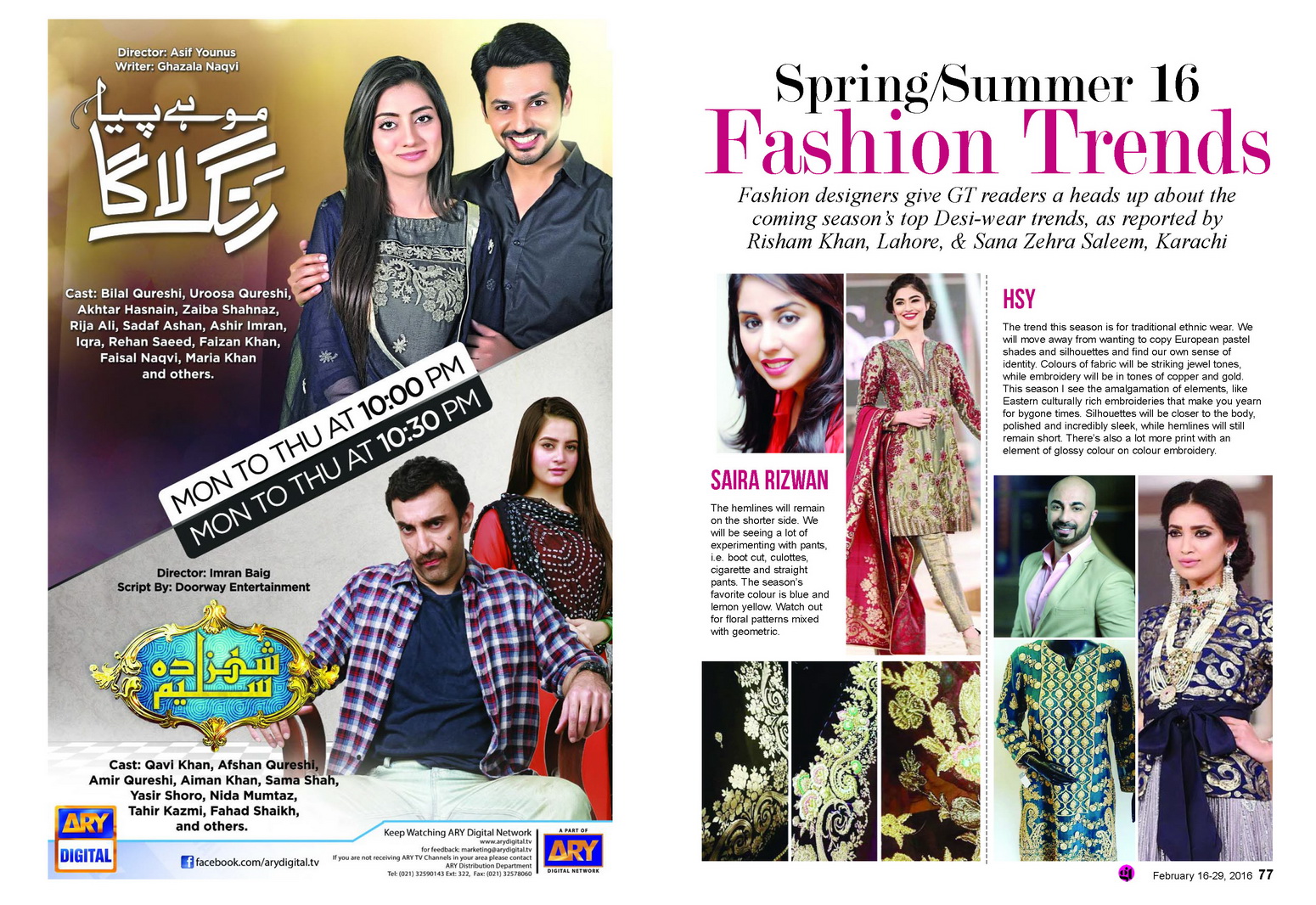
Well-educated, sophisticated and good looking, Aijazz Aslam has been a successful actor and model for more than a quarter of a century. Aijazz started modeling in 1989 and got his big break, two years later, with a commercial for shaving cream. In 1993, he made his television debut with the serial Kashkol and has worked in dozens more in the years that have followed. In an exclusive interview for GT, Aijazz Aslam talks to Ally Adnan about his friendship with actor Faysal Qureshi, the state of show business in Pakistan, the abuse of newcomers in the field, the importance of professionalism, and his fears for Pakistan’s television industry

You started as a model and moved into acting. A lot of actors have followed the same path. Is acting the next step for models in Pakistan?

No, it is not. The trend of models moving into acting is dying nowadays. In the past, people used to find it easier to enter the field of modeling compared to acting. A good face, a well-built body, and some friends in the industry, used to be all that was needed to become a model. Therefore, a lot of aspiring actors started out as models with the hope of eventually making it to acting. Things have changed now.

How have they changed?

Modeling in Pakistan has evolved as an industry. It is no longer a hobby, or a stepping stone, but a proper vocation. Models need a lot more than good looks these days. They require: a dynamic presence, charisma, good posture, an understanding of one’s strengths and weaknesses, strong runway walk, individual style, professionalism, proper training, etc. People who succeed as models today are also hard working, talented, focused and professional. Gone are the days when just about anybody could become a model and flirt with the profession of acting. Show business has come of age in Pakistan. Models need to plan a career in modeling and actors need to focus on acting.

Aijazz Aslam - Photograph by Yaseen Lakhani - 08

Aijazz Aslam & Ally Adnan - Photograph by Yaseen Lakhani - 01

Is a career in show business viable and respectable today?

Yes, absolutely. In the early days, actors used to find it easy to become famous. A few that were talented, or lucky, or both, would also gain respect, but none became rich working in this field. Today, actors make good money and are able to find fame, fortune and respect simultaneously. This is new in Pakistan and not everyone is able to handle it with dignity, maturity and class.

Why do you say that?

There are a number of actors, mostly new ones that are trying to exploit the boom of the industry for short-term, personal benefit. Popular actors have far too many opportunities available to them. The ones that are smart, respectful and professional are enjoying the good times as well but are not letting success get to their heads. Others are under the impression that their popularity is permanent and that they will always be able to get away with holding producers and directors hostage. They make unreasonable, sometimes obscene demands of producers, sponsors and production houses. Since there is a dearth of good actors in the industry today, their demands, albeit ridiculous, are often met with acquiescence and acceptance. This will not last. The industry will eventually find better and more professional actors, good conduct will become necessary, and greed would be considered an undesirable characteristic in actors.

The young actors, who misbehave today, will soon get their comeuppance.  I believe in professionalism and value the attributes of decency, dignity and propriety. People who have these attributes and are committed to their profession will prevail in the long run.

You are now producing television plays. Is production a difficult business?

Terribly, but it does not need to be. A lack of professionalism, commitment and discipline on the part of some actors makes it a very difficult business; otherwise, production would be rewarding and a lot of fun.

Aijazz Aslam - Photograph by Yaseen Lakhani - 09 Aijazz Aslam - Photograph by Yaseen Lakhani - 14

Why do you think some actors act irresponsibly?

There are several reasons for their misbehavior.

One, they have let success in a few projects go to their heads and have become arrogant.

Two, they do not understand the business well enough to know that their irresponsible behavior affects a lot of other people negatively and results in huge losses for producers.

Three, they believe that successful actors must always conduct themselves with arrogance, haughtiness and pride. They think that showing up on time and being disciplined will lower their stature as stars.

Four, they believe that the situation where we have more opportunities than actors is permanent. As a result, they believe that they can get away with anything. They will, of course, eventually come to their senses but, until that happens, they will hurt the industry. The unprofessionalism of a few stars has a very corrosive effect on the entire team working on a project. It should never be tolerated or allowed.

You have been in show business for almost twenty five years and been successful throughout your career. You, however, have never had the roaring success that actors like Fawad Khan have seen. Why?

The roaring success that you refer to is a very recent phenomenon. Traditionally, Pakistani actors have been content with getting appreciated for the histrionic ability, gaining popularity, and not much else. I have starred in a large number of extremely successful television plays and continue to get good roles. I like to play my age and stay away from making poor choices based on vanity. My desire was always to be an actor and not necessarily a star. I enjoy the perks of being a celebrity but true satisfaction comes from acting well.

Show business is known for the sexual, financial and emotional abuse of newcomers. How does one avoid the abuse?

One must always remember that people who ask for financial and sexual favors are invariably fraudsters and never give anyone the opportunities they talk about. One must also be confident in their own abilities. If he is lacking in any one area, he should work on improving his craft instead of giving in to abuse. A lot of newcomers feel that allowing abuse will get them on the fast track to success. This is patently false. No good director or producer will hire a person who lacks talent and ability no matter how many people he has slept with and how many palms he has greased.

How do you hire actors for your own productions?

The channels dictate casting for major roles. They provide us with names of actors they wish to have in the serials we produce and we try to cast them. Casting for other roles is up to us. My company does not have the proper set-up for auditions. I, therefore, rely on casting through talent and casting agencies.

There is more money and less risk in television compared to films. Yet everyone in Pakistan seems to be focused on making and working in films. Why?

Cinema has always had more glamour and allure than television. It is considered to be a step up from television. The appeal of films is immense. The sheer size of the screen is fascinating. People are automatically drawn to cinema. A lot of people who have made a name for themselves in television, are moving to films because they consider it to be the next logical step in their career progression.

There is a hidden danger here. A lot of talented people from television are moving to cinema. Veterans of the television industry are seen to be looking down at television these days.They declare their preference for doing films unabashedly. This is a dangerous trend because the television industry will die if all talented people move to films. Historically, Pakistan has been known more for its television plays than for its films. We cannot and should not let the popularity of cinema hurt our well established and well regarded television industry.

The intensely competitive world of show business is not known for friendships, Yet you have had a strong and enduring friendship with fellow actor Faysal Qureshi.

Yes, I have. Our friendship has lasted primarily because both of us are very secure individuals. We do not feel threatened by each other, or by anyone else, for that matter. There is enough work for all of us. Faysal and I have both had very successful runs as actors and continue to be popular and in great demand. There is no reason for us to compete with each other. When one of us performs well, or bags a prestigious project, or wins an award, the other is happy. Jealousy never comes into play.

 I have other good friends in the industry as well. Humayun Saeed is a very dear friend as are several others.

Photographs by
Yaseen Lakhani

Australia based artist Nazia Ejaz’s work is current and thoroughly expressive on many levels and touches upon relevant queries regarding identity and culture in an expatriate lifestyle. She talks to Saba Ahmed about her art, life in Australia and her mother Madam Nur Jehan’s influence on her

What influences drive your work?

Two distinct narrative threads run through my work: one is my response to my lived experience and another parallel one is about the exploration of the medium and engagement with global art discourse. I think that both investigations work side by side. On the one hand, you can engage with your emotions and everything that’s happening around you and try and interpret that through your work, the conceptual matter. On another level, I try to engage with what’s happening in the art world today. The materials that I use and their limitations and the way I test those limitations informs my work as well. I think both aspects are very important and interesting to me and they keep me engaged, the conceptual and the material.

How do you decide between mediums, such as paintings and installations and what informs your decisions?

I really enjoy the idea of working between mediums. In fact, the work itself is about being in between. The conceptual premise of the work is about being inside and outside. If you’re inside something, then you’re outside something else. The fact that my work moves between mediums also fits in with the concept and it doesn’t limit itself to any specific medium like sculpture or painting. I’ll photograph something and then I’ll paint it and then take a photograph of that painting and then I’ll do something else with it. As far as the medium is concerned, my choices fit in with what I’m thinking about conceptually as well. That’s what I find interesting at the moment.

_MG_0110

OLYMPUS DIGITAL CAMERA
Jaali

My love for Lahore I think is connected to my relationship with my mum (Madam Nur Jehan). She’s not the focal point of my work but she’s linked to everything that influences it. We’ve always had eyes on us being so and so’s children and this perspective is something that I’ll be looking into for a long time through my work

Which mediums do you most commonly work with?

The jaali (screen) is what has inspired these paintings. The jaali was in turn inspired by some paintings I had done earlier. So, you see, the work moves back and forth. I use materials that are at my disposal and use whichever medium I feel like working with at that time. It keeps me interested in the work. More recently, the screen has translated into grids and patterns, which I’ve used metaphorically in the three wall paintings in my most recent show.

Apart from traditional mediums, like photography, painting and sculpture, I use things such as plastics and mirrors, and light and shadow. I plan to use mirrors in future works, because mirrors are also about here and there and I enjoy playing around with the philosophical implications of that.

Tell us more about the jaali and being the ‘other’.

The installation of the jaali fits in with my concept of the experience of our environment. I feel that the experience of our environment is a mediated experience in so many aspects of our life, whether it’s gender, nationality or religious affiliation. And to anything that is different, we respond through these affiliations. So the jaali is almost like a screen which is there almost all of the time, especially in our interactions with other people. Being ‘the other’ myself, living in Australia and coming back to visit Pakistan, where I’ve lived away from for 11 years and before that for 4 years when I was away at college, I find that I’m very deeply rooted within this society, but at the same time I’ve always been on the outside of it.

_MG_0068

RAZ_9259

The jaali is multipurpose and, in my work, it also refers to how sometimes truth or reality can get covered up deliberately or sometimes unwittingly. The jaali is also used extensively in Islamic architecture. Throughout South Asia, you can see it used as a shield. I’ve used that as a metaphor for talking about separation. It also directs the gaze, making it an interesting metaphor with which to work. At the end of the day, it’s about the shifting perspectives, because everything depends on which side of the jaali you are on, either you’re inside or you’re outside and, on both sides, the perspective is very different. It becomes a major concern when you come across it all the time. Once you start realising that, you begin to notice it everywhere and in everything. It’s not other people but it’s your own personal journey and how you respond to these situations that determines who you are. That has been a main area of investigation for me.

What time of the day do you like to work?

Well, I’m a mother of two, which means that apart from taking care of my children, I work all the time. When you’re younger and single, you have the luxury of choosing what time of the day you work as opposed to when you have children you work at whatever time is available to you. I do like to paint during the day because I need natural light, so I’ve got to work around my children, especially since I live abroad and don’t have the support system that we do back home. When my kids are at school, I paint and do other work while they’re asleep.

OLYMPUS DIGITAL CAMERA
Jaali 2

_MG_0011

How is your work received differently in  Pakistan and abroad?

The work was very well received in Australia. Obviously it takes time for people there to understand the metaphorical implications, but there are people there that can engage with the work. Where I exhibited was a non commercial hub of galleries and is frequented by a number of people that are connected to the art world and already engage with art, art history and what’s happening now in the contemporary art scene. It’s not difficult for them to take in the symbolism in my work. However, some of them are not well versed in Indo-Islamic art history where some of the features of my work are coming from. But thankfully so far I’ve received a good response.

Lahore is home territory for me and it was really important for my colleagues in Lahore to see my work as well. It’s a lovely feeling. The responsiveness of the art world and the community that was present and supportive was heartening.

What role did your mother (Madam Nur Jehan) play in your art?

She always encouraged whatever I did and she was always an inspiration for me in terms of her attitude towards my work. My sisters and I are all hard working and that comes from our mother because we’ve seen her work ethic and how hard she worked throughout her life. For me, my work is strongly connected to Lahore and, again for me, Lahore is all about her. My love for Lahore I think is connected to my relationship with my mum. She’s not the focal point of my work but she’s linked to everything that influences it. We’ve always had eyes on us being so and so’s children and this perspective is something that I’ll be looking into for a long time through my work.

OLYMPUS DIGITAL CAMERA
Dil Ka Kiya Rang Karoon
Laal_2015
Laal
In the Shadows
In the Shadows

How do you feel about the current art scene in Pakistan?

Take miniature painting, for example, and the boost it’s gotten from internationally acclaimed artists, such as Shahzia Sikander. Pakistani artists are a force to be reckoned with all over the world. We have so much young creative talent and institutions support it, but I would love to see some support from the government as well. In Australia, a lot of artists would not be able to produce art without the grants they receive. They’re doing non commercial work all through government grants or public artwork commissions.

I recently saw that fantastic Birdhouse commission outside NCA and I think it’s great. I believe that art belongs in the public domain and would love to see it come out of galleries and be displayed in public spaces. In a gallery, only a select few get to see it. An artist’s job is to think about life and to illustrate it in the way a historian might document it or a writer might interpret it. It becomes richer with interaction because you need the viewer to complete the work.

By Laaleen Khan

Regardless of vast differences in time and place, there are certain parallels that can be drawn from Jane austen’s Regency england and contemporary pakistani society. There are also universalities that have made austen’s work resonate through the ages and transcend the confinement of her society. A leading authority of all things Austen,  and the founder of the Jane Austen Society of Islamabad, Laaleen Khan has written a thesis on the subject, literally. she chats with fellow janeites caroline jane knight, moni mohsin and jane odiwe about their mutual love for the author’s enduring legacy 

Jane Austen is the perennial rock star of the literary world—two centuries later, she refuses to go out of style. This past December marked Emma’s bicentennial publishing anniversary, along with Ms Austen’s 240th birthday. Next year, she’ll replace Charles Darwin on a new £10 note to mark her 200th death anniversary. BBC Culture’s list of 100 greatest British novels of all time named four of Austen’s titles (only six were published in completion)— Pride and Prejudice at #11, Emma at #19, Persuasion at #20 and Sense and Sensibility at #66. Austen is even related to the future Queen of the United Kingdom—she is 11th cousin, six times removed, to the Duchess of Cambridge via Kate’s paternal ancestor Henry Percy, 2nd Earl of Northumberland. Austen transcended fashionable readership circles of her lifetime by earning the respect of scholars and academia long after her death, dipping in popularity during the Bronte-led Victorian era and resurging during the 1940s (also a popular choice in the war trenches for home-sick soldiers). Her novels have long held international acclaim beyond the English-speaking world, translated into various languages (including an Urdu version of Pride and Prejudice, Takabbur aur Taassub by Prof. Shahid Hameed).

Over the preceding two decades, Jane Austen has been a part of mainstream popular culture and quite a force to be reckoned with in Hollywood. In 2013, British viewers voted Mr Darcy’s lake scene as the top dramatic moment in British television history—Darcy emerging drenched from the lake at Pemberley to greet Elizabeth Bennet in Andrew Davies’ adaptation of the BBC’s celebrated 1995 Pride and Prejudice series. This catapulted actor Colin Firth and an outbreak of ‘Darcy Fever’ broke out. Henceforth, a relentless stream of postmodern homage to Austen ensued, including Clueless, Bridget Jones’s Diary, Aisha, Lost In Austen, Austenland, Death Comes To Pemberley and Pride and Prejudice and Zombies. Austen has since inspired multigenre tribute fiction, stage, musical, film, TV and digital adaptations; entire merchandise collections from tea and porcelain to jewellery and gowns; cultural festivals including balls, picnics and promenades; and travel and tours to settings depicted in her novels and adaptations and within her lifetime. Annual Jane Austen Festivals in Bath, England and Kentucky, U.S. rival one another in sheer size. Enthusiasts don custom-made apparel and authentic accessories as they attend picnics and assembly balls, indulging in historic recreation in the guise as Regency-era ladies and gentlemen.

1

The British Raj ensured that the subcontinent’s influence upon Regency England was felt, so fashions at the time included Indian muslin, kundan and polki jewellery and Kashmiri shawls 

Global Jane Austen fans from Brazil to South Korea enjoy her work and often celebrate her legacy through ‘Jane Austen Societies.’ One such literary group, the Jane Austen Society of Islamabad (JASI), founded in 2014, is the first known Austen group in Pakistan. The group’s first themed Regency Tea took place last autumn. Members dressed in empire-waist gowns with whimsical touches, enjoying afternoon tea inspired by Georgette Heyer’s London references as they discussed pertinent literary topics and played a game of Jane Austen Matchmaker.       Dressing up as a Regency lady in Pakistan is a little easier than one might imagine; the British Raj ensured that the subcontinent’s influence upon Regency England was felt, so fashions at the time included Indian muslin, kundan and polki jewellery and Kashmiri shawls.

In December, JASI celebrated Jane’s 240th birthday with a Pride and Prejudice-centric literary session that included members Skype-ing in from Paris and Lahore to take part in the discussion. It’s certainly not all bonnets and scones for the members, who explore topics such as gender disparity and social mores in Austen’s work within the context of contemporary Pakistan.

2

As JASI’s founder, I’d say that our community is a haven for like-minded literary buffs and Regency aficionados. Like many of my contemporaries in South Asia, I grew up in a literary household in Lahore with a wealth of books, mostly by classic British authors. My English aunt gave me a box set of Jane Austen novels on my twelfth birthday—and there was no looking back. At university, prior to working on my honours thesis on postmodern Austen screen adaptations, I wrote a paper comparing social elements between contemporary Pakistani ‘drawing room society’ with the Regency era, referencing the marriage mart, eligibility, reputation, feudal families and class-consciousness. For not only do we grow up with classic literature as part of our postcolonial heritage, we relate to it as well. Filmmaker Mira Nair (of Monsoon Wedding fame) once joked in an interview with AboutFilm during the promotion of her adaptation of Thackeray’s Vanity Fair (replete with Indian touches such as Reese Witherspoon in Banarasi with Bollywood dance moves), “If there’s anyone who understands class better than the English, it’s the Indians!” She continued, “We are real colonial hangovers…Really steeped in Dickens, and Shakespeare, and Blake, and Dylan Thomas. I can recite—my father used to make me memorize Portia every summer—crazy things like that…I’ve not shot in England before, but I love England, and in many ways I’m very familiar with it. So it was a great joy.”

Calling in at the BBC World Book Club’s 200th celebration of Pride and Prejudice, Karachi-raised British novelist Kamila Shamsi described Pakistani and Regency social similarities, “Your relatives play a role in your wedding, the economic side of it, where it’s not assumed in any way that a woman will earn a living, and, therefore, her income is tied to who she marries.” Sahar Habib Ghazi of Global Voices made an astute gender observation in a critique of a viral video depicting shopping-frenzied possibly middle class Pakistani women—which, in retrospect may well describe Austen’s Regency ladies, who were similarly judged by appearances and lived in a status-conscious, restrictive era: “Pakistan’s social system systematically rewards women and girls dressed in privilege and shuns those who don’t. That (Sapphire) sale offered some families a short-cut to privilege that they normally couldn’t afford for their daughters. They weren’t fighting for an outfit, they were fighting for perceived privilege. Perhaps some of these women are seemingly ‘privileged women from wealthy families’ made to live on tight budgets…an outcome of the massive imbalance of power and privilege between genders within families. Some men control all the money…some women are discouraged from working by their families…For many women, their outings and socialization is limited to family or social gatherings, where they are expected to look their best.”

3

JASI’s online community is 94% female and 55% are aged between 25 and 44. 40% are from Pakistan (approximately a third are from Islamabad, Lahore and Karachi respectively). 23% are from the USA, with 9% from Britain and 7% from Brazil. Remaining members come from the Americas (Argentina, Canada, Mexico, Peru), Europe (Albania, Finland, France, Germany, Greece, Ireland Italy, Malta, the Netherlands, Romania, Slovenia, Spain, Turkey), Africa (Algeria, Egypt, Uganda), the Middle East (Iran, Israel, Palestine, the UAE), Asia (Bangladesh, Hong Kong, India) and Australia.

Islamabad-based members are an eclectic yet compatible group of journalists, academics and professionals in the arts and sciences. Architect Zarminae ‘Nini’ Ansari lived in Islamabad before moving to Paris. “This group is everything I love about Islamabad: a group of smart, qualified people getting together because of their common interests, rather than the fact that their grandfathers were business partners or mothers were committee or coffee-party friends!” she reveals. “My favourite city in Pakistan is Islamabad. It’s where I found ‘my tribe’…The transient social nature of Islamabad and its high turnover of residents—diplomats, expats, multinational HQ—people are more open and less cliquish than in places with entrenched social groups and ‘acceptable’ social practices and activities.”

4

5

It’s certainly not all bonnets and scones for the members, who explore topics such as gender disparity and social mores in Austen’s work within the context of contemporary Pakistan

Basia Heath is a PR executive who relocated from London. “Knowing Islamabad now, it comes as no surprise (for JASI to exist here),” she confides. “There is a real depth of interest in art, music and literature. There are vibrant cafes and an artisan culture, and there are all sorts of activities catering to special interests with a real sense of community. If a person bases their perception of Pakistan on episodes of Homeland and the (popularized) image of Pakistan, then I suspect this would come as quite a shock!” A qualified dentist, Shirin Saifullah Khan shares, “Pride and Prejudice was the first Austen novel I read, and naturally, there was no looking back. Austen makes the characters evolve in such a way that one becomes uncertain about their own feelings towards them. The happy endings are the  cherry on top!”

Social practices in Austen’s time that seem quaint or outdated in western societies today are still flourishing in Pakistan. “There is still so much focus on what makes people ‘eligible’ here when people consider marriage that was also done in Jane Austen’s day,” comments broadcast journalist Sophia Sultana Saifi. Gayathri Warnasuriya, a health scientist from Sri Lanka, remarks, “When I first really immersed myself in Pride and Prejudice I was 15 years old and it was of course with Elizabeth and her sisters that I most identified. Now, more than 25 years later, I am quite possibly older than Mrs Bennet yet I find myself unable to walk in her shoes!Maybe it’s because I am an older mum and my daughter is only four years old. I am out of sync with Regency and indeed Pakistani society, where I sometimes meet mothers my age whose daughters are already ‘out in society’.” Remarks barrister Saniyya Gauhar, “Miss Bingley was unanimously voted by our group as most disliked,” referring to an opinion poll that JASI created for its members. “Most of us know or have known a Miss Bingley—that sugary sweet friend who subtly puts you down without you being aware of it until much later! Pure old-fashioned jealousy is usually the motive. It doesn’t necessarily have to be competition over a man!”

6

7

10

The Jane Austen Society of Islamabad has plans for future meets and themed occasions. The group is to be featured in the spring issue of Jane Austen’s Regency World Magazine, the official publication of the Jane Austen Centre, Bath. It also has plans to work with the Jane Austen Literacy Foundation, a registered not-for-profit charity, to raise funds towards worthy causes including UNICEF’s school-in-a-box program for Syrian refugee children.

Enthusiasts of Austen, classic literature and period drama are invited to view the JASI facebook page at: Facebook.com/Janeites

Founder of the Jane Austen Literacy Foundation (JALF) and Ms Austen’s fifth great-niece (a descendent of Jane’s brother, Edward Austen Knight, Squire of Chawton), the Melbourne-based marketing executive grew up at Chawton House, which is now a library—The Centre for The Study of Early Women’s Writing, 1600-1830. Incidentally, Chawton village in Hampshire is where Jane lived and wrote for the last eight years of her life. The cottage has been preserved as Jane Austen’s House Museum. The JALF is a charitable organization that hopes to tap into Austen’s global popularity for the benefit of literacy programs, such as UNICEF’s school-in-a-box programs as part of Jane’s legacy. Current ambassadors include Simon Langton, Director of the BBC’s acclaimed 1995 Pride and Prejudice TV series that Caroline credits for Austen’s continued cultural and commercial popularity: “As well as talent and determination, there has also been a healthy dose of luck—the casting of Colin Firth, for example. Rarely have two people born 185 years apart had such a profound and lasting effect on each other’s careers!”

Caroline Jane Knight

8Laaleen: In what way do you plan to work with the Jane Austen Society of Islamabad and other Austen societies around the world on literacy projects?

Caroline: “JALF is all about harnessing the passion for Jane Austen to raise

money for literacy. We will work with JASI and other societies to raise funds and select the right communities to support with literacy resources. We are a registered not-for-profit organisation run by volunteers with no wages or commission paid to anyone, created to extend Great Aunt Jane’s legacy. Janeites are united in their love of Austen, books and literacy and together we have the power to really make a difference.”

Jane Odiwe

The Bathonian/Londoner author of tributes (i.e. prequels and sequels to Austen’s original novels) speculates how Austen’s characters’ lives might have continued after the last page of the novels. “Jane’s voice is very strong, speaking through her characters to tell us what she thinks about men, society, and women’s position within its confines, but sweetening her outrage with a little romance,” she says. “We all enjoy glimpsing back into the past, becoming absorbed in and inhabiting Jane Austen’s worlds, which were created with genius.” Her latest novel is Jane Austen Lives Again (literally; Ms Austen winds up in 1925).

11

12

Laaleen: What is it about the Jane Austen Society of Islamabad that interests you as a member?

Jane: “Jane Austen’s work seems to be able to connect us on many levels, and meeting like-minded people who share a love of her work is always wonderful. I think it’s fantastic that an author who lived 200 years ago still has the power to unite us through her novels, and to know that her books are loved on the other side of the world is amazing. I love meeting people from other countries who feel the same way as I do about Jane Austen, and I am fascinated by the life and culture in Pakistan…I only wish that Jane could have known how much her work was to be loved by so many people worldwide, and can only imagine she’d have been thrilled to learn her work is still read by millions of people and translated into so many languages.”

Moni Mohsin 

London-based author, satirist and columnist (the ‘Social Butterfly’ series, The End Of Innocence and various periodicals) is a Janeite herself and participated in the BBC World Service’s broadcast celebrating Pride and Prejudice’s bicentennial.

Laaleen: What’s your personal interest in Austen? Has she ever inspired you in your work?

Moni: As a writer, I have learnt on so many different levels from Austen. Stylistically, she’s in a class of her own. The elegance of her language, the crispness of her sentences, the sharpness of her dialogue and the acuity of her observations hit me anew every time I read her. She’s an extraordinary early (perhaps the earliest) practitioner of the now much talked about ‘free indirect style’ whereby the story is neither in the voice of the first person nor is it an omniscient third person’s narration. Instead, it is told entirely from the point of view of the protagonist. As such we inhabit the very consciousness of her heroines. It is a delicate and nuanced form of story telling, fiendishly difficult to pull off convincingly. Yet she does it flawlessly, time and time again.

9

I also love her sly, irreverent humour. She doesn’t have the broad comedy of, say, Dickens but she has wit in abundance and she uses it to great satirical effect. Austen is a stickler for manners and tact and yet she is not in the least sanctimonious, or heaven forbid, sentimental. In fact, she’s quite the opposite. She pinpoints the vanities, hypocrisies and snobberies of her characters with devastating accuracy. As Mr Bennet says, ‘For what do we live if not to make sport for our neighbours, and to laugh at them in our turn?’ For me, Austen’s the undisputed queen of social satire.

Lastly, her heroines are perfectly realized characters. They possess a lively, independent intelligence and, like their creator, they are not afraid to speak their minds. Yet, they are by no means saintly. In fact, they frequently make gross errors of judgement. But they learn from their mistakes and it is through their struggles to better understand themselves and others that they eventually find happiness. Austen, then, is a believer in second chances. There is something inspiring about an author who holds that hope out to you.

Laaleen: Why do you think so many Pakistani women are fond of Jane Austen and her legacy?

Moni: “I can’t answer for all Pakistani women who are fond of Jane Austen but I can tell you why she resonated with me as a reader. Though written in Georgian (Regency) England, many of the themes she raises are still pertinent to present day Pakistani society. So the importance of family; the significance of social rank; the need for a secure marriage and the preoccupation with appearances and reputations were familiar territory for me. So too was the smallness of the canvas. In each of her books, Austen writes about small groups of people, all intensely interested and involved in each other’s personal lives—just like Lahori society! And, finally, all her books have the deep satisfactions of a morality tale. The good are rewarded and the bad punished. The hero and heroine face their trials but finally get to marry and live happily ever after. What’s not to love?”

Laaleen: At the BBC World Service’s World Book Club broadcast, you’d said that you sympathized most with Mrs Bennet. Can you elaborate?

Moni: “Mrs Bennet is a crass, foolish, tactless woman. With her loud, vulgar manners and blatant attempts to ensnare wealthy suitors for her daughters, she is a truly cringe-making mother. That said, her fears for her daughters are grounded in real concerns. Mr Bennet is not well off. His estate, such as it is, is entailed and will be inherited not by his daughters but by Mr Collins, his unctuous male cousin. Should Mr Bennet die before his daughters are married, they will be destitute. The girls have no inheritance, no brothers who will protect them and no wealthy relatives to bail them out. When Lizzie rejects Mr Collins’ marriage proposal, Mrs Bennet fears—quite rightly—that Mr Collins will turf them out of their home on Mr Bennet’s death.

In Georgian England penniless, single genteel women did not have many options: they either became companions to wealthy difficult old women or they became governesses to spoilt, rich young girls. In both cases, they were little better than servants, forced to endure a life of genteel poverty and petty humiliations. The only other option was prostitution. There really wasn’t much else by way of career choices. Mrs Bennet, for all her foolishness, is acutely aware of the threat of real impoverishment and disgrace that hangs over her daughters and herself. Yes, her attempts to throw her girls at rich young suitors are blatantly vulgar but what choice does she have? She can’t count on her educated, erudite husband’s input. Spending all his time closeted in his study among his precious books, he seems totally unaware of her concerns. When he does emerge, it is only to mock her opinions and undermine her authority in front of her daughters. So it falls on the shoulders of this stupid, vulgar woman to protect her girls. That she rises to the challenge is in no doubt. Which is why I can’t help but sympathize with her.”

By Mahlia Lone

What makes a Bollywood power couple? It takes talent, good looks, connections, lineage, box office success, awards, and an ability for self promotion and marketing to become a star. When both partners possess these ingredients then the sum is greater than the parts, as in the case of Saif+Kareena=Saifeena. Let’s take a look at these savvy stars and what they want to achieve together

“If you are in love and you are happy, then that’s all that matters. I believe in the institution of marriage. It’s like a tag to cement the relationship for your friends, family and public. And it is a celebration of the fact that Saif and I are in love and we want to spend our life together,” said Kareena Kapoor Khan speaking about her marriage to fellow actor Saif Ali Khan.

Eleven years his junior, one of the most popular and highest paid Bollywood actresses at the time of their 2012 wedding, what made Kareena Kapoor go for Saif Ali Khan, a short squeaky-voiced supporting actor and divorced father of two children, albeit a nawab? Unlike other Indian actresses who are photogenic and less attractive in real life, apparently Kareena (named by her mother Babita after Leo Toltstoy’s epic novel Anna Karenina) is tall and extremely pretty in person, just as she appears on screen. She is also Bollywood royalty, theater and film actor Prithvi Raj Kapoor’s great granddaughter and film maker/studio owner/actor Raj Kapoor’s granddaughter. Nearly all the Kapoors are or have been working actors, including in her immediate family her father Randhir Kapoor, her mother Babita, who is of Anglo-Indian descent, and even her elder sister Karisma. In fact, her parents split up because Babita wanted her daughters to become actresses, but the more conservative Randhir did not think it suitable for the women of the family. Though many of the male members of the family married actresses, they were all made to retire from their careers and become housewives, which they willingly did.

Untitled-2 copy

kareena-with-dashing-saif-ali-khan

Randhir, Karisma, Babita & Kareena
Pataudi's Ibrahim Palace
The Pataudi Ibrahim Palace

Saif Ali Khan, named Sajid at birth, comes from an entirely different stock from his father’s side. He is the tenth Nawab of Pataudi, (honorary) titular head of 52 villages, who studied at prestigious Winchester College in England and grew up in Ibrahim Palace, 26 km from Gurgaon, a New Delhi suburb. Ibrahim Palace is a vast fairytale palace that looks straight out of Disney’s Aladdin and has recently been renovated and converted to a hotel. His father Mansoor Ali Khan Pataudi, the ninth Nawab, also known as Tiger Pataudi, captained the Indian national cricket team, as did his paternal grandfather the eighth Nawab Iftikhar Ali Hussain who played first class cricket for both the British and Indian cricket teams. Saif’s paternal grandmother Begum Sajida Sultan was the daughter of the last ruling Nawab of Bhopal, while his mother is former B’wood actress Sharmila Tagore (renamed Begum Ayesha Sultana after converting to Islam uon her marriage), herself the granddaughter of Rabrindranath Tagore, the Nobel Prize winning Bengali poet. She currently serves as the head of the Indian censorship board. Saif’s youngest sister Soha Ali Khan and her husband Kunal Khemu are also actors, as was his first wife Amrita Singh, who hails from a Sikh landed family.

Amrita is not only 12 years older than her ex-husband, but physically taller and broader as well with a husky voice. Though the marriage lasted for some 13 years and produced two children Sara and Ibrahim, Saif cheated on her for a considerably portion of the time, finally leaving her for a Swiss model Rosa Catalano. Rosa herself contemplated moving to India and also becoming an actress at which point the by now divorced Saif broke up with her and started reinventing himself in an effort to revamp his image and career.

in Tashan
They hooked up during an oudoor shoot for Tashan
kareena_jab_we_met_6250
With ex-boyfriend Shahid Kapoor in Jab We Met

Saif Ali Khan is the tenth Nawab of Pataudi, (honorary) titular head of 52 villages, who studied at prestigious Winchester College in England and grew up in Ibrahim Palace, outside New Delhi, which has recently been renovated and converted to a hotel. His father Mansoor Ali Khan Pataudi, also known as Tiger Pataudi, captained the Indian national cricket team, as did his paternal grandfather the eighth Nawab Iftikhar Ali Hussain, who played first class cricket for both the British and Indian national cricket teams. Saif’s paternal grandmother Begum Sajida Sultan was the daughter of the last ruling Nawab of Bhopal

Kareena, as younger sister of Karisma, a mildly successful lead heroine, had a highly anticipated film entry, though unluckily she opted out of a debut film with Hritihik Roshan’s Kaho Na Pyaar Hai (2000) that went on to be a big hit. Struggling to find her niche with initial box office duds, she finally had a massive hit with Karan Johar’s Kabhie Khushi Kabhie Ghum opposite Hritihik, with whom she reportedly also had an under the radar fling. Though the movie was a multi-starrer, Kareena gained a fan following after portraying an Indian version of Alicia Silverstone’s character in the hit Hollywood teen comedy Clueless. An intuitive and spontaneous actress, Kareena continued with fluff roles till she played the role of a prostitute in the film Chameli, for which she won a Filmfare Award. She started a relationship with newcomer Shahid Kapoor, a diminutive trained dancer, which lasted for three to four years and a mobile video of them French kissing went viral during this time. It was after their hit movie together Jab We Met that she broke up with him. Though she had starred with Saif Ali Khan in two movies up to this point, including the Othello inspired Omkara, they had not had many scenes together. To get over her breakup, Kareena decided to focus on exercise, weights and yoga (she can do 50 sun salutes at a time holding eacho position for 30 seconds), and diet regimen by becoming a vegetarian to get her body in tip top shape. Her size 0, 48 kg figure was then duly reported in the press and a noticeably trimmer Kareena appeared in tiny hot pants and bikini tops in the 2007 Yash Raj movie Tashaan, opposite a buffed up and goateed Saif Ali Khan. According to Kareena, it was during an outdoor shoot for this movie that she saw Saif lying bare-chested in just his jeans, sunning himself at the hotel pool that she checked him out and thought he was hot. However, according to what Shahid Kapoor alluded to in his interviews, there was some overlapping, during which time Kareena decided to dump the young actor for his older, vastly more eligible rival.

The phenomenon of Saifeena, as they were dubbed by the Indian press, was born. They announced their relationship at the Lakme Fashion Week that year.  A source reported to the press, “Bebo (Kareena’s childhood nickname) and Saif behave like teenagers in love. They constantly send each other lovey-dovey messages and even have photos of one another on their phones.”

Untitled-2 copy
The chic couple at a polo match

The couple garnered much publicity that has translated into many lucrative endorsements and modeling contracts together as a couple. Kareena, who has not been averse to plastic surgery to fine tune her looks though she has never publicly accepted this, introduced her boyfriend to botox and collagen fillers to rejuvenate his middle aged looks. Saif, henceforth, started appearing in films creaseless and with a taut forehead and an expressionless face. The publicity also helped his career and he ventured into film production making moderately successful films. Not only did Kareena help him out by starring in some of these, like his 2012 movie Agent Vinod, but she has also said she helps him market his films. “Saif just doesn’t take himself seriously enough. After his performance in Love Aaj Kal (2009 movie produced by Saif’s production company Illuminati Films that he stars in opposite Deepika Padukone and that has been directed by Imtiaz Ali), I’m convinced Saif’s best time begins now. But he doesn’t know how to market himself….This is Saif’s best performance after Omkara. I’m so proud of him. Love Aaj Kal is as much my baby as Saif’s. I’m going to be completely involved in the publicity, marketing, everything. This is our first production and we’re going to make it rock.”Not content with just taking vacations together, Saif told Babita that he was committed to her daughter and wanted her to move in with him. “Kareena is my woman and we know that we want to spend the rest of our lives together.” Babita gave them her blessing and they started living together like a modern Indian couple.

   Actresses that Saif formerly had flings with, such as Priyanka Chopra, Bipasha Basu (during the fliming of Race) and Yana Gupta, Kareena is openly hostile and bitchy to, calling Bipasha, a “kaali billi” (black cat) for her dusky complexion. She said she knows that Saif has sown his wild oats, but now he has become grounded and if he ever cheats on her she threatened, “I will slaughter him.”

But Saif proved his faithfulness to her and five years of dating later, they decided that their hectic careers allowed them a short time in which to tie the knot. “Of course, I want to be with her as much as I can,” Saif said in an interview. “My regret is we can’t be together more often. We are uncannily similar people and I’ve only now begun to understand why I need to be with her constantly. She complements me, as I hope I complement her. So of course, I try to be where she is.”

During this time, Kareena’s career went from strength to strength. She’s the only heroine who can boast of starring in four hits that have grossed over Rs.1 billion each and has starred in films with all the top Khan triumvirate: Salman, Aamir and Shah Rukh. The highest paid Indian actress in 2012 for Heroine, receiving Indian Rs. 80 million (PKR 127 m) and with 16 brand endorsements, Kareena stints herself no indulgence. In 2010, Kareena bought herself a seven-carat diamond solitaire. She said in an interview that the ring was bought based on the advice of an astrologer who said it would bring her stability and happiness in her life. She also owns a fleet of luxury cars including a Mercedes S class sedan, an SUV and a Lexus LX 470. Kareena never misses an opportunity to head to Europe to unwind with London and Swiss skiing destination Gstaad being her top favourite vacation spots. She believes that two actresses in the same league can never be best friends, so her pal is struggling actress Amrita Arora.  On October 27, 2011, Kareena’s wax statue was unveiled at Madame Tussauds in Blackpool in the UK. Quite the entrepreneur, Kareena also has a clothing brand and has co-written a few diet books.

Untitled-3 copy

At the age of thirty, Kareena became Mrs. Khan in a lavish wedding with five main functions spanning two cities. Unlike prior Pataudi Begums, she refused to covert from Hinduism to Islam or give up her lucrative film career. With his father already deceased, Saif did not demur and indulged his bride in all her wishes. The starry Mumbai functions, a Sangeet, a Mehndi and a Reception were hosted by Kareena’s parents. It was reported, “The Sangeet evening was marked with music, dance and masti. The terrace party was held at Kareena’s Bandra residence. Buddies Malaika Arora Khan, Amrita Arora, and Tusshar Kapoor shimmied to well-choreographed moves by Karan Johar. There was an array of dance performances to popular Bollywood numbers dedicated to the lovely couple. The terrace venue was covered to prevent media getting a snoop….Kareena in a pretty sari set the tone and note for the mehndi ceremony, where Saif looked dapper in a tuxedo. The mehndi ceremony was coupled with a private dinner for family and friends, which took place in Mumbai’s Taj Mahal Palace Hotel. The bride chose to wear ensembles made for her by her favourite fashion designer, Manisha Malhotra and especially created diamond and gem encrusted jewellery. A simple Nikkah and signing of the marriage registry was held at Saif’s residence in Mumbai. This was a personal affair to which they donned shalwar kameezes and waved to the press from the balcony. Kareena had refreshingly minimal makeup on. It was reported, “The after-marriage bash was a vibrant affair. Around 150 selected guests attended the celebration. B-town celebs like Shah Rukh Khan with wife Gauri, Sonam Kapoor with dad Anil Kapoor, Amrita Arora with husband Shakeel Ladak, Priety Zinta, Karan Johar, Tusshar Kapoor, and many more upped the starry quotient of the evening. Family members including Randhir Kapoor, Babita, Karisma, Rishi Kapoor with wife Neetu Singh and son Ranbir, Soha Ali Khan, along with Saif’s daughter Sara and son Ibrahim were seen in a joyous mood.”

“After marriage, love becomes bigger, better. There’s greater understanding and respect. Saif admires me for being a working woman. A partner should help you fly. Saif’s perfect!…I can’t breathe without love. It gives me energy, a feeling of belonging, the need to GO out and conquer the world,” said Kareena

Then, the wedding moved to New Delhi where Sharmila hosted a grand Dawat-e-Valima in true Nawabi style at the Ibrahim Palace. All the top politicians and remaining royal families of the land attended. The Pataudi relatives from Lahore flew in as well. Kareena wore traditional gold jewellery that complemented a gharara, replicated by ace Delhi fashion designer Ritu Kumar from a vintage one worn by Begum Sajida Sultan at her wedding to the eighth Nawab Pataudi. Then, the Begum passed it to her daughter in law Sharmila, who wore it at her own wedding. Saif wore a Benarasi brocade achkan that had been copied by menswear designer Raghavendra Rathore from achkans worn by Saif’s father Mansoor Ali Khan in his lifetime. Saif carried the ceremonial family sword and wore a traditional pagri on his head. Even the paans served at the valima were special crafted according to an age old recipe. Sharmila wanted to impress the Kapoors with the Pataudi family’s pedigree, royal traditions and aristocratic connections, which she did so, sparing no expense or effort. “Celebrities from the world of cricket, Bollywood and politics graced the Mughal-themed reception. The cream and gold décor with antique props, jasmine floral arrangements and traditional brass hanging diyas added a delicate spice and romance to the wedding ambiance,” it was reported. Against the glittery, B’wood wedding, the regal Delhi wedding festivities made quite an impact. No glitzy hotel or palatial bungalow could compete with the newly renovated splendor of the Old World and regal Ibrahim Palace. Upon attendance to their new step mother at the wedding were teenage Sara and Ibrahim. Saba and Soha Ali Khan, Saif’s younger sisters, also fittingly played prominent roles at the wedding.

The couple returned to their respective film sets after the wedding and it was a little before they could take off for their honeymoon.

Kareena
Spotted at Maldives Airport, Kareena, Saif, Soha & Kunal on a family holiday

Kareena has maintained that she will continue to act and may not have children till the age of 39. Kareena likes to cook for her husband, while he plays the guitar for his ladylove. She has also carefully cultivated a close relationship with his daughter Sara. Kareena said in an interview. “They are the most well brought up children. I always remember Sara standing up and doing adab (greeting). Both Sara and Ibrahim are like that. I am like a friend for them…. In fact, we’re like best friends. Saif refuses to come out with us. Sara’s my bar hopping partner. I enjoy my equation with her…. At times Sara and I chat over a glass of champagne. That’s the way Saif wanted it and that’s the way I wanted it. Whenever she wants to call me she does at time when Saif isn’t around and she doesn’t want to talk to him. She talks to me.’’

In another interview, Kareena said, “’After marriage, love becomes bigger, better. There’s greater understanding and respect. Saif admires me for being a working woman. A partner should help you fly. Saif’s perfect!’ She pointed out that she’s given a lot of time to the marriage, in fact to every relationship. ‘I can’t breathe without love. It gives me energy, a feeling of belonging, the need to go out and conquer the world,’ she stressed.”
“I understand people want to put our relationship under a microscope. They want to know about our relationship,” said Saif thoughtfully in an interview. “But there’s only so much that they can know or perceive. What Kareena and I feel for each other, only the two of us know.”

Pin It