Tag

Interview

Browsing

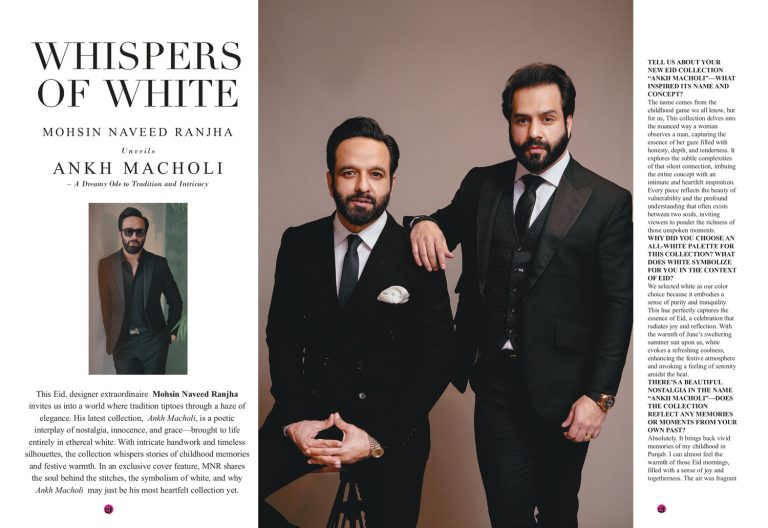
This Eid, designer extraordinaire Mohsin Naveed Ranjha invites us into a world where tradition tiptoes through a haze of elegance. His latest collection, Ankh Macholi, is a poetic interplay of nostalgia, innocence, and grace—brought to life entirely in ethereal white. With intricate handwork and timeless silhouettes, the collection whispers stories of childhood memories and festive warmth. In an exclusive cover feature, MNR shares the soul behind the stitches, the symbolism of white, and why Ankh Macholi may just be his most heartfelt collection yet.

Tell us about your new Eid collection “Ankh Macholi”—what inspired its name and concept?

The name comes from the childhood game we all know, but for us, This collection delves into the nuanced way a woman observes a man, capturing the essence of her gaze filled with honesty, depth, and tenderness. It explores the subtle complexities of that silent connection, imbuing the entire concept with an intimate and heartfelt inspiration. Every piece reflects the beauty of vulnerability and the profound understanding that often exists between two souls, inviting viewers to ponder the richness of those unspoken moments.

Why did you choose an all-white palette for this collection? What does white symbolize for you in the context of Eid?

We selected white as our color choice because it embodies a sense of purity and tranquility. This hue perfectly captures the essence of Eid, a celebration that radiates joy and reflection. With the warmth of June’s sweltering summer sun upon us, white evokes a refreshing coolness, enhancing the festive atmosphere and invoking a feeling of serenity amidst the heat.

There’s a beautiful nostalgia in the name “Ankh Macholi”—does the collection reflect any memories or moments from your own past?

Absolutely. It brings back vivid memories of my childhood in Punjab. I can almost feel the warmth of those Eid mornings, filled with a sense of joy and togetherness. The air was fragrant with spices and sweets, and everyone wore their simplest yet most beautiful clothes, adorned with vibrant colors. It’s a nostalgic reminder of that pure, innocent love we all seem to recall from somewhere deep within us, capturing the essence of simpler times and cherished moments.

How did you approach the embroidery work in this collection? Can you describe the kind of craftsmanship that went into it?

We focused on creating a design that is both delicate and intricately detailed. The piece features exquisite threadwork that weaves a tapestry of texture, complemented by charming eyelet details that add an airy elegance. Each element has been meticulously hand-finished, showcasing our commitment to craftsmanship. Every stitch and embellishment has been infused with love and care, resulting in a product that truly reflects our passion for quality and artistry.

White is often seen as a minimalist color, but your designs are known for their richness. How did you strike a balance between simplicity and opulence?

That was the challenge—making white feel distinctly MNR. We wanted to preserve the purity and elegance of the color while infusing it with the brand’s signature character. To achieve this, we worked meticulously with texture, layering, and fine embroidery, allowing the fabric to come alive with subtle complexity. Each detail was carefully considered to create dimension and depth without adding visual or physical weight. The result is a piece that feels light and effortless, yet unmistakably rich in craftsmanship and identity—true to the spirit of MNR.

Would you say “Ankh Macholi” is a departure from your usual work, or is it an evolution of your signature style?

This experience represents a pivotal moment in both my personal development and the progression of our brand. It adopts a more nuanced and reflective tone, while still being firmly anchored in the unique details and narratives that characterize MNR. We have gained a deeper level of maturity, which is also reflected in the evolution of our brand storytelling.

What kind of woman do you see wearing this collection? What mood or energy does she carry?

She’s confident, kind, and graceful. She doesn’t need to shout to be seen because there’s power in her calm.

Which piece from the collection is closest to your heart and why?

There’s a white kurta with floral vines. It’s simple but has such emotion in the embroidery. It feels like home to me.

You’ve always had a deep connection to tradition in your designs—how do you keep that alive while staying relevant and contemporary?

By being honest. I love our culture and our people, but I also see how people live today. So I blend the two. It is never forced, always natural.

How do you want people to feel when they wear “Ankh Macholi”?

Happy, and loved.

What was the creative process like behind the scenes—mood boards, materials, late-night design sessions? Give us a glimpse.

Lots of chai, lots of sketches at 2 a.m., discussions with my team and many beautiful messes in the studio.

What does Eid mean to you personally, and how does that reflect in this collection?

It’s family, prayer, food, and dressing up with love. This collection carries that spirit.

Can we expect any signature MNR silhouettes or are you introducing something fresh with this line?

Some signatures are there, yes but we’ve played a lot with  new silhouettes and fabric textures, especially in menswear. It will feel new.

You’ve dressed celebrities and royalty—any hints on who might be spotted wearing “Ankh Macholi” this Eid?

Let’s just say you’ll see some familiar faces but to be honest the real joy is seeing everyday people wear it their own way.

What’s next for Mohsin Naveed Ranjha after this collection?

Something very close to my roots, think stories from the soil and abroad but with a twist. I’m excited.
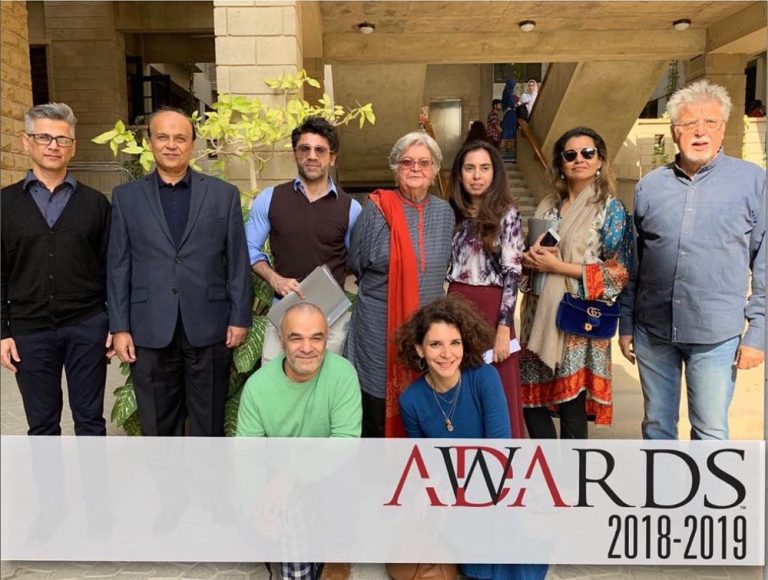
Maria Aslam is a multifaceted individual, renowned as a prolific writer, architectural historian, and environmental activist. Her expertise spans the fields of interior design, architecture, heritage, and urban revitalization. As the founder and Editor-in-Chief of ADA Magazine from Pakistan, Maria has made significant contributions to the discourse on architecture, design, and art. She holds the distinction of being the first female entrepreneur from Pakistan to venture into publication, spearheading the ADA Awards, a ground-breaking initiative in the disciplines of Architecture, Design, and Art. In addition to her editorial role, Maria Aslam is the Founder and Principal Architect of ArchWorks, a Karachi-based creative and research practice. ArchWorks operates at the intersection of architecture, urbanism, landscape, interiors, and cultural geographies. Maria’s work at ArchWorks encompasses diverse projects, including architecture, interiors, environmental geographies, community settlements, and curatorial ventures such as exhibitions, seminars, installations, and speculative projects. Furthermore, Maria is actively involved in advocacy and activism for sustainable design through her role as the Co-founder and President of SDC – Sustainable Design Council from Pakistan. She is committed to addressing issues related to the health of the planet and promoting environmentally conscious practices within the design industry. Maria Aslam has held leadership positions in prominent professional organizations, including serving as Chairperson of the Karachi Chapter of the Institute of Architects Pakistan (IAP) and currently as Chairperson of the Pakistan Institute of Interior Designers (PIID). A published author, Maria wrote ‘Interiors of Pakistan Volume I’, published in 2016, and her second book on seven decades of Pakistan architecture landscape co-authored with Hasanuddin Khan is in production. She is currently working on two more publications. With a Bachelor of Architecture from Indus Valley School of Art and Architecture and a master’s in architecture from McGill University, Maria advocates for the environment, built structures, and equitable spaces. Maria Aslam will be representing Pakistan in WAF – World Architecture Festival, November this year. Her influence extends beyond national borders, as she has represented Pakistan on numerous international platforms as a juror, critic, convener, and speaker, contributing to the global dialogue on architecture and design.

How did the concept of ADA awards come about?

The concept of the ADA Awards was born out of a reflective moment during our decade-long journey of documenting, archiving, and fostering critical discourse within the realms of architecture, design, and art. As we celebrated ten years of ADA’s existence, we asked ourselves a fundamental question: What more can we do?

While our publication had successfully provided a platform for intellectual engagement and scholarly documentation, we realized that a crucial element was missing-formal recognition. There was a glaring void in acknowledging and celebrating the immense creative talent and groundbreaking work emerging from Pakistan and the region.

The ADA Awards were thus conceived as a means to bridge this gap-an initiative that would not only honor exceptional contributions in architecture, design, and art but also elevate the creative fraternity by fostering visibility, appreciation, and dialogue on a grander scale. It was our response to the need for a dedicated platform that would champion innovation, sustainability, and cultural identity while inspiring future generations to push the boundaries of creative excellence.

What were the challenges you faced while establishing the idea.

Establishing the ADA Awards came with its own set of unique challenges. One of the primary hurdles was the absence of any local precedent for such a platform in Pakistan. There was a significant gap in recognizing creative excellence across architecture, design, and art, making it essential to build an entirely new framework from scratch-one that would be both credible and impactful.

Creating awareness and understanding about the significance of such an award system required extensive engagement with the creative community, industry stakeholders, and institutions. Establishing a structured process for evaluation, curation, and selection was another key challenge, as it had to uphold the highest standards of excellence while being inclusive and representative of the creative fraternity.

Guidance from advisors played a crucial role in shaping the ADA Awards, providing strategic direction and ensuring that the awards aligned with international best practices. A major milestone in this journey was the support and inspiration drawn from the Aga Khan Award for Architecture, which provided valuable insights into how such an initiative could be structured effectively.

Additionally, forging alliances and learning from global organizations operating in similar domains helped refine the vision and execution of the ADA Awards. Building credibility required not just a strong jury and evaluation mechanism but also the trust of the creative community. Over time, through persistence, collaborations, and a commitment to excellence, the ADA Awards have grown into a prestigious platform that continues to celebrate and elevate Pakistan’s creative talent on both national and international stages.

What makes you choose historical locations especially in Lahore for the awards?

Our selection of venues for the ADA Awards is not solely about historical significance, nor is it limited to Lahore. Rather, it is a conscious decision to host events in spaces that have undergone conservation, adaptive reuse, restoration, and have been reintegrated into communal life. By doing so, we highlight the importance of preserving and repurposing architectural heritage while demonstrating the potential of these sites as vibrant, functional spaces for contemporary cultural dialogue. We were the first one to step in the power corridors of the Governor House in   Karachi, when it was opened to public in 2019.

All our events-whether the awards, exhibitions, or seminars-are intentionally hosted in such venues, reinforcing our commitment to sustainability, cultural preservation, and community engagement. However, hosting formal, invitation-only events in public spaces brings its own set of challenges, from logistical planning to ensuring smooth execution while maintaining the sanctity of these heritage sites.

Looking ahead, we are eager to extend this initiative beyond Lahore, exploring venues in the northern regions and other cities of Pakistan. Our approach is holistic; it is not just about a single awards night but a series of engagements, including talks, knowledge-sharing seminars, and exhibitions. Each city’s infrastructure, accessibility, and suitability for national and international participation are carefully considered in our planning. This multi-faceted approach ensures that the ADA Awards and its associated events continue to grow as an inclusive, impactful platform for Pakistan’s creative community.

How rewarding has been this strive for the pursuit of excellence?

The journey of the ADA Awards has been immensely rewarding, yet we continue to evolve. The response from each host city plays a crucial role in shaping our experience, and Lahore, with its unmatched hospitality, vibrancy, and active participation, has set a high benchmark.

Beyond just creating awareness about excellence and cutting through mediocrity, we see a deeper impact unfolding. The awards have become a catalyst for introspection within the creative community. When architects, designers, and artists tell us that they now strive for more meritorious work, it is an affirmation of the purpose we set out to achieve.Encouraging self-exploration, pushing boundaries, and fostering a culture of critical questioning-these are the true rewards. The fact that creatives are reflecting on their own work and asking, How can I respond better to a project? How can I integrate climate-conscious design, sustainable materials, and cultural relevance?-this is the most significant achievement of all.

The journey is not just about recognition; it is about nurturing a mindset where excellence becomes a standard, not an exception. And to keep questioning, challenging, and pushing forward remains our driving force.

Do you want to take the awards international?

Good question!

How do you see art, design and architecture industry being evolved in Pakistan?

The art, design, and architecture industry in Pakistan is undergoing a dynamic evolution, shaped by a confluence of tradition, innovation, and global influences. Over the years, we have seen a remarkable shift in how creative disciplines are perceived, practiced, and integrated into the larger socio-economic and cultural framework of the country.

One of the most significant transformations has been the increasing emphasis on sustainability and contextual relevance. Architects and designers are now more conscious of materiality, climate responsiveness, and the environmental impact of their work. There is a growing movement towards adaptive reuse, restoration, and conservation, as creatives recognize the importance of preserving heritage while reinterpreting it for contemporary needs.

Another key shift is the interdisciplinary approach that is emerging across creative fields. The boundaries between architecture, design, and art are becoming increasingly fluid,  and entangled leading to more experimental, research-driven, and socially responsive projects. Public spaces, community engagement initiatives, and urban interventions are becoming more prominent, reflecting an awareness that design and architecture are not just about aesthetics but about shaping experiences and fostering inclusivity.

Moreover, technology and digital advancements are playing a pivotal role in reshaping the industry. From parametric design and AI-driven solutions to digital art and virtual exhibitions, Pakistani creatives are embracing new tools to push the limits of expression and functionality. The global reach of our creative fraternity is also expanding, with more artists, designers, and architects gaining international recognition and engaging in cross-border collaborations.

However, challenges remain-there is still a need for stronger institutional support, policy frameworks, and industry-wide standards that can further nurture innovation and excellence. The role of platforms like the ADA Awards is crucial in not only celebrating achievements but also creating critical discourse, mentorship opportunities, and avenues for knowledge exchange.

In essence, the creative industries in Pakistan are in a state of flux, moving towards a more conscious, collaborative, and critically engaged future. The conversation is no longer just about designing spaces or objects but about designing impact-culturally, socially, and environmentally.

Maria Aslam Interview

Are there any back lash and or criticisms after the results are announced?

Yes absolutely! Like any prestigious recognition platform, the ADA Awards are not immune to backlash. The challenges primarily stem from disappointed participants, subjective interpretations of merit, and misconceptions about the jury process.However, those who do not win often assume bias, favoritism, or lack of understanding of their work. The lack of winners in certain categories, especially when the jury deems submissions not up to standard, can lead to misconceptions that categories were canceled or unfairly judged.In the age of instant reactions and viral discussions, public events are subject to real-time criticism. Some artists and designers take to emails, messages and social media to express disappointment, occasionally stirring controversy. The challenge is to differentiate between constructive feedback and unfounded negativity.

While backlash is an unavoidable aspect of any competitive platform, the ADA Awards will continue its strive for the pursuit of excellence in architecture, design, and art.

Interdisciplinarity will be the future working in the design world.; how do you see that evolve the awards process?

Each cycle is a learning process, is an evolution in itself!

Interdisciplinarity is undoubtedly shaping the future of design, architecture, and art. The ADA Awards, which already celebrate a holistic approach to creativity, will continue to evolve by embracing cross-disciplinary collaborations and recognizing works that transcend conventional boundaries. Each cycle the discipline categories are reviewed by the respective chairs and in consonance will expand categories to reflect hybrid practices. The future of design is collaborative, and the awards must reflect this. Categories or subcategories may need to highlight co-creation between disciplines-for instance, a project where an architect, environmental scientist, social anthropologist and artist collaborate to design resilient urban spaces. Awards will be mindful of the recognition of such projects and team by reframing evaluation metrics. The two distinctive awards are already in the program and well received by the fraternity, these are projects with long-term effect on community, environment and industry.

Interdisciplinary work demands a diverse jury panel with expertise beyond traditional architecture, design, or art. The ADA Awards will benefit from including scientists, technologists, anthropologists, and urban planners, ensuring a comprehensive evaluation of projects from multiple lenses.Interdisciplinary work often requires public participation, whether through community-driven urban projects, interactive installations, or participatory art. ADA is working in introducing public voting elements or impact-based awards that highlight how a project engages with society.

I am supremely aware that the ADA Awards must continuously adapt to recognize and honor boundary-pushing, interdisciplinary work that reflects the evolving creative landscape. The future is not about siloed disciplines-it is about the synergy between them, and ADA can lead the way in showcasing this new paradigm of design thinking.

What advise do you have for artists who want to participatein ADA awards in coming years?

For artists, designers, and architects aspiring to participatein the ADA Awards coming years, my two cents would be centered around authenticity, innovation, and impact.The jury looks for meritorious work that pushes creative boundaries.Whether it’s material exploration, sustainability, or storytelling, originality is key.Whether you are working in fine arts, architecture, or design, consider how your work responds to its environment, materials, and sustainability challenges. The jury values projects that address contemporary issues with responsibility and awareness.

A strong submission is not just about great work; it is also about how you present it. Ensure that your project is well-documented through high-quality images, detailed descriptions, and a compelling narrative that conveys the essence of your work.Not being selected in one cycle does not mean your work lacks merit. Use the experience to refine, grow, and evolve. Keep challenging yourself with self-exploration and critical questioning.

Familiarize yourself with past winning projects, jury citations, and selection criteria. This will help you understand what the ADA Awards stand for and how your work can align with the vision of recognizing excellence and innovation in creative fields.

In short, focus on creating work that is meaningful, thought-provoking, and impactful-that is what sets apart true award-worthy projects.

In an industry where glamour meets the spotlight, Abeer & Sauban have always captivated audiences with their charm, elegance, and effortless style. But this time, they aren’t just gracing the runway—they’re stepping into a beautiful new chapter of their lives as husband and wife.

For the first time since their wedding, the power couple of Pakistan’s fashion scene sits down for an exclusive interview with Good Times Magazine.

From their breathtaking wedding moments to their journey as life partners, Abeer & Sauban open up about love, commitment, and what makes their bond truly special.

Join us as we take a closer look at their dreamy wedding and the magic that brought them together!

Your wedding decor beautifully recreated your parents’ barat. What inspired you to pay such a heartfelt tribute to their special day?

The reason I recreated that image from my parents’ wedding was actually as a gift to my father. My mother passed away 15 years ago due to cancer, and my dad never left her side for even a second. He never remarried because he believes, “Shaadi aik hi baar hoti hai, biwi aik hi hoti hai.”

I wanted him to see the picture and feel the love they shared. I’m always manifesting the love and chemistry that my parents had.

Walking into a setting that mirrored your parents’ wedding, how did you feel in that moment? Did it bring back any special memories they’ve shared with you?

It truly gave me goosebumps—like a reel of my parents’ entire life playing before my eyes. I was so emotional, having grown up listening to their wedding stories, and now experiencing my own felt surreal.

Your bridal look was stunning! How did you decide on your dress, jewelry, and overall aesthetic for the big day?

Thank you so much! I always wanted to look like a true bride on my big day. As a model, I have worn thousands of bridal dresses, but I never wore something that truly felt like “my own” bridal dress. I always dreamed of wearing an all-red outfit and had a clear picture in my mind for years of how my dress would look and exactly how my jewelry would be.

Hassan from Mihha is a good friend, and I knew only he could bring my vision to life because I had been on his nerves for almost a month!

You and Sauban are both celebrated fashion models. How was it planning a wedding where style and elegance were naturally expected?

To be honest, it wasn’t something we had planned for months. People are still asking if there was any pressure to look our best on the big day since we’re always dressed as a bride and groom. But honestly, that wasn’t the case at all.

One day, we just sat down and decided that we would do and wear whatever made us feel good, and everything went so smoothly, Alhamdulillah!

The response to your wedding pictures has been overwhelming! What has been the most touching or memorable comment you’ve received?

Yes, Alhamdulillah! You have no idea how humbled we are by the love we’ve received.  It’s not just one or two comments— every single one is filled with so much love and heartfelt prayers.

My absolute favorite was from my Mister: “Meri biwi, meri aankhon ki thandak”.

Marriage is a new chapter. How do you and Sauban envision your journey together, balancing both your personal and professional lives?

Of course, it is! It’s all about balance. We don’t see each other as competition—his win will always be my win, and my win will always be his.

To be honest, relationships built on love are entirely different from those based on materialism. Love brings nothing but positivity and goodness, allowing you to spread the same energy to the world.

If you could give one piece of advice to future brides who want to add personal and nostalgic touches to their weddings, what would it be?

First of all, find a Dulha who truly loves you—haha! It all starts with finding a great partner with whom you can share everything.

I hope all future brides find the best life partners. Just do what makes you feel good, and everything will automatically fall into place!

Ghania is an internationally certified yoga teacher renowned for expertise in mindfulness and holistic wellness. With a deep commitment to promoting overall well-being, Ghania combines a wealth of knowledge with a compassionate teaching style to guide students on their journey towards physical, mental, and emotional balance. Having trained extensively in various mindfulness techniques and holistic health practices, Ghania empowers individuals to cultivate inner peace and resilience in their daily lives, to experience a transformative journey to wellness that nurtures the mind, body, and spirit. She also holders a degree in Child Psychology and is a Mindful Parenting Expert.

What inspired you to start practicing yoga, and how has your journey evolved over time?

My healing journey began in 2015 when I discovered yoga as a means to manage chronic pain and stress. I was determined to revive my career as a child psychologist and reignite my passion for designing clothes. Yoga became my salvation, and I enrolled in Aliya Agha’s yoga academy to deepen my understanding.

I pursued yoga teacher training to gain independence and fully heal myself. Through yoga, I’ve regained control over my life, alleviated pain, and rediscovered my creative spark.

Today, I’m grateful for yoga’s transformative power and its role in my holistic healing journey.

Can you share a pivotal moment that led you to establish Holistic Yoga Lounge?

During my 200hr Yoga Teacher Training (YTT) course, I experienced a profound shift in perspective. I realized that yoga is not just physical practice, but a holistic way of living. It’s a lifestyle change that encompasses mental clarity, emotional balance, and physical well-being.

As I delved deeper into practice, I felt a strong urge to share this transformative knowledge with others. I saw the potential for yoga to positively impact on the lives of those around me who were struggling with stress, anxiety, and other modern-day challenges.

This realization sparked the idea to establish The Holistic Yoga Lounge in 2020. My vision was to create a serene and supportive space where individuals could experience the profound benefits of yoga and embark on their own journey of holistic transformation.

How has yoga influenced your personal life and well-being?

Yoga has been the catalyst for my healing and transformative journey. It has deeply impacted my physical, mental, and spiritual well-being. I’ve experienced profound calmness, love, and positivity in my life.

Yoga has redefined my purpose and meaning of living. I’ve noticed a significant decrease in stress and anxiety, replaced by boundless energy and positivity. Overall, yoga has been a game-changer, empowering me to live a more balanced, harmonious life.

What is the mission and vision behind The Holistic Yoga Lounge?

The mission behind The Holistic Yoga Lounge is to offer a sacred space for those seeking healing and guidance. Our vision is to support individuals on their physical, mental, and spiritual journeys.

I invite everyone to embark on this transformative path and discover their inner strength. Having experienced the profound benefits for myself, I feel a deep sense of responsibility to share this gift with others. I encourage you to join us for a session and experience the healing power of yoga for yourself.

Could you describe the range of services and classes offered at your center?

At our studio, we offer a holistic experience nurturing body, mind, and spirit. Clients can share their concerns, and I tailor sessions to address their needs. Our services include:

l  Personalized /group yoga classes with relaxation, breathing, stretches, and Hatha yoga

l  Meditation sessions for inner connection and self-awareness

l  Detox plans & weight loss techniques

l  Mindfulness sessions for parents and kids

l  Kids’ yoga sessions

l  Yoga for pain management

We focus on Hatha yoga, mindfulness, pranayama, and meditation for overall wellness, creating a supportive environment for physical, mental, and emotional balance.

How do you ensure a welcoming and supportive environment for women at your studio?

I strive to create a warm and inclusive space for women at my studio. To foster a sense of community, I encourage clients to share their personal experiences, thoughts, and feelings. We support and show compassion for one another, creating a safe and nurturing environment. By doing so, I aim to provide a welcoming space where women can feel comfortable, empowered, and connected.

What aspects of yoga do you find most transformative for physical and mental health?

The philosophy of Yoga offers reflective insights that can simplify life. The mind-body connection is powerful, and negative thoughts can elevate cortisol levels, leading to obesity and disease. However, Yoga has the transformative power to control our thoughts and calm our minds. In just 9 yogic breaths, our physiology shifts, cortisol levels drop, and our body becomes stress-free and ultimately, disease-free. This transformative practice is an excellent way to achieve a balanced and relaxed nervous system, leading to optimal physical and mental well-being.

How do you integrate holistic wellness practices into your yoga teachings?

Integrating holistic wellness practices into yoga teachings creates a comprehensive and enriching experience for students. Incorporating mindfulness and meditation helps cultivate present-moment awareness and inner peace. Breathwork enhances energy flow and reduces stress, and sound healing with mantra breath works creates a calming atmosphere. Energy healing practices like chakra balancing complement physical yoga practice. Stress management tools and lifestyle education on routines and holistic living further enhance well-being. This holistic approach addresses physical, mental, emotional, and spiritual aspects, empowering students to lead healthier, more balanced lives. By integrating these practices, we offer a well-rounded experience that fosters overall wellness and personal growth.

In your opinion, what role does yoga play in promoting overall well-being in today’s fast-paced world?

Yoga plays a vital role in promoting overall well-being by training the body and mind to be stress-free. By incorporating yoga into daily life, one can experience a profound energy shift, leading to a state of contentment and serenity. Ultimately, yoga helps prevent health issues arising from stress, leading to optimal health and wellness.

How has the local community in Qalb14 responded to The Holistic Yoga Lounge since its opening?

The opening of Holistic Yoga Lounge in Y Block DHA has received an overwhelmingly positive response from the Yoga enthusiasts. Students of all ages and backgrounds have been joining monthly sessions and have expressed their excitement and appreciation for such a facility to help them connect more deeply with their yoga practice and embrace holistic wellness. Our studio’s serene ambiance, diverse class offerings, and skilled training has been well appreciated. The encouraging response is a testament to the strong demand for a nurturing, inclusive space where individuals can embark on their wellness journeys.

Can you share any success stories or testimonials from your clients that highlight the impact of your work?

One of my client, who is a 34-year-old executive in a multi-national, had always been swamped with the demands of her high-pressure job, family responsibilities, and personal commitments. This relentless pace left her feeling exhausted and anxious. Traditional fitness routines offered little respite until she discovered the transformative power of yoga. From the first class, she felt an immediate connection with her mind and body.

Over time, yoga became her sanctuary. Mindfulness and breathing exercises seamlessly integrated into her daily routine, leading to reduced stress and heightened focus. Physically, she experienced enhanced flexibility and strength, while emotional resilience blossomed. The practice enabled her to navigate life’s challenges with newfound grace and calm.

Today, she attributes her newfound health, happiness, and inner peace to yoga. It has not only improved her physical well-being but has also deepened her self-awareness and emotional balance.

Do you collaborate with other wellness professionals or organizations to enhance your offerings?

I strongly believe in collaborating with other healers and professionals to give back to society. This synergy benefits clients and professionals alike, promoting a holistic approach to wellness. By working together, we can create a positive impact on a larger scale, fostering growth and learning for all involved. I welcome collaborations and encourage others to do the same.

What are your future goals for Holistic Yoga Lounge?

The plan is to expand class offerings to cater to diverse preferences, enhancing community engagement through workshops and events, and integrating technology with virtual classes and a wellness app. The studio aims to implement sustainability initiatives and offer holistic services like nutrition counseling and energy healing. Additionally, focusing on research, innovation, and global reach through international retreats and online communities will be key.

Are there any upcoming events or programs that you’re particularly excited about?

I am extremely excited to confirm a series of upcoming events, including engaging yoga workshops at schools tailored for kids, fostering mindfulness and physical activity from a young age. Additionally, we will host separate workshops focused on mindful parenting and yoga, providing parents with valuable tools to integrate mindfulness into their family routines. Looking forward to people from all walks of life joining us to embark on an enriching journey of wellness and connection.

Meet Husnain Akram, a visionary hair technician celebrated for his ability to create stunning hair transformations. With a keen eye for detail and a mastery of technique, Husnain turns hair into a canvas, delivering personalized styles that boost confidence and redefine beauty. Whether it’s a subtle change or a bold makeover, Husnain’s magic lies in understanding his clients’ needs and crafting looks that leave a lasting impression.

What inspired you to enter the beauty and hair industry? 

It was my wife who inspired me to become a hair technician and infact saw this talent in me that I would be able to do it. Infact she was the one who searched my primary course of hair artistry.  She has been the biggest supporter, promoter and encouragement of my work and has always paved the way for me. I have simply just walked on that way.

What motivated the move to Lahore and opening your salon in DHA Raya? 

Challenge! The single factor which motivated us to move to Lahore was to Challenge ourselves in the biggest and most competitive market of Pakistan. We aim to be the best service providers in the Capital of Punjab too!

How has your journey been as a trainer at L’Oréal Pakistan? 

My journey as a trainer and idea stylist with Loreal Pakistan has been very enlightening. It feels great to spread my knowledge as I strongly believe that you only get more when you give more. So I give knowledge and gain much more of it in return.

What sets your salon apart from others in Lahore? 

Our salon would give you a corporate vibe and not a Parlor vibe. We always strive to make our systems according to what a multi national company would follow and not take it as someone has opened a shop. Unfortunately most of the salons/beauty parlors run their places like running small shops.

How do you approach hair transformations for your clients? 

The foremost thing which needs to be kept in mind before any hair transformation is the hair health. If the desired shade means comprising hair health more than the usual then I don’t recommend it. I don’t go much into what color would suit which complexion as I feel fashion is all about how you carry your self and one can compliment any hair color with right type of dressing which goes with it.

Do you have any signature techniques or services that clients love? 

Yes! People love our Ombre Balayage technique which I have created myself and my Signature shade of “Ash Mocha” which I have invented myself has been the talk of the town for quite some time now.

How do you keep up with evolving trends and techniques in the beauty industry? 

Every year my wife pushes me to go to different countries to learn different steps. I keep up with the game by learning new techniques and school of thoughts every year. I have been to Turkey, England and numerous times in Dubai to enhance to learn new trends and techniques. I proudly say that I am probably the one hair technician in the country who has learned so many completely different school of thoughts of hair artistry.

What challenges did you face transitioning from Gujranwala to Lahore? 

Before starting the branch I started taking appointments in Lahore once a week and I continued it consistantly doing 4-5 clients a week. That was the time when Amaima and I were testing the waters. We discussed and decided to not miss even a single week as an average of 4 clients a week would make it 208 clients in an year and that is what is paying off now with the new branch.

Can you share a proud moment or achievement in your career so far? 

Each day is a proud moment now. Seeing the business flourish; Seeing the team Amaima and I have built from scratch do wonders on one of the top Celebrities of our country is a really moment.

What are your plans for the future of your salon and your career? 

Plans are BIG! We have to go around the Country and Across borders to other countries as well. We are not stopping now. The motive is not to make money only. Ofcourse you need to make money to make ends meet and run the business but the Main motive is to create an institute in which we give talent in the hands of those females who are not considered much in their households or society. We want to see them be the main supporters of their families and be a respectable figure in the society.

What advice would you give to aspiring hairstylists in Pakistan? 

Learn before you Practice you work. Unfortunately I see almost 90% of the salons working on clients without any basic knowledge at all. No wonder you see so many ruined hair in Pakistan. Knowledge is the key for Hair artistry. It is not a simple hand painting art, it requires calculations too

How do you balance being a salon owner, trainer, and creative professional?

You would feel this interview is all about my wife but in all honesty it is because of Amaima’s management in side the salon that I have been able to go and work on things outside of the salon too. Since it has been the main Vision of Amaima to empower the girls which we hire it has been the core strength of the compamy. We kept on empowering them with knowledge and in return they have given me the margin to carry out my activities out side of the salon.

What inspired you to pursue a career in ad filmmaking, and how did you get started? 

Although this question may seem easy to answer, it’s surprisingly difficult to pinpoint the exact moment it all began. I’m not sure when the canvas of real life started transforming into frames that transported me to new realms. If I had to summarize, I’d say it’s the power of visual storytelling that has captivated me since childhood. When I joined the advertising world, I realized that this visual storytelling could shape my story while keeping me behind the camera. My professional journey truly began nearly two decades ago with the start of my advertising career.

How do you keep up with trends while maintaining a unique voice in your ads?

To stay up-to-date with trends while maintaining a unique visual style, I stay informed on industry trends—and then deliberately choose not to follow them. 😀 Simple. I always keep myself aware of the latest developments in advertising, but rather than strictly adhering to trends, I use them as insights rather than a blueprint. This approach keeps my work relevant yet distinct, offering a unique perspective that stands out amidst mainstream approaches.

What challenges have you faced as an ad filmmaker, and how do you overcome them? 

In Pakistan, predicting brand’s demands, feedback, and even the brief is often very unpredictable. You need strong adaptability and mental flexibility to meet the market’s needs while keeping the visual and story elements creative. Challenges like limited budgets, ever-changing technical requirements, logistics, and lack of industry standards are common, but I overcome these obstacles through innovative storytelling, resourcefulness, and building strong industry connections. However, I believe things are changing a lot for the better now.

What do you think sets a successful ad campaign apart from others? 

A successful ad campaign stands apart through its concept, visual scenarios, and copy. A discerning perspective, coupled with innovative storytelling and a unique visual approach, is crucial to creating exceptional work. Always strive for perfection, as mediocrity can never create a masterpiece. Celebrity endorsement can be a factor, but it’s not the key to a successful campaign. The real focus should be on brand and consumer insights—understanding what the brand wants to convey and finding captivating ways to communicate it. Collaboration and shared understanding are essential, as the merging of diverse perspectives, talents, and expertise yields a dynamic outcome that resonates deeply with target audiences.

How do you approach the creative process for a new ad? 

By redefining the fine line between ‘what is created’ and ‘what is left to be created,’ we open up a new realm of creative possibilities. The creative process for a new ad is about challenging conventional limits and rethinking the process itself. The magic lies in exploring the gaps, the spaces yet to be filled, and the unanswered questions. It’s in these uncharted territories that the most innovative and impactful ideas emerge.

What are the key elements you focus on to make an ad memorable and impactful? 

Hard work and perfection. Hard work drives the dedication needed to understand the brand and its audience and to ensure every detail aligns with the overall vision. Perfection is about refining each element—from script to visuals to the final product—until it resonates and leaves a lasting impression.

Could you share how you conceptualize ideas that resonate with diverse audiences? 

I start by visualizing the ad as a filmmaker, then shift perspectives to see it through the audience’s eyes, imagining how they would receive each visual. Conceptualizing involves balancing my creative vision with the audience’s expectations, as well as focusing on artistic and technical needs, and the narrative itself.

Who are some of the filmmakers or creators who inspire your work?

Steven Spielberg for his range in narrative storytelling and Stanley Kubrick for his meticulous craftsmanship and visual flair.

How do you think the ad filmmaking industry has evolved over the past few years?

Ad filmmaking is evolving at a rapid pace, but only a few impactful ads stand out. These standout campaigns create a ripple effect, sparking competition and raising expectations for other filmmakers and agencies. Many campaigns follow traditional formulas, which can make much of the advertising landscape feel predictable and repetitive.

What trends do you see shaping the future of ad filmmaking?

The ad film industry is experiencing rapid transformation driven by technological innovations, changing consumer behaviors, and new tools. We’re likely to see a surge in immersive storytelling, with technologies like VR and AR transporting viewers into brand experiences. AI-powered tools in production and post-production will also become increasingly important as the industry evolves.


How do you ensure your work reflects cultural sensitivity and authenticity?

By prioritizing originality. For me, originality means being unique, creative, and innovative.

Which ad campaign of yours are you most proud of, and why?

The recent TVC for Lake City, starring Mahira Khan and Fawad Khan, is a personal favorite. This project required shifting real estate advertising from a direct, amenity-focused approach to a 360-degree, thematic visual storytelling style. Our goal was to tell an elegant, charismatic story through each meticulously crafted frame, and the overwhelmingly positive response has been incredibly rewarding.

Another favorite is the Hanif Jewellers ad film, which featured a distinctive concept shot in nature. This project stood out for its attention to detail and elegance, requiring a delicate balance between artistry and precision.

Then there’s “Bachi Bari Khush Rahey Gi,” the famous ad film for Mughal Steel, and many others that are close to my heart.

What advice would you give to aspiring ad filmmakers? 

To aspiring ad filmmakers: There’s a world beyond YouTube references and stock videos—so no more chappa (copying). Never stop learning; keep exploring, and be persistent. The industry is competitive, but with hard work, passion, and originality, you can leave a lasting mark.

Are there any upcoming projects or collaborations you’re particularly excited about? 

I’m really excited about my upcoming project, ‘Akram: An Era’, a biopic on the life of cricket legend Wasim Akram. It’s a true honor to work on a project dedicated to my all-time favorite cricketer and a great friend. This opportunity feels incredibly special, and I’m looking forward to bringing his incredible journey to the screen.

What’s your favorite part of the filmmaking process?

That satisfying moment of saying, “Cut!”

One skill every ad filmmaker should master? 

Stop selling ad films—start selling solutions.


A dream brand or product you’d love to create an ad for?

When I start working on a project, it becomes my dream project. For me, the idea matters more than the brand. However, I would love to create something for Ferrari.

Your go-to source of inspiration when you’re facing a creative block?

Brainstorming with my creative team. When we gather, ideas start flowing, and different perspectives come into play. It’s a collaborative process where everyone shares thoughts without judgment, which often leads to breakthroughs.

A piece of advice you received that’s stayed with you?

“There’s always another way to tell the story—keep searching until your heart says, ‘This is what you need to do,’ regardless of budgets or impossibilities.”

Hadiyya Aazer is no stranger to the world of public relations, but it’s her personal journey that has captivated and inspired countless women. Known for her jaw-dropping weight loss transformation, Haadiya has become a beacon of motivation for those striving for self-improvement and wellness. Beyond her work in PR, she has expanded her influence into the beauty industry with the launch of ‘H Salon & Spa’, offering a space where self-care and empowerment go hand in hand.

In this interview, Haadiya shares her story, her passion for beauty, and the drive that keeps her constantly evolving.

You’ve had an inspiring weight loss journey that many look up to. How did this transformation influence your personal and professional life?

My weight loss journey has transformed both my personal and professional life. Personally, it gave me newfound energy and confidence, allowing me to be more present with my family. Professionally, it boosted my focus and determination, helping me grow my salon business and connect more deeply with my audience as an influencer. It’s shown me that discipline and consistency are key to success in all areas of life.

Being a well-known PR person in the media industry, how has your role evolved over the years, and what key lessons have you learned along the way?

Over the years, my role as a PR person in the media industry has evolved from managing basic communications to crafting strategic narratives that resonate with audiences. The key lessons I’ve learned are the importance of building genuine relationships, staying adaptable in a fast-changing landscape, and always being authentic. Consistency and credibility have been vital in shaping my professional growth.

With a successful career in PR, what motivated you to venture into the beauty industry and open H Salon?

My passion for beauty and the desire to create a space where people can feel confident and empowered motivated me to open H Salon. I wanted to combine my PR experience with my love for beauty, offering personalized services that reflect the latest trends while building strong client relationships.

What is the vision behind H Salon, and how does it stand out from other salons in the industry?

The vision behind H Salon is to provide a personalized, luxury experience where clients feel pampered and confident. We stand out by blending the latest beauty trends with exceptional customer service, ensuring each client leaves feeling their best. As both a salon owner and influencer, I aim to create a space that’s stylish, innovative, and welcoming, setting new standards in the beauty industry.

Can you tell us about the services H Salon offers? Is there a signature treatment or experience that sets it apart?

H Salon offers a range of services, from haircuts and styling to skincare treatments and makeup. What sets us apart is our signature personalized consultations, where we tailor each treatment to the client’s unique needs and style. Our luxury hair treatments, combined with a focus on modern beauty trends, ensure every client receives a bespoke experience that makes them feel truly special.

How did you curate the team for H Salon? What qualities were you looking for in your stylists and beauty experts?

When curating the team for H Salon, I focused on finding stylists and beauty experts who are not only highly skilled but also passionate about their craft. I looked for individuals with creativity, a keen eye for trends, and a dedication to providing exceptional customer service. It was important to me that the team shared my vision of making each client feel valued and confident, while also staying innovative in the beauty industry.

Did your own beauty and wellness journey influence the offerings at H Salon in any way?

Absolutely! My personal beauty and wellness journey played a significant role in shaping H Salon’s offerings. I wanted to create a space where clients could enjoy not just great beauty services but also feel empowered in their own skin. This is why we focus on personalized treatments that cater to individual needs, blending beauty with wellness to ensure a holistic experience.

The beauty industry is constantly evolving. How do you plan to keep H Salon innovative and aligned with the latest trends?

To keep H Salon innovative and aligned with the latest trends, I focus on continuous education for my team, ensuring they’re up-to-date with new techniques and products. We regularly introduce trending services and invest in the latest beauty technologies. By staying active in the beauty community, both online and offline, I’m always in tune with emerging trends and incorporate them into the salon experience to keep it fresh and exciting.

As a business owner, what challenges have you faced in launching a salon, and how have you overcome them?

Launching a salon came with its challenges, from building a skilled team to ensuring consistent quality in services. Balancing creative vision with the operational side of the business was also tough. I overcame these by focusing on strong leadership, creating a supportive work environment, and staying adaptable. My PR experience helped me build the brand, while maintaining clear communication and fostering a customer-first approach ensured the salon’s success.

Self-care is a big part of the beauty industry. How do you prioritize your own self-care while managing your business and career?

I prioritise self-care by setting aside time for myself in my daily routine, whether through exercise, meditation, or enjoying quiet moments. As a business owner, I understand the importance of leading by example, so I make it a point to practice what I preach. I also delegate tasks to my talented team, allowing me to focus on both my well-being and the salon’s growth. Finding balance is essential, and I believe that taking care of myself ultimately enhances my ability to serve my clients and lead my team effectively.

Ms. Zafar established Kashf Foundation after working for several years with the World Bank in Islamabad in the Water and Sanitation department. She was among the first Ashoka Fellows in Pakistan and has been a Schwab Foundation Social Entrepreneur since 2004. Her contributions to development and women’s empowerment have earned her numerous accolades, including the Tamgha-e-Imtiaz, one of Pakistan’s highest civilian honors, awarded by the President of Pakistan. She also received the Skoll Award for Social Entrepreneurship in 2007 and the Vital Voices Award for Economic Empowerment in 2010. Additionally, Ms. Zafar serves on the Prime Minister’s Taskforce on Austerity and Federal Government Restructuring, and is on the boards of several institutions including Finca Microfinance Bank, the Punjab Board of Investment and Trade, the Punjab Social Protection Board, and Kaarvaan Crafts. Ms. Zafar is a graduate of the Wharton School, University of Pennsylvania, and holds a Master’s degree in Development Economics from Yale University.

You’ve had a remarkable journey from studying at Yale and Wharton to founding Kashf Foundation. What inspired you to move from global academia to on-ground work in Pakistan’s microfinance sector, particularly for women?

My academic journey gave me a strong foundation in understanding economics and finance but it also exposed me to the idea of global human connectivity. At Yale and Wharton, I gained the analytical tools to see how business and finance impact ordinary lives but it was also a process of self-actualization. This journey gave me the confidence to apply these tools in a way that could make a tangible difference particularly in empowering women in Pakistan. The global exposure helped me realize that despite our different backgrounds, we all share the same human thread, and it became clear to me that my role was to empower women locally by addressing systemic economic inequalities

Kashf Foundation has pioneered Pakistan’s first gender bond, a significant step in linking women entrepreneurs to capital markets. Can you share the vision behind this initiative and the impact it has had on women’s financial inclusion?

The gender bond is one of the most transformative initiatives we’ve undertaken. The gender bond was truly groundbreaking. It marked the first time that capital markets were directly connected to low-income women entrepreneurs in Pakistan. Initially, it was difficult to convince investors but we demonstrated that women’s businesses have better credit ratings and strong potential. A story that stands out is Rehana Javaid, who expanded her cash bag stitching business by using funds from Kashf to grow her operations to serve major banks. Her success, along with many others, proves that when you give women access to resources, they thrive. This bond created a credible, investable class of women entrepreneurs in Pakistan.

With your background working with the World Bank in women-in-development projects, how did your experience shape the way you approached microfinance and women’s empowerment in Pakistan?

My time with the World Bank allowed me to travel across Pakistan, from the small villages of Balochistan to the Neelam Valley in AJK, and speak to women from all walks of life. Regardless of where they came from whether it was Sindh, KP or Punjab, their aspirations were the same: they wanted control, access and agency over their lives. That was the turning point for me. Everywhere I went, women spoke of the need for income generation as a path to decision-making power within their households. This realization shaped my approach at Kashf Foundation where empowering women economically became central as it’s clear that unless women are part of the economy, the country cannot progress.

Kashf’s holistic approach to financial inclusion goes beyond micro-lending. Can you tell us more about how this approach integrates financial literacy, business support, and community development for women entrepreneurs?

Our holistic approach is built on four key pillars: economic empowerment, capacity building, mindset change and reproductive health. Micro-lending is just one part of the equation. We equip women with financial literacy and business management skills but we also focus on changing mindsets, empowering women to believe they can lead and succeed. By addressing broader issues like women’s reproductive health and community engagement, we ensure that our interventions support not just individual women but their families and communities leading to sustainable long-term change. Take the story of Salma Kanwal, who began making dolls from home after receiving a loan from Kashf. With training in financial literacy and business management, she expanded her production to 1,000 dolls per week, employing other women in her community. Salma’s story illustrates how our programs do more than provide capital, we build confidence and support women’s roles as leaders in their families and communities

You have received prestigious awards such as Tamgha-i-Imtiaz and the Skoll Foundation’s Social Entrepreneurship Award. How have these recognitions influenced your work and motivated you to push the boundaries of women’s economic empowerment?

Awards are, of course, incredibly rewarding, especially when recognized in your own country. But these aren’t personal accolades, they represent the resilience and hard work of women in Pakistan who tirelessly improve the lives of their families. The Tamgha-i-Imtiaz holds special significance for me because it’s a recognition from my own people and that makes it one of the most meaningful honors in my journey. It raises the bar for all of us, acknowledging the powerful role women play in driving change.

As a member of the UN’s Advisors Group on Inclusive Financial Sectors and the World Economic Forum’s Global Agenda Council, how have your global perspectives informed your local strategies in Pakistan, particularly in bridging the gender gap?

My international participation provided not only recognition of the work we are doing in Pakistan but also the opportunity to see its broader impact on gender equality. Being exposed to how other countries tackle similar challenges allowed us to adopt best practices and contribute to a cross-fertilization of ideas. It also gave me the chance to impact global policies related to financial inclusion for women whether through the UN or other entities by bringing the voices of Pakistani women and women entrepreneurs to the global stage. As a Pakistani woman, this has strengthened my resolve to continue making a positive impact on gender equality locally and globally.

Women in Pakistan, especially in low-income areas, face multiple social, cultural, and economic barriers. How does Kashf Foundation address these challenges beyond financial support, and how do you encourage a cultural shift in these communities?

At Kashf, we focus not only on financial support but on tackling the underlying social and cultural barriers that hold women back. We provide financial literacy but we also conduct extensive gender trainings that address cultural mindsets. We use media campaigns, television dramas and theatre to spark conversations around taboo topics like child marriage and domestic violence. By engaging entire communities in these dialogues, we are slowly but surely helping to shift perceptions about women’s roles showing that empowered women can positively transform their families and communities.

Looking at the broader microfinance landscape, what do you see as the biggest challenges and opportunities for microfinance institutions in supporting women’s entrepreneurship in developing countries?

The biggest challenge is changing mindsets – both for the women themselves and for the society around them. Access to loans is just one part of the solution; the real challenge lies in giving women the confidence and the societal backing to start and sustain businesses. The opportunity, however, is immense. By leveraging technology, microfinance institutions can reach even more women in rural and underserved areas. Additionally, designing products that are tailored specifically to the needs of women entrepreneurs opens up enormous potential for growth and impact.

Your journey includes serving at some of the world’s top organizations and now leading a grassroots movement through Kashf Foundation. How do you balance the international and local aspects of your work, and what key lessons have you learned along the way?

My journey has been shaped by key lessons from global leaders like the Grameen Bank and SEWA. From Grameen, I learned the importance of trust, respect and the associative strength of women coming together which is central to Kashf’s work. At SEWA, I saw how critical it is to build women’s self-confidence and give them voice and agency within their households. We’ve integrated these learnings into Kashf by focusing not just on microfinance but also on training, financial education and leadership development, so women can truly take control of their lives. We’ve also drawn lessons from places like Bolivia, where we learned the value of designing tailored products for women in different trades and sectors, and our work on insurance emerged from studying global models on managing vulnerabilities. It’s these cross-border insights that have helped us create a comprehensive approach to women’s empowerment.

Kashf Foundation has expanded into diverse areas like climate finance, youth equity, and maternal health clinics. Can you tell us more about these initiatives and how they contribute to your overall mission of empowering women and communities in Pakistan?

Kashf is continuously evolving and our recent focus areas reflect the emerging challenges and opportunities in Pakistan. We’re working on climate finance to ensure that women and their communities are more resilient in the face of environmental challenges. Our youth equity programs aim to provide young people with the tools and opportunities they need to succeed. Additionally, we’re establishing maternal health clinics because we recognize the direct link between women’s health and poverty reduction. These initiatives align with our holistic model, ensuring that we address not just economic empowerment but the broader challenges women and communities face.

Kashf Foundation’s television series have been groundbreaking in addressing gender inequality and promoting strong female characters. What inspired you to venture into media production, and how do you see storytelling as a tool for social change?

Storytelling has the power to challenge societal norms and offer hope. Our drama serials, like Udaari and Rehaii, were the result of extensive research into issues like child marriage and domestic violence. We made sure that our storytelling was rooted in reality but without sensationalizing these topics. Our goal has always been to offer a message of hope by showing that change is possible. For instance, the Udaari storyline on child abuse not only reflected a harsh reality but also demonstrated how communities could come together to protect their children and challenge societal taboos.

Your dramas highlight women not as victims but as survivors, which is a powerful shift in narrative. How important is it for media to reshape the way women are portrayed in Pakistan, and what impact have you seen from these productions on societal views?

It’s crucial that we portray women as survivors because they are the backbone of their families and communities. We’ve seen significant societal impact from these dramas. By showing women overcoming adversity, we’re changing the narrative around what women are capable of. The feedback we receive tells us that these productions are starting important conversations, breaking taboos and shifting perceptions of women’s roles in society. These are not just dramas – they’re a reflection of real struggles and they inspire real change.

Tackling deeply ingrained taboos through entertainment is no small feat. What challenges did you face in producing content that questions traditional norms, and how have you managed to balance cultural sensitivity with the need for progressive storytelling?

Our biggest challenge has been balancing respect for cultural norms with the need for progress. We tackle issues like child marriage and domestic violence head-on, but we always show a way forward. Our productions don’t just point out problems; they highlight how communities can come together to find solutions. The real focus is on offering resolve and resolution. For example, in Rehaii, we didn’t just show the horrors of forced marriage; we showed how women can rise above these situations and reclaim their rights. This careful balance allows us to push boundaries while maintaining cultural sensitivity.

Shazia tell us about your label,  Ivy couture and its design philosophy.

Ivy Couture is committed to celebrating craftsmanship and preserving a rich heritage, consistently honoring traditional handwork and couture techniques. Our designs, while richly embellished and historically grounded, also incorporate influences from the diverse cultures we have explored during our travels.

From a design perspective, our creations feature easy-to-wear yet distinctive cuts in a sophisticated palette, incorporating elements like resham, pearls, nakshi, korra, gotta, Swarovski thread work, and dabka. Renowned for our focus on luxury and impeccable craftsmanship, our design philosophy seamlessly blends classic and contemporary elements, with opulence remaining a hallmark of our signature designs.

Can you tell us about your new collection, “Scheherazade,” and why it holds a special place in your heart?

“Scheherazade” is particularly meaningful to me as it is named in honor of my granddaughter. This collection celebrates vibrant colors, weaving them into a tapestry that combines timeless beauty with modern sophistication. Each piece captures the essence of tradition reimagined for the contemporary bride, bringing a touch of magic to every design.

How do you ensure that your designs resonate with the modern woman while honoring traditional craftsmanship?

My designs feature luxurious, handwoven fabrics beautifully paired with intricate, timeless motifs, capturing both our cultural heritage and the pivotal moment when a young girl’s dream transforms into a lasting legacy of beauty. I believe today’s women are more aware of global fashion trends and have a keen sense of style. With that in mind, I feel a strong responsibility to apply my expertise and knowledge to their fullest potential.

What excites you the most about designing clothes?

For me, it’s the entire experience. Every stage of the design process is both challenging and fascinating—from brainstorming new styles and sketching them out, to selecting the perfect colors, matching materials, and bringing it all together. The real reward is seeing the final creation come to life.

Each piece I create is one-of-a-kind, and I constantly evolve and explore new techniques to ensure my work reflects my vision exactly as I imagine it.

How do you stay true to your roots while experimenting with new ideas in your designs?

My heritage is deeply important to me, even when I blend it with other cultural influences to create avant-garde designs. I never lose my authentic voice in the process and continue to learn and grow every day.

Given the impact of inflation on everyone, how do you intend to keep your new bridal collection affordable for the general public?

We plan to address this by adjusting our profit margins and designing timeless pieces from high-quality fabrics that offer durability and can be enjoyed for many years.

How do you incorporate cultural elements into your designs while maintaining a modern aesthetic?

Our studio beautifully merges Eastern and Western influences, creating designs that are both stylish and wearable. I believe that every woman deserves to celebrate her body with elegance, style, and grace. My approach combines modern practicality with unique embellishments and a captivating color palette.

Any advice for the upcoming brides and aspiring fashion designers?

For all the upcoming brides and aspiring designers, my advice is to remain true to yourself and not feel pressured to follow every trend just because it’s popular.

Aima has a 12+ years of experience in the corporate sector and have worked with top companies in UAE & Pakistan but furniture and interiors has always been her passion inherited from her Late Father who had a deep love for wood work.

Today Takhleek is a brand known and recognised by people who understand quality and are looking for bespoke pieces tailored to their interior needs.

What inspires your designs?

Takhleek’s design philosophy emphasizes blending rich cultural heritage and local craftsmanship into modern furniture. By creating pieces that reflect heritage while fitting seamlessly into modern or contemporary interiors, we strive to create designs which are culturally resonant and relevant to today’s design sensibilities.

How do you approach selecting or designing furniture to fit within an overall interior design scheme?

We start by considering the overall style of the interior to ensure the furniture enhances and not conflicts with the existing design elements. Then we assess the space-its size, layout, and natural light. Understanding how the space will be used is crucial, as it guides the type and scale of furniture that will be most functional and visually appealing.

Can you walk us through your process for designing a room, from concept to completion?

Our design process is thorough and client-focused, by starting with a clear understanding of the client’s needs and budget, and then progressing through detailed stages like 2D layouts, mood boards, and 3D modelling. After the design phase we move onto preparing a detailed BOQ along with material selection and execution cost.

Do you offer customization services? If so, what aspects can be customized?

At Takhleek, customization is our specialty. We offer a range of customizable aspects, including size, shape, material, and polish finishing, all while considering ergonomics and aesthetics. Our skilled product designers create 3D furniture models, allowing clients to visualize the final product before it goes into manufacturing. Although this process is time-consuming, it helps us meet client expectations and distinguishes Takhleek from many other businesses.

What types of materials do you typically work with? and do you work with local suppliers? *

Takhleek takes pride in sourcing materials from local suppliers. We primarily use high-quality Sheesham wood from across Pakistan, which undergoes a rigorous seasoning process. Additionally, we incorporate red oak, mahogany, and ashwood based on design requirements. For our polish finishes, we use Renner products to ensure that the surfaces of our furniture are scratch-free and durable.

Do you have a showroom? And how can the client’s see your work and order from you?

We plan to open a showroom at the start of next year. Currently, we operate from our factory in Lahore and have a fully functional website that offers deliveries across Pakistan. Our social media pages are regularly updated with our latest product range. Clients can view our work by booking an appointment to visit the factory, and site visits can also be arranged.

How did your background in furniture design influence your approach to interior design? *

My experience as a furniture designer has significantly influenced my approach to interior design, allowing me to balance all elements in terms of aesthetics and functionality-whether it’s interiors, soft furnishings, or furniture. The meticulous attention to detail required in furniture manufacturing, especially in terms of finishing, has carried over into my interior design projects due to which I focus more intensely on ensuring that our interior finishing is of highest quality.

What are the biggest challenges you faced when transitioning from furniture design to interior design?

The biggest challenge I encountered during the transition from furniture design to interior design was finding the right team and skilled workers. Particularly, having a reliable and skilled execution team is crucial for the success of any project. It took me about five years to develop a proficient team in furniture manufacturing. However, labour challenges remain a significant hurdle in this field, requiring constant and vigilant supervision to ensure quality and durability.

Where do you see your brand in the next 5-10 years?

We aim to build a team that provides a comprehensive solution for all our clients’ furniture and interior needs. In the next 5-10 years, I envision Takhleek evolving into a lifestyle brand known for its luxury and unmatched export-quality standards. Additionally, I plan to explore international markets such as the US and Canada, where there is significant demand for high-quality, Pakistani-manufactured furniture.

Are there any upcoming projects or collections you’re excited about?

We recently completed a 3-bedroom apartment in Gulberg, Lahore, where we had complete freedom with the interior design, budget, and furniture choices. I thoroughly enjoyed working on this project. Currently, we are developing a new collection in collaboration with Architect Ali Raza for his farmhouse project on Bedian Road, Lahore. I’m particularly excited about this project as the architecture is inspired by a resort, and we’re designing custom pieces to complement this unique theme.

What trends or styles in furniture design are you currently excited about? and how do they integrate into your interior design projects?

I’m personally thrilled about the resurgence of Rattan in furniture design. Additionally, I’m working on a Japandi style interior project that features a neutral palette. This project involves creating customized statement pieces using Rattan and red oak, blending traditional and modern elements to achieve a unique and cohesive look.

What techniques or principles from furniture design do you find most useful while executing interior spaces?

Woodwork is a major component of interior design, and the detailed approach required in furniture design-such as precise wood joinery, accurate sizing, and thoughtful placement of elements-profoundly impacts interior execution. These skills are essential for ensuring that every element fits together harmoniously and meets both functional and aesthetic goals, ultimately achieving the desired results in interior spaces.

What kind of warranty or guarantee do you offer on your furniture? Do you provide after-sales services, such as maintenance or repairs?

We take full responsibility for our products. We ensure high-quality delivery and encourage clients to inspect their furniture upon delivery. In the event of any issues, we have a comprehensive repair, exchange, and after-sales service policy to address all client needs.

Fatima Shaheen is a Barrister by training. She holds a degree of Bachelor in Law from University of London & was called to the Bar in England & Wales at The Honourable Society of Lincoln’s Inn.

Fatima has diverse work experience from that ranging to hard core litigation to corporate advisory work; from human rights advocacy to influencing law/policy making. Additionally, her TV career spans to around 13 years where she has worked with various private TV Channels hosting different genre of shows. She joined PTV in 2012 with her show ‘Qanoon Bolta Hai’, a popular show recognised by the Pakistani Government to help it fulfill its’ international obligations as per Pakistan’s Periodic Report on compliance with CEDAW in 2017.

Since 2019, Fatima has also been hosting a social issues based English talk show ‘The Society’ at PTV World. Fatima was nominated as ‘Ponds Miracle Woman’ of the Year 2018 & her work has been officially recognised & acknowledged by Pakistan’s first ever ‘Women in Law’ Publication too.

Fatima, you are recognized as one of the most influential women in Pakistan, could you share a bit about yourself and your educational journey?

I did my O & A Levels from Lahore Grammar School after which I completed my University of London, LLB Honours Degree. Then I went to London for my BAR and studied the Bar Vocational Course at Inns of Court School of Law (now City Law School).

A lot of people don’t know this but I don’t come from either a legal or a media background—rather I come from a family of doctors!

From receiving professional education in Law to building your career in media, tell us about the transition.  What compelled you to change your field?

People often ask me that question. A lot of people do not know but in addition to conducting my TV shows, I have been teaching law….furthermore I am also working as an independent legal consultant. Hence it would be wrong to say that I have changed my field completely.

Earlier on in my career, I have worked with top notch lawyers like Asma Jahangir, Justice Ayesha Malik (now sitting a Supreme Court Judge). I always wanted to make most of my practical experience of the profession. I wanted to share my knowledge through media ,and TV allowed me to do just that. I used media to translate all my practical knowledge/ experience of the legal profession for the betterment of the Pakistani masses.

What is the ultimate goal that you want to achieve by spreading awareness and giving life to real taboo issues in Pakistan?

I am a strong believer of the fact that awareness is empowerment for all,especially for women/vulnerable segments of the Pakistani society. Those who are unaware of their rights cannot claim them. Hence my ultimate aim in conducting informative shows is to ‘empower’ the Pakistani society at large.

Debate & discussion about real taboo issues be it child rape, honour killings or domestic abuse etc definitely sensitizes the society about the same. It helps shape societal attitudes in developing zero tolerance for such crimes. Media, as we all know, has a strong role in making & breaking stereotypes &/or in changing perceptions—I (in my limited capacity) try to use my television shows to do just the same.

We know TV Anchor Fatima Shaheen. Tell us something personal about yourself, something which we don’t know?

I am glad I am a principled and secure person, I do not believe we need the opinions or pronouncements of others to feel validated or feel we have self-worth. I believe the most subversive thing a woman can do is be happy with herself. I surround myself with a group of likeminded friends, who I know I can trust fully.  But I must also admit a weak spot of mine—I am notoriously impatient, especially if I sense a weak or flawed argument. If you want to win me over, you either have to be genuinely kind or you have to bribe me to dessert. I’m big on sweets!

What stimulates you to come up with new ideas for your shows?

Several things shape the scope and direction of each show. I actively follow news and latest developments to ensure my shows are up to date and topical, I like to deepen people’s knowledge and information regarding what is happening all around them. I also quite like meeting new people of diverse backgrounds and differing experiences, this helps me deepen my own understanding and offer fresh perspectives on television. As they say, everybody has a story to tell and I have met hundreds of people with stories worth telling.

How do you manage time for yourself in such a busy routine?

To be honest, this has always remained a struggle. I am always striving to be better at time management, which I find easier on the weekends when I am “off” but as we all know, the news never sleeps! I also am quite nocturnal, something I am actively working on changing. But of course the success of a person is based on how diligent they are to their priorities. I work hard to ensure I give time to my work and of course, make time for the most important people in my life too.

Your love for fashion speaks for itself! Who are your favorite designers nationally & internationally?

Sania Maskatiya, Bunto Kazmi & Fahad Hussayn top my list of favorites in Pakistan. Love Coco Chanel’s statement pieces & her distinct signature style, which reflects clearly in all her pieces. Big fan of Elie Saab & the attention he gives to detail in his line. My list would be incomplete without Manish Malhotra & Sabyasachi Mukerjee; both of whom I love for their feminine, exquisite yet balanced designs.

What are the social challenges faced by women in Pakistan’s media Industry? Especially when dealing with sensitive topics?

It isn’t easy being a woman in media anywhere in the world. I would say there is general pressure on a wide variety of issues. First is the painful salary gap between female and male individuals, everyone knows it’s true and yet we are still stuck with this injustice. Yet woman must always work thrice as hard to be seen as credible as their male colleagues. I recall in my early days I was refused a show because I looked too young to be talking about challenges such as domestic violence, divorce, etc. People will flock to hire a young girl if she comes across as a dumb blonde, and seat her next to a smart enough middle-aged or higher male counterpart, showing that gender discrimination is alive and well in our society. Yet I believe these challenges produce real stars because women are tenacious and determined. That is why you have several fantastic female anchors and reporters worthy of admiration.

We know your love for travelling! Which countryyou visited left a lasting impact on you?

I went to Rio De Janeiro, Brazil a few years ago and I must say it was one place which left a lasting impact on me. Brazilians’ ability to smile on everything that came their way, their positive energy and infectious vibes and their zest to celebrate today, likethere is no tomorrow definitely left me thinking…why  it is  so important to celebrate life even when its isn’t good! I met ‘real’ people in Brazil and that is what made the trip so memorable for me!

If you could have coffee with any celebrity/public/historical figure, who would you choose?

I would have coffee with Princess Diana—I am a die hard fan of the late Princess; her looks, her style, her love for humanity, and her kindness will always make her a source of fascination for me. I would like to ask her one question—how did she gain the courage to speak up for what she believed in….against ALL odds?!

In an age of social media and instant access to public figures, how do you manage to maintain an aura of mystery around you?

I think its’ because I am selective about what I share online—I post to keep my followers and fans interested, but not to bore them with every tiny detail of my life. Your aura is established from the tone you set for yourself, the access you give others into your personal space—be spontaneous, but do not let them see everything!

Who has influenced your decisions the most—whether it is in real life or your career?

My mother and my best friend…both. They are two people I always turn to for advice and support. Both of them have always encouraged me to do things—I might just not have done staying in my comfort zone. Later on, these things have turned out to be the perhaps the best decisions of my life!

Your message to your fans?

Love yourself first & everything else will then fall into line!

Photography by: Marib Shahid Alvi

Makeup by: Layla Belal

Wardrobe by: Noreen & Neelam

Zahra, I truly appreciate your agreeing to do this interview. Tell me a bit about your career so far, how did you become a fashion stylist?

Since a very young age I used to admire people for how they dressed. I’ve always believed that the way you dress yourself is a silent language & it introduces you before you introduce yourself to anyone else.

Thus I was always way too opinionated about what my mother dressed my sister & I in, & later I carried my opinions to dress those around me.

Till the age of 23 I wasn’t even aware of ‘fashion styling’ being a career option, I witnessed Maryam Raja a dear colleague styling fashion models at a shoot which I was photographing & I was blown away when I found out that people get ‘paid’ to tell other people what to wear & how to wear it.

That’s when the whole concept stuck with me & I decided to pitch myself as a ‘fashion stylist’ to Saira Rizwan for her lawn campaign with Sanam Saeed. I still remember driving around the whole city, going jeweller to jeweller, collecting accessories & putting my mood-board together. I was on top of the world & the feeling hasn’t changed with every time I am chosen for a project!

What prompted you to journey into the field of being a fashion stylist?

Back when I was completing my bachelor’s in psychology at Middlesex London, I was way too unhappy with the subject I was studying. It didn’t excite me, it didn’t intrigue me, I used to find myself lurking outside fashion exhibitions & shows, mesmerised by the world of fashion.

That’s when I started my photography blog & I started photographing street style in London. Back then I believed that photography was my passion but I was wrong, I was actually smitten by how people put together the most basic of pieces to create a look that one could never think of, it was like art to me.

It was the grit that led me to my career as a ‘fashion stylist’, I refused to give up on my passion & perseverance for a career in fashion. My refusal to settle down for a career that gave me no excitement & motivation to wake up in the morning, led me to where I am today.

Who have been some of your inspirations, mentors, or role models?

Clothes are just clothes at the end of the day, I know it’s weird of me to say that considering my career revolves around them. But I don’t think I’ve ever made someone my role model in life on the basis of how they dress.

You can be dressing yourself up in the most glamorous of outfits but if you don’t know how to dress yourself in humility, kindness & generosity, I don’t think there is anything that can save you.

Thus I’ve picked up inspiration from different people in my life – my mother & sister for one – for their hard work & resilience – from my khala (aunt) for how she balances her work life & family. From my father – who places nothing above his value system & has taught me the art of ‘giving’. From my brother – who is passionate about providing for himself & never asking anyone for anything. My husband who is one of the smartest businessmen – he inspires me to be confident with who I am & what I can do.

Tell us all about Glamgency and how do you feel being the founder of Pakistan’s first styling agency?

Back when I was getting married in 2022 – I really struggle to explain my vision for my bridal looks to those around me. Yes I was surrounded by a sea of opinions but I longed for a professional support system. Even for me, someone who dresses models up on daily basis & leads designers ‘how’ to style their fashion campaigns, I was overwhelmed with my own bridal journey.

That’s when I decided that I will open up Pakistans first styling agency & extend my services & professional knowledge to brides to be. Back then no one thought I’d be able to establish ‘bridal styling’ as a service in Pakistan but it was in a matter of months that the response I received was so brilliant! In the past 2 years we’ve styled over 50 brides from every corner of the world.

The best part about ‘Glamgency’ is that I’ve managed to ‘Pakistani Couture’ to every part of the world!

Describe your style in 3 words.

Experimental, flamboyant & modest!

Who are your style icons?

Zendaya is the undisputed queen for me!

How was your experience styling the top icons of the fashion industry for HSY’s 30 years celebration?

I am someone who performs her best under pressure – while working I make sure to push myself beyond my capacity & potential.

I am never happy or satisfied with the work I put out there – I always feel like I can do more! Thus I was constantly driving myself crazy – until a night before the show I broke down in front of Hassan & told him that I simply wasn’t happy with the work I’ve put out. That’s when he reassured me that he thought what I had put together was fabulous & that I was being too hard on myself.

I’d be lying if I told you that changed anything for me – I still grilled myself through the show day – I didn’t get a chance to breathe or process anything – all that I cared about was not letting him or myself down.

At the time of the show my team dragged me to the front of the ramp – forcing me to witness what I had put together & now I feel like had I not done that – I would’ve never felt the storm of emotions that rushed through me in those 4 minutes & 10 seconds.

To style icons – the actual people that blessed Pakistan with fashion & have left their mark in our fashion bibles is something that is truly irreplaceable!

As a celebrity stylist, what are some opportunities you have been blessed to get your hands into?

I am grateful for every single opportunity that has walked my way! Even the ones that broke me down & made me doubt my profession as a ‘fashion stylist’!

You don’t lose when you have a bad day at work & when someone makes you feel like you’re not good enough – you lose when you believe them & give up!

I am more than thankful to Allah Mian for blessing me with resilience, for letting my sensitive little heart take so much in, for making my body strong enough to take more load than I thought it was capable of!

You create opportunities for yourself, by putting yourself out there, by being through the grind, by being on a constant look out!

What challenges do you face as a stylist?

Style is something very subjective! I may love something & you may hate it! It’s not math, there is no right or wrong!

It’s extremely important for you to earn the trust of those you’re working with! If the person you’re styling doesn’t trust you a 1000% person there is no way that you can get the job done!

Also I am always surrounded by a sea of opinions while styling fashion models, the model has her own opinion, so does the makeup artist so does the designer so does the photographer! Every time I’ve surrendered to those opinions – I’ve regretted it!

What are a few tips you would like for people to remember concerning overall self-care and beauty?

You’re just as beautiful on the outside as you are from the inside! I know you might think this is cliche for me to say! But I really can’t stress on it enough!

Looking glamorous is all fun & games – please don’t prioritise this worldly aspect above the actual reason for why we are here.

Who are some of your go-to designers for styling now?

Our designers are doing a fabulous job but they still need that push to come out of the lehnga choli bubble!

Bridal fashion is the only ‘fashion’ that exists in Pakistan! We need to push beyond our boundaries more – we need to go international – we need to designing for a larger audience & bringing more attention to Pakistani Couture!

I love what HSY has done with his Resort Collection – designers need to push themselves to think more internationally!

What styling advice would you give other women?

Never be scared to experiment – never be scared to make mistakes – it’s in all the looks that go wrong that you’ll find the right!

And you don’t need brands ladies – you are the brand!

Heartiest congratulations, Hassan on achieving the significant milestone of thirty years in the fashion industry. This remarkable accomplishment undoubtedly merits commendation. How do you reflect upon this momentous achievement?

I am deeply moved and gratified by this milestone. Beyond merely completing three decades as a fashion designer, these years have been marked by profound growth and diverse accomplishments, including directing fashion shows and venturing into acting.

The presence of my sister and niece, who walked the ramp for me, imbued the celebration with personal significance. The overwhelming support and attendance of all who came to show their love and support underscored the immense value of familial and professional relationships. Despite facing unforeseen challenges, the unwavering commitment to persevere and ensure the show’s success was emblematic of resilience and dedication.

Hassan you have always been very creative with your fashion shows, and this 30 years celebration was just magnificent. Tell us about all the challenges that you had to face in bringing this huge show together?

The undertaking of this grand celebration presented a myriad of challenges, each demanding meticulous attention and unwavering resolve. Fashion showcases of such magnitude are a rarity in Pakistan, amplifying the complexity of the endeavor. Yet, I am profoundly grateful for the steadfast support and dedication of all involved, driven by their unwavering allegiance to our shared vision.

The journey was marked by countless sleepless nights and formidable obstacles, yet it epitomized the resilience and collective effort of an unwavering team. From orchestrating the intricacies of venue planning and adornment to orchestrating the participation of esteemed international luminaries and distinguished local models, every aspect demanded meticulous attention.

Our team left no stone unturned in imbuing the event with the quintessential essence of HSY’s aesthetic, from the meticulous studio embellishment to the seamless orchestration of the runway. Even the culinary offerings were thoughtfully curated to harmonize with the overarching ambiance of the celebration.

Despite the inherent challenges and moments of fatigue, the overwhelming outpouring of affection and acclaim from all quarters served as a potent antidote to any tribulations encountered. It is this resolute support and the resounding triumph of the event that truly overshadow any adversities encountered along the way.

Hassan, your reputation as the king of Couture precedes you, and your bridal creations, particularly in the rich hues of red, have garnered widespread admiration. However, why do you consistently opt for white as the theme for your celebratory events?

The choice of white as the thematic cornerstone for celebratory events symbolizes unity and inclusivity. It serves to transcend societal differences and foster an environment of harmony and togetherness, where all individuals feel welcomed and embraced. By embodying purity and elegance, white creates a canvas upon which diverse attendees can converge and celebrate collectively, irrespective of social or status distinctions.

Can you mention the names of the distinguished international guests who adorned the ramp for HSY, imparting an aura of global allure to the event?

For our ‘HSY Resort’ collection we had

  • Afshan Samee
  • Anushe Samee
  • Waleed Khalid
  • Maheen Kardar
  • Shehryar Taseer
  • Jalal Babar
  • Rema Taseer
  • Asif Rehman

For our ‘HSY Trousseau’ collection we had

  • Daniel Lee
  • Shoa Caan
  • Haseeb Ahmed Shah
  • Adhrita Nowrin
  • Hormigo Valldeperez
  • Kunwal Safdar
  • Khaled Jamal Mustafa Sharan
  • Nina Filippa Noshin Zandnia
  • Mohamed Labib Rafiq Alborno
  • Sufeena Hussain
  • Ayman Ahmed Fakoussa

Our final segment ‘HSY Couture’ featured:

  • Vaneeza
  • Mehreen Syed
  • Focus Aman
  • Amna ilyas
  • Aimal khan
  • Amna baber
  • Rizwan jaffery
  • Hasnain lehri

The fashion industry of Pakistan has witnessed a fusion of both digital and live elements within a single fashion show for the first time. What was your inspiration behind this?

The integration of digital and live elements within the fashion show reflects a commitment to innovation and redefining industry standards. Inspired by the evolving landscape of fashion showcases globally, the decision to incorporate these elements was driven by a desire to create immersive and unforgettable experiences for our audience. This visionary approach not only captivated attendees but also set a precedent for future fashion events, heralding a new era of experiential excellence.

Revisiting the presence of all the supermodels on the ramp must have evoked nostalgic sentiments. I would be delighted if you could share your most memorable moments with Vaneeza, Mehreen, Fouzia, Hasnain, Waleed, and Aimal.

The reunion with esteemed supermodels evoked deeply nostalgic sentiments, underscoring the profound bonds forged over the years. Each individual holds a special place in my heart, with memories of collaborative endeavors and shared triumphs. Mehreen’s presence particularly moved me, evoking tears of gratitude and reflection. Mehreen was and will always remain the face of HSY.

As for Vaneeza, Fouzia, Hasnain, Waleed, and Aimal, their contributions to the fashion industry have been invaluable, and our collective journey has been marked by moments of immense pride and camaraderie.

Why did you choose Ever New Studios for your 30 years celebration?

The choice of Ever New Studios for the 30 years celebration holds significant sentimental value. It was where my journey in the fashion industry began, accompanying my sister to a commercial shoot. The studio served as a nexus for industry connections and friendships, marking the inception of my career as a fashion designer. Thus, selecting it as the venue for this milestone celebration was a heartfelt tribute to the place where it all began.

Tell us a bit about ‘Trousseau’ and your design philosophy behind it.

Trousseau embodies our commitment to democratizing luxury fashion, offering opulent designs at accessible price points. Our design philosophy revolves around creating exquisite pieces that resonate with individuals worldwide, ensuring that the elegance and sophistication synonymous with HSY’s creations are accessible to a broader audience. Plans for international expansion underscore our ambition to bring the allure of couture to diverse global markets.

Which segment was your favorite from the show & why?

Each segment held profound significance, representing the culmination of meticulous craftsmanship and creative ingenuity. From the intricate designs to the seamless choreography, each segment epitomized the essence of HSY’s artistic vision. It would be remiss to single out a favorite, as each held its own importance and contributed to the overall success of the show.

There was just magic & love in the air on the show

Esteemed fashion designer and cultural icon, Hassan Sheheryar Yasin, widely known as HSY, marked a significant milestone on Friday, April 26th, 2024, commemorating three decades of unparalleled contribution to the fashion industry. The grand celebration, held in Lahore, Pakistan, underscored HSY’s steadfast dedication to innovation and sartorial distinction.

The event, a first of its kind in Pakistan, witnessed the convergence of digital fashion and live show presentation, setting a new standard in the realm of couture. For three decades, HSY has been at the forefront of directing hundreds of shows and fashion weeks, and his latest endeavor highlighted his pioneering spirit by seamlessly integrating both live and digital experiences for a global audience, thus advancing the “Made in Pakistan” brand.

In recognition of his profound influence and eminence within the fashion fraternity, HSY extended invitations to an illustrious cadre of international fashion luminaries, each distinguished in their respective domains. Noteworthy attendees included Shoa Caan, Head of BURBERRY Middle East; Ayman Ahmed Fakoussa, Co-founder of The Qode, LVMH; Daniel Lee, a revered Creative Director who has done shows with mega icons like Beyonce, Nicki Minaj and Mariah Carey; Sufeena Khan, Vice President at IAM Entertainment representing the likes of AP Dillon and Mariah Carey; Kunwal Safdar, Celebrity Chef and founder of Moreish by K; Enrique Hormingo, Founder of MONTROI; UAE Celebrity Nina Zandnia; Haseeb Ahmed Shah and Khaled Sharan, Co-Founders of Creative Clinic; and Adhrita Nowrin, entrepreneur & investor with expertise spanning DeepTech, Fintech, Startups, Investments, Fashion, and Real Estate. Their esteemed presence underscored HSY’s pivotal role in elevating Pakistani fashion onto the global stage, solidifying its status as an epitome of creativity and refinement.

The event also featured prominent Pakistani luminaries, including Vaneeza Ahmed, Hasnain Lehri, Fouzia Aman, and Mehreen Saeed, who graced the runway alongside their international counterparts, culminating in an unforgettable spectacle of grace and sophistication.

Reflecting on the significance of the occasion, HSY has expressed his profound gratitude for the unwavering support and camaraderie that have accompanied his illustrious journey over the past three decades. “I am deeply honored and truly grateful for everyone here and for the opportunity to transcend boundaries, exceed expectations, and showcase the best of Pakistani fashion to a global audience,” remarked HSY.

As the curtains descended on HSY’s 30-year commemoration, attendees were left awestruck by the magnificence of the spectacle they had witnessed. Through his visionary leadership and unyielding commitment to excellence, HSY continues to inspire generations, leaving an indelible imprint on the global fashion landscape.

Event Partner: @jbnjaws

Gifting Partner: @_bigbash @cookieauntypk

Digital Show Director: @nusairrahman.photography

Special Thanks to Evernew Studios & @sajjadgul114

HSY Lounge Setup by: @mahinareki @khizerdurraniofficial

Airline Partner: @flyjinnah

Hospitality Partner: @the_nishat

Social Media Team: @happastudios

PR Team: @phsolutions

Styling by: @zahrasarfraz @glamgencyy @mamoontariq

Hair & Makeup Partner: @nabila_salon @ngents.lahore

Special Thanks to: @khojiiii

Jewellery Partners: @hanifjewellers @dhola.aa

AV Creative Director: @amarali.film

Food & Catering Partners: @sweet_affairs_official

@cravethecaterers

Natasha, you have a decade of experience in advertising, communication and digital and social media; tell us a bit about yourself & your educational background.

Hi, I’m Natasha Durrani, Chief Operating Officer at Media Matters Communications, which is one of the leading PR and digital agencies of Pakistan. I’m a mother of two grown kids. My daughter is studying in UK and my son is in his last year of A Levels. I started my journey into the world of advertising and communications with an MBA degree from IoBM. I actually got admission in a medical college but at the last minute ditched it and decided to study marketing. I guess it was destiny as I found my true calling in this field.

What inspired you to step into the digital world of PR & advertising?

My husband has been into media and advertising for around 2 decades now and it was but a natural step to join the family business. When I stepped in the business, there was a revamp as I instigated the shift towards the digital side. Today, we are a 360-degree agency which caters to print, electronic, digital advertising and PR.

How did Media Matters came  into being and what is your work philosophy?

Media Matters is a group company of Media Pulse which was founded by my husband in 2004. Media Pulse was a core media buying house but we felt that there was a gap in the market in terms of good PR agencies. Hence, Media Matters came into being in 2015. Our philosophy is to be adaptable, innovative, and forward-thinking, ensuring our strategies are as dynamic as the landscapes in which we operate. Our goal is to foster trust and admiration for our clients, turning their vision into compelling stories that engage, inform, and inspire.

What skills or qualities do you feel helped you build a digital marketing agency?

I believe several key skills have been instrumental in building our digital marketing agency. Adaptability and agility are crucial in the fast-paced world of digital marketing, allowing us to respond quickly to industry trends and client needs. Effective communication skills have enabled us to articulate our vision clearly to clients and team members, fostering strong relationships and collaboration. Creativity and innovation drive our approach, ensuring we stay ahead of the curve and deliver impactful campaigns. Finally, a strong focus on data analysis and insights allows us to make informed decisions and optimize our strategies for maximum results. I am very passionate about digital and social media. There is so much you can achieve through it.

Outside of your professional/work area, what hobbies or interests do you have?

I’m a big foodie and a travel enthusiast which also made me start my own Instagram page www.instagram.com/tashathefoodietraveller where I review restaurants and travel destinations. I’m also a self-proclaimed Netflix addict.

Tell us about the collaborations or projects that have made Media Matters stand out.

The first collaboration that I’m extremely proud of is the cover page shoot with Sajjal Ali to promote our client Dubai Department of Economy and Tourism. We are also doing a travel-based YouTube series for Dubai which will be out after Ramadan. This is the first time in Pakistan that someone is making customized content to promote a travel destination.

#LoveLocalPakistan campaign was another feather in our cap which we developed for Meta to promote small businesses which started off using Meta platforms such as Facebook, WhatsApp or Instagram.

Furthermore, we are engaged in exciting and clutter-breaking campaigns for our clients Jazz, foodpanda, Daraz, Careem, Bank Alfalah, PUBG Mobile  and many more.

Where do you see the advertising industry, (its importance and influence) going in the coming years?

The importance of advertising will be there but we have to adapt to the changing landscape. The significance of influencer and social media campaigns will increase. The reason being that Gen Z are looking for more relatable, real and authentic content and they look up to influencers to make their buying decisions. TV and print readership are decreasing in this demographic, hence we need to be more creative and use platforms like Meta, TikTok, Netflix, and Spotify to communicate with this segment.

What is the benefit of hiring a PR agency and how do they help in building brands?

PR is all about image management and perception building. Hiring a PR agency can be a valuable investment in building and maintaining a strong, positive brand image. Their expertise, networks, and strategic approaches enable businesses to communicate effectively with their audience, manage their reputation, and achieve their marketing and business goals. We are in the age of boycotts and controversies and it is imperative for companies to seek out the services of a reputable PR agency to keep a clean slate.

What advice would you have for someone looking to get into digital marketing?

Success in digital marketing doesn’t happen overnight. It requires persistence, continuous learning, and adaptability. Start with a solid foundation, build practical experience, and never stop growing your skills and knowledge.

Haleema your salon, Muse is the new go to place for everyone. tell us a bit about yourself and your journey so far.

I come from a political and farming background and I have been raised as an independent strong woman. I am a mother of two children and I love to travel and explore new places to keep my adventuress spirit up-lifted. I grew up with an astounding love for arts and design. Although I have a degree in Finance and marketing but my inclination was always towards arts. Also I wanted to do something that helps people feel confident and good about themselves. The philosophy behind our name Muse is ‘Be your own muse’ ~ You see the beauty within yourself. You acknowledge it, connect to it and become passionate about who you are, and appreciate your own uniqueness. Today when I look around, what I see is a reflection of who I am. I thank those things that reflect back to me the beauty and love that I want to see, as they show me that I am beauty and love. Knowing that I am my own muse, I recognize the power within me.

What inspired you to become a makeup artist & from where did you receive your training as a makeup artist?

My mother is my biggest inspiration and support. She’s the driving force behind MUSE. She has been successfully running her salons since the 90’s. Running a salon is something I have been seeing and experiencing since the age of 7 and I couldn’t have waited longer to have my own salon and my own brand.

Explain how you’d advise a young girl going for a look that’s both trendy and parent-approved.

Muse is all about believing in yourself and making choices that makes one feel good about themselves. Coming from a family oriented background I would never opt for something that’s not parent -approved nor would I advise anyone. There’s always a smart way to work around trendy look and make it look so elegant that it’s hard for anyone to disapprove.

What do you think is the biggest challenge for makeup artists?

Firstly there’s a lot of competition, Lahore alone has numerous talented makeup artists who are crafting beautiful looks every day. So competition is one of the biggest challenge. Secondly in this down trodden economy I believe it has become rather difficult to provide quality services and yet keep the prices low so that it’s affordable for the masses also and not just for the niche market.

Tell me about three makeup trends you’re a fan of.

I’m a huge fan of minimalist makeup because it enhances one’s own features and not make them look like a different person. Using less product helps the overall makeup to not look overdone. With minimal makeup, less is more, darlings! Secondly I’m loving how SKIN CARE products are being incorporated into MAKEUP products,  how wonderful is the concept of using a concelears which help not only in concealing the dark circles but also helps in brightening Those dark circles. As I’m a big fan of minimalist makeup, I am also a big fan of  sleek hairstyles and I couldn’t be happier with customers asking for it as well. Overly done hairstyles are so over done now.

What are the three best services offered at Muse Salon?

Muse is a full-serviced salon, we have hair services, spa services, nails services along with makeup services. I’m am extremely proud of my team for it’s doing an incredible job in all departments. With immense gratitude I’m saying that we have been getting repeated customers who go home leaving amazing reviews. Apart from our makeup, Clients are raving about our facials (Jensen, Dermalogica and guinot) and our manicures and pedicures. we have in-house scrubs that have been carefully crafted to cleanse the skin thoroughly while leaving it well hydrated. People are a fan of Our voluminous blowdrys, we have clients coming from DHA phase 8 for blowdrys. Balayage and keratin are also client’s favourite at MUSE.

What are the three best services offered at Muse Salon?

Muse is a full-serviced salon, we have hair services, spa services, nails services along with makeup services. I’m am extremely proud of my team for it’s doing an incredible job in all departments. With immense gratitude I’m saying that we have been getting repeated customers who go home leaving amazing reviews. Apart from our makeup, Clients are raving about our facials (Jensen, Dermalogica and guinot) and our manicures and pedicures. we have in-house scrubs that have been carefully crafted to cleanse the skin thoroughly while leaving it well hydrated. People are a fan of Our voluminous blowdrys, we have clients coming from DHA phase 8 for blowdrys. Balayage and keratin are also client’s favourite at MUSE.

Any advice for the brides of winter and spring wedding season?

I know how stressful the wedding preparations can be but I would advise them to look after their health and skin. They should eat healthy, drink juices, follow a good skin care regime and keep the skin well hydrated. Having a good skin is very important in creating a flawless foundation. Also don’t forget to enjoy this period, it is precious.

Farah Talib Aziz is now one of the leading fashion houses, tell us a bit about your journey and what inspired you both to become fashion designers.

My mum would cut and stitch her own outfits from scratch from a very young age and realized she had a passion for creating flattering and wearable designs, for not just herself but her friends as well who would really encourage her to keep creating!!

What’s your favorite part about being a fashion designer?

Inspiring people, making women feel their best and executing ideas and bringing them to life.

What’s your greatest strength as a fashion designer?

Staying true to our aesthetic and maintaining supreme quality.

Can you describe your signature design aesthetic?

Effortlessly luxe and timeless pieces that can be passed down to generations.

What has been the most pivotal moment in your fashion career?

Opening our first international store in Houston has been the most pivotal moment for us.

How do you stay true to your design philosophy when trends change?

Keep focus on flattering silhouettes that remain classics but can be accented with trending elements.

Can you share a design or collection you are most proud of?

One of our first bridal collections that was shot by my dear friend Muzi Sufi and featured one of my favourite muses Imaan Madani

As inflation has affected everyone, how do you plan to keep your new lawn collection still affordable for the masses?

By adjusting our own profit margin and creating classic designs from premium fabrics that can be worn again and again for years to come.

Farah Talib Aziz has also marked its name in making the most stunning and traditional bridal outfits. What according to you will be the hot favourite colour palette for the spring brides?

Lavender is really taking over international markets and I feel like it should come in ours too!!

Tell us about your new upcoming collection (both bridal and lawn).

Our Lawn collection pushes boundaries to introduce innovative techniques such as cut work appliqué, laser cut, ribbon work and stylised 3D embroideries, on PURE PREMIUM fabrics, making a lawn collection like never before

Our Bridal collection is created to be loved and cherished for generations to come. It uses traditional embroidery techniques all painstakingly intertwined on pure handwoven fabrics with modern flair.

Any advice for all the upcoming brides and aspiring designers.

Stay true to yourself and you don’t have to follow whatever is selling.

Aaleen recently completed her Dressage lessons Level 1 from the Emirates Equestrian Centre in Dubai and will be continuing her training there.

“It is my dream to represent Pakistan in the Grand Prix and bring home a gold medal for my country IA. I have taken the first step towards my dream to make it come true & IA make it into a reality in the near future. Please keep me in your prayers & support me with your well wishes”

Aaleen you have the honour of being the only upcoming female dressage rider in the history of Pakistan; tell us a bit about yourself

Hi,my name is Syeda Aaleen Bokhari and I’ve been riding since the age of 5. I’m a horse enthusiast or you can say a horse fanatic. I have learn’t my basic riding from Pakistan Rangers.

My father whose my very first coach/trainer is himself a very keen horseback rider and a Tent Pegger from his school days at Aitchison College. It was he who engraved Dressage into my head and my heart as a child. Telling me stories of Royal School of Vienna which is one of the best Dressage schools out of the four pillars.

So here i am today turning my dreams into a reality Alhamdulillah with the support of my parents and both my phupho’s.

What is the concept of dressage?

The word “Dressage” means training in French. The main concept of Dressage is to make the horse move in precise movements from barely showing signals from it’s rider. It’s a next level form of trust and bond between the two.

The rider is responsible for building it’s muscles to it’s fullest potential. A Dressage rider is supposed to train his/ her horse to be calm yet confident. To be submissive yet attentive and to have a unique bond with it’s rider.

Like the famous term goes “Dressage is like a ballet on a horse back.”

What is the difference between a horse rider and a dressage rider?

The difference between a normal rider and a Dressage rider is vast i.e a dressage rider like i explained before has to build the horse from scratch and take it to it’s full potential. Dressage is the highest expression of horse training.

Where as the normal rider is supposed to have a seat ( how to sit on a horse) to learn how to hold reins and how to balance himself/ herself on a horse. From basics you go into professionalism.

Why horses? And What was your riding “career” like as a kid?

Horses, horse riding and horse breeding all run in my blood. The passion for horses was something I inherited from both my paternal and maternal side. I find horses to be such unique,elegant and beautiful beings that they captivated my heart since i was a child and still do. I was just a basic rider like everyone else as a kid and that’s how it all started.

What was your FIRST favorite horse breed – the one you loved most now and as a kid?

My most favourite breed is a Fresian. The one i love now is Mr Medici a “Thoroughbred “who is a Hong Kong derby champion and belongs to one of maternal grandmother’s.

A horse named Toofan (Half bred) at Pakistan Rangers (Punjab) was my horse whom i rode as a kid.

If you could ride with any trainer in the world, ASIDE from your current trainer, who would it be?

Ofcourse It will be Charlotte Dujardin and Patrick kittle .

Tell us about the training challenges you have to face and how do you overcome them?

Getting trained for dressage is not easy at all. I have to remember all the meters and the alphabets. It’s like doing algebra all over again mentally without a paper and pen. Everytime i feel or felt that I’m doing something wrong i would come home and draw it on a paper to memorise it. If i make one wrong move i would have to do it all over again because i have to be perfect with the alphabets and the meters. There is absolutely no room for mistakes.

Tell us about your favourite horse and your relationship with it

Mr Medici (medo) i can go on and on about him. He is my love at first sight. I even have a tattoo of him on my arm haha.  He is my rottweiler in a horse’s body as he is so possessive and protective about me. He is my Break through after the bad fall i had as a child and i completely stopped riding. He trusted me before i trusted him. He made me realise that i shouldn’t let my fears get into my way. I treat him as my child. Every year i specially travel to Murree just to meet him in the summers. I can do just about anything and everything for him like  grooming him from head to toe or cleaning up his pellets without even remotely  feeling gross about it. He is my son and i love him to all the galaxies and back. It is a never ending love story.

What is one item on your horse-related bucket list?

“Maybach saddles” they are just pure love.

How was your experience at Dubai Emirates Equestrian Centre?

My experience in Dubai Emirates Equestrian Centre was absolutely amazing. I got to meet people from all over the world with different stories and experiences. My Spanish coach “Mr Alonso” who mostly trains for competitions gave me a very tough time in the arena as he is ex military. Once i fainted also. As at time’s i have back to back “45mins each” classes and that particular day i didn’t even get a 5 minute break to catch my breath. So yes my coach has definitely made me stronger and more confident with myself and my riding.

What do you do when you are not training or spending time with the horses?

As I am not training presently, i will be training others at Lahore Polo Club as a trainer to teach  basic and advanced riding. I want to train my students properly as I’m very particular about horses and riding. So basically there is not a day when I’m without a horse lol.

What is Aaleen’s day like?!

As ironic as this might sound but it’s the truth …I’m a sloth at home lol. I love being in bed scrolling through insta and listening to music as everyone else. My daily step count is max 48 steps lol.

Where do you see yourself as a dressage rider in the upcoming five years?

First and foremostly i see myself  completing all of my dressage levels INSHALLAH by the will of Allah swt and the prayers of my loved ones especially (My Fato pho) without whom i would not be where i am today. If not this year then definitely next year i will be competing in an international competition INSHALLAH. It is my dream and wish to win a gold medal in the Grand Prix for Pakistan INSHALLAH and hold the Pakistani flag really high.

Any advice for all the female aspiring dressage riders?

For all the girls out there. Never give up on your dreams or your passion. Ignore all the superstitious talks that exist about horse back riding and do it without even thinking. There will be bad days but never give up. Even if you fall get back on the horse. Never let your fear take away your dreams.

Tamkenat’s journey into the world of acting commenced with her debut in the 2022 drama “Kala Doriya,” alongside esteemed actors such as Sana Javed and Usman Khalid Butt. Her portrayal of the character Bitto in the series left an indelible mark on viewers, who were captivated by her impeccable acting skills and on-screen presence.

For starters, she is not only an influencer but also a medical doctor. Currently, her drama “Standup Girl” is on air on Green TV. With a unique combination of talents, Tamkenat Mansoor stands as a testament to the convergence of passion and profession. Her journey serves as an inspiration for those aspiring to excel in diverse fields, illustrating that one can successfully navigate the worlds of acting and medicine with equal prowess. As an influencer, actress, and medical professional, Tamkenat continues to make a meaningful impact on both the entertainment and healthcare landscapes.

Tamkenat you are a multitasker, from being a doctor, a single mother to a famous content creator; how has the journey been so far and how did you land into this industry of social media?

The journey so far has been very exciting. I got many interesting opportunities & made a lot of new friends. So been quite fulfilling.

I always wanted to work as an actor & writer. But I was a complete outsider so social media seemed like the right option to showcase my work & make a way into the media industry.

You have marked your name as being a comedian, what challenges do you think comedians face in the industry?

I think the biggest hurdle is the categorisation as a comedian. Because then the work opportunities sometimes get limited. You are not considered for non comedy roles. Other than that, people can take a lot of jokes coming from men but not from women. So you may get policed for saying certain things that men have all the liberty to express.

Tell us a bit about a project that was very close to your heart and why?

I have not done many commercial projects, but each one has been thoroughly enjoyable. Both my serials Kala Doriya & Stand Up Girl were with amazing teams. I had a lot of fun with the casts & learnt a lot because I was lucky enough to get to work with very esteemed actors. But having said that, getting to work with Kashif Nisar so early on my career has been a highlight.

What types of content do you enjoy creating the most?

I find a way to enjoy everything that I do. Whether it is my own content or a collaboration, I make it a point to have fun. That’s one of the most important aspects of work for me.

How do you maintain consistency in the quality of your content and projects?

By being selective. I decided it way back that I won’t make content or take up projects just because I have to be consistently seen. Stand Up Girl came out about a year after Kala Doriya. Similarly, I don’t keep dishing out videos just because I have to.

What do you consider to be your greatest achievement so far and why?

Whenever someone tells me that one of my videos changed their perspective regarding a social issue, I feel very elated & accomplished. Also when people tell me that their parents love my content.

Any upcoming project that you would like to give us some details about?

There is a mini series that I am going to start working on soon. And then another fun project for television. So far I can only say that people will get to see me in two very different yet interesting characters. Let’s see!

Any advice for all the aspiring comedians and content creators?

Just be your unique self. Don’t be afraid to experiment & find your niche. Don’t feel pressured to follow every trend. And be consistent.

Co ordination Umer Mushtaq
Makeup Waqar Hussain
Photography Hussain PI art
Styling @alchemistspk

Model-turned-actress Zubab Rana has garnered acclaim for her role in the recently concluded drama serial “Bandish.” Haider Rifaat sat down with her to know more about the rising star

What drew you to acting?

I knew I wanted to act since I was a child. The way actors are able to portray different characters and bring them to life has always fascinated me.


Tell us about your role in Bandish.

I played the character of an innocent bride-to-be, who happens to be a victim of black magic.

Are you open to experimentation with roles? 

Of course, I would like to play versatile characters. I feel doing justice to a challenging role is any actor’s biggest achievement.

Will you consider signing a film anytime soon? 

Definitely! If the right script comes along, I’d be game.

Who has been the biggest influenc in your life?

My father. The values he’s instilled in me and the way he’s lived his life continue to inspire me daily.

Do you think a career in acting makes it difficult to spend time with your loved ones?

I can’t speak for my colleagues, but I make sure I take enough time out for those who matter.

How do you stay fit?

I strongly believe a healthy body ensures a healthy mind. I don’t necessarily follow a set diet plan, but I try to make healthy choices whenever I can.

Define beauty.

I don’t think there is anything more beautiful than confidence. A confident person wins half the battle before even drawing his sword.

What makes you smile and what scares you the most? 

My mother’s happiness makes me smile. What I fear most on the other hand, are my loved ones going through adversity.

Your thoughts on marriage? 

I’m open to the idea of marriage, when the time is right, with the right man.

What brings you the most satisfaction?

I’m a very family oriented person. Whenever my family is happy and content, I’m satisfied.

What’s the best advice you’ve received?

“Just have faith in God.” It has always helped me.

“The way actors are able to portray different characters and bring them to life has always fascinated me”

What’s on your bookshelf?

I’m not much of a reader. All I ever read are the scripts I receive.

What’s on your to-do list for the coming months?

I’m planning to travel and Europe is most definitely on the list.

Your greatest indulgence?

Freud said, “To be happy, all one needs is love and work” and I would define that as my indulgence.

If you could, what one piece of advice would you give to your younger self?

I wish I had understood the importance of self-worth. Therefore, I’d advise my younger self to be proud of who she is and to stay true to her beliefs.

Meher Hasan is on our radar for a number of reasons. Having started modelling only a short time ago, she has already scored high profile campaigns with the likes of Muse Luxe, Afsaneh, Rema Shehrbano, and Zaha to name a few. Not only is she beautiful, but is also a highly imaginative and dedicated writer of short stories and poetry. We love her buoyant personality and kitschy sense of style. Read more in her chit chat with Afshan Shafi

Name three things you love:
Roses, Clouds, Rain

Name three things you hate:
Morning alarms, Waiting, Bullies

What do you do in your free time?
I hardly get any free time anymore but when I do, I like to spend it with my loved ones or catch up on lost sleep.
describe your style: Boho-chic. Sometimes I like masculine cuts and take lots of inspiration from vintage glamour, especially for colour palettes and makeup looks.

Dream career:
Working at Vogue

Favourite holiday destination:
Paris

Best thing about modelling:
Being part of a creative vision

Worst thing about modelling:
Never having time!

Last dream:
I was standing in the garden of my old house when a strange reptilian creature tried to attack me. Fortunately, I managed to defend myself with a sharp sword. Basically, I’m a ninja in my dreams. And in real life

Favourite writers/books:
I’m the worst at answering questions like this. I can never decide a favourite book, but I can name writers I like to read again and again: Vladimir Nabokov, Mohammed Hanif, Arundhati Roy, Sandra Cisneros, Nadeem Aslam, Italo Calvino, Francis Scott Key Fitzgerald, Salman Rushdie, Jhumpa Lahiri, Toni Morrison and Miriam Toews, to name a few. There’s tons more but these are all I can think of for now.

People that inspire me:
Lady Gaga

Favourite designers:
Fiorucci, Raf Simons, Ali Xeeshan, Faraz Manan, Jean-Paul Gaultier, Alessandro Michele, Naeem Khan, Kamiar Rokni, Azzedine Alaïa, Faryal Aftab, Marc Jacobs, Miuccia Prada, Nomi Ansari, Phoebe Philo, Virgil Abloh, Sabyasachi Mukherjee, Alexander McQueen, Iris van Herpen, Misha Lakhani, Maheen Khan, the Mulleavy sisters and Elsa Schiaparelli

Future projects:
You’ll have to wait and see!

Photography: Tajwar Munir

 Coordination: Afshan Shafi

Wardrobe: Hira Ali, Dolce & Gabbana

Beautiful, witty and never afraid to speak her mind, actress Ushna Shah has won a
devoted fan following through her powerful performances and forthright demeanor.
Born to a family of artists, her love for artistic expression is deep-rooted, but what
makes her truly special is her admirable aplomb and integrity. Mehek Raza Rizvi
meets her on a chilly afternoon in Lahore for an exclusive tête-à-tête

Rani, Bubbly, Nigaar… the recent roles you’ve portrayed have been of multi-layered strong women. Is this a conscious decision?

Yes. The status quo for a lead heroine is to play the docile girl in need of a man to save her and I have to admit I’ve accepted such roles many times. However, I now feel like I’ve paid my dues and can choose the characters I want to portray. With AAAI (Alif, Allah aur Insaan) I also think I set a precedent for myself. My audience wants to see me portray real women. Women are complex creatures with many layers. To box them in as one- dimensional characters is unfair to our gender. I’m glad the screen is changing and I’m humbled to be chosen to play such characters.

With the conversation on gender equality and feminism on the rise, how important is it for female actors to choose their roles carefully and avoid playing the damsel in distress?

We can’t completely avoid playing the damsel in distress because she is the quintessential fantasy heroine. It’s a treat for audiences to see their favourite faces play the fairytale princess they’ve grown up admiring. I think it is okay to indulge in that fantasy every now and then but the over-all ideology must change. We must never glorify abuse, which is what we did in my drama serial Bashar Momin. As much as I love that project of mine, I do feel guilty sometimes because that’s not the message I want to give young women. In Lashkara, my character is that of a beautiful daydreamer who is very much in love with her prince but when tragedy hits, it’s her own strength that perseveres, not that of a man. Drama serials, such as Lashkara, have been my way of rectifying the messages my submissive roles have sent.

As actors we have a lot of power over the message we send out and in today’s age, women have a responsibility to further the feminist movement. Female actors are certainly not exempt from that. It’s not my job to tell other actors which roles to select but, as I grow older, this responsibility becomes clearer to me.

“EVERY NOW AND THEN, ANOTHER ACTRESS IS
FAVOURED FOR A ROLE MEANT FOR YOU BECAUSE
SHE IS WILLING TO GIVE IN TO A MISOGYNIST
PRODUCER/DIRECTOR’S WHIMS”

How hard is it to detach yourself from the intense and complex characters you play? Does some part of them stay with you?

When on set, the traits of my on-screen characters definitely seep into my own personality. I became versions of myself I didn’t recognize during Rukhsaar and Piya Mann Bhaye. I found myself behaving very timidly during Bheegi Palkein, Shehre-Yaraan and Bashar Momin. Alif Allah took me through many emotional stages off and on camera, which certainly helped the evolution of Rani to Reena Begum but made me behave almost bi-polar. Lashkara was dark and I often found myself depressed and with Nigaar in Balaa, I would be very difficult sometimes (quickly realized my fault and apologized though).

Hence, you could say I’m definitely somewhat an unintentional method actor during shoot. Once camera packs, a quick getaway vacation is mandatory to get the character out of my system and become Ushna again.

Out of all the characters you’ve portrayed, which one do you relate to most and why?

My characters are an extension of myself and my experiences, so in a way they’re always a part of me. However, there isn’t any one character that’s completely like me. I’d feel too exposed to play something like that. There’s security and protection in playing something that’s not you. You can then bring yourself in that character without feeling vulnerable. That’s the beauty of expression through acting.

“IT IS NOT MY JOB TO TELL OTHER ACTORS WHICH ROLES TO
SELECT BUT AS I GROW OLDER, THIS RESPONSIBILITY
BECOMES CLEARER TO ME”

The fame and influence celebrities enjoy, puts immense responsibility on them to use it wisely. Do you ever feel burdened by the constant spotlight?

I always feel a responsibility to speak up for what I believe in and that almost always gets me in trouble. The platform celebrities have for their voice is a huge responsibility and it would be ungrateful not to use it. The spotlight is rather overwhelming, which is why I’ve backed away from a lot of the PR related social media posts and focused on acting and performance centric roles.

Apart from your strong screen presence, you’re also known for being very outspoken on social media. When a public figure sparks debate, backlash is inevitable. How do you deal with the difference of opinion and hostile voices in particular?

I’ve developed a fairly thick skin so I do what my contemporaries do, which is to ignore. Hostile voices are usually anonymous ones belonging to keyboard warriors who are extremely unsatisfied with their lives and feel the need to attack famous people for their own gratification; those voices aren’t worth responding to. Every now and then, however, I’ll respond, but that’s usually due to boredom or maybe a bad mood.

“WOMEN ARE COMPLEX CREATURES WITH MANY LAYERS. TO BOX THEM IN AS ONE-DIMENSIONAL CHARACTERS IS UNFAIR TO OUR GENDER”

As a woman, have you experienced any inherent prejudices in your line of work?

Absolutely! Ageism for one. The blatant sexism and objectification we are subjected to are a close second. Every now and then, another actress is favoured for a role meant for you because she is willing to give in to a misogynist producer/director’s whims.

When a male actor/ producer/director is firm, it is because he is professional and he is the boss, but when a woman behaves in a similar  way, she is called an entitled diva.  Women are expected to always have a smile on their faces and not show any signs of authority.

I’m glad to see this trend finally change but I’ve gone through a lot because of it in the past. It bothers me greatly.

As the ambassador of Todd’s Welfare Society (TWS), animal well-being and safety is a cause close to your heart. How do you wish to contribute to this objective?

“HOSTILE VOICES ARE USUALLY ANONYMOUS ONES BELONGING TO KEYBOARD WARRIORS WHO ARE EXTREMELY UNSATISFIED WITH THEIR LIVES AND FEEL THE NEED TO ATTACK FAMOUS PEOPLE FOR THEIR OWN GRATIFICATION”

I do my best to raise my voice wherever I can. I believe there needs to be a movement in Pakistan in favour of animals, both domestic and wild.

Firstly, strict laws need to be passed and implemented against animal abuse. The hunting of wild animals, especially endangered bucks and snow leopards in the north, should be strictly banned. For domestic animals, there ought to be licenses and health checks to ensure they’re not overworked and are well fed. ACF (Ayesha Chundrigar Foundation) has come out with “humane harnesses” for donkeys, which I think should be mandatory for anyone using these animals for transport.

Culling of any kind should be strictly banned and instead a spaying and neutering campaign should be made to control the stray population in Pakistan. Animals meant for slaughter (such as chickens) should be kept in healthy environments.

Most importantly, the public should be educated on the importance of treating animals with compassion. To this end, public service ads should be issued and school curriculums should include courses on the importance of empathy towards animals.

We have a long way to go.

What is Ushna Shah like at home? Tell us about your childhood and family?

I grew up as the youngest of six children. My elder siblings and I have a huge age gap so it was more like having five extra parents instead of brothers and sisters. I guess in that way I was a bit spoiled but also very disciplined. My family is full of artists and performers and I am essentially an extension of them.

Theater, film or TV?

Theater

What irks you most about social media?

People getting insecure by the fake lives created by others.

Biggest pet peeve?

Slow drivers/walkers/ATM users, etc.

 Your biggest strength?

My uncompromisable integrity

 And biggest weakness?

Fries

 Favourite ‘90s jam?

Everybody by Backstreet Boys What was the last photo you took?

A selfie with my niece

 Your personal style in three

words?

Comfort Costume Swag

 Last impulsive buy?

A plane ticket

 Most prized possession?

Possessions shouldn’t be prized, people should be.

 What was the last lie you told?

“I’ll definitely try to make it!”

 One habit you have that annoys your family?

Taking ages in the shower (I just asked my sister).

 Do you have a nickname?

Several: Ush, Ushi, Ushners, Uch, Uchi, Tush, Ushi-Baby and many other variations of Ushna. The rest are very personal and only for family so won’t share those.

 What’s one choice you really regret?

Any choice I’ve made that may have hurt someone else.

 What’s your favourite movie quote?

“Don’t tell me you’re innocent. Because it insults my intelligence and makes me very angry.”

—The Godfather


Interview: Mehek Raza Rizvi
Photography: Mohsin Khawar
Hair & Makeup: Zara Gul
Location: Marina Home

Please tell us about your background as an artist and your education in this regard

In 2006, I did my Bachelor’s in Fine Arts, specializing in Indo-Persian Miniature Painting, and in 2012, I did my Master’s in Visual Arts (M.A honours) both from The National College of Arts, Lahore, Pakistan.  Before this, I went to the Lahore Grammar School, Defence Branch, and The Convent of Jesus and Mary, Lahore.

Which artists, local or international, have influenced or informed your point of view the most?

Famous miniatures, poetry, and stories  from such great masterpieces as Shahnama of Firdausi, especially under the patronage of Shah Tahmasp and Mohammad Juki, Hamzanama, Mirajnama, The Conference of the Birds by Farid ud din Attar, Maqamat or Sessions of Al-Hariri, Diwan of Hafez, The Khamsa of Nizami, and The Haft Awrang by Jami are some of my major literary and artistic inspirations. As far as the great painters of these manuscripts are concerned, undoubtedly painters such as  Kamal ud-Din Behzad Heraw1, Mir Sayyid Ali, Reza I Abbasi, Sadiqi Beg, Khawaja Abdus Samad,and Agha Mirak who for the first time brought individualization, free manner of interpretation, of portraiture and nature in the World of Islamic Art as we see it now.

Sana Kazi’s work takes you on a sweeping journey of deftness and grace through the narratives of Sufi poets and thinkers. Both intellectual and mystic, there are no boundaries to what Kazi can accomplish with exhibitions both internationally as well as locally. Sana catches up with Afshan Shafi for an insightful interview

What has been a seminal, life changing experience in terms of your art? 

A meeting with a group of professionals and intellectuals i.e. doctors, engineers, musicians, painters, lawyers, and writers from the Chishtia order in 2016 changed my views on art and literature, and nurtured my existing practice with a profound meaning and purpose.  Frequent visits and sittings with these bright and talented individuals developed my understanding towards Beauty, and the Beautiful, or as is the Prophetic (SAW) saying, “Allah is Beautiful and loves Beauty.”

The aspect of sublime beauty and its incorporation through image and its concept has been the most life changing experience for me.

Which of your creations are you most attached to and why?  

Attachment to any given thing has never been a part of my art practice, in regard to painting or even its concept. I paint, the transitory, what is in transit and the passing of every single aspect of life, searching and yearning to be with the One and Only Constant, which is God.

Mount 8ft by 8ft Dry pigments on ash covered wasli, 2017

What themes do you find yourself drawn towards most often in your art? 

The only theme of love, as Waris Shah explains in his poetry, is that all worship is based and is through the circle of love, not by fear or any law and ordinance. Work is worship and worship is nothing without love.

This “is the freest and the most accepting of times that the world has ever seen”

If you could travel back in time to an era in art history which period would you choose and why? 

This time, this age, this era, I would rather be here than any other time ever. We may not broadly categorize any specific art movement at the moment, but it is the freest and the most accepting of times that the world has ever seen.

What is your dream project?  

I am currently in process of two projects, which were my dream projects, and have come to reality, hoping for their completion in 2019. Those projects involve materials and concepts that no one in my knowledge has ever attempted before. So let’s see.

Which work of art do you wish you owned?

The complete Shahnama under the patronage of Shah Tahmasp.

Servant
8ft by 8ft
Dry pigments on ash covered wasli, 2017

“A meeting with a group of professionals and intellectuals i.e. doctors, engineers, musicians, painters, lawyers, and writers from the Chishtia order in 2016 changed my views on art and literature, and nurtured my existing practice with a profound meaning and purpose”

Whose portrait would you love to make?

A portrait is in process a surprise that shall unravel itself in March 2019 in Karachi. It is a portrait of someone I had only dreamed I would make one day. So I am, and let’s see how it turns out. Its titled, Shaikha, meaning calling out to Shaikh, (teacher, murshid.)

Pendulam
8ft by 8ft
Dry pigments with gold, & copper on ash covered wasli, 2017
Yearn
8ft by 8ft
Dry pigments and gold on ash covered wasli, 2017


Which artists living or dead would you have loved to collaborate with?

Reza I Abassi

What are you working on as a future project? 

Currently I am working on solo shows in Italy, France, Karachi and Lahore for 2019.

Photography by Raza Ali

There is no stopping this duo. Farhan Saeed and Urwa Hocane are two stars that collided to form a supernova.
Sana Zehra catches up with this starry couple on the eve
of their second wedding anniversary

Farhan

What are some fun facts about you?

I love playing sports. Cricket is my favourite.

Which of your scars has the best story behind it?

Every scar is a memory, and every memory is special.

What annoys you the most about cliques?

Communication gap

You are strong on social media. Sometimes it’s a double edged sword. While it gives you a platform to get your message across but it also….

Makes your life open to public opinion. There’s a price for everything.

Apart from not trusting others what is one lesson you had to learn the hard way?

That not everyone wants good for others

What’s your style?

Comfort and expressing myself

What insults your intelligence

Computers (I’m a computer engineer.)

When do you agree to disagree

Whenever you’re working as a team, you have to agree to disagree.

What do you think people say behind your back?

I hope good things.

How would you end poverty?

By educating everyone

What’s a more challenging role? Husband, singer or actor?

None, if done properly

“Urwa and I are way too connected to each other for there to be room for any rumours”

What should be the title of your biography?

Battler

What are the hot topics that turn into an argument for you?

Mostly political views

Do you think the best part of life is yet to happen or has it already happened?

Has already happened and is yet to happen too, again.

What do you spend too much on?

Clothes

How would like you people to remember you as?

A great human being

How did you guys meet?

The first time we met was at a get-together at a mutual friend’s place.

“We can’t get enough of each other”

What was the first thing that attracted you towards each other?

The thing I love most about her is her straightforwardness and honesty. In a world full of people with so many faces, she’s really herself. Sometimes she gets in-your-face and people may not like that about her, but I love it.

In what way has life changed ever since marriage?

To be honest my life has changed entirely. I’m more focused, organized and disciplined. Great things have happened to me since we got married.

How do you define your relationship?

Friendship. To be together as a couple and to have to work it out, you are first and foremost friends. You are honest with each other, look out for each other and protect each other. That’s what friends do.

How has your relationship evolved over time?

We became the best of friends over time – luckily for us. And that is the key to a successful relationship. We can’t get enough of each other. We spend so much time together, watching movies, laughing at the same jokes, etc.

What are the keys to a successful relationship?

Like I said, firstly, be friends. Guide each other, understand each other, and love each other. If there’s something not right with your partner, call it out. Communicate. Talk.

Who is the typical life partner from both of you?

Neither. We are both far from being “typical” and I think we’re both unpredictable at times. It’s what makes us interesting to each other.

Who is more romantic or more expressive with feelings?

I like to think I’m the more romantic one. I don’t know what Urwa would have to say about that.

In what ways do you think you complement each other?

She complements me in each and every way. She gives me strength when I need it. Similarly, I complement her. Different people have different strengths and weaknesses. When two people come together, they’re supposed to complete each other.

How do you deal with rumours about each other?

Thankfully, we don’t have that problem. If we hear things, we laugh it off together. Urwa and I are way too connected to each other for there to be room for any rumours. Touch wood!

You have worked in Udari. How does working together bring out the best in each of you?

Udari was a great project to do together. Naturally, the chemistry between us in such projects is phenomenal. It wasn’t even acting. It was just the vibe between us. People were really rooting for us from that point on.

Are there any projects you are both working on currently or are such projects in the works?

Yes, there are a number of projects for which we’re both reading scripts, and if we find something interesting our fans will be the first to know.

How do you both spend your weekends?

Weekends are mostly spent watching Netflix. We love to watch movies together. I think it’s a healthy exercise. It helps build a common intellect or sense of humour. If not, find some other common ground.

How do you describe each other’s style?

We both try to keep it natural and whatever we are comfortable with. We don’t believe in having to go out of our skins to experiment. People should stick to what they feel comes naturally to them.

How has your style evolved since being together?

We take advice from each other and listen to the input each of us has to give. Honest advice really goes a long way.

Do you travel together? Where did you go for your honeymoon and how did it help you understand each other?

We went to Mauritius for our honeymoon. We love to travel together, for gigs, shoots, etc. We’ve been all over Europe together. Traveling together is a beautiful experience. They say there is no better way to get to know someone than to travel with them. So couples should definitely travel together as much as they can.

What is on your goal board for 2019, work wise and family wise?

We obviously want to do great things together. We share our goals and we want to achieve big things for ourselves and for our country. And family wise, we intend on staying just as we are right now, touch wood.

Urwa

What piece of entertainment do you wish you could erase from your mind so that you could experience it for the first time again with Farhan?

I would never want to remove anything that I have experienced. I still enjoy some of my favourite films like I am watching them for the first time.

If all jobs had the same pay and hours, what job would you like to have?

I’d still be an actor. I truly enjoy my work.

How different was your life one year ago?

Life is different every day. It will be very difficult to put that in words but I can definitely say it’s different in a good way today.

What quirks do you have?

Defining my cup of tea

“The first thing i noticed…is the humility in his body language Eventhough all the girls were drooling over him at the gt where we met”

Best way to start the day?

Stretching and yoga is the best way to start the day.

What fad or trend do you hope comes back?

Bell bottoms

Which city would you most like to live in?

Karachi

Which movie title best describes your life?

It’s a wonderful life

“Our fans love our chemistry”

Why did you decide to do the work you are doing now?

I never really decided to be an actor. I think the field chose me, and opportunities kept unfolding.

What’s the best way a person can spend their time?

By reading

Which website do you visit most often?

Integra

What one thing do you really want but can’t afford it?

A trip to the moon. Ha-ha!

Where do you usually go when you when you have time off?

I like spending time at home when I have time off. That’s the best way for me to unwind.

Where would you spend all your time if you could?

With my mother because she lives in Sydney. I miss her so much.

What is special about the place you grew up in?

Islamabad was the most beautiful place to spend my childhood. I think I will always remember it as a peaceful and clean city. I loved the abundance of nature there.

What age do you want to live to?

For as long as I am healthy, whatever age that might be.

When was the last time you changed your opinion/belief about something major?

I think I do that very often whenever I become convinced about something.

What was the best compliment you’ve received?

That I am a “people builder”  and I am always there for everyone. Mawra calls me that.

If you were the only human left on Earth, what would you do?

That’s a very scary thought.

What is something you will NEVER do again?

I wish to never hurt or upset anyone again intentionally or unintentionally.

What do you spend the most time thinking about?

My loved ones; my family

What are some of the events in your life that made you who you are?

I think every experience has played a role so far.

What are three of the most significant numbers in your life?

I don’t believe in numerology.

What are three interesting facts about you?

I’m super organized.

I’m a morning person.

I don’t like shopping.

If you could make a 20 second phone call to yourself at any point in your life present or future, when would you call and what would you say?

I would tell myself to just believe in myself and keep going further and further with what I love doing.

Urwa, you got married at the peak of your career. Did it ever cross your mind that it could affect your professional growth as an actress?

I think this only added to my professional growth. I believe if you have the right partner who celebrates your career then you only perform better and better.

How did you guys meet?

The first time we met was at a get-together at a mutual friend’s place.

What was the first thing that attracted you towards each other?

The first thing I noticed and the one thing I love most about him is the humility in his body language even though all the girls were drooling over him at the gt where we met.

In what ways has your life changed since marriage?

Life has changed in a really good way.

How do you define your relationship?

Friendship. I second Farhan on this one.

How has your relationship evolved with time?

We became the best of friends over time. Also, we embrace the changes in each other and try to learn about each other as we are growing. We support each other’s individual growth.

What are the keys to a successful relationship?

Communication

Who is more romantic or more expressive with feelings?

I would say we both are our own kind of romantic. Can’t really tell who is more romantic.

In what ways do you think you complement each other?

He makes me feel intelligent, witty and beautiful every day, more than I think I am.

How do you deal with rumours about each other?

They are hilarious sometimes. We laugh it off together.

You have worked in Udari. How does working together bring out the best in each of you?

Udari was a great project to do together. I also really enjoyed working with him on two of his music videos Tu Thori Dayr and Saathiya. Our fans love our chemistry.

Any projects you are both working on currently or are such projects in the works?

Yes, we are. We shall announce them soon.

How do you spend your weekends?

We love spending a slow relaxed day on our days off. We love watching movies. Dining out is Farhan’s favourite, so we do that too sometimes.

How do you describe each other’s style?

We both have a minimal and comfortable style.

How has your style evolved since being together?

Like Farhan said, honest advice really goes a long way. We turn to each other for guidance when needed.

Do you travel together? Where did you go for your honeymoon and how has it helped you understand each other?

We went to Mauritius for our honeymoon. We love to travel together.

Photography by Adnan Qazi
Hair & make-up by Mehwish Almas
Assisted by Nas Din

Sonya Hussyn defies the criteria of beauty in Pakistan.
She walks in her truth and embraces the perfect version of herself.
The star of the highly anticipated period drama Aangan,
Sonya shares her story with Haider Rifaat

Describe yourself in a few words.

Intuitive, somewhat indecisive and a self-proclaimed fashionista!

What kind of household did you grow up in?

A very liberal household where open conversations and dreaming big were the norm and heavily encouraged. I grew up in a family that not only provided me with wings to fly, but also taught me how to fly.

Has your family been supportive of your career?

They always have. My mother was my first ever stylist. She was very particular about how I carried myself and was open to what I wanted out of life. The same goes for the rest of my family. Not only have they been by my side, they take immense pride in where I am today, and for that, I am eternally grateful.

Are you camera-shy? What was your initial response to seeing yourself on the screen?

I don’t think I was camera-shy but I was most certainly unaware of how the camera worked, and how brutal it can be. It was after I had seen myself on-reel that I realized I could do much better. I wouldn’t say I became more self-conscious but I was definitely better equipped to face the camera with much more assurance.

Are you a director’s actor or a spontaneous one?

I think I am a bit of both. I do walk in on a set hoping that I’ll be able to approach the character how I have perceived it over script readings. I am also a very keen listener and open to all kinds of ideas. The director is undoubtedly the captain of the ship, and he/she knows best. I cannot deny that some of my greatest performances have been with a director’s vision, someone who listens and directs.

“Embrace the light”

Where can we see you next?

You will get to see me in Aangan on your TV screens very soon, and Sorry: A Love Story in the cinemas.

What role changed your life?

In and as Nazo.

Your response to people comparing you with Priyanka Chopra?

I don’t entirely find it bizarre, for Priyanka Chopra is truly very inspiring but I think we are very different from each other. I do admire how she has grown as a person and performer over the years.

sonya is said to resmeble Priyanka chopra

Why do women find the need to change their appearance in this and every other industry?

It has a lot to do with how women are required for projection. For centuries, beauty standards for women, particularly in showbiz, have been unreal and unacceptable. I enjoy dressing up and putting on makeup, but I do it for myself, and not to fit into what people expect of me. It’s about time we look beyond appearances. Do notice and appreciate people apart from their looks.

A message to your critics?

I truly value constructive criticism. It honestly helps me grow. However, I do believe in paying the devil no mind. Embrace the light.

Do you take television and film critics seriously?

I do if I know it is coming from a place that is constructive and will help me hone my craft. If there are other vendettas for criticism, I don’t bother pondering over it.

“I grew up in a family that not only provided me with wings to fly, but also taught me how to fly”

A motto you live by?

Be yourself with no pretense whatsoever

What’s your success mantra?

I think being able to trust my instincts with scripts that I end up choosing. It’s always a gamble. You never know how well a project may perform, one has to take a leap of faith.

Which colour defines your personality. Why?

White as it’s a spiritual colour

What gives you confidence?

My family and self-belief

This lovely starlet is still searching for her soulmate

What do you look for in a soul mate?

Somebody who can complete my sentences and who knows the person I am inside out; someone who I can live and celebrate my imperfections with. I know it is a struggle finding a soulmate, but I am not someone who gives up easily.

How do you keep fit?

Consistent and persistent workout and a healthy diet

Is casting couch an issue in Pakistan?

The casting coach is most definitely an issue in Pakistan. It’s not the predominant state of being otherwise people like myself wouldn’t have been able to survive in the fraternity. Nonetheless, I feel that both men and women are taken for a ride, in all professions and walks of life.

It is appalling and extremely unfortunate, but things are getting better with time. With recent movements and freedom of speech, we are all more equipped and I am glad that the perpetrators are being called out. It is about time we realize what fair and just work is.

Is free will real or an illusion?

Free will has been a reality for me. As long as I can remember, my family was very accepting and open to however I wanted to lead my life. I know it is not the case with most people in our country, or even across the globe, but I truly believe in the phrase, “to each, his own.”

What should be the goal of humanity?

As clichéd as it may sound, it’s simply, live and let live.

Where does one’s self-worth come from?

It comes from within — to believe that you are worth everything that is good in the world and you are at the top of your game. It is self-doubt that kills you!

What is art to you?

Self-expression

What gives you solace?

My family and the contentment that comes with being able to live my dream.

What would you like to say to your devoted fan base?

I am most grateful for the love my fans shower me with each time. They keep telling me how I need to work more and their support keeps me going.

Fresh entrant to Pakistani television, Anmol Baloch tip-toed into the entertainment industry with a slew of prominent commercials and TV series, but is best known for her role as the much beloved protagonist in Aik Larki Aam Si.
Grabbing all the attention she duly deserves, the model and actress has proved to be a lot more than just a pretty face with her strong screen presence and acting prowess. Sana Zehra meets her for a quick tête-à-tête

Has a disastrous start ever led to something great for you?

Fortunately, I can’t think of anything that didn’t start out well for me.

Which weird food combinations do you really enjoy? 

French fries with chocolate

How would your country change if everyone, regardless of age, could vote?

With younger citizens being more socially aware through open dialogue and the use of social media, I think our nation could change for the better. By allowing the youth to vote, they will be able to help create a country they would like to grow up in and start families in at a future date. It would also create a greater sense of civic duty.

Slider

What are some red flags to watch out for in daily life?

You can tell someone lacks sincerity when they’re only nice to you when you are surrounded by cameras. A tendency to be overly consumed by one’s phone with no value for interpersonal connections is also a major pet peeve.

If you were surprised with a three day paid leave from work, how would you spend your time?

I would take a quick trip somewhere I can shop till I drop or spend quality time with my cats and family.

Where do you get your news from?

Facebook and Instagram

What movie can you watch over and over without getting tired of?

DDLJ (Dilwale Dulhania Le Jayenge)

What’s wrong but sounds right?

Love

What’s the most epic way you’ve seen someone quit or be fired?

Someone I know quit their job fearlessly by simply handing out their resignation letter to their boss saying “Hasta la vista, baby.” (Goodbye)

What social stigma does society need to get over?

A lot of the stigmas women have to face on a daily basis. An independent woman is not “corrupt” nor is a woman obligated to bow down to her husband. It’s all about mutual respect, which society needs to acknowledge.

What’s the most creative use of emojis you’ve ever seen?

Narrating a full story through emojis, only making it sound funnier.

What’s something that will always be in fashion, no matter how much time passes?

Watches. I think people will never get over watches

Which actors or actresses play the same character in almost every movie or show they do?

Humayun Saeed and Mahira Khan; he always plays the charming protagonist and she is always seen as the damsel in distress.

In the past, people were buried with items they would need in the afterlife. What would you want buried with you?

My cell phone

What’s the best /worst practical joke that you’ve played on someone or that was played on you?

Prank calling Pizza Hut and asking them for advice to solve my problems.

Who do you go out of your way to be nice to?

I try to be nice to everyone I come across but mostly my family. I would take a bullet for them if I had to.

Which celebrity do you think is the most down to earth?

Mahira Khan

What would be the worst thing to hear while going under anesthesia before a surgery?

The doctor cracking a joke about the survival rate of that particular surgery. Bad timing doc!

Something you have you never eaten but would really like to try?

Sushi

What food is delicious but a pain to eat?

Pani puri. You’ve got to time your dunk and eat it super quickly so the whole thing doesn’t crumble in your hands. But I will gladly eat pani puri any day for as long as I live.

Who was your craziest/most interesting teacher?

My math teacher. He was known for telling the lamest jokes that only he found funny.

“An independent woman is not ‘corrupt’ nor is a woman obligated to bow down to her husband. It’s all about mutual respect”

What “old person” things do you do?

Stay home and sleep in on a Saturday night instead of partying.

What was the last photo you took?

The one I just uploaded on Instagram

Hair & makeup: Eric Sen

at JY Style Studio

Photography: Raza Jaffri

Though Ramsha Khan’s debut movie Thora Jee Le never made it to the box office, she has risen like a phoenix from the ashes. Currently, the starlet is working alongside industry veterans on super hit dramas, like Wo Aik Pal, Daagh, Khudaparast, and Mah-e-Tamam, and has outdone herself regarding her histrionic abilities in Tumhari Mariam. Sana Zehra sits down with pretty Ramsha Khan for a heart to heart

With whom do you connect with most both on and off set?

I try connecting with the director and my co-actors on set so we can all sync with each other and jump into scenes easily. I’m not much of a good friend off set lol, as I have trouble keeping in touch.

What is your take on love? Can a person fall in love with two people at the same time?

I think love is about caring deeply for someone. And, no, I don’t believe in falling in love with two people at the same time. That’s not love then.

You think you have found your living right now?

Nope, not yet. I have a lot to discover.

You are working with so many people right now. What makes a fruitful collaboration?

I thrive to dig deeper into my craft so I can learn and experience more, and working with all these amazing actors gives me just that opportunity.

Is it harder to get started or to keep going? What was the particular thing that you had to conquer to do either?

For me sometimes it’s harder to keep going, I guess I was lucky I started off easily.

Ramsha thinks Mahira Khan can become a beauty pageant queen

What’s the one thing that’s happening in our industry right now that needs to stop?

I feel like there’s a lobby when it comes to films, it’s like there are a bunch of friends who make films and cast each other. There are so many talented actors in the drama industry who deserve to be seen on the big screen.

What is that one rumor that is not true?

I haven’t heard a signle rumor about me, so I don’t know, lol.

Who do you think could run for a pageant from our industry?

Mahira Khan — she’s both intelligent and beautiful.


What is one thing that men should know about women and vice versa?

We’re a lot stronger than you think, mentally especially.

Can body language be considered a language?

I guess I don’t understand body language. I know it’s wrong but I’m always slouching.

What do you think that tells people?

Lol

How would you start a conversation in a party if you wouldn’t know anyone?

I’m not a conversation starter; I’m socially awkward. Crowds make me anxious.

“Acting isn’t something that you can teach people. It just comes naturally”

What promises have you never carried through for yourself?

That I will be regular with my yoga and diet, which stopped in 2012.

Have you ever expected love in return? Did you get it?

No, I don’t expect love in return. I already get it from my family, friends and fans of course!

If you could spend ten minutes with your “hero” alive or dead, what would you ask him?

Why did you get bored of being Batman? I thought he completed you!

A lot of people in our industry do not have the training or background in acting. Do you think you need one?

I don’t think so, I feel like anyone can act. Acting isn’t something that you can teach people. It just comes naturally. And, no, you don’t need an acting background to become an actor.

“I’ m not a conversation starter; I’m socially awkward. Crowds make me anxious”

If you were in the decision committee to make the next 8th wonder of the world what would you pick?

As weird as it sounds, I’d make an underwater aquarium/gym.

Any crazy fan moment?

Wasn’t really a crazy fan moment, but just last week my friends and I were in a humongous queue for this concert, and one of the people from the security recognized me. It turned out that he and his sister are my fans. So he discreetly helped us cut the queue and get our tickets. It was super sweet of him. He saved the day because all of us had to go to the bathroom really badly.

If you could erase an event from your mind, which one would you choose?

I wouldn’t want to erase any events because then erasing an event would mean erasing an experience, which I obviously don’t want to lose.

Best story in one sentence?

The fool didn’t know it was impossible, so he did it.

Photography by Jaffer Hasan

An actor, musician and model, Taifoor Khan entered the world of show business while still in his teens. After a successful stint as the founding member of a band named Jadoo, Taifoor moved on to acting. He has since worked in a large number of televisions serials including Choti, Daray Daray Naina, Dil Ka Darwaza, Do Naina, Kaun Karta Hai Wafa, Khalish, Meka Aur Susral, Meri Dulari, Mubarak Ho Beti Hui Hai, Pardes, and Parsai, and made a name for himself as an actor of considerable merit. In an exclusive interview for Good Times, the talented young man talks to Ally Adnan about his band, making music, the craft of acting, his career, sibling rivalry, cinema, his plans for the future, and many other things.

“I am an atypical person with a lot of eccentricities”

You started your career in show business by founding a two member band, Jadoo, together with Shehroon Khan. Jadoo produced a string of hits, such as Come Into my Life, Meri Sanson Main, and Ve Mahiya Ve, but was disbanded in 2008. What went wrong with the band?

Jadoo enjoyed a period of success for several years but, like most bands, began to see its popularity wane as fans of its music grew up and developed a different taste in music. Shehroon Khan and I had a great time with our band but, over the years, the grind of the road and the mounting of shows became too much to handle. Jadoo became more work than play and, by 2008, we had become young adults who did not have an interest in carrying on what had essentially started out as a teenage activity.

Are you still friends with Shehroon Khan?

Yes, I am. Shehroon Khan and I never fell out as friends. Our priorities in life changed and the band ceased to be one. We decided to dissolve the band jointly. The two of us have great memories of our time together as band members and remember the songs that we created very fondly.

Do you plan to resume your career as musician?

I do not have any plans to resume my career as a musician but do harbor a secret desire to make music at some point in the future. I believe that I have a lot of music left to make and need the time, energy and wherewithal to create it. I am sure it will happen but do not know how and when.

What training do you have in music?

I don’t have formal training in music. I am fortunate to have been born with the gift of music. It was and will always be a part of me.

Which do you enjoy more: acting or making music?

I find acting more rewarding but making music is more fun. These days I am focusing only on acting but that may change in the future. I am not a big believer in careful, meticulous planning and let things happen as they are ordained. Artists have an inborn belief in fatalism and allow predestination to chart the course of their life and career. I really don’t know when my focus will shift to music but I do feel that it will happen, sooner or later.

You hold two master’s degrees – one in business administration and the other in multimedia studies. Why did you opt for a career in show business instead of pursuing a more conventional career, say, in business administration?

I am an atypical person with a lot of eccentricities. My individualistic, and sometimes quirky, personality makes me unfit for a conventional career.  I tried to find success in the corporate world but failed miserably. Typical nine-to-five jobs are not for someone like me. I find the regimented atmosphere of corporations stifling. I thrive in creative, artistic and open environments and feel at home in the world of show business. This is where I belong and where I plan to stay.

(brother) Sami relies on intuition and instinct whereas I follow the method

You are an alumnus of the venerable National College of Arts, Lahore. The institution has, however, attracted a lot of criticism in recent years and is believed, by many, to have morphed into an elitist institution that caters to the privileged, promotes classism, values money over merit, and allows the disparate treatment of rich and poor students.  Do you believe the criticism is justified?

No, I do not. It’s unfair, unjustified and unwarranted. The National College of Arts is a great institution that welcomes people from all cross-sections of society and treats everyone with fairness and equity. I do not think that any other institution in the country can boast of the kind of diversity that one sees in the National College of Arts. I am aware of the few incidents that have hurt the image of a truly wonderful institution but those were an anomaly and not representative of the way things are done at the college.

Did you enjoy your time at the National College of Arts?

Yes, I did. It is a wonderful school and helped me mature both as a person and an artist. My time at the National College of Arts made an invaluable contribution to my intellectual, emotional and academic growth. I would not be the person that I am today had I not spent time in the college.

How did you learn to act?

I believe that I was born with innate acting talent. As a child, I was highly animated, loved to entertain others and had unusually high levels of energy. My imagination was highly developed. I liked to be the center of attention. And I loved to participate in activities that required me to live and behave in cleverly defined, imaginary sets of circumstances. When I look back at my childhood, it is obvious to me that I was always an actor. I always behaved like one.

I’ve expanded Stanislavski’s seven questions to fourteen. I make sure that I have the answers to these questions when preparing for a role

Once in show business, did you rely just on your innate acting skills and get no training?

One’s acting talent is necessary but not sufficient. I had to work hard to develop and refine the skills that I was born with.

What did you do to hone your craft?

I studied acting technique and became familiar with the various styles of acting. I learnt how to read a script, understand the goal of the writer, follow the instructions of the director, and bring a scripted character to life. Most importantly, I worked on developing the ability to create specific relationships for the characters that I play.

Are you referring to “points of view” when you say, “specific relationships?”

Yes, I am. A competent actor creates relationships with all the characters, places, events, circumstances, settings, and things in the story. He needs to have a clear point of view towards other characters, his circumstances and his world.  An actor cannot deliver a good performance in the absence of clear points of view and an understanding of relationships.

You and your brother, Sami Khan, are well known television stars. Have your careers in show business fueled sibling rivalry between the two of you?

No, it has not. We are both successful actors who have been blessed with fame, fortune and glory. We get offered much more work than we can possibly take on and often find ourselves saying no to projects, sometimes to desirable ones. We are lucky that we don’t have to fight or compete for work – not with each other and not with anyone else. Neither one of us harbors the negative feelings that typically fuel sibling rivalry. We are both very positive people.

Who is the better actor, you or Sami Khan?

We are both good actors but follow different styles of acting. Sami relies on intuition and instinct whereas I follow the method.

Is that the Stanislavski Method?

Yes, along with the techniques developed by renowned acting teachers Stella Adler, Sanford Meisner and Lee Strasberg. I have expanded Stanislavski’s seven questions to fourteen. I make sure that I have the answers to these questions when preparing for a role. I rely on them very heavily. They help me be a fully developed and connected actor.

What are the fourteen questions?

Who am I?

What are my strengths?

What are my weaknesses?

Where am I?

When is it?

Where have I just come from?

What do I want?

Why do I want it?

Why do I want it now?

What will happen if I don’t get it now?

What obstacles must I overcome?

How will I get what I want?

Why would audiences care about me?

Why would audience care about my success or failure?

What criteria do you use to select acting projects?

I like to work in projects that give me an opportunity to play roles that are unorthodox and different from my real life persona. I enjoy inhabiting the skins of vastly different people. The psychological make-up of people who are not like me is of great interest to me. I enjoy deconstructing and understanding it.

You have worked in a very large number of television serials, both in lead an in supporting roles. What have been your favorite serials?

I like Do Naina, Dil Ka Darwaza, and Mubarak Ho Beti Hui Hai a great deal.

What do you think of your body of work as an actor?

I think it is good but a work in progress. I hope that it will grow into a memorable oeuvre of television serials and films.

Your recent television serials, Tohmat and Mubarak Ho Beti Hui Hai, have been very successful. What television projects do you have in the pipeline?

I am directing and acting a television serial titled Be Wajah. It has been written by Monam Majeed and stars Noman Ijaz, Alyy Khan, Saba Faisal, Mehrunissa Iqbal, and Kinza Razaq. It is a good play and I believe it will do very well with viewers.

Did you enjoy being one of the contestants of the television reality show Madventures?

Madventures was one hell of a journey for me. I surprised myself with the energy, stamina and guts that I was able to summon during the reality show. And Samia Azhar was a great partner.

Did Danish Hayat and Mehwish Hayat deserve to win the contest?

Not at all. Saima and I should have won.

You do not seem to have a great interest in cinema. Is television all you want to do?

No. I want to do films but very few are being made in Pakistan and I have yet to be offered a role that I want to do. I will make my movie debut as soon as I find the right role in the right film.

What are your plans for the rest of the year?

I plan to complete work in the various television serials that I have signed. I hope to land an interesting role in a good film. And, I want to take some time off for rest and relaxation.

Photographs By :Daud Malik
Interview By : Ally Adnan

Ally Adnan lives in Dallas and writes about culture, history and the arts. He tweets @allyadnan and can be reached at [email protected].

An actor, advertising professional, lyricist, musician, vocalist, and writer, Shahvaar Ali Khan is a man of many parts. He entered the world of music with a splash with No Sazish No Jang in 2008 and went on to quickly establish himself as a musician of merit by producing a number of hit songs including Azad Ki Dua, Jab Koi Pyar Se Bulayega and Filmain Shilmain, which was featured in Rohit Dhawan’s feature film Desi Boyz. A few years later, the handsome young artist took up acting and starred in the popular television serials Noor E Zindagi, Tishnagi Dil Ki, and Mera Dard Na Janay Koi. Khan is one of television’s most bankable actors today. In an exclusive interview for Good Times, he talks to Ally Adnan about his personal and professional life, music, acting, politics and a lot else.

You study Hindustani Sangeet, the music of Northern India and Pakistan, with Basharat Hussain Khan, who belongs to the Gwalior gharana  of music. Why does a pop musician like yourself need training in classical music?

All musicians need training in classical music; there really is no other form of training. One can practice lighter form of music but a sound foundation in music is necessary and this can only be built with proper, rigorous training in Hindustani Sangeet. The most popular singers of Pakistan and India, Noor Jehan and Lata Mangeshkar, were both trained in classical music although they almost always sang ghazal, geet, and other lighter forms of music.

What are the unique characteristic of the Gwalior gharana of music?

The Gwalior gharana was founded by Raja Man Singh Tomar in the sixteenth century. It is the oldest gharana of khayal, which is the most popular genre of classical music both in India and in Pakistan, today. The history of most of the extant schools of music is inextricably tied to the Gwalior gharana. It is an ancient school of music with a truly venerable history.

The Gwalior gharana is known for the purity, authenticity and simplicity of its music. Gwalior musicians make music accessible, lucid and comprehensible. They try to both entertain and educate in their concerts. Their goal is to endear and not to impress listeners. They focus on pure singing, free of artifice, complication and gimmickry. Musicians of the gharana are known for their tayyari (virtuosity) and ilm (knowledge). They prefer to sing at medium and fast tempos and like to perform well-known, popular raags, and using musical ornamentation with restraint. The most commonly used tan is the sapat tan, which employs music notes in sequence. A lot of emphasis is placed on the text of compositions, the bandish, which is rendered with great fidelity and accuracy. The asthayi (first part of composition) and antara (second part of composition) are sung in their entirety before improvisation and the introduction of variations.  The music of the Gwalior gharana is serious, somber and genuine.

What does your teacher, Basharat Hussain Khan, teach you?

A whole lot.

Basharat Sahib works with me on the clarity, tone and timbre of my voice. Voice culture is of paramount importance in music. A singer must have a rich, resonant and distinct voice to achieve success in music, and he must protect his voice from damage and deterioration. It is easy to ruin one’s voice by singing without proper training and instruction.

Basharat Sahib trains me in the basic elements of music, sur (melodic notes) and lay (tempo), by introducing raags (musical modes) and taals (rhythmic time cycles) of Hindustani Sangeet to me. He teaches me the various alankaars (musical ornamentations) of music and guides me in their proper and judicious use during singing. He makes sure that I explore my full vocal range, from teep (high registers) to kharaj (low register). Most importantly, he makes sure that I focus on riyaaz (practice) and give it due time and attention.

Basharat Sahib is a truly special teacher. He is a full trained classical musician but has equal facility in the lighter forms of music. He used to sing for films in his youth and has, in fact, recorded duets with Noor Jehan. Since, my goal has never been to become a classical musician, he has trained me in a unique manner: he has established a base in classical music but trained me in the singing of lighter genres of music like geet, ghazal and film songs. I am truly blessed to have him as my Ustad (teacher).

A lot of your songs deal with themes of peace, syncretism and tolerance.

Yes, they do. Nationalism, peace and tolerance are very important to me. They are a part of my person and my music and I am proud of the fact that my songs represent my beliefs, values and politics. They would be meaningless if they did not. All good art represents the truth that is held dear by the artist. Art that does not do so makes no impact, affects no one, and fails the test of time.

Your parents are graduates of the venerable National College of Arts, Lahore, and are known to have a great love for art, culture and history. How did their love for the finer things in life affect you?

It helped me develop whatever I have by way of taste, appreciation and fondness for the finer things in life. I owe a lot to my parents. They gave me a lot of time and attention, in addition, of course, to love. They made sure that I was introduced to the best of art, poetry, literature, and music, as a child. They made me proud of my heritage by introducing the culture, history and arts of Pakistan to me, at a very young age, in a very effective and interesting manner.

My mother is a graduate of the National College of Arts, Lahore, and received her doctoral degree from Harvard.  She has an unwavering belief in the necessity and importance of education. It inspired me to secure the best education that was available to me. She is also a very hardworking woman who did more in a month than people do in a year. She was the perfect mother and wife while being a dedicated academician and educationist. She helped me understand the value of time and the importance time-management. I am embarrassed when people say that I do a lot – acting, singing, managing a business – because what she used to do in a day is so much more than I manage to accomplish in twenty-four hours. She set high standards for me.

My father is an artist. He has a very deep understanding of art, design and aesthetics. He is also a lover of music and the person who first introduced me to South Asian music. As a child, I use to watch him listen to music with both awe and amazement. He did not take it lightly and gave it time, attention, thought, and love – A lot of love. He made me realize that listening to music is an art in itself and as important as performing music. Good listeners bring out the best in good musicians.

You have a degree in Economics & International Studies from Trinity College, Hartford, Connecticut, and have held jobs in advertising and investment banking. What prompted the move to show business?

I am an artist and was born and raised as one. I can only work as an artist; other careers are not for me. I enjoyed studying at the Trinity College but was never comfortable in the corporate world.  A corporate junkie by day and a performing artist by night – the dichotomy seemed duplicitous and was hugely disconcerting. It became necessary – very quickly –  for me to make a move to the arts in order to be true to myself.  And, although it was daring and risky, the move was refreshingly easy. I felt great relief after making it.

You work as an actor, writer, musician, vocalist, and lyricist while managing an advertising company. That is a lot to do.

It does seem that way but, although I get overwhelmed with work, every now and then, I am very happy to have a lot on my plate. It is good to be busy. It keeps one out of trouble.

You are known to be a workaholic. Do you find time to pay attention to your family?

I try to do my best but sometimes fail to give my family the time it deserves. There are times when I wish I had more than one of me to do all that is on my to-do list but, for the most part, I enjoy being overloaded with work. Time is precious and every single moment should be productive. Workaholism is good. I do not really believe in work-life balance. I think it is a regressive ‘corporate’ concept. We have twenty-four hours in a day and need to make them count so that we make a mark in life and leave behind a meaningful legacy. Small talk, gossip, meaningless conversation, shallow socializing, and the like are a horrible waste of time. I believe in spending quality time with friends and family members, that helps all of us become learn and become better, more intelligent people. Idling is not for me.

Which do you like the most, singing writing, or acting?

I like all three. I am a singer at heart. Writing helps me explore myself and my psyche. And, acting affords me an escape from the din and vagaries of daily life.

Did you have formal training in acting?

I do not. I learn from the directors, actors and producers that I work with. I also learn by watching great actors perform in films and on television.

Do you enjoy acting?

Yes, I do. I like being able to take over the identities of other people and experience lives that are vastly different than my own.

What do you find most difficult about being an actor?

I have trouble dealing with lack of discipline, professionalism and responsibility and get annoyed when have to deal with it as an actor. Fortunately, it does not happen very often.

What constitutes a lack of discipline, professionalism and responsibility?

Changing schedules at the last minute and without justification tops the list. Giving actors scripts a few minutes before the start of shooting is unprofessional. It prevents them from preparing properly and limits their performances. Tardiness is bad, as is poor scheduling. I have a lot going on in my life and do not like having my time wasted. Nothing makes me angrier than having someone disrespect my time.

Your advertising agency, Farigh Four, produced a remarkable promotional campaign for the Shaukat Khanum Memorial Cancer Hospitals, a few years ago. Who conceived the campaign?

My partner, Beenish Mir, and I conceived the campaign. Farigh Four has developed a number of very successful campaigns during its relatively short history. I am proud of all that I have accomplished with the company but, like everything else that is good in my life, I give full credit for the success to my wife. She manages the business and the home while I reap the benefits of being married to a particularly special lady.

Do you believe that the Shaukat Khanum Memorial Cancer Hospitals have made a genuine contribution to Pakistani society?

Shaukat Khanum Memorial Cancer Hospitals are truly great philanthropic institutions. One can have millions of differences with Imran Khan but no one can deny the fact that the Shaukat Khanum Memorial Cancer Hospitals are a huge gift to Pakistan, much bigger than the 1992 Cricket World Cup. I consider being associated with Imran Khan’s noble cause both an honor and a privilege.

Farigh Four was also behind PTI’s 2013 Naya Pakistan campaign. Why did your advertising agency take the risk of aligning itself with one particular political party in the highly polarized political landscape of Pakistan?

Farigh Four is not politically aligned with any one party. Different people at the company have different political ideologies and preferences. These do not affect their work. We treat PTI like any other client and work hard to do deliver the best possible work to the party.

On a personal level, do you agree with the politics of Imran Khan?

I am a student of political science and human behavior. I do not believe in messiahs and in having blind faith in political leaders. On the political front, I like what Imran Khan stands for but dislike some of his actions and decisions. It is not black or white for me. If we take politics out of the picture, I am a tremendous fan of Imran Khan. He was a great cricketer. His philanthropic and charitable work is truly awesome. And he is a dreamer with boundless energy, unbridled optimism and infinite grit. I am a fan of Imran Khan, the person if not the politician.

You lost your son, Sher Ali Khan Azad, to a lung disease a few years ago. How did you deal with the tragedy?

Yes, that was the biggest tragedy of my life. I tried to find solace in faith, friends and family. It was not easy. It still is not. I think that I have gotten used to living without Sheroo but am as sad about his passing today as I was when he left us. He has left a gaping hole in my heart that can never be filled. Not a day goes by without me thinking of him. The loss of a child is an enormous tragedy. I hope that no parents ever have to deal with it.

I want to add that, in leaving us, Sheroo gave me and Rohma the gift of marital bliss. He brought us together in a truly remarkable manner, giving us an understanding of matrimony that we did not have earlier. He united us, made us grow closer, and strengthened the bond between the two of us.  He was with us for a very short time but gave us enough happiness to last a lifetime. He was a very special baby.

Acting was helpful at the time. It was therapeutic for me. The opportunity to act came along shortly after Sheroo left us. I am glad that I seized the opportunity because it offered me the escape that I needed at the time. It helped me leave my own and lead someone else’s life for a few months. It was an incredibly healing experience.

Did you name your son after the renowned Indian writer and poet Jagan Nath Azad?

No, I did not. People just assumed that I did because I had put Azad Ki Dua, the national anthem written by Jagan Nath Azad, to music.

What is keeping you busy these days?

Three things – television, music and Farigh Four.

I am working in a television serial for Geo Entertainment. It is the story of a simple, young man who is torn between the conflicting demands of love and tradition, as he tries to navigate Pakistan’s disparate urban and rural cultures. I am in talks with another channel about doing a serial. It has a great script and looks very promising.

I am growing Farigh Four and recruiting some very talented people into the agency. We have a lot of interesting work ahead of us and I am assembling the right team to execute it.

I am also working on music. It has been a while since I released a song and have a strong urge to create good music. I plan to release several singles during the year.

And on the personal front?

I am having a great time with the love of life as we celebrate the arrival of our new baby daughter. She is the best thing that has ever happened to me.

Photographs by Daud Malik

Ally Adnan lives in Dallas and writes about culture, history and the arts. He tweets @allyadnan and can be reached at [email protected].

Shahroz Sabzwari may be the son of veteran actor Behroz Sabzwari, but he has made his own place in the field of acting and modeling, making his mark with his impeccable performance in the drama serial Tanhaiyan Naye Silsilay and Nanhi. Though his debut movie Chain Aye Na flopped at the box office, his recent hit serial Zard Zamano Ka Sawera made that look like a little bump in his very shiny ride. Sana Zehra sits down with the star of drama serial Seep to talk about love, life and his plans

One regret you live with?

None

How are you different after the release of your movie Chain Aye Na?

I’m much stronger.

What insults your intelligence?

Lies

In an emergency who would you call for help?

I have a lot of friends I can call but in an emergency I would call Naeem Khan.

Ever falsely accused of something?

No

What do you think people say behind your back?

He is one pompous @#%*!

What temptation have you successfully resisted?

A lot of them! (Laughs)

If you are in an honesty room with Syra what would you ask her?

Syra is an open book really. I don’t need to ask her anything.

First thing that comes to your mind when you think of the word fun?

Music

Name one commonly held belief that you find offensive?

That you shouldn’t eat to lose weight. No, you need to eat and eat right to lose weight.

Crazy held belief you held as a child?

That my mother was a tooth fairy.

Tell us about your project Seep?

Seep is on air now. It is Shaista Abbas’s debut. I’m very proud of it, as it’s very different.

Who did you get the most retakes with?

Sarish Khan

What is your most useless talent?

Nothing, everything has been pretty useful so far.

How do you seek someone special’s attention?

By talking. I sure can talk!

One song that you can never get tired of?

Running away by Hoobastank

Do you believe in love at first sight?

Yes, yes! With Syra.

Have you ever been stalked by an ex?

Yup

Who do you think has it easier, men or women?

Women

Who do you think is the best dressed celebrity?

My uncle, Jawed Sheikh

If you get a chance to ask God one questions what would it be?

I ask Allah questions every day. I’m very much connected to Him.

If Hareem Farooq and Hania Amir were drowning who would you save first?

Hareem

Rule breaker or take permission?

Take permission

Who would rather by your costar in 007?

Syra, who else?

Who is your favourite actor?

The late Marlon Brando

What is that one character you feel like you should’ve never said yes to?

No such character

An advice from your father that you should’ve followed?

Just recently, my tooth cap came off and my father said to go get it fixed right away. I didn’t listen and lo and behold I have severe toothache right nowL

Most embarrassing comment anyone has ever made?

There were a lot of lethal comments made when Chain Aye Na trailer was released.

Describe love in three words?

I can’t describe love in three words. I can write a whole book about it!

One word for Chain Aye Na?

My first film

One word for awards?

If you have a good jury then that’s fine, but awards should not be given based on public opinion or as a result of a popularity contest.

One word for Botox?

I like it. Everyone should get it done.

Do you think you got it before your time?

No

Do you think people should invest money in flop films?

I think investment should be done regardless. Whether it’s smart or not, the end result always speaks for itself.

Who would you rather go dancing with? Mahira or Maya?

Maya Ali

Imagine A movie scene. you have to introduce your girl to your mother. Who would it rather be: Soha Ali or Shaista Abbas?

Shaista

Who would you rather arm wrestle? Bilal Ashraf or Ali Rehman?

Ali Rehman because I might have a chance with him, but Bilal Ashraf hell no!

If you were given a chance to do a high school musical that would you rather do it with: Sonya Hussain or Armeena Khan?

Sonya

Were your exes invited to your wedding?

I invited some of them.

Did they show up?

One of them did.

Imagine you are swimming in sunny California and suddenly you start drowning. Who would rather be your lifeguard: Sadaf Kanwal or Amna Babar?

Sadaf Kanwal

Imagine there is an alien attack happening. who would rather be your side kick: Kubra Khan or Syra Shahroz?

If I say Kubra Khan my world will end so I will say Syra Shahroz.

If you had a choice of a personal butler, would it rather be Sanam Baloch or Sarish Khan?

Sarish Khan

And why is that?

Because she’d be one hot butler.

Who is that one actress you really wish to work with?

Maya Ali

Rate the following as the best actress: Mahira Khan, Mehwish Hayat or Saba Qamar?

Mehwish Hayat, Saba Qamar and Mahira Khan

What does GT mean to you?

Good times!

“I invited some of my exes to my wedding”

Off the Cuff with
Shaista Abbas

Making her debut with the drama serial Seep opposite Shahroz Sabzwari, Shaista is the younger, half-sister of Meera Jee and is a paralegal by profession. Growing  up in London, her Urdu is not fluent so she’s working extra hard on her dialogue delivery as  all eyes are currently on this beauty. Sana Zehra sits down with the ingenue for a fun rapid fire session

Most googled question: Are you really Meera Jee Sister?

I’m her half-sister.

Do you think you got special treatment because of your sister?

I don’t think so. I had to audition for this role just like anyone else

How come you are not so active on social media?

That’s because I am a very shy person.

What is your personal grievance?

Don’t have any.

Who is your style icon?

Aishwarya Rai. I think she is gorgeous, a real lady and has a positive energy around her. She exudes optimism.

What is the most expensive gift you bought for yourself?

A pair of gold earrings

What do you think about celebrities posting pictures of various brands on their social media?

Well, if something makes them happy then why not? If it gives them a sense of achievement then why not celebrate it and share it with the rest of the world and give inspiration to young girls as well? No harm in that!

What about people who cannot afford these brands?

It’s a sad reality that so many people are in want and are suffering. We should all help them but if someone wants to enjoy life then I say let it be. God has everything. He can provide anything to anyone. We are divided into social strata for a reason. Everything should be taken positively.

Ever seen a ghost?

No, but I wish to because I don’t get scared.

If you have an unlimited food supply what one thing would you want to eat?

Fish and eggs

What is your guilty pleasure?

Chocolates.

Favorite Music?

Punjabi songs

Last video watched on YouTube?

Series of interviews of celebrities

Last crush?

I had a crush on my classmate.

Any tattoos?

No, I’m not a tattoo kind of person.

Analog or Digital?

Digital

Who is your spirit animal?

I love dogs.

If you are a magician and you could change one thing about yourself what would it be?

I’d make myself more beautiful.

Can you cook?

Yes, I love to cook.

Fahad Mustafa, Junaid Khan, and Ahsan Khan: Who would you want to work with in the future?

Fahad Mustafa

Out of these two who would you say yes to a dinner date. Imran Abbas or Mikaal Zulfiqar?

Mikaal Zulfiqar

An actor you really wanted to work with?

Mikaal Zulfikar

What is your take on Botox and fillers?

Something very convenient nowadays, a good thing to have I guess. I appreciate the people who would be that daring to go for it.

Have you ever been hit on by a co-star?

Maybe

Have you ever committed to a shoot and not show up?

No way, I’ve always met my commitments.

If you have an opportunity of losing one memory what would it be?

Hating someone.

How many times have you been in love?

I love to love and I love the feeling of love and I don’t mind falling in love again and again.

Everything is fair in love and war—True or False?

True

What does GT means to you?

Every time can be a good time.

Photography:

Arsalan Bilgrami of a.bilgrami studio

Hair & makeup:

Shaista Studio Z salon and spa

Shahroz grooming:

N-Pro

Location courtesy:

The Deli

Shaista is Meera’s younger, half-sister

“We are divided into social strata for

a reason” (Hmmm    )

A well-known and highly popular director and actor, Adnan Malik is making his film acting debut with Asim Abbasi’s Cake. The talented young man sits down with Ally Adnan, and talks about Cake, Pakistani cinema, minority rights, the charm of family dysfunction, and a lot else

I absolutely believe that all Pakistanis — Christian, Hindu, Muslim, Sikh, Zoroastrians and others — should have equal citizenship

Cake had its world premiere in London’s West End recently. How did it go?

It was absolutely amazing! To see the name of our Pakistani film up in lights in London’s most iconic film destination was enthralling. It was a proper, world-class premiere with a full house and people loved the film.

It took you a long while to sign on to do a film. Why?

Yes, it sure did. I had a few offers after the success of television serial, Sadqay Tumhare, but none that really appealed to me. I had worked in Dil Banjara after Sadqay Tumhare. The serial was not successful and made me realize that I needed to be choosy and selective when deciding to take on acting projects. I resolved to take on projects that appealed to me, both personally and professionally, and that were in line with my personal values. Cake certainly was all of that.

What did you like about Cake?

A lot but three things specifically – the story, the cast and crew, and the director’s vision – stood out.

The script of Cake blew me away when I first read it. It moved me, made me laugh and had me in tears. It was a real page-turner. The team of Cake was truly brilliant. Not only were the actors great, but the crew included some of the finest people in the business, like production designer Aarij Hashmi, cinematographer Mo Azmi and costumier Samiya Ansari, to name a few.

Most importantly, I loved the vision Asim had for the film. He had a fantastic story and he had the wherewithal to tell it in a simple, thoughtful and effective manner. Cake has a lyrical quality to it, which is a reflection of his sensibilities as a director.

Does the finished product live up to your expectations?

It sure does. Cake is a great film with a wonderful story and features some truly outstanding performances. It excels in a lot of areas – casting, editing, cinematography, colour grading, art direction, and costume design – that have often been ignored in Pakistani films and it has great music. It is a well-integrated film, crafted by a very astute director.

I feel that the story of Cake will resonate with a lot of viewers. The themes of aging, family dysfunction, sibling conflict, marital ennui, and love are universal. People will relate to the themes and identify with the characters of the film. We hope that it will become the perfect crossover film that appeals to audiences from all over the world. The attendees of the London premiere were certainly not limited to people from the South Asian diaspora.

What are the strengths of Cake?

In many ways, Cake is a groundbreaking film because of its story and technical soundness.  It is wonderfully written, meticulously crafted and intelligently structured. It is engaging, entertaining and moving and will force people to think about their own relationships and re-examine the way in which they view familial bonds. It will encourage dialogue and debate, and, hopefully effect positive change in the lives of viewers. I know that it stayed with me for a long time after I watched it for the first time at the premiere.

One of the issues that hurts Pakistani cinema is the desire to watch and produce films that imitate Bollywood. Cake is an important film because, if successful, it could change the trend and encourage producers to invest in films that are original and groom audiences to want more than copies of Bollywood films. We need more authentic stories to be told. So, a lot is riding on this film.

You play the character of Romeo, a Pakistani Christian, in Cake. The character is very different than your own. Was it difficult for you to play this role?

Playing Romeo was a daunting task at first but Asim was very certain that I was the actor to play the character. It was his belief in me, more than anything else that convinced me to take Romeo on. The preparation to play this character was tough but, once I got into it, playing the role became easy.

How did you prepare for the role of Romeo?

Very diligentl.

A lot of research went into playing the character of Romeo. It had been written so well that I wanted to do full justice to the role. Asim and I had a lot of discussion about Romeo’s person, history and psyche. We created a backstory for him. I spent a lot of time with people similar to Romeo in environs that were frequented by them but were totally alien to me. I remember the first day when I wore his wardrobe, donned the moustache, and walked down the street near a commercial market. I noticed that people engaged with me very differently. I looked at myself from their viewpoint and realized that I was no longer Adnan Malik; I was Romeo. The reaction of people to the persona of Romeo emboldened me to get fully into his character. It was a great experience.

A lot of attention was paid to Romeo’s look as well. Asim had written him as a young man who wore checkered shirts with jeans. I did not think that jeans went well with the character and found a pair of pastel coloured, bell-bottomed pants, which my father wore in the sixties, for Romeo. They gave the character a retro look. Asim, Samiya and I decided to give Romeo a moustache and add a cut to one of his eyebrows to allude to a more complicated and, perhaps, dangerous past. I think that the effort that was put into getting Romeo’s look right was rewarded very richly. He looks like he is from another era, and, in many ways, given his values, he really is. His world view and sincerity are from an era far gone. In many ways, Romeo embodies nostalgia in the film.

You seem to be very fond of the character of Romeo.

Yes, I am.

Romeo is quiet but charming and the moral compass of the film. When I saw him on screen for the first time, I viewed him as another person, instead of myself, and found him to be very likable. He is a strong person but deals with others with kindness, sensitivity and patience. I think he is truly a hero for the twenty-first century. I think in this era of female empowerment and with the Me Too movement, we need to reexamine the portrayal of men in popular culture. In the Subcontinent, we have always depicted the hero as an alpha male. I do not believe that a grown-up, spoilt momma’s boy, who is perpetually angry, picks fights easily, and chases women relentlessly, is a “hero” in this day and age.

We need to redefine the “hero” for the twenty-first century. In my mind, he is a man who is strong, kind, supportive, emotionally intelligent, and a believer in gender equality. Romeo is such a hero and very much a man after my own heart.

What did you learn Pakistani Christians while researching the role of Romeo?

I learnt that they are not at all treated well by Pakistani society. That’s very upsetting because, in a truly Islamic society, all citizens have equal rights, and religion is never the basis for any discrimination. Islamic law considers Muslims and non-Muslims to be equal and does not accord any special privileges to Muslims. The history of Islam is full of instances where Muslims and non-Muslims have been treated equally and are subject to one and the same laws. Indeed, Christianity and Judaism have flourished in many Islamic empires. It’s upsetting to see Muslims in Pakistan treat religious minorities with contempt, disdain and unfairness.

On the positive side, I discovered that Pakistani Christians are intensely patriotic and love their country dearly. They do have a strong desire to become a part of the mainstream and be treated with love, respect and kindness.

Do Christians have equal citizenship in the predominantly Muslim Pakistan?

No, but they should.

I absolutely believe that all Pakistanis – Christian, Hindu, Muslim, Sikh, Zoroastrians and others – should have equal citizenship.

Why do you think the population of minorities in Pakistan has decreased by more than fifteen percent since its creation in 1947?

It has decreased because we have failed to treat minorities with fairness, kindness and equity. We have denied them equal citizenship and not allowed them to live with us in peace and harmony. Many Islamic countries, Egypt, Malaysia and Turkey, to name a few, have succeeded where we have failed. It makes me profoundly sad to see Pakistan lose the rich benefits of diversity due to the exodus of minorities.

The constitution of Pakistan guarantees the rights of minorities. A few laws have been passed to protect the rights of religious minorities, as well. Yet, the country seems to be plagued by systemic, endemic and egregious violations of freedom of religion. Do you believe that the laws and the constitution have failed to protect religious minorities because they contradict societal, cultural and local norms, or is there another reason for their failure?

Laws work when they reflect the norms, beliefs and morality of people, and fail when they are at odds with the intellectual, moral and cultural fabric of society. The people of Pakistan need to believe that treating religious minorities with fairness, equality and justice is the right thing to do; unless that happens, the laws won’t work. The only way to ensure the effectiveness of the laws is to develop a culture where religion is not allowed to become the basis of any sort of discrimination.

Do you believe that Cake has the power to positively affect the manner in which minorities are treated in Pakistan? 

Yes. I hope and wish that is makes a difference.

Ally Adnan lives in Dallas and writes about culture, history and the arts. He tweets @allyadnan and can be reached at [email protected].

Photography by Yaseen Lakhani


Pin It