

1. How would you describe your personal style?Â
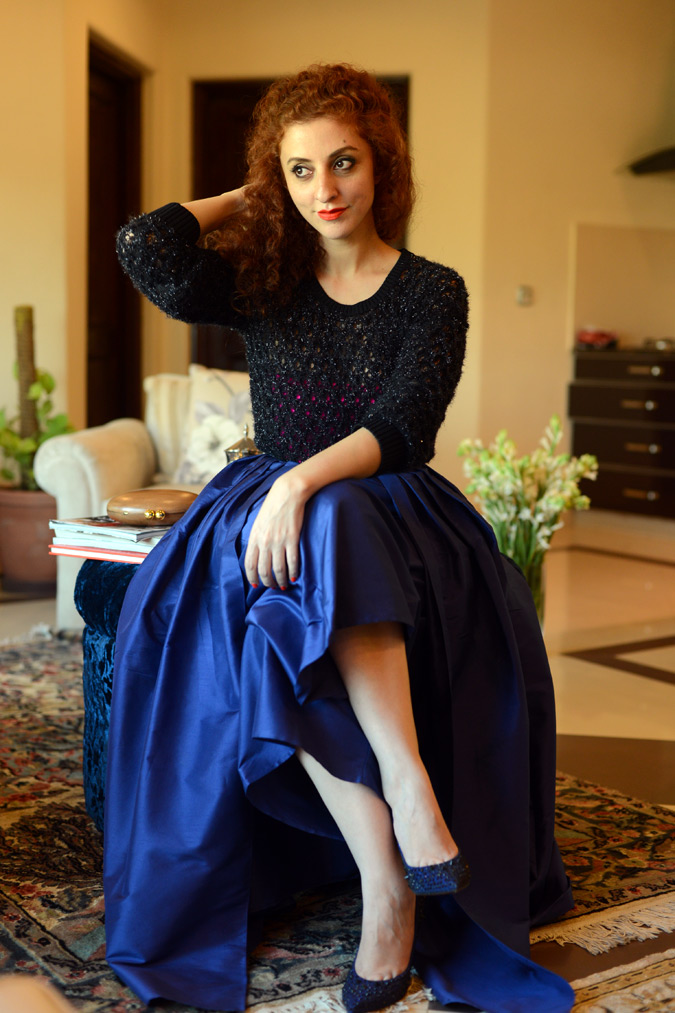
Pretty yet precise, elegant but not excessive.
2. Your favourite fashion designer?
Valentino with the duo, Lanvin, sometimes Chloe, sometimes Dior with Raf Simmons. Actually many.
3. Where in Pakistan do you love to shop?
I buy MUSE, and sometimes white Bareeze fabric and that’s all.

4. What is the oldest item in your closet?
My mother’s white shawl with blue thread embroidery all over it. I’m always tempted to cut it up and design something. I have this terrible habit of cutting up things and breaking jewelry to create new things.
5. What do you think are must have items that are essential to a great closet?
Dark jeans, a beautiful pair of ballerina flats in black, a pair of kitten heels in color, a black or navy skirt, a white oversized cotton shirt, and a cashmere sweater. A man’s watch.
6. What items in your closest do you love?
At the moment I love my new hot pink suede kitten heels that I picked up in Paris. They are adorned with huge colored crystals, and look fantastic with androgynous dark clothes. I also love this black sweater I got recently with holes in it.
7. Who are your inspirations when it comes to style?
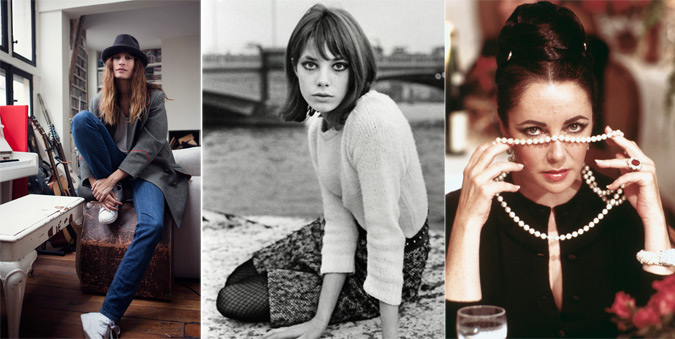
There are so many stylish women. Some of the ones I love are: Jane Birkin, Elizabeth Taylor, Caroline De Maigret, Emanuelle Alt, Chloe girls (in the adverts), Pucci models (only on the ramp) and the Chanel girl (on the ramp) and of course Audrey Hepburn in her black cigarette pants and flats.
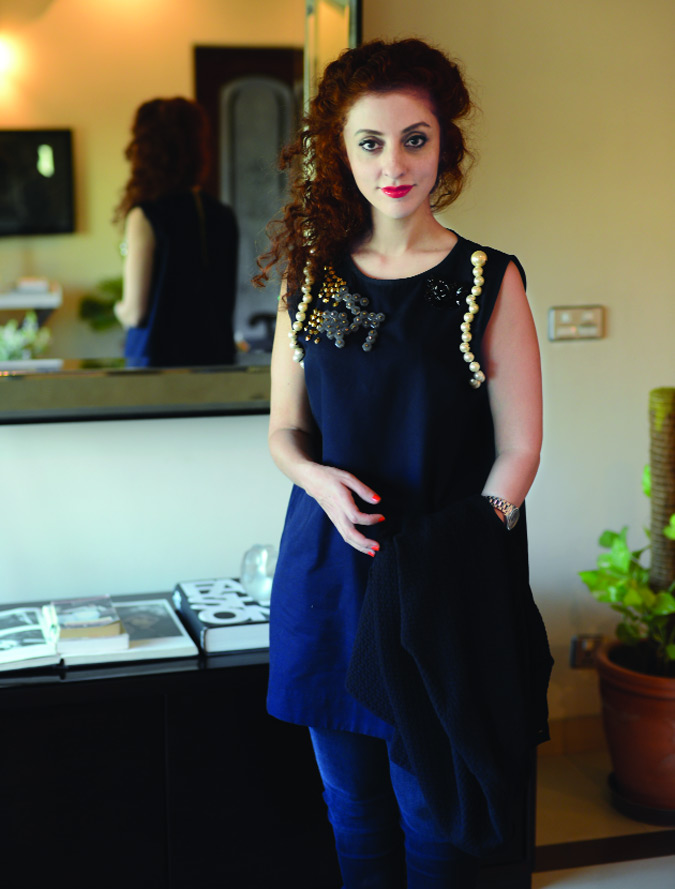

8. Describe the look you would put together for a coffee with a friend?
Dark distressed denim, gold tie up ballerina flats, a black oversized cashmere sweater, a red envelope oversized clutch and natural hair with red lipstick.
9. What makeup do you wear?
I skip the foundation and go for a primer, eyeliner, mascara and a red or coral lipstick.
10. Your hair is your signature, how do you maintain the curls?
I wash it everyday and let it dry naturally with a leave in moisturizing balm by Shu Umera. I tie it up without looking and very quickly. That creates a some what disheveled look.
11. Would you prefer to wear fine jewellery or fashion jewellery?
I love both. Simple stud earrings and chains look elegant and the only fashion jewllery I really like is by Lanvin. At weddings I love big vintage necklaces and earrings.
12. A former editor of Vogue, Diana Vreeland once said, “Elegance is refusal.” Your thoughts?
Elegance is well thought-out simplicity, and to achieve that you have to say “no” quite a few times. Skip the blow dries, the screaming labels on every part of your body, a foundation caked face, rings on every finger.


GT: After spending almost a quarter of a century in the industry, you are today one of television’s most successful and respected actors. Are you happy?
Naumaan Ijaz: No.
I have had a lot of success, made good money and turned in a few good performances during my career but, in the process, I have lost my true self. The real ‘Naumaan Ijaz’ is hidden far behind the many roles that I play in my life. My celebrity requires me to act a certain way. My children have very specific requirements of a ‘good father.’ My wife wants a respectable husband. Friends demand sincerity. My religion has its own dictates. Directors want good acting. Producers want professionalism. The media wants a certain amount of showmanship. I have been busy meeting all these expectations, all these years, and have been unable to take care of myself. Mine has been a life led for others. This brings me a certain amount of satisfaction but very little, if any, happiness.
I am not a happy person.
GT: You may not be a happy but are you a good person?
NI: Yes, I believe so. I like to think I have been a good son, husband, brother, father and friend. I am simple and straight forward. I do not lie. I genuinely care for others. I am sincere in my relationships. I am principled. I can fight for the right cause. Most importantly, I am not scared to stand up for myself and for what I believe is right. So, yes, I think I am a good person.


GT: You recently stood up for an eight-year-old girl on set. What happened?
NI: I was working on a scene with a senior female actor, who played my wife, and this young girl who played our daughter in the play. The girl was not an actor and no more than eight years old. She was nervous and kept forgetting her lines. My female co-star became impatient with the little girls and lost her cool. She threatened to slap the little girl if she did not get her lines right. In my opinion, her behavior was unacceptable. One does not threaten to hit young girls. The fear in the girl’s eyes made me see red and I lost my temper. I told the director that I will abandon the scene unless my co-star started behaving herself and acting with kindness and compassion.
GT: And there is the strike you are said to have engineered a few years ago.
NI: Oh, yes, there is. When Rana Sheikh took over television, she raised the fees for actors. After she left, PTV tried to retroactively undo the raise. I found this offensive and unfair, and made a call for a strike. As a result, I was accused of inciting trouble and declared an anti-state person. Things became difficult for me for a while but I stood my ground. It was the right thing to have done at the time. I am proud of my actions and for having defended the rights of actors.
GT: You are considered to be one of Pakistan’s finest actors. How did you learn to act?
NI: I am a sensitive person and feel things acutely and deeply. I watch others carefully. I observe human behavior. I think. In my opinion, these qualities have helped me become a good actor. I did not have a privileged childhood. I grew up in a small mohalla where I got to interact with all sorts of people and was exposed to events and incidents that do not take place in the sanitized neighborhoods of Gulberg and Defence. This helped develop a keen understanding of the human mind, behavior and actions. I apply this understanding to the craft of acting.
I did not attend any academy or school to learn acting but did get a lot of help from senior actors. I am a thief where acting is concerned. I steal what I like from other actors and incorporate it into my own craft. I learnt how to use pauses judiciously by closely observing Talat Hussain.     Muhammad Qavi taught me how to use facial expressions effectively. I accurately represent restrained emotions from Farooq Zamir. He was the master of understated performance. My education in skillful footwork and movement came from Firdaus Jamal. And it was not just the senior actors who helped me with my education as an actor. I borrowed, or stole, from everyone that I admired.


GT: Do you consider yourself to be a good actor?
NI: Yes, I do. I know my craft.
There have been both good and some not-so-good performances in my career but there are some that I consider truly outstanding. I think I did very well in Yeh Zindagi, Dasht, Mera Saayeen, Rihaai, Nijaat, Man O Salwa, Bari Apa, Ullu Barayee Farokht Nahi and a few other plays. These plays tackled subjects that were near and dear to me. I put my heart and soul into these plays and am proud of the results.
GT: What do you think of the acting programs being offered in academies and schools in Pakistan?
NI: These programs can be useful but, as of today, they are not. These institutions groom students for an industry that does not exist in Pakistan. We show Iranian, Eastern European and Bengali cinema to students in these schools in a country where films titled Ghundi and Aakhri Gujjar play in the cinemas. The schools introduce them to Stanislavski, Chekhov, Meisner, Stratsberg, Mamet and Adler, but the industry does have roles where professional acting techniques can be applied. Students graduate and end up in small cable or news channels, or other jobs, that neither require nor utilize their talent and education. Acting schools and academies make money but the students don’t gain much. Education is only useful when it can be put to practical use.
GT: Newcomers complain a lot about the casting couch. What is your opinion on the financial and sexual abuse of beginners in the field of show business?
NI: My opinion, unfortunately, is not very sympathetic. I believe that they complain about something that they largely create themselves. The phenomenon is not unique to Pakistan. The casting couch exists all over the world and respectable actors find ways around it. I did not sleep with anyone to get to where I am in show business. And no one else has to either.
The truth is that fear, greed and impatience drive people to the casting coach. Predators sense people’s desperation to become successful, rich and famous, overnight, and abuse those who want to achieve their goals quickly without making requisite efforts. Newcomers who look at my success and want the same need to keep in mind that it took me twenty-five years of hard work to achieve fame and fortune. People who don’t work hard, honestly and patiently, end up giving in to abuse in their rush to achieve stardom. There are, of course, exceptions and I am possibly being a little harsh but, truthfully, newcomers can and should themselves draw the line and make it clear to everyone that abuse is unacceptable to them.


GT: What are your views on the resurgence of Pakistani cinema?
NI: Cinema in Pakistan is undergoing a genuine revival but, in my opinion, our enthusiasm for the resurgence is a little premature and exaggerated. We are still several years away from where we need to be. We have produced a few good feature films recently but these have been few and far between. In order to become a serious player in the world of cinema, we need to be churning out more than twenty or so good films a year. Our writers, producers, directors, and actors have tremendous potential but it will take a long time to create the right environment to fully exploit their potential. Fortunately, we seem to be on the right track and on our way.
GT: You have worked with both veteran and new directors in television. Are their styles very different?
NI: Yes, they are. Vastly different.
At the start of my career, I worked with the stalwarts of PTV. The list includes Haider Imam Rizvi, Hasnat Ahmed, Kanwar Aftab, Nusrat Thakur, Rashid Dar, Sahira Kazmi, and Yawar Hayat. These people worked in a leisurely manner. Sets were erected in studios where all required equipment was available. They did not have to worry about finances and were not held responsible for recouping investments. In those days, actors did not act like stars and were accommodating and cooperative. The veteran directors did not have to worry about much other than direction and production. As a result, they were able to maintain their focus and produce work of great quality.
Television has now moved to the private sector. Things are more difficult. Today, directors and producers have to ensure both artistic and financial success. They have to make sure that locations are secured, the right equipment is available, scripts are available when needed, actors show up on time, the crew is paid in a timely manner, catering is done correctly and a whole lot else. They are more project managers than directors and producers. Unlike the producers and directors of the past, they do not have the luxury of focusing solely on the art of direction. In fact, that is often the last thing on their mind.
Yet there are a few directors today — Sarmad Khoosat, Kashif Nisar, Mehreen Jabbar and a handful of others — that combine the best of both worlds. They work within the constraints and demands of the current environment to produce work of superior quality. The private sector forces these truly amazing people to work tirelessly, sacrificing sleep, rest, personal lives and much else, to produce plays that makes money, receive critical acclaim, and have mass appeal. This is not a small achievement.

GT: Are actors able to make good money today?
NI: Yes, they are. I think talent, track record, star staus, professionalism, popular appeal and looks affect an actor’s paycheck but the profession is viable and worthwhile in Pakistan today. Acting is my only livelihood and I lead a comfortable, somewhat luxurious, life.
Now that we have money, I hope respectability will follow. Most Pakistanis do not consider acting to be a respectable career choice. In the minds of some, men in show business are all bhaands (jokers) and women sex workers. This is sad and has to change.
GT: Would you like your children to become actors?
NI: First and foremost, I would like them to get a solid education. Then they can do whatever they want as long as it is legal, respectable and financially viable. I used to discourage my kids from taking up acting as a profession but now that things seem to be improving in Pakistan, I am not necessarily against the idea.
GT: Do you have many friends in the industry?
NI: I have many friends but only two — producer Kashif Nisar and actor Sohail Ahmed — in the industry. Friendship is important in my life. Very important. I will do any and every thing for a friend and, often, without him even having to ask. On the other hand, I expect very little in return. It does not matter to me if my friends like me or not. I do not expect them to do anything for me. My focus is on being a good friend myself.
GT: What are your upcoming projects?
NI: I finished shooting for Mehreen Jabbar’s Jackson Heights a few months ago. I first worked with Mehreen in the feature film Ramchand Pakistani five years ago. This time the serial brings us together. The serial revolves around six expatriates living in Jackson Heights, a neighborhood in the northwestern portion of the New York City borough of Queens. It tells the story of their lives in what is essentially a foreign land, focusing on their trials and tribulations, successes and failures, and despair and happiness. I think the serial will be a great success.
GT: Pakistan is in the midst of serious political turmoil. Where do you think the country is headed?
NI: Serious political turmoil. Now that is an understatement. I believe, and I have hope, that there will be light at the end of this very dark and long tunnel. There will be blood, suffering and pain. A lot of blood, suffering and pain but I think Pakistan will emerge as a successful, progressive and respected nation. That is my hope, belief and faith.