

What do you feel is unique about your perspective on skincare, and how has it evolved since you started your career?Â
I believe that only medical grade skincare can help to maintain a good healthy skin; this perspective evolved slowly, after having worked with many such brands over the years. I’ve noticed phenomenal results using the correct medical grade products for your skin.

What inspired you to pursue this career?
Seeing many people with a lot of skincare issues and not enough knowledge of how to address them inspired me to start this as a career. It really makes me happy to see someone achieve some confidence by just eliminating few skin issues they have.
Is there really an easy way to achieve glowing skin?
I won’t say it’s easy, because you have to be very patient and consistent. Consistency is the key to achieving glowing skin.

How soon should one start considering treatments like botox or derma fillers?Â
I suggest to start with other bio-stimulating treatments to help build collagen and then if you feel there’s still something lacking, then we can go down that route.
What beauty and skin care products can’t you live without?
I can’t live without sunscreen, moisturiser and a good hydrating serum. In beauty products I love using the Nars lip balm and mascara.
What’s your own daily skincare regimen like?Â
I’m very consistent with my skincare routine. I use the Age Kit from pHformula along with SPF and Hydraserum. I also incorporate different masks.

What’s the best skincare advice you’ve ever received?
Always use medical grade products and remove your makeup before sleeping.
What’s your idea of beauty? Is there a definition you live by?
For me beauty is feeling confident in your own skin and not trying to achieve something which is artificial.
I believe living a healthy, positive lifestyle will automatically create beauty around you.

Razia Sultana’s ‘Mehnaz’ is a resplendent pret collection that pays homage to feminine beauty by drawing poetic inspiration from the beauty of the moon. With ensembles consisting of pure fabrics, hand work, appliques and adda work, this classic collection showcases the passion of the artisans behind it. Here a team of creatives presents ‘Mehnaz’ in all its radiance


Wardrobe: Razia Sultana
Models: Abeer Asad Khan, Atikah Gardezi, Aqsa Shah
Coordination: Centaur One
Photography: Tuba Afzal
Styling: Arbaqan Changezi
MUA: Usman Style Artist
Jewels: Mahvish Naeem, Kundan Co


Ft. Zahra Malik
The beautiful Zahra Malik styles three wedding guest looks that are festive, yet easy to carry. Featuring jewellery by Zahid Jewellers, this is the inspiration you need for the upcoming wedding season.


Attending a garden event? Then opt for this Saira Shakira ensemble and pair it with the gold-hued, understated makeup as seen on Zahra.


Zahra pairs a powder blue outfit by Zubia Zainab with exquisite diamond and emerald jewels by Zahid Jewellers—a perfect look for a day time Walima.


This navy blue number by Razia Sultana, worn with a traditional, heavy gold set by Zahid Jewellers is bound to make heads turn.
Jewellery: Zahid Jewellers
Muse: Zahra Malik
Coordination: Centaur One
Wardrobe: Saira Shakira, Zubia Zainab & Razia Sultana

Having completed a decade in the entertainment industry, Sonya Hussyn has portrayed some of the most memorable (and diverse) characters on screen. The leading lady, Popular for her poignant performances and style sense alike, sits down with Mehek Raza Rizvi to reflect on her career, the evolution of the industry and more
With the conversation on gender equality and feminism on the rise, how important is it for female actors to choose their roles carefully and avoid playing the damsel-in-distress?
With the ongoing movements and the current climate, I believe now more than ever, it’s become imperative for female actors to be more conscious about the scripts they choose. From the beginning of my career, I’ve attempted at walking the untrodden path, breaking the whole notion of what’s deemed commercially successful or what a conventional leading lady is expected to look and act like on screen.
To me, it’s solely about the character and what my portrayal in a project can do to further a narrative—if it’s in line with the message I want to put forth, I’m always up for it. At times a damsel-in-distress can also be written very sensitively and the characters around her can possibly contribute to her empowerment and growth. Every character deserves representation, what matters is how the story is portrayed.

How hard is it to detach yourself from the intense and complex characters you play? Does some part of them stay with you?
It does become very difficult to separate. As actors our job is to completely immerse ourselves in our characters’ worlds. Nazo, for example, was this mentally-challenged girl I played years ago who stayed with me for a very long time, especially her mannerisms and the way she spoke. There was a lot of research that went into it and eventually, once we’d wrapped filming, I struggled with going back to what my reality was.
Most recently, I’ve done “Saraabâ€, where my character Hoorain is schizophrenic. In the process of shooting, I was able to understand more about this condition, how it can be controlled and how one can deal with such patients. In all honesty, every character I’ve played has contributed to the person I’m becoming, consciously or subconsciously. All one can really do is wear these facets as a badge and try to do justice to what’s next—I simply live from one character to another.


The fame and influence celebrities enjoy puts immense responsibility on them to use it wisely. Do you ever feel burdened by the constant spotlight?
Yes, I do. However, I don’t let that come in the way of speaking my mind. If I strongly believe in something, I share that opinion without a second thought, because that’s my truth, even if it leads to backlash or controversy. The spotlight can be very daunting, but I keep reminding myself how it doesn’t define who I am.


In recent times you’ve had a war of words with a couple of other female celebs. How does difference of opinions that becomes so public affect you and how do you deal with it?
The pandemic has given some of us a little too much time to criticise others and take things out of context. I genuinely have a lot of respect for women in the industry; I know that there’re prejudices against women at large and to be successful, it takes great courage, resilience, hard work and talent. I also know that I’ve evolved over the past few years and now I fully believe that putting one woman down to defend another doesn’t do much for what we’re all fighting for.


Have you experienced any inherent prejudices in your line of work?
I’ve been fortunate to not have had any first-hand experience of it myself. I’ve worked with good people and have had the freedom in choosing my characters. But that doesn’t mean it doesn’t exist—it’s a male-dominated industry after all, both in front of and behind the camera. Scripts are penned and then shot according to the male gaze. Sadly, a lot of naive women are exploited, but I do see things changing. I completed a decade in the industry this year, and I’ve seen how the position of women has evolved—characters and environments are better. Slowly but steadily, we’ll get to equality.


Many follow you ardently for your great sense of style. Do you, however, ever feel that takes away from your work as an actress?
Not at all! I feel honoured when I’m told that people appreciate my sense of style, Every outfit my stylists or designers help me put together tells a story and is representative of how I feel in that moment. I recently wore a neon-green power-suit by Mahgul at the Hum Style Awards and I felt it was a very contemporary, funky take on who I am today. My work as an actor has always been somewhat separate, because there’re often characters that demand simplistic outfits, lesser makeup, dark circles, dirty hair, or a dishevelled look. Thankfully, my audience accepts that. Fashion I think is storytelling as well, and if anything, it’s added to my work.

Tell us about your new project “Mor Moharaanâ€.
“Mor Moharaan†is a very interesting project. I’m working with phenomenal actors such as Samiya Mumtaz, Firdous Jamal, Mustafa Changazi and my favourite co-star, Zahid Ahmed. This is my third project with Zahid and there’s always such great camaraderie between us. I think we really understand and respect one another as artists and that’s really all one needs to perform well. My character Rohi is from Cholistan; she’s an environmentalist who’s dedicated her life to her community and the issues they deal with. The series also dabbles with subjects of politics, global warming and climate change. These are such pertinent topics and I’m very proud of the fact that I’m part of something that sheds light upon them. It’s coming soon on TV One.


Out of all the characters you’ve portrayed, which one is the closest to your heart and why?
This is a difficult question. As I said, I think almost every character I’ve played has been very special to me: whether it’s Nazo from “Nazoâ€, Pakeeza from “Aisi Hai Tanhai†(a victim of cyber-bullying), Safeena from “Meri Guriya†(a drama serial on child sexual abuse), Gauhar from “Ishq Zah-e-Naseeb†(dealing with her husband’s dissociative identity disorder syndrome), Hoorain of “Saraab†and everyone else in between. I’ve had the honour of playing such diverse, beautiful, flawed women. It’s impossible for me to select one!
What inspired you to start your own YouTube channel?
As an actor I believe viewers see you for the character that you play, and as grateful as I’ve been for the journey, I felt like I needed a medium to connect with my audience on a more personal level. I wanted to tell my story and introduce people to what really goes on behind the scenes, speak my mind and elaborate on subjects that I’m passionate about. I was ready to put together more slice-of-life, real content, but I understand that one has to be more consistent, which I haven’t been. Hopefully, I’ll be putting out some more videos soon.
What is Sonya Hussyn like at home? Tell us about your family and childhood.
My childhood was full of many ups and as many downs, but I think such is the beauty of life; trying experiences shape you. I personally feel that I’m more loving, stronger and determined than I ever was before, and a lot of it has to do it with my family and how we’ve all evolved together.
At home, I’m just my most real, unabashed self. It’s where I recharge—I can comfortably hibernate in my room for days. My family and I work as a strong unit: watching movies, having food and deep conversations, all of it together. It’s beautiful being with them and I wouldn’t want it any other way. Every chapter of my life has taught me immensely.
Concept, Coordination & Production: Centaur One
Makeup & Hair: Qasim Liaqat
Photography: Najam Mahmood
Art Direction: Saad Amjad
Outfits: Munib Nawaz (printed suit), Mahgul (neon suit)
Jewellery: The Jewel Company


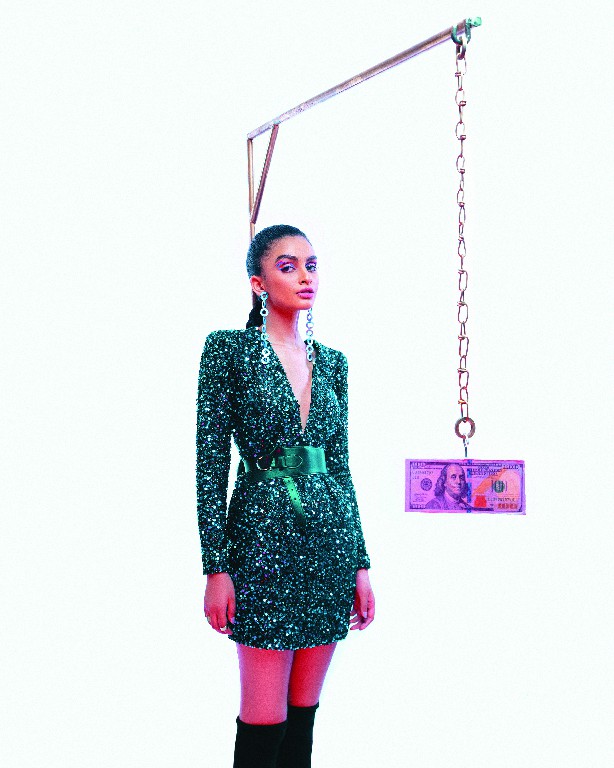
For fashion model Ayesha Rajput focusing on her goals is the most important thing right now. This fortnight she sits down with Mehek Raza Rizvi to talk about her career, along with serving looks for an editorial by Asad bin Javed.

What inspired you to take up modelling professionally?
I didn’t chose modelling, modelling chose me. I always wanted to become an actress-and God willing, I will be-but for now, I’m enjoying my current profession.

What do you feel are your strengths and weaknesses as a model?
Being able to stay true to myself and my steadfastness are my strengths as a model. I’m not sure about the weaknesses.

Do you have a fitness and beauty regimen?
To be honest, I don’t go to the gym. I eat a lot, but don’t gain weight thanks to a fast metabolism. As for my skin, I’m very particular about drinking at least six to eight glasses of water every day, along with moisturising my skin before bed.

How would you describe your personal style?
Bold and beautiful, yet classy


What do you think about the competition in your industry, and the relationship models have with each other?
My biggest and only competition is with myself, and my relationship with other models is really good. I’m friends with all my colleagues; everyone has always been very kind to me.


What do you consider the toughest aspect of your job and how do you overcome it?
Most people think that modelling is an easy job, but that couldn’t be further from the truth. There are many difficult aspects to modelling, but the toughest according to me is when you aren’t in a great space mentally but have to pretend you’re good in front of the camera. However, being sincere to your job helps you deal with such situations gracefully. That’s what works for me.


Where do you hope to see yourself in the next five years?
I see myself improving my craft as much as possible. I believe Allah has big plans for me.


Photography: Asad Bin Javed
Styling: Mahnoor M Ashraf
Hair & makeup: Ayan Amir
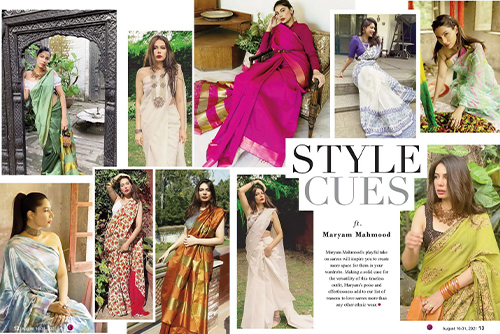
ft. Maryam Mahmood
Maryam Mahmood’s playful take on sarees will inspire you to create more space for them in your wardrobe. Making a solid case for the versatility of this timeless outfit, Maryam’s poise and effortlessness add to our list of reasons to love sarees more than any other ethnic wear.


Azfar Rehman is one of the most successful actors of his generation. This fortnight he speaks to Mehek Raza Rizvi about his start in acting, exploring new avenues, choosing responsible scripts and more.
Everyone knows Azfar Rehman the celebrity, but what’re you like at home? Tell us about your childhood.Â
I’m very chilled out and easy going at home. I had a very wholesome childhood and I’m fortunate to be blessed with the best parents a child could ask for. I was born in Islamabad, but we moved to Karachi soon after, and that’s where I went to school. It was a comfortable and privileged childhood, for which I give complete credit to my parents.

You’re the first in your family to pursue a career in the entertainment industry. How supportive was your family of your passion for acting?Â
I’m absolutely the first in my family to pursue a career in show business. It all happened accidently; I had completed a degree in advertising and got a job at an advertising agency that was starting an entertainment channel. Eventually, I was recruited for that channel. My parents were always adamant about their children first getting a solid degree and then choosing whatever path they wanted to take. I had both a master’s and bachelor’s degree in advertising, but I always wanted to be an actor. At that time the entertainment industry was booming and a lot of private channels came into being. My parents were supportive of my decision. They don’t get to watch a lot of my work, because they’re busy with their own businesses and travel a lot, but they respect my job and appreciate my success.

How do you feel the industry has evolved since you joined it and what’s been your biggest learning so far?Â
It’s evolved a lot during the past couple of years. We’ve reclaimed the stature of the best drama serials in the subcontinent. The scripts are now better. There’re so many new productions and television channels, along with an abundance of very talented writers and directors. I’m very proud of where our entertainment industry is today; the writers deserve a lot of credit for their insight and depth.

Looking back at your career, would you do anything differently?Â
I’d be a little more conscious of the friends I make and be more punctual. If I were to do things differently, I’d not accept projects just to support friends, nor would I give favours to the fickle and two-faced people I’ve encountered during my career. I’d not be as sweet and a little firmer perhaps.

What would you say have been the highlights of your career so far?Â
I think I’m extremely privileged and cannot thank God enough. I’ve had one of the best talk shows called “Spotlight with Azfar Rehmanâ€, when I first started my career. From that to doing numerous drama serials and getting several award nominations, hosting one of Pakistan’s biggest reality shows, “Miss Veet Pakistan,†doing feature films like “Chhalawa†and “Punjab Nahi Jaungi†and just staying relevant for almost twelve years—there’ve been multiple highlights.

Out of all the characters you’ve played, which one do you relate to the most and why?Â
I did Pakistan’s first web series for Eros called “Enaaya.†My character in that, Jimmy, along with my character, Sheheryar in “Aatish,†a drama serial that aired on HUM TV, are two roles that I can relate to most. Both were easy going and realistic.

Being a public figure comes with immense responsibility towards your audience and fans. How conscious are you of that fact while selecting scripts?Â
I think I’m more conscious now than I was earlier. I’ve started leaning more towards scripts with a social message. For example, these days I’m doing a drama serial called “Aakhir Kab Tak,†which creates social awareness regarding predators and harassers and how to report harassment. I do believe, though, that if you’re working on a project that provides comic relief or some sort of entertainment to your audience, that too is a social service. We’re living in stressful times; there’s so much depression because of the pandemic as it is and that’s made worse by constant bad news in the headlines. We all deserve some respite through entertainment.

In our interview with Ayesha Omar she mentioned how her road accident changed her as a person. You were in that accident with her. Did it change your outlook towards life in any way?Â
It changed my outlook on life completely. The accident was like an awakening for me, a knock on the door. You know how they say a close encounter with death brings you closer to God? That’s true. I feel I’m a lot more religious now. I also work on being a better, more considerate and humble human being every day.

As of now, you have four drama serials airing on different TV channels. How does that leave behind any time for family or for yourself?
I believe I’m great with managing my time. I make it a point to take out time for family, which is why I don’t work on weekends, unless there’s something very important. I take annual vacations with my family, but people don’t get to see that on social media because I like to keep it private.

Do you think it’s important for actors these days to explore the web and other avenues apart from traditional television?
Regardless of which field you’re in—whether you’re an actor, model, director, or even a journalist—it’s always great to explore different avenues. You should be open to expanding, growing and improving your craft. The web gives you more room to experiment with projects, characters and voicing social issues, so making use of that platform is beneficial for all.
Photography: Yasser Sadiq Grooming: Sajid’s

LADIESFUND organised a culinary showcase with 15 of their home chefs, who’re part of their MasterChef programme. Sindh Minister for Culture Sardar Shah was in attendance as a guest of honour.

Fashion Boulevard Lahore hosted their multi-designer Eid exhibit with much fanfare. Guests were able to view the latest designs up close.

It’s that time of the year again when we longingly look towards the skies, waiting to be drenched. A spell is cast all around, as the heat lifts and joy settles in. This fortnight Mohsin Khawar captures the magic of the monsoon season with AMK Libaas


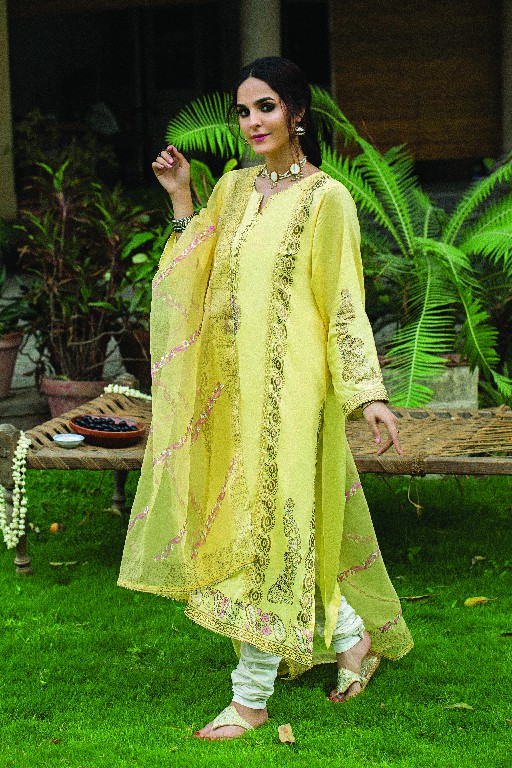


Label: AMK Libaas
Photography: Mohsin Khawar
Art Direction & Styling: Aysha Mohsin
Talent: Mehrunnisa & Shahnam
Makeup: Sunny Zohaib
Location: The S Studios by Sophie


Fashion and entertainment stars arrived on the red carpet of Kashmir HUM Style Awards 2021 with their best feet forward. It was fun to see all our favourites in one place again.

The biggest misconception about skincare is that it’s to do with appearing fairer. Nothing can be further from the truth. Skincare deals with nourishing and protecting our existing skin tone from changing weather conditions. To shed more light on the issue, Haider Rifaat got in touch with dermatologist Dr Maleeha Jawaid for an insightful conversation about redefining beauty standards, switching to summer skincare and her new role as Pakistan’s official representative of the L’Oréal Paris Skin Expert MENA Dermatology Board

Maleeha, please introduce yourself to our readers.
I am a full-time doctor and a part-time blogger. I practice clinical and aesthetic dermatology in Karachi at a leading private skin clinic located in the heart of DHA. My practice revolves around helping my patients via medical means along with teaching them the importance of self-love and acceptance.
On the other hand, my Instagram blog (@inyourfacebymaleeha) is me in my unfiltered, raw form with content ranging from skincare and makeup advice to smashing society standards set upon us, especially women.
How does it feel to be a part of the L’Oréal Paris Skin Expert MENA Dermatology Board representing Pakistan?
It feels fantastic! It’s such an honour to be handpicked by the L’Oréal Skin Expert team in Paris to be on the MENA Dermatology Board and to represent Pakistan. It’s been extremely overwhelming and I’m extremely grateful for all the love and support I’ve gotten over this.

What core responsibilities come with this role?
Being a part of the MENA Board for L’Oréal Paris comes with a huge responsibility of validating formulae and ingredients for products that’re about to be launched or endorsing products that’re already in the market. The recent launch of the Hyaluron Expert Hyaluronic Acid Serum involved all of us from the board to be a part of a virtual tour of the very lab that developed this product. Learning about what goes on behind the scenes helps build more confidence in the product, and most importantly, helps us impart the right kind of information that’s needed, given the fact that there’s so much misinformation on the internet.
What would the new skincare products achieve differently this time around?
L’Oréal Paris, as a brand, has always been very progressive and up to date with consumer demand. This is something I can say for sure, since I’ve been using L’Oréal products forever. In the current day and age, with very little spare time on hand, everyone wants products that’re effective and can be used easily. Launching a key skincare ingredient like hyaluronic acid in serum form is just the right thing to do. It’s easy to apply, has great results, can be used by all age groups and genders, and does not burn a hole in your pocket in doing so.
As a dermatologist, what can women and men working outdoors throughout the day do to protect themselves against sunburn living in climatic conditions where temperatures are extremely hot all year round? Guide us through the skincare process here.
This is something I repeat so often in my clinic to all my patients. Skincare has to change according to the season and your geographical location. Skincare in summer is all about oil control, sun protection (this is all year round though), and keeping your skin as clean as possible, given the increase in sweat and sebum production.
Summer skincare involves gel-based products, SPF, oil blotting sheets and of course, lots and lots of water. A majority of the L’Oréal day creams contain SPF in them, which can be great for additional sun protection. Just because it’s hot, doesn’t mean your skin requires no hydration. The Hyaluron Expert Hyaluronic Acid Serum helps with this particularly as it retains moisture in the skin without making it feel too greasy or heavy.

In South Asia, appearing fairer than one’s actual skin tone is considered common practice. Light skin equates to beauty, which beauty brands shouldn’t encourage in the first place. What’re your thoughts?
This is something I come across in my clinic and my Instagram more often than I’d want it to. I’m a firm believer of self-love and acceptance and this is something I’ve been preaching through both platforms of mine. Most often, families and societal pressure push people to look for treatments that can change their skin tone, or they’ve been compared to their sibling or cousin who is fairer and that’s what they aspire to look like. Before I started working, I always thought this would be an issue for females only, but I was surprised to see how prevalent this is across genders.
Will L’Oréal Paris follow a similar footprint when it comes to embracing all skin types in their upcoming campaigns?
L’Oréal Paris is already based on inclusivity and empowerment. The products are made for use for all individuals regardless of their gender, colour, ethnicity, or age. I’m a hundred per cent sure that they’ll continue this practice in the future as well.

Juggun Kazim has done it all: motherhood, entrepreneurship, acting, hosting and vlogging. This fortnight she speaks to Mehek Raza Rizvi about balancing her personal and professional life, and all that she’s planned for the future

You have three beautiful children. How different was each experience, both pregnancy and postpartum?
Yes, I have three biological children and two from my husband’s previous marriage, so a total of five children. As far as the biological children are concerned, each pregnancy and postpartum experience was very different.
I had my firstborn, Hamza, when I was very young. He’s fifteen now. It was a tough pregnancy because I was in an abusive marriage, but beyond that, as far as physical discomfort is concerned, my pregnancy was a breeze; I was very active and constantly working. Up until the last two weeks before delivering, I didn’t even realise I was pregnant. I had a C-section, but recovered from postpartum pretty quickly as well.
My second-born, Hassan, is four, while Noor, my daughter, is eight months, so they came along much later in life. A year before Hassan was born, I had a miscarriage and went through a really tough time coping with my loss. It really sent me through a spiral of emotions. I was very upset, so naturally when I conceived again, I was excited, but also overly cautious. In terms of that, pregnancy for the second time was strange and complicated, but precious. Also, when I was expecting Hamza, I only gained 10-12kgs, but when I was pregnant with Hassan, I put on almost 30 kgs, which was crazy. Postpartum recovery this time around was also tougher. With Noor, pregnancy was difficult again. I was put on bedrest and also gained about 35 kgs, so even more than before!
Each pregnancy is different and comes with its own set of challenges, but I wouldn’t change anything. I’ve been through a total of five pregnancies (one miscarriage each before Hassan and Noor), so while the experience can be difficult, I have to admit that having children is the biggest joy in the world. I feel very grateful for all my children—the ones I gave birth to and the ones I got through marriage. It’s amazing being a parent—an indescribable feeling. There are days when I look at them: one’s jumping on a bed, the others running around, another is crying—and I’m just in awe thinking I made these little humans.

Weight stigma directed at pregnant and postpartum women is extremely alarming. How does one tackle it?Â
The weight stigma is directed towards every woman and every man. Pretty much every human it seems is first noticed for gaining or losing weight, which is not just infuriating, but also very offensive. We need to create awareness regarding this hurtful behaviour. It’s not okay for some aunty to come and tell you that you’re looking bigger or a friend to make apologetic statements. It’s important to make those around you realise that it’s not okay to be nasty about someone else’s body or inquire about their weight. Like I said in one of my YouTube videos, I’m all for people leading healthy lifestyles and losing/gaining if necessary. However, even someone like me who works out twice a day and is quite particular about her diet put on 30/35 kgs during pregnancy. Everyone has their own journey and making someone feel bad about it, especially when they’re pregnant, with their hormones all over the place, is just horrible. In fact, even if someone is in an otherwise great space, commenting on their weight is not acceptable. This is something very personal. Part of why I had severe postpartum depression after Hassan and Noor was because of the amount of people commenting on my weight and body. It was really upsetting.

How does your upbringing influence the way you’re raising your kids?
I think everyone’s upbringing does influence how they raise their own children. I learned good mannerisms and etiquette from my parents, including how to speak to or address my children. My father was extremely particular about being respectful towards elders: how to greet them, standing up in respect when they enter a room, offering your chair, etc. This learning has stayed with me, and I try to inculcate it in my kids.
However, one thing that had a negative impact on me as a child, I feel, is the fact that I came from a broken home. My parents got divorced when I was very young. The fights and arguments that led to them parting ways used to really disturb me, which is why my husband Faisal and I are very conscious about never arguing in front of our children. Of course, it’s natural and normal to have disagreements with your spouse, but we never have them in the presence of our kids.

There’s also no concept of violence in our family. It’s not okay to scream at or hit a child, no matter how frustrated you may be. We’re very mindful of that.
Another pressure I felt as a child, that I’d never want my children to have, is being an academic. I let things be a bit more fluid with them. I try being as accommodating as possible and provide them with the support they need, but do not believe in burdening them with unnecessary stress. The most important thing for me is to raise good human beings, who are kind, healthy and stable.
I guess I’d say that my parenting is influenced partly by what I learnt from my parents and partly by what I learnt from life myself. At the end of the day, the only thing that really matters to me is seeing my children happy.

Working mothers continue to face a number of obstacles in balancing their dual roles. How do you cope?Â
Working mothers have always faced obstacles and I’ve been no exception. The biggest issue is the attitude of those around us. Constant scrutiny, criticism and questions like “won’t the kids get neglected?†“how will you manage?†etc. can really get to you. I’m lucky to have a good support system which includes the help at home, along with a supportive family—there’s no way I would’ve been able to work so much again without it, but it’s still hard sometimes. Judgmental behaviour is very hurtful.
The other major issue is the constant mom guilt. My career is important to me and I’m solely pursuing it because of my passion now, but I’m constantly worrying about rushing back home to my children. How do I cope? By taking it one day at a time. There’s no set formula that I know of, but if some does, please share it with me.

We love your YouTube channel and how real you are. Where do you, however, draw the line in terms of sharing your private life?Â
When I created my YouTube channel, I was only hosting morning shows. There’s a slight limitation in morning shows about how honest or straight up you can be about a strong opinion you hold or an issue close to your heart. You’re the host, you can’t make it all about yourself.
With my YouTube channel, I wanted to create a platform for dialogue; a place where I could talk about things like fat-shaming, abusive relationships, etc. and interact with my audience through the comment section. Soon people started asking for videos for skincare and my lifestyle, so it was all very organic.

Regarding my private life, I’ve done a house tour and that video’s views are in millions! Having said that, I only go as far as I’m at ease. I don’t share absolutely everything, nor do I think I ever will. There’s a very clear line that I draw. For example, you’ll very rarely see pictures of my daughter.
A lot of people think they know me well, but there are many sides to me most are unaware of. I’m actually a very private person and the maximum you’ll ever get to know me is through my YouTube channel.

Do your kids know you’re famous? If yes, how do they react to it?
Hamza definitely knows I’m famous and likes to take advantage of that sometimes too. He’ll say things like, “You know my mama is Juggun Kazim, right?†and I have to tell him not to say such stuff. Hassan and Noor, however, are too young to realise it. Noor especially, as she’s only eight months.
Hamza was much more aware because I used to take him to sets with me—I was a single mom at that time—so he definitely knew. I remember, when I would smile for a picture, he’d strike a pose too. There was also a bit of jealousy if we were ever out and someone asked for a picture. He’d grab my arm and say “No mama!†so I had to politely refuse. I think he’s handled it pretty well though and I’m curious to see how his younger siblings will take it, that is if I’m still famous by the time they grow up.

Congratulations on your newly launched skincare brand! Tell us more about Nur and where the inspiration came from.Â
Noor is my daughter’s name: Syed Noor Bano Naqvi. I love the name Noor, it’s always been a favourite. It means heavenly light. It’s common to compliment someone on their beauty in Urdu by saying there’s noor on their face; that’s how everyone wants to look. So I feel that’s the inspiration behind the name of my skincare line: NUR by Juggun Kazim.
The idea to start this venture came after constant comments on my skincare videos on YouTube. So many people used to say that I should create my own products based on the tips and totkas I shared. These are all things that have existed in the Subcontinent since centuries. I’ve basically just taken natural, organic combinations of herbs etc. and put them together. This is a pure labour of love. The products aren’t expensive, as I’ve tried keeping it as affordable as possible.
The response I’ve gotten is phenomenal. We’re online right now, but will be available in stores in a few weeks too.

We hear we’ll be seeing you act very soon. How does it feel to be back at it after a five-year hiatus?
Yes, I’ve already shot a couple of projects recently. I did a short film for Sohail Javed and now I’m working on a web series with a very renowned director and writer; I’m not at liberty to reveal more about this as of now, but it should be out in a few months. I’m also going to be seen in a telefilm for Eid on ARY.
I didn’t think this would happen again though. The reason why I put my acting career on hold was because I wanted to focus on family, of course, but also because I was so sick of the stereotypical roles I was being offered. I was either the innocent girl who was treated badly, or I was the English-speaking negative character, who was rude to everyone. It was getting too boring. I’m happy to have started acting again, though, because there’s really good work being produced now. My morning show is also scheduled to start this Eid on A-Plus, but I’ll be acting a lot more as well. There’s a film in the pipeline too and while I can’t say more on that, there is definitely a film that’s being worked on. Lots of really exciting things happening, so life is good! The kind of love and encouragement I’m getting is overwhelming.


Photography: Rizwan Baig at Deevees
Makeup: Munazza Rizwan at Deevees
Wardrobe: Reése, Vanya, Anaya by Kiran Chaudhry

Hania and Kamil Chima are a dynamic sibling duo with a passion for filmmaking. Their debut film production was the critically and commercially acclaimed “Laal Kabootar”. This fortnight, Mehek Raza Rizvi speaks to them about their creative journey, their future projects and more

How did you get into filmmaking?Â
Kamil: There was always a creative bug in me while growing up (I was a part of Ajoka Theater as a child actor), but I was more drawn to sports. It was upon returning from college that the opportunity to make a film and start a film company presented itself. Too naive to reject it, I kind of learnt on the job. These days my response to this question is that I’m an accidental filmmaker. That probably sums it up best.
Hania: My exposure to theatre got me interested in the art of storytelling at a young age. Although I started out as a theatre actor with Ajoka Theatre, I was drawn to working behind the scenes. I was interested in designing the story that gets told and I was interested in telling stories through a medium that can be preserved. But it all started with theatre for me.

Tell us the story behind “Laal Kabootar†and how both of you decided to start working on it together.Â
It sounds haughty, but we liken the process of making “Laal Kabootar†to the parable of the ‘Ship of Theseus’ (if you keep replacing parts of a ship one by one, is it the same ship when you’ve replaced all parts?). “Laal Kabootar†was like that. We started off wanting to see what it would be like to see a boy and a girl from different strata of society interact. In trying to find an organic, real basis for such a relationship, we found ourselves making an urban crime caper.

Does the success that came with “Laal Kabootar†put pressure on you regarding future projects?Â
Kamil: Initially, I did feel a lot of pressure if I’m honest. In my case it was also the first film project that I ever did. It seemed like a tall order to follow it up. Now that I look back, I find comfort in knowing that I was actually a part of a supremely talented team. And we made so many mistakes. Luckily we were humble enough to learn from them. As long as we can keep finding that humility, we should be good to go.
Hania: Yes, definitely. I felt freer to take chances before LK came out. After its success I’ve been restricting myself and my ideas. But I’m slowly trying to let that go.

What are the pros and cons of working with a sibling?Â
The pros are that you really have your own blood by your side. It’s makes for a strong foundation. On the flip side it gets tough separating personal life from work. We’re still learning how to push each other, but also how to fly solo and enjoy each other’s journey’s.
How would you describe your relationship?Â
Aik aur aik, gyaara (1+1=11)

Are there any projects you’re working on currently?Â
Yes! We’re working on a couple of very exciting projects. One of them we have to remain a little tight-lipped about, but it’s an international collaboration. The process of working with a studio in LA has been an immense learning curve and we can’t wait to share more details when the project is further along in its development.
Are there any specific actors you wish to work with next?Â
Kamil In Pakistan I think Fawad Khan is the gold standard. I’m drawn to brave choices, and his performance in “Kapoor & Sons†is one that I admire a lot. I would love to work with Mansha Pasha and Ahmed Ali Akbar again too. They became their characters, which is something you don’t see too often in Pakistan.
Congrats to both of you on your respective weddings! How has life changed?Â
Kamil: We all get but one shot at life, and I’m the luckiest guy in the world that I get to spend it with someone I love.
Hania: It’s a wonderful change. I’m really enjoying this new chapter in my life and hope to live it as fully as the chapters before.
Hania, given your acting experience, can we expect to see you in a film or drama serial any time soon?Â
There’s nothing on the horizon right now in terms of acting for me, so the answer is no.

What advice would you give aspiring filmmakers?Â
Kamil: I’m an aspiring filmmaker myself, so please share some with me as well. I can share what I struggle with, and that’s thinking that I know it all. I have to be reminded that it’s a constant learning curve.
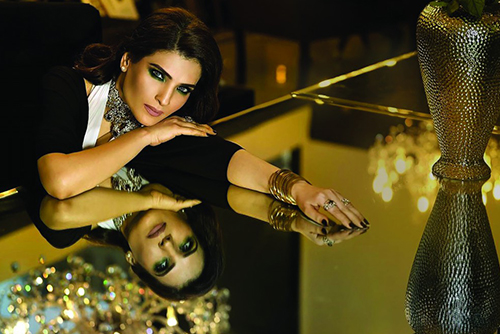
‘Aphrodite’ by HSY is a celebration of art, culture and classic elements. Showcasing exceptional crafstmanship through elaborate embroidery and and classic silhouettes, the collection embodies the quintessential couture spirit that is central to HSY. Inside our pages, HSY collaborated with glam icon Resham and masters of beauty Ather Shahzad for a resplendent shoot. This spread is an ode to the incomparable contributions of these three powerhouses; each one one a trendsetter in their own right
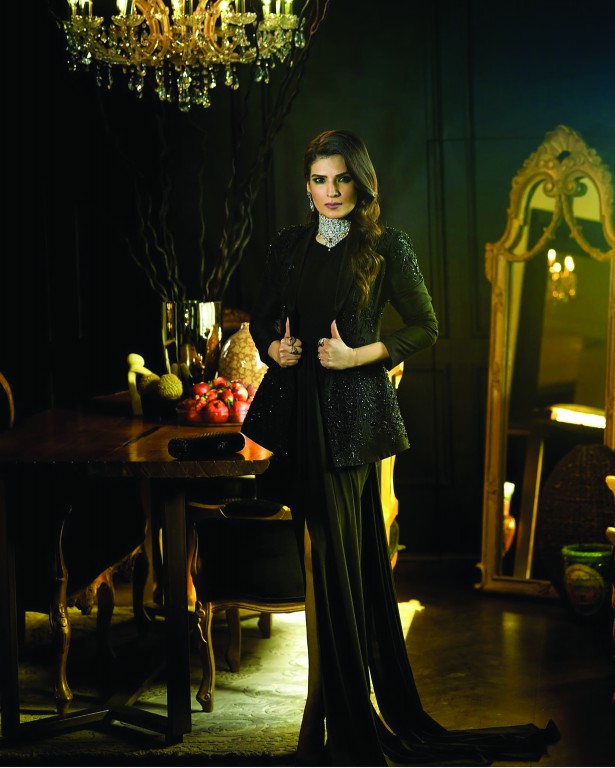


Wardrobe: HSY
Hair & Makeup: Ather Shahzad
Photography: Ather Shahzad
Jewellery: Hamna Amir Jewelry


Credits
Hair & Makeup: IRIS by Hira Ali
Styling: Aarinda Tul Noor
Creative Direction: Hira Ali & Shahroz Hyder
Photography: Shahroz Hyder
Videographer: Ali Chaudhry
Art: Saad Amjad
Models: Durdana, Farwa Kazmi, Manal Saleem, Eesha Asad, Maham Shahid & Natalia Shahid


OURÂ FAVOURITEÂ INSTAGRAMÂ HANDLEÂ FASHIONÂ &Â LIFEÂ STYLEÂ ONÂ POINT
From food blogging to his wardrobe, Saim Ali ticks all the boxes. He’s one TV artist who doesn’t need a stylist to style him; from red carpet looks to talk show appearances and high fashion to street style – his fashion game is always on point.

Saim Ali is the first Pakistani TV artist to have appeared in Malaysia’s most popular theatrical play and has also played the main lead in a Malaysian short film that was later nominated in the film festival in Malaysia.
Additionally, he is also the first Pakistani TV artist and fashion influencer to model for international brand, Splash Dubai, in New York.

His character in drama serial “Jhooti†with Iqra Aziz made him a household name, while his comedy work in “Barfi Laddu†with actors like Behroz Sabzwari *and *Irsa Ghazal was also very well received by the audience.

Saim Ali has become a favourite of many corporate brands for their digital advertising and we also see many paid partnerships on his Instagram handle.

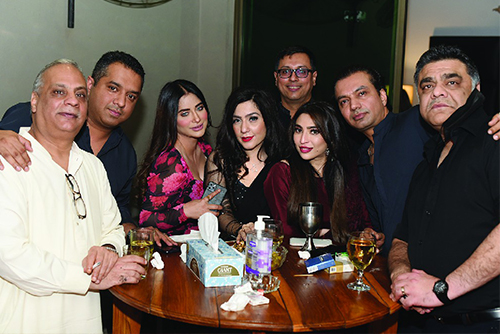

Summer means time to amp up the volume in our wardrobes with bold prints and strong colour palettes. Who better to turn to for this than our very own 9Lines. This fortnight, Mehek Raza Rizvi speaks to the creative forces behind this brand known for its quirk, Hassan Iqbal Rizvi and Saad Shahid. Learn about their personal style preferences and then get a preview of their menswear collection in our pages

What impact do you believe the COVID-19 pandemic has had, if any, on men’s fashion trends?Â
Hassan Iqbal Rizvi: The pandemic has made me feel comfortable in stepping out with whatever I feel comfortable in and I believe it’s the same for others. It seems that people have now warmed up to the idea of one’s own ease coming first in fashion.

Saad Shahid: As Hassan stated, people are more inclined towards what’s easier for them, but with that being said, they have also gotten creative with their looks. Staying in during isolation has certainly given everyone an excessive amount of time to brew up new looks, experiment with styles and portray themselves like never before.
What would your advice be to someone wanting to venture into slightly daring territory in terms of their wardrobe?
Hassan: Personally speaking, I always vouch for exotic prints and patterns: prints from the wild, summer foliage or floral blooms. I feel that they speak for you before you even enter the room. Experiment with anything which makes you think twice before wearing it.

Saad: The more you think about people’s reaction to what you’re wearing, the more you drift away from being confident with you unique looks.
What are some essential wardrobe staples for this summer?
Hassan: Resort shirts with eccentric prints—always!

Saad: A t-shirt with a good graphic or statement on it and you’re good to go.
Since most of us are still working from home, how does one stay comfortable yet well put-together?
Hassan: It’s always the effort that counts. All you have to do is put the same amount of effort into your looks, as you would’ve had you been going in to the office. It’s that simple and it works.

Saad:Â WFH has an important part to play, as we learn to become more efficient, more responsible and become aware of the idea that being in your comfort-zone while handing official hours really works well if you enjoy what you do!

How different is your personal style from each other and how does that reflect in the clothes you design?Â
Hassan: My personal style is always loud and communicative. So it’s always a teams effort. Blending in both our aesthetics works for us in terms of making something that isn’t already there in the market, because it’s unique.
Saad:Â I believe I fall in the line of always following the lead of contemporary fashion with a sprinkle of that one quirky element that sets the mood for the whole look. So yes, mixing our styles together does the trick for us.
What’s a style rule you never break?Â
Hassan: In my case style rules are meant to be broken. I’m never one to shy away from trying new things, even if most of people don’t agree with them.

Saad:Â Wearing sunglasses inside. I mean, the whole point of wearing sunglasses is to protect your eyes from the sun, right?Â
What’s been the best fashion advice you’ve received?
Hassan: The best style advice I’ve ever received is probably from my parents at a pretty young age, but they had no idea at the time how it would directly or indirectly affect me. It was more of an all-encompassing ‘be yourself, no matter what’ perspective. I applied that confident individuality to every aspect of my life: how I think, what I say and do, and of course, how I dress. I wear whatever I wear. I don’t let trends or seasons get in the way. I never have. Most days I like wearing t-shirts, jeans, and flat-bill snapbacks, and I like colors—lots and lots of colors. It’s all about creating an image that uniquely embraces your own personality. And it never hurts to have some fun too.

Saad: Whatever you wear, just wear that with confidence. I follow this tip no matter if it’s jeans or a formal suit. If you feel good then you’ll be more confident and be better able to take on whatever life throws at you.
Is there anyone in particular whose style you’re inspired by?Â
Hassan:Â David Beckham. His unique sense of style in both formal and street wear always puts forth inspiration to never be afraid to mix it up.

Saad: It’s a mix between Jinnah, Richard Biedul and Cody Fern.
Tell us more about your new collection.Â
Hassan: As always, the Men’s Collection this time around focuses a lot on pattern and print detailing. Ranging from different colors and wild prints from rich florals, contemporary stripes and lush foliage, this collection provides our customers with a wide variety to choose from.
Saad: Our Men’s Collection is one of our favourites, as we decided to play with different prints. Like always this time yet again we weren’t afraid to bring in that wild element that always makes a mark in your wardrobe.

What can we expect from 9Lines menswear in the future?
Hassan: A brand staying close to its ethos, our signature menswear will always be bold, out of the box, and only for those who aren’t afraid to experiment with their looks.

Saad: 9Lines will always promote the idea of being free and limitless when it comes to updated and playful fashion. All our collections, including menswear will always be wild and popping with that quirky goodness.


Wardrobe: 9Lines
Photography: Asad Bin Javed
Grooming: Turab Haider
Models: Zarrar Khan, Suleman Hussain & Qamar Khwaja
Art Direction, Concept & Styling: 9solutions


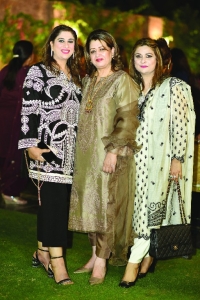
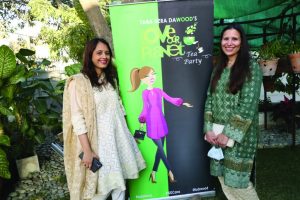
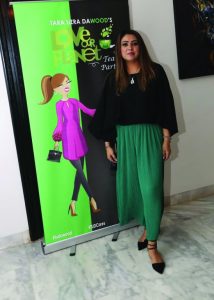
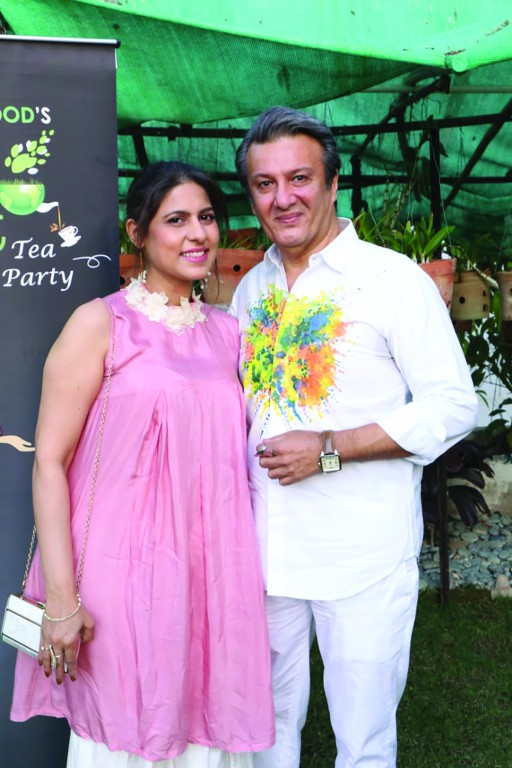
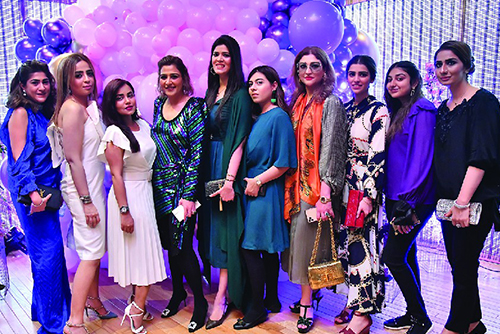
Tara Uzra Dawood held an eco-friendly “Love Your Planet†themed garden tea party for her birthday. Each guest received a neem tree as
an appreciation gift.

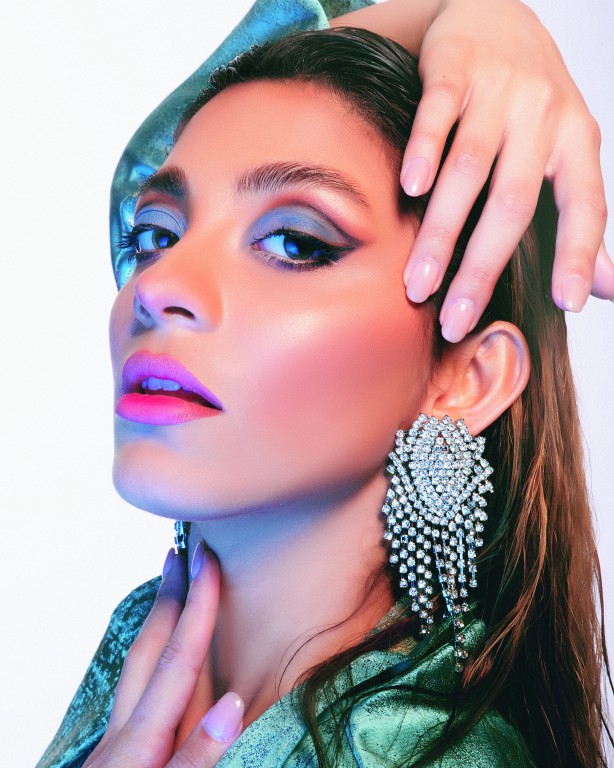
Spotlighting new talent has always been at the forefront of GT’s mission and this fortnight we bring you Natalia Castillo—a rising star in the fashion industry. Styled in Lajwanti by Zahra Sarfraz and captured by the lens of Asad Bin Javed, she proves in this editorial why she is here to stay.

What inspired you to take up modelling professionally?
I’ve always loved being in front of the camera, but modelling wasn’t something I had ever planned on taking on professionally. Friends would always ask me to model for things in the past, because I’m quite tall and then when I came back to Lahore six months ago, things surprisingly took off quite quickly. I realised I could make a serious career out of it. Honestly, days on set barely feel like work, so I figured I found my calling.

What do you feel are your strengths and weaknesses as a model?
I would say my strengths are definitely with editorial style posing; I love contorting myself into new shapes and seeing the results on camera. Weaknesses would probably be my 41 shoe size, because I never fit into sample size shoes.

Biggest career high so far?
This right here, right now-my very first magazine cover!

Do you have a fitness and beauty regimen?
I box fairly regularly, but sometimes it’s hard to find time if I’m shooting back to back. However, I’ve boxed for years and just really enjoy hitting things. As for a beauty regimen, not really. I’ll take my makeup off with coconut oil at the end of a day and then just use face wash and call it a night. I’ve been blessed with skin that doesn’t give me any issues. Oh and I always use sunscreen in the day!
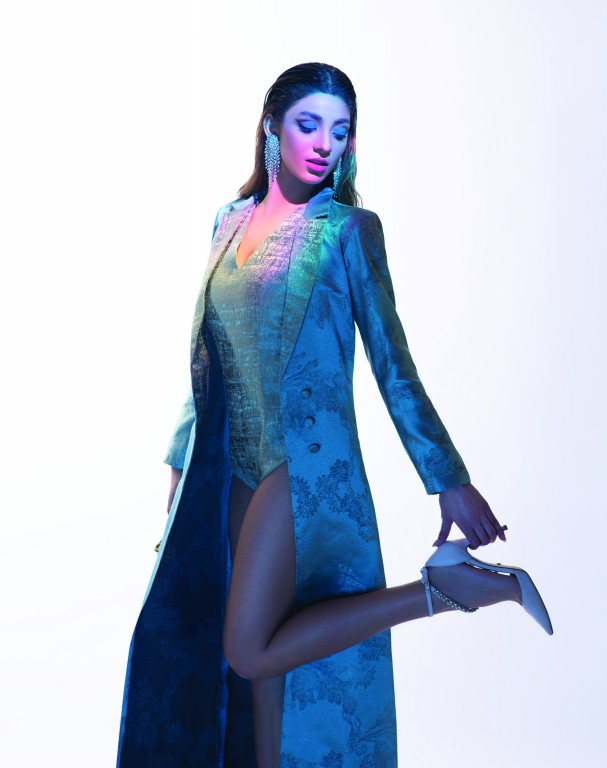
How would you describe your personal style?
That’s a difficult one, as some days I feel very colourful and feminine; on other days I’ll just be in all black or sweats. But one thing is for sure, I love crop tops. I don’t even think I own a shirt that covers my midriff all the way.
What do you consider the toughest aspect of your job and how do you overcome it?
5am call times and shoots that go on for 15-16 hours. Waking up is hard for me, even if I’ve gotten a full 8 hours, so I’d say that’s definitely the toughest part. Not letting how exhausted you are show up on camera can be very challenging at times.

Where do you hope to see yourself in the next five years?
On the cover of Vogue.

Describe your dream project.
My dream project would be working for a brand that flies me out to somewhere tropical and also gives me some creative freedom with my posing.


Photography: Asad Bin Javed
Muse: Natalia Castillo
MUA: Imran
Styling: Zahra Sarfraz
Wardrobe: Lajwanti